Monday, May 13, 2024

Fritz Lang's Die Nibelungen!


I have to get into a particular mood to enjoy a silent feature film. They require a tick more concentration than a talkie and in the case of Fritz Lang the story being told is a hefty one with big themes. It's rather the opposite of watching the latest superhero release today, which require more attention simply because they move so quickly. Silent films tend to have their own pace, and it's often a measured one. That's certainly the case with Die Nibelungen. The pace is so measured that it's actually two movies -- Die Nibelungen: Siegried and Die Nibelungen: Kreimhild's Revenge. 


The first film follows the hero Siegfried who we find living among a band of strange and withered men and his mentor Muse. There seems little love lost here, but Siegried is tasked with going to kill a dragon which he does almost immediately. then bathing in the dragon's blood which makes him invincible save for one spot, and then he's off to get treasure and a sword from the duplicitous Alberich who attempts to ambush the handsome hero. He also gets a little net that makes him invisible when he throws it on his head. He becomes a king and with his retinue goes to castle of King Gunther and asks for the hand of Kriemhild his sister. Gunther wants Siegfried's help in winning over the warrior woman Brunhilde to marry him and Siegfried agrees. The we get a double wedding. Things fall apart from there. Secrets are shared and revealed and before you know it, Gunther and Siegfried who have sworn blood oaths to one another find themselves on opposite sides. Hagen of Tronje is an ally of Gunther's and he's pegged as something of a visual stand-in for Wotan/Odin because he has one eye and wears a resplendent winged helmet. He takes steps to find Siegfried's only physical weakness. Suffice it to say that by the end of this long movie with seven Cantos or chapters we find Kriemhild vowing vengeance against Hagen. 


The second movie picks up the action immediately. Kriemhild is very much in the midst of mourning Siegried's death, and she still holds bitter animosity towards her brother and hatred for Hagen. Then she gets a message that the powerful King Attila would like her hand in marriage, and she sees a way to gain power enough to gain vengeance. Hagen is no fool and knows that he's about to become quite powerful, so he sends the riches Siegried had gained, and which now belong to Kriemhild to the bottom of the river. Nothing he does quenches Kriemhild's lust for revenge and when she decides to play a long game. She and Attila have a son and when the Nibelungs visit Attila she wants him to kill Hagen. He refuses due to ancient traditions of hospitality, but when Hagen for reasons I still don't quite understand kills his infant son, he's more than ready to help Kriemhild. They sic the Huns on the Nibelungs and what follows is a rousing series of battles and a siege which results in an epic fire, a fire which the director Lang really set and burned down the immense set. It was a spectacle used to advertise the film. 


I found the first movie fascinating in many ways. Siegfried is the very essence of many a hero, and this was not lost on the Nazis when they came to power relatively soon after the movies were completed. They praised his Aryan physique and wanted Lang to make movies for the Reich. Lang wisely said no and quickly moved to the United States to continue his career. As I said, Siegried is the very essence of a hero visually, but the movie makes him out to be insanely naive and it's hard to feel much sympathy for him since he never saw it coming despite abundant warning. He's rich, brash, and invulnerable and these traits make him foolish in the final estimation. In the second movie Kriemhild's grief is palpable and her unrelenting will to see her vengeance done is remarkable. She pleads for the murderer to be brought to justice but a system of loyalty, one which was violated to slay Siegfried, keeps that from happening. 

These movies (especially the first one) have those elements which possibly inspired Tolkien's Middle-Earth epics, and for that I was driven to check it out. I don't know if I can recommend nearly three hours of silent cinema to anyone, but if you have the time and curiosity, I'd say you'll be entertained. 

Rip Off

Sunday, May 12, 2024

The Ring Of The Nibelung!


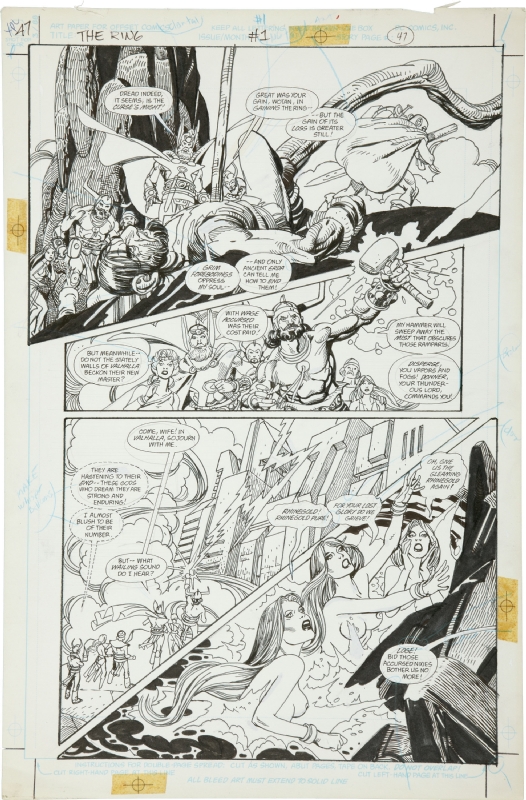
The Ring of the Nibelung is a bravura collection which attempts no less than to adapt the libretto of Richard Wagner's epic Ring Cycle operas. I'll have to honest and say that Roy Thomas and Gil Kane are not the talents I'd have first thought of to produce this work with the help of Jim Woodring on colors and letters by John Costanza. Thomas has lots of experience with sword and sorcery stories with his fine adaptations of Robert E. Howard's works, and Kane is certainly no stranger with much epic work of his own including his sword and science epic Blackmark. But Kane's dynamic style seems somehow too modern to my eye to take up a myth like this one. His buildings always have a modernistic regularity to them. But he does draw a damn attractive naked dame and he gets a grand opportunity in these epic yarns. 


In Book One: The Rhinehold we meet those unclad damsels who guard their gold, but not before we get a bravura presentation of the creation of the world and the gods.  The shapely Rhine maidens tempt a dwarf named Alberich. He seeks his revenge on the world by stealing the gold and using his skills to make a ring which gives him great power and a helmet which lets him become invisible and change his form. The gods Wotan and Loge seek out Alberich to steal away his stolen booty to ransom a goddess that Wotan in a foolish moment had promised to two giants so that they would build him a great fortress called Valhalla. That goddess protected some special apples which gave the gods immortality and Wotan has bartered this gift away. There is no end to the treachery in this opening salvo of the epic saga. 


In Book Two: The Valkyrie we meet the Volsung Siegmund, a heroic type who is on the run from warriors who hate because he tried to stop a rape. He finds sanctuary with a young woman name Sieglinda who looks remarkably like him, but when her husband comes home, he challenges our hero to a death match. Before that can happen, the woman doses his drink and she and our hero realize they are brother and sister, separated by circumstances long ago. There's a magic sword "Needful" only Siegmund can extract proving he's the hero the day. The then have sex. The scene shifts to Valhalla where we find Wotan and Fricka his wife arguing, and Wotan agrees that his son Siegmund will die and sends Brunhilde the Valkyrie (also his daughter) to Earth to do the deed. She can't bring herself to do it, but it does get done. She is put into a deadly sleep. The magic sword is broken. We learn though that the tryst has proven fruitful, and the dead Siegmund has a son. 


In Book Three: Siegfried, the son of Sieglunda and Siegmund is being reared by a terrible dwarf named Muse who is trying to use the boy, now a young man to win the Rhinegold from the dragon Fafnir. His attempts to forge a blade for Siegfried are failures. Then he is challenged by Wotan to a game of chance and loses his head if he doesn't prevail. He finally has Siegfreid reforge the blade "Needful", and this is used in a terrific battle with Fafnir. Our hero is able to do this because he is without fear. Then Muse tries to kill Siegfried but fails. Wotan reveals to our hero the whereabouts of a lovely warrior and he finds Brunhilde asleep. One kiss and she is awake, and the couple declare their love. 


The saga wraps up in Book Four: The Twilight of the Gods. This final installment begins when King Gunther and Queen Gutrine are tricked by Gunther's half-brother Hagen and so seek both Siegfried for Gutrine's husband and Brunhilde for Gunther's wife. Hagen it turns out is the son of the Nibelung Alberich and is seeking all along to gain control of the Rhinegold treasures. Using magic Siegfried is given amnesia and becomes a pawn of the royals and even uses the Tarnhelm to disguise himself as Gunther and bed Brunhilde in his name. Brunhilde is of course angry and seeks vengeance. Our hero passes up an opportunity to give the ring back to the Rhinegold maidens but refuses and soon is killed by treachery. Brunhilde joins him on the funeral pyre as the age of the gods passes away for all time. The ring is taken by Hagen who is himself lured by the maidens into the water where he will die, and the ring will reside hidden from men. 


I don't suggest for a moment that The Lord of the Rings is based on the The Ring of the Nibelung. But they do draw from the same sources and both epic tales share a great many details. There is of course a great ring of power which is sought by the characters to make them masters of the world, there are brothers who fall out and one kills the other for the ring, and there is a broken sword which must be reforged before a hero can fulfill a prophecy and strike down an implacable enemy. There are not elves in this story, but dwarves abound and giants as well. Tolkien is wise to steer clear of incest as that might've impacted sales of the Middle-Earth saga more than a smidgeon. This presentation by Thomas and Kane is potent and straightforward. Kane's angular artwork either works for you or it doesn't, and Thomas does a pretty good job with capturing the flavor of high-toned language throughout. 


More on the Nibelungs tomorrow. 

Rip Off

Saturday, May 11, 2024

Tales Before Tolkien - The Roots Of Modern Fantasy!


As a learned man steeped in ancient lore, it's probably impossible to track down all the influences on J.R.R. Tolkien when he fashioned his stories of Middle-Earth. But editor Douglas Anderson has given it a go with the book Tales Before Tolkien -The Roots of Modern Fantasy. There are a number of delightful tales tucked away in this volume such as "The Golden Key" by MacDonald, "The Folk of the Mountain Door" by Morris, "The Far Islands" by Buchan, "The Thin Queen of Elfhame" by Cabell, "The Woman of the Wood" by Merritt, and "The Coming of Terror" by Machen. "Puss-Cat Mew" by E.H. Knatchbull-Heugessen is a story Tolkien read to his children. Fantasy existed before Middle-Earth was born and this tome gives a brief glimpse of the world into which Tolkien launched his epic tale. 

The story I want to focus on today is the famous one titled "The Story of Sigurd" from Andrew Lang's Red Fairy Book. 


Here is an audio presentation of that famous story. 


This myth is likely familiar to most folks, at least in some form in which it has passed down to us over the centuries. 


While I'm on this subject I might as well mention that is a similar volume for C.S. Lewis classic fantasy yarn. Tales Before Narnia - The Roots of Modern Fantasy and Science Fiction is by the same editor. I'll get around to that one sooner than later. 


In The Legend of Sigurd & Gudrun Tolkien produced his own poetic rendition of how a hero must overcome adversity and confront a dragon for the sake of magic rings. Sounds familiar. But the good Professor wasn't the only one interested in this epic tale. 


Here's a nifty item, an ad by Neal Adams for The Metropolitan Opera's The Ring of the Nibelung, the epic Wagner opera. More on these matters tomorrow. 

Rip Off

Saturday, May 4, 2024

My Goldberry!


Goldeberry is the utterly charming wife of Tom Bombadil, the enigmatic character from J.R.R. Tolkein's The Lord of the Rings. Goldberry was a water nymph who has golden hair and is a radiant figure who brings peace and love to those around her. My beloved Liz was like that. Gorgeous blonde hair and a bright winning smile that drove out the gloominess which all too often inhabits my spirit. 


Seven years have passed since I lost my Lizzie -- my wife and partner, the woman I've spent most of my lifetime with, and the woman who was the caring and doting mother of our two delightful, lovely and admirable daughters. I lost her much sooner than I expected, more quickly than seemed possible. But now seven years later, the wounds have begun to close over slightly. Nonetheless I will never betray the memory of the woman I loved, and the woman I still love to this day. 


My wife is no longer here for me to talk to and to laugh with and to take care of. And she's no longer here to help take care of me as I become more and more an old man. I step into the twilight, the unknown without her wisdom and guidance and support. 


The Dojo has taken a brief hiatus around this time in years past, and so too this year in loving memory of my beloved Lizzie. Normal activity (more or less) will resume in a week's time or thereabouts. Look for more Tolkien in this month of May. 

Be well my friends and cherish the ones you have -- they are not yours to keep for all time.

Dean

Friday, May 3, 2024

In The Shadow Of Sauron!


I was still a fairly untutored country boy in the summer of 1969, much agog with comics and especially Marvel Comics but little read beyond classics such as Frankenstein and the tales by Lovecraft. And it's entirely possible that my very first inkling of the works of J.R.R. Tolkien was in the pages of The Uncanny X-Men when Roy Thomas and Neal Adams conspired to create a new and rather hideous foe to battle the Marvel's merry mutant band in issues #60 and #61.  


Dr. Karl Lykos is an unscrupulous psychiatrist who is also a mutant who can tap into the power of others to feed his appetites. When he chances upon the lovely mutant Lorna Dane, he gets more than he bargained for and before you know it, he's bursting with power, power which transforms him into a bizarre human-pterodactyl hybrid with a potent hypnotic gaze. And as he says quite directly, he has the choice of good or evil and he chooses evil. He christens himself with a name lifted from the pages of popular literature. As he says "An evil so great...so monumental that only one name in all the annals of literature will contain it! The name of Tolkien's ultimate villain...the dark lord who personified evil...who was truly evil incarnate...the name of ...Sauron!!"


He flies into the night sky and confronts the Avenging Angel, who had just left the X-Men in a moment of frustration. 


The X-Men battle this new enemy, and they of course prevail in the end. The team is reunited, and Lykos is left to deal with the consequences of his violations and crimes. 


Sauron returns many years later in the pages of the revived X-Men comic under the auspices of Chris Claremont and John Byrne. The name was too good to waste. By this time, I was in college and had read the Lord of the Rings and realized that as vile a character as this modern Sauron was, he didn't hold a candle to Tolkien's original immortal necromancer who haunted the Third Age of Man in the pages of Tolkien's classic. 

Rip Off
 

Thursday, May 2, 2024

Atlas-Seaboard Comics - May 1975


May is a tiny production month for Atlas-Seaboard with only two, color comics wear a May date. IRONJAW #3 offers a tremendous tale by Fleisher and Marcos. Ironjaw, who in the previous issue rejected a kingship, finds his way back home to find his adopted father Tar-Lok. Tar-Lok is a grand character and his exchanges with Ironjaw are very entertaining. The two clearly have an affection for each other, but they won't lift a hand to assist each other before a price has been bartered. There are robbers, sheriffs, and serpent-headed cannibals in this wildly imaginative tale that introduces us to the Great Machine, the god that Ironjaw worships and has invoked repeatedly in the first two issues. Well  let's just say the "Great Machine" is a relic from our time and is actually a humble humbug managed by a corrupt cleric more interested in the collection plate than his flock. Ironjaw is shown to be a naive yet devout individual who ignores his father's advice to quit throwing money at his "god". This a well-paced self-contained story with energetic artwork and a very entertaining and funny script.


SCORPION #2 gives us another Moro Frost adventure by Howard Chaykin. This time there is voodoo and curses galore. The Ernie Colon cover isn't all that accurate of what goes on inside the book so beware. The story is another period piece, a bit confusing in places but filled with vivid characters and situations. The artwork is another group-project with diverse hands throughout. This is another indication that Atlas is fragmenting, and Chaykin has clearly pulled away from the project.


Aside from the second installment of the black and white DEVILINA magazine (more on the black and white publications later this year), this is the whole of the Atlas-Seaboard May offerings. One more month and the train comes off the rails for good.

More Atlas-Seaboard to come in June.

Rip Off

Wednesday, May 1, 2024

Maius!


Three Rings for the Elven-kings under the sky,
Seven for the Dwarf-lords in their halls of stone,
Nine for Mortal Men doomed to die, 
One for the Dark Lord on his dark throne
In the Land of Mordor where the Shadows lie.
One Ring to rule them all, One Ring to find them,
One Ring to bring them all, and in the darkness bind them
In the Land of Mordor where the Shadows lie. 

It's the merry month of May, or "Thrimidge" according to the Shire Calendar. The influence of J.R.R. Tolkien's The Lord of the Rings is difficult to reckon. It can be argued with some confidence that an entire publishing sector owes its existence to the saga, one which redefined fantasy. I fell into the clutches of Tolkien's imagination when I was still a very young man and was eager to expand my reading from the masses of comics I had consumed and the few bits of science fiction I'd enjoyed. I wanted to step up and take on something with a bit more rigor and Tolkien's The Lord of the Rings was just the ticket. I first got a glimpse at Tolkien's classic fantasy when I spied it in my high school library, three attractive black books in a slipcase tucked high and up out of reach behind the librarian's desk. They were presented almost like totems of worship. I was fascinated but never asked to see them. (She was that kind of librarian.) And then I went to college. 


It was 1975 and the publishing world was enjoying a boom of sorts with fantasy catching on with younger folks. In addition to TLotR, there were the Earthea trilogy from LeGuin, the Deryni Cycle from Kurtz, the grim weird Gormenghast trilogy from Peake, and copious amounts of Robert E. Howard and Edgar Rice Burroughs. Ballantine Books had a whole division advised by Lin Carter dedicated to putting back into print obscure fantastic and weird novels of decades gone. For a glimpse check out this link. I gobbled them up. But there always seemed to be something special about Tolkien's Middle-Earth, it seemed richer and more completely realized than many of the other places I visited. I'd learn that Tolkien had spent decades refining it with a special care which was not available to the whipsaw pulp creations of the Hyborian Age or ERB's myriad landscapes, worlds produced at the prodigious speed needed to produce income. Tolkien didn't work like that. He was a professor, and his Middle-Earth was a thing he fashioned first to entertain his children and himself. It was his hobby and his passion. He produced the books in those times that life allowed.  


I revisit these tomes from time to time. Certainly, they have gotten a great deal of notoriety since the Peter Jackson adaptations have made cash cows out of them to an even greater degree. (The trilogy is being exhibited in theaters again after over two decades.) I want to go there again, in Middle-Earth's many guises. I want to read the source material found in The Hobbit, The Lord of the Rings and The Silmarillion and even The Unfinished Tales, and more. I want to view and enjoy these animated adaptations from Ralph Bakshi and the Rankin-Bass outfit. And I want to plum again the Jackson versions in all their sometimes, overwrought glory. And if time allows, I'd like to explore some of the tales that inspired Tolkien's imagination. We might even get around to the music, the art, and satire inspired by Tolkien's creation. So, expect everything this month to be either Tolkien related or Tolkien adjacent, with only a few exceptions. And it's a lot for a tiny month which I'm making tinier still. 


The blog will take a break early in the month but expect wall-to-wall Tolkien when it gets fired back up to full heat. Back tomorrow though with a little something from Atlas-Seaboard Comics. 

Rip Off