Big John Buscema was born on this date in 1927. Buscema is arguably my favorite comic artist, because I started reading Marvel at just about the time he was taking the reins as the top artist in the company. It was a slow build but then his stamp was on most books Marvel was putting out. Buscema for his part loved Conan the Barbarian and worked on those stories as much as we could as he notoriously disliked the costumed heroes he rendered so masterfully. One example was the Silver Surfer.
1968 a bountiful year for Marvel Comics. The company had just gotten free of a distribution deal that severely limited their output, so they had jammed their creations into titles like Tales of Suspense and Tale to Astonish. Now those creations, the Hulk, the Sub-Mariner, Iron Man, Doctor Strange, among others were getting their own titles. New characters blasted onto the racks, such as Captain Marvel and Captain Savage leading his Leatherneck Raiders. And I was there to enjoy it as a spanking brand-new Marvel fanboy.
And perhaps the biggest debut of the year was The Silver Surfer #1, a character deemed so potentially great by Stan Lee that the book was made king-sized. There is certainly no doubt that Marvel had high hopes for this one. The ad is bombastic even by the dizzying heights of bombast that Marvel regularly traded in at the time. But it was not without controversy.
Jack Kirby created the Silver Surfer. No one doubts that. We might quibble about the Fab 4 and other Marvel characters, but the record is pristine relative to the herald of Galactus. And the first issue of The Silver Surfer was produced without any involvement by Kirby. As far as we can tell he was not consulted about it in any way, and he was not pleased. It left a mark and was yet one more reason he'd leave the company he'd helped salvage and transform into a cultural touchstone a few years later.
The assignment was given to "Big" John Buscema, and his work on this title is one of the many reasons he's my all-time favorite comic book artist. (For the record Kirby is second.) And while the Surfer of the early issues of the comic might have cleaved close to Kirby's original model, there's no doubt that by the end of the series Buscema has given us a somewhat different Silver Surfer altogether.
The debut issue gives us an origin. We learn that the Surfer's name is Norrin Radd and that he is originally from the planet Zenn-La. When that planet was threatened by Galactus, Radd sacrificed himself to save his world and Shalla-Bal, the woman he loved. He volunteered to become a herald for Galactus in order to see to it the world eater consumed only world without sentient life. Stan Lee gave the Surfer an origin that was Shakespearean in its appeal. It made the tragic figure of the Silver Surfer even more tragic.


Somehow, I missed the second issue of the Silver Surfer back in the day. Just one of those things, but reading it again today I was struck both by the power of John Buscema's artwork and the devious nature of the attack by the scaly "Brotherhood of the Badoon". Their invisibility was somewhat akin to the Skrulls' shape-changing ways. That the Surfer in fighting the invisible enemy only seems to be destroying property and further creating enemies among the people is quite ironic.
Of course, this issue is part one of one of Marvel's strangest two-parters. The Badoon threaten to return to Earth after their defeat by the Surfer and sure enough they do, a thousand years later in the time of the Guardians of the Galaxy. I did get hold of this one back in the day and loved it. I wish I'd had the companion as a boy. But it's all good now.
That Stan had been presenting the Surfer as being analogous to Christ himself, it's no great surprise that he gets tempted by Satan himself, or more specifically in issue three by Mephisto. This is Mephisto's debut in the Marvel Universe and he selects the Silver Surfer as a being of such high character and nobility that he supplies a sufficient challenge to this master of the hellish depths.

We had learned in issue two that Shalla Bal still lived. When I read the Surfer's origin in the debut, I assumed that his role as herald to Galactus had occurred in the distant past and that if not for the "Power Cosmic" as Stan took to calling it, he'd have perished long ago. But still, she pines for Norrin Radd and Mephisto moves to bring her and the Surfer to his domain where the temptations begin. It's worth noting that despite all his moaning on about the savagery of mankind, that the Silver Surfer is consumed with rage and attacks the world in this issue. He'd regret it, but it seems he too was a prisoner to some degree of his passions.

Surviving the temptations of Mephisto, but losing his girl, the sad Surfer is noticed by another god of evil, this one from the Norse canon of myths. Loki is moping and scheming and plots to use the Surfer's power against Thor and to do that he convinces the Surfer that Thor is about to lead an army to attack the walls of Asgard itself. The Surfer seems a tad too gullible but nonetheless it works, and he heads to Asgard to kick some butt. It's a mighty battle.
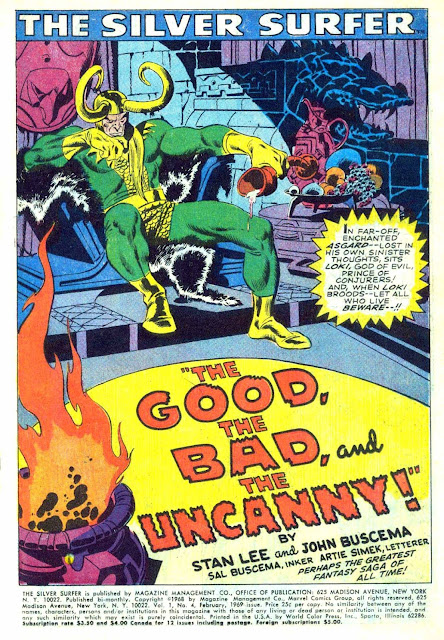
This issue features some of the finest artwork of its era. John Buscema did not like to draw superheroes, despite doing it so well, but he found that Asgard and Thor gave him the chance to really showcase his skills. The cover of his issue is one of Marvel's most famous and properly so, it's nigh perfect in its composition and effect. The biggest change though was the addition of Sal Buscema as inker. (Joe Sinnott was a master over Kirby's pencils, but I never found that he and John Buscema were as successful a combo. Though I'll admit their work on the Surfer was among their most successful as a team.) Sal's lustrous lines give a new vigor to his brother's pencils that had not yet been seen. Though he'd prove too valuable to keep on as an inker, Sal inking John was one of the best teams in the company's long history. Buscema as also starting to change the Surfer, making him leaner and less the muscle man that he'd been in the first few issues.

.jpg)
The fifth issue of The Silver Surfer yielded one of the most emotional stories as the Surfer comes into contact with Al Harper, a physicist who is able perhaps to fashion a way for the Surfer to penetrate the shield that Galactus put around the Earth to keep him prisoner. Harper is a black man and I think Lee wants us to see that he like the Surfer is something of an outsider in society. When the Stranger decides that mankind has been around long enough and builds a bomb to take care of the problem, like some interstellar exterminator, only the Surfer and Harper stand in his way.


Sal's inking changes somewhat in the sixth issue, the Surfer being less a glistening object and more merely a pure white presence. Reading these stories in Essential volume works well as black and white serves the art of Big John and his little brother quite well. The Surfer goes to the future and finds the Overlord, a malicious mutant who has destroyed most of sentient life in the universe and enslaved the remainder. He's more powerful than the Surfer, but our hero still finds a way to win the day.
It's a different kind of story in the seventh issue as the Surfer encounters a Frankenstein, a mad scientist who wants to surpass the misdeeds of his ancestor. To that end he fashions a deadly doppleganger of the Surfer and it's all the Surfer can do to beat himself. This seemed a strange story after the broad sci-fi of the previous two issues. Sadly, this is also the last issue inked by Sal Buscema who of course went on to become a mainstay artist at Marvel for a few decades.
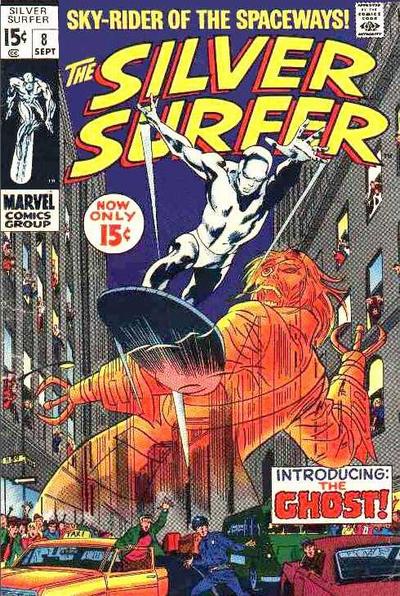
Mephisto is firmly established as the Silver Surfer's nemesis when he returns and brings with him a souped-up ghost especially designed to bring the Surfer to his knees and pledge allegiance to Mephisto. The Ghost is actually the legendary Flying Dutchman. The comic has shifted from a bi-monthly king-size to a monthly regular edition. To do that the original Ghost story was split into two parts. Dan Adkins steps in, to ink Buscema and does a wonderful job, and brings back a little of the Surfer's sheen.
In another two-part story Shalla Bal convinces the unscrupulous scientist Yarro Gort to bring her to Earth to find the Surfer. How she knows he's on Earth is never addressed to my knowledge. The Surfer is embroiled with an invasion of a nameless South American country when the ship arrives and is shot down. He doesn't know Shalla Bal is on Earth until she is shot, and he is forced to send her back to Zenn-La to receive treatment.
It was about this time that Martin Goodman mandated that all Marvel Comics be one-issue stories and so the Silver Surfer book conforms for the brief time this mandate is in force. The first of these one-off adventures by Lee, Buscema and Adkins had the Surfer fall literally into the clutches of a coven of witches which conjures up the Abomination, the gamma-ray powered monster last seen in the pages of Tales to Astonish. It's pure strength against the power cosmic. One can detect a number of John Romita touch-ups in this issue.
The Doomsday Man is a robot. An indestructible robot which is imprisoned by his creators on a distant island, but which gets loose. Only the Surfer has a chance to stop the Earth-shaking threat when the robot gets his metallic mitts on a cobalt bomb. Stan's plotting in this one is pretty shaky but I've always liked this parable pleading for peace on Earth.
I'd guess that sales reports were not promising for the series, so in issue fourteen Stan played the web-slinging card and had Spider-Man guest star in the title. It's a typical Marvel heroes ruckus with both sides full of regret. Spidey often was called upon to battle Marvel stars more powerful than he was, because he had a power many of them lacked to the same degree and that was the ability to sell comics to the merry marching minions of Marveldom.

After Spidey we get another helping of guest-star assistance when the Human Torch tries to stop the Surfer. The Silver Surfer had been growing ever more cynical as the series progressed, going from seeking to assist man to just hoping to find a refuge away from people, to now firing the first shot when he thinks he's under threat. Whether Stan meant it or not, it's easy to see the Surfer getting more and more miffed as the months roll by. He makes his share of mistakes, but things are only going to get worse. This is the last issue inked by Dan Adkins by the way.


Chic Stone returns to the Marvel fold to ink Buscema's pencils on the sixteenth and seventeenth issues of the run. Mephisto returns again to try and gain the Surfer's soul. His gambit this time is to kidnap Shalla Bal and bring her to Earth and hide her within the spy outfit SHIELD. At the same time, he goads the Surfer to attack SHIELD hoping that the Surfer will fall into despair when he finds out he killed his own beloved. Nick Fury and his agents fight to fend off the Surfer who refuses to take lives. Mephisto is frustrated and sends Shalla Bal home to Zenn-La.

In the eighteenth and final The Silver Surfer issue the wounded Surfer returns to Earth smack dab in the middle of Inhumans territory. The Inhumans are having a bit of a civil war with Maximus the Mad once again leading his rebels against Black Bolt and the Royal Family. The Surfer cannot really tell friend from foe and fights with everyone. His frustration builds until he bursts out in anger. This final issue's interior was drawn by Kirby with inks by Herb Trimpe who almost certainly produced the cover art as well. But it was too little too late as Kirby's plans to leave the "House of Ideas" were well underway.
Rip Off


.jpg)