Showing posts with label Bob Layton. Show all posts

Tuesday, December 10, 2024

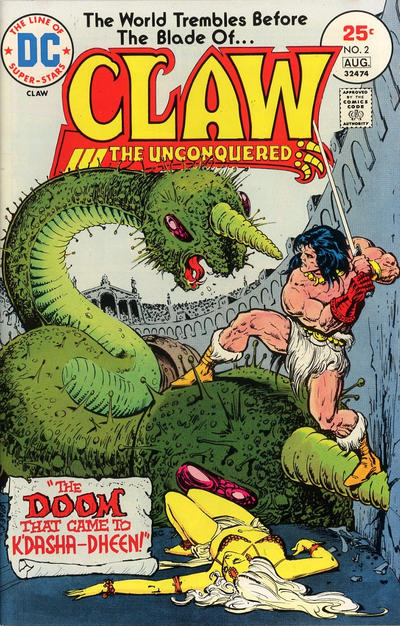
Claw The Unconquered!


Conan the Barbarian was a hit. Marvel was sopping up sales with the color comic and the black and white version. Barbarians were selling it seemed in 1975, so the call went out at DC to bring more barbarians to the table. And that's how we got Claw the Unconquered. 


The book was written by David Michelinie and was originally drawn by Ernie Chan who had just left his gig at Marvel inking the Conan comics. It is to be noted that Chan drew under the name "Ernie Chua" when he first started in U.S. comics because of a typo on his immigration documents. Chan is assisted on art chores by Pat Boyette. Claw was apparently supposed to be called "Talon", but Jim Steranko had dibs on that name. The first nine issues were all edited by Joe Orlando.   


Claw is the one character in DC's "All-New Adventure Line" that looks like Conan. That the series lasted twice as long as most of its companions and three times as long as more than few it's possibly due to that resemblance. In the first Claw story we meet our hero, a man who suffers a bit of amnesia yet is still a potent warrior. Possessed of a red gauntlet which overs a furry claw, he is a man prophecy suggests will bring down King Occulus of Pytharia. The King orders his underlings to kill Claw, but that proves more difficult than one might've thought. 


The first several issues follow a familiar pattern as Claw will encounter an individual, save them from some threat and then see them turn on him either for reward or other recompense. His "Claw" seems to have a will of its own, and moves to save him in circumstances in which he is oblivious to the threat. This is the best cover of the series. 


He also confronts giant creatures with names such as Kann the All-Consuming , often referred to as gods and is able in most instances to kill them or at least escape their clutches. The look of the earliest Claw comics seemed especially designed to evoke the Conan comics being produced over at Marvel. 


In the fourth issue he meets Ghylkin, a warrior from another dimension who sought adventure and so came to our world, but not before he got a nifty pair of horns. Claw and his new ally battle N'Hflhss, an ogre-like demon called down to Earth. The story stays open as the threat is not ended, and leads to the first multi-part epic. A prophecy from Asvitar the Burning Man causes the duo to seek the Moonthorn, a sword which will be effective against the threat of N'Hflhss and will give Claw much needed info as well. 


"The Gemstone Trilogy" begins the search for the Moonthorn, a sword which will reveal great secrets to Claw. But before they can find the Moonthorn, they must find the Gristone and that's divided into three parts. The first takes them to a territory guarded by strange women with a bizarre secret, the second has them battling a teenager who comes into possession of great magical powers, and the third is found at the bottom of the sea among a society of passivists. King Occulus and his court magician are keeping an eye on Claw and making things none too easy for him. 


The cover of issue eight is Ernie Chan's last contribution to the series. He headed back to Marvel, leaving Claw in the hands up new talent Keith Giffen who is aided by a bevy of inkers. 


Alas, Claw the Unconquered number nine is the only issue of the run I actually bought off the stands at the time of publication. I must have had some extra quarters in my pocket when it hit the spinner rack. Giffen is inked by Bob Layton in this issue. 


Claw the Unconquered returns to the stands after a one and six-month hiatus. Joe Kubert joins the book's regular team of Michelinie and Giffen as the cover artist for the final three issues. So, at long last we are about to get a face-off between Claw and Occulus, foes who battled but never met in the many issues previous. But not before Claw must confront the weird trio of "Those Who Must Abide". This issue was edited by Paul Levitz. 


The actual confrontation between Claw and Occulus is in issue eleven and it's an Occulus made even  more powerful by the magic of Miftig. To avoid Claw, the palace is even lifted into the air, but that doesn't stop our hero and he finally gets to see the man behind the death of his parents pay a price. This would've been an ideal place to end the series, but we get one more issue. Joe Orlando returns as editor. 


In the final issue drawn by Giffen and Layton, Claw is robbed of his red gauntlet and later when he hooks up with a group of fighters, he finds he loses control and the violence gets out of hand, so to speak. We see that Occulus is rescued so to speak from the wreckage of his palace and there are hints of battles to come. Without his protective glove, the Claw we are left with is a man who fears himself, so much so that in the final panels of the story he makes a tragic decision. Larry Hama is the third editor in three issues, probably one good reason this revival didn't get off the ground. 


Apparently two more issues of Claw the Unconquered were prepared but went unpublished. I note that the price on issue thirteen is for fifty cents so there might've been discussion of bumping up the price and adding a back-up, like another of the Adventure line. I haven't read these, but those Kubert covers are incredibly suggestive. 


Claw made DC's Who's Who line-up in the 80's, suggesting that he wasn't forgotten about. In fact, he makes a few cameos in comics over the years, but nothing of real substance. 


Claw the Unconquered was brought back to comic life in a cross-over with Dynamite's Red Sonja. The two shared two issues in 2006 which initiated a revival of Claw in his tittle from the Wildstorm brand. I love the cover Alex Ross produced for the crossover event. 


Wildstorm gave us a full-blown Claw the Unconquered limited which featured the slightly reimagined hero, with a full name -- Valcan Scaramax. In this story we are reminded that Claw cut off his hand (again) in the Red Sonja appearance, but the hand refuses to die and in fact regrows on Claw's arm. The abandoned hand also grows and develops into a full-blown copy of Claw but more savage. (Reminded me of the plot to Frankenstein Versus the World.) Claw is recruited by a sorceress and is led to her compound by a gang of werewolves. I'm not  that taken with Andy Smith's artwork on this one. The series seems to lack the elaborate detail I like in my fantasy yarns which creates that other world. Sadly, this presentation reeks of those bad old Image days when muscles mattered more than storytelling. They are im freezing temps in much of this story, so put some darn clothes on! I will give the story credit for a bold ending. 

Below is a short gallery of the  Wildstorm issues. 


Next time we meet Stalker - The Man with No Soul. 

Rip Off

Saturday, July 30, 2022

Magnus - The Tarzan Of The Future!


One of the greatest comic series of all time is Russ Manning's stunning Magnus Robot Fighter comics from Gold Key. Manning had been like most the capable staff at Gold Key a reliable and sturdy artist, first on Brothers of the Spear in the back pages of Tarzan and later on Korak Son of Tarzan and the lead Tarzan feature itself. In between these gigs he produced one of the most striking and memorable comics of the sizzling 60's. Magnus was an adventure comic in the spirit of the times, forward looking but blended with skepticism about the nature of mainstream society. He took the notion of Tarzan, a man raised by apes and so at once an ally of civilized man and a creature of the jungle as well. Magnus was raised by a robot and is gifted with physical gifts that allow him to combat the unique menace to mankind two millennia from now. 


Magnus appears from nowhere (a problem for him in later stories when the authorities seek to restrict his behavior), the prodigal son of A-1, a benign robot who sees that mankind has become too dependent on the robots who serve their every need and whim. Magnus is given training specially designed to allow him to demolish his potential metal opponents and the ability to understand the subtle electronic communications between robots. This hidden talent is most useful to him and the one secret he guards most zealously, even from his paramour the gorgeous Leeja Clane. Magnus saves North Am, the immense sprawling city-state which occupies all of what is the current United States and more. From the tallest most sleek towers to the darkest alleys in the depths of the society he finds enemies and allies and most importantly adventure, lots and lots of adventure.


Magnus battles aliens from the depths of space, troglodytes from the depths of the Earth, and depraved and sometimes insane men from the bowels of the society of 4000 A.D. The most frequent foe is Xyrkol, a maniac who hatches several schemes to take control of North Am, but he is always stopped by Magnus, though he always seems to turn up again. Also, there's Dr.Laszlo Noel who hates robots and their influence on society even more than Magnus and takes extreme steps to eradicate the problem. Mekman shows up a few times, a deranged but dangerous fellow who imagines himself to be a robot. There are treacherous alien threats from Sirius and even a remote robot planet called Malev-6.

Magnus fights giant robots, tiny robots, indestructible robots, police robots, criminal robots, homemade robots, handsome robots, ugly robots, and even magical robots. Always Magnus with help of Leeja and his sometimes helpers The Outsiders wins the day.


The Outsiders are a gang of boys who want to emulate Magnus and figure in several of the stories. Another recurring item are the neo-animals. These are hyper-intelligent creatures (dogs, apes, raccoons, etc.) created by a lovely woman named Danae. One of these critters even gets the power to speak thanks to some special technology. Then there are the Gophs (as in "gophers"), the people who live in the remote depths of North Am and who challenge the rule of the "Cloud-Cloddies" of the upper reaches. This fracture in North Am society is not much developed in these original Manning stories, but does form a potent angle for Jim Shooter's Valiant revival.


Manning's artwork is uniformly superb throughout the series, his sleek and modern style ideal for this futuristic "Tarzan". Even the fact Magnus wears a tunic with fabulously white boots somehow works.

The saga of Magnus is not some sprawling extended story in the modern sense. Each issue is self-contained, each story has a distinct beginning, middle and end. But the stories do have memory and in the later installments there's an increased sense of a connected quality. Each installment takes you to another part of North Am, spreading the story from coast to coast. It's hard to remember that these stories of a largely contented populace is the dream of society. But there's always the threat to individuality and the interconnected nature of the society often makes it vulnerable to sabotage.


As I was reading, I kept thinking how the world of North Am echoes our own modern world. While the robots which serve us are in the form of handheld communicators and even the desktop wizardry which allows me to type these words, among other things, the sense that society has fallen victim to its own success is familiar. Magnus would see many aspects of North Am in modern America, a shallow population increasingly reliant on technology to live what is deemed a civilized life. Threats to communication, food production, and even our own reproductive capacities are changing as man's ability to use technology gives opportunity and forces decisions. Magnus Robot Fighter is not primarily a cautionary tale for our times, but it is certainly that too.

Here are the covers for Russ Manning's outstanding run by Manning and painters George Wilson and Vic Prezio. 

Russ Manning and George Wilson
George Wilson
Russ Manning
George Wilson
Russ Manning
Russ Manning
George Wilson
George Wilson
George Wilson
George Wilson
George Wilson
George Wilson
George Wilson
Vic Prezio
Vic Prezio
Vic Prezio
Vic Prezio
Vic Prezio
Vic Prezio
George Wilson
Vic Prezio

But it turns out that even after Russ Manning's untimely death and even the collapse of the Gold Key brand Magnus the Robot Fighter was not done. That is all due to a gent named Jim Shooter who once upon a time was editor as Marvel Comics. In 1991 he along with some partners created Valiant Comics and to help cement the new company they leased the rights to Gold Key's vintage heroes, Magnus first and foremost among them. 


The future world of North Am is a bit more complex in this Valiant version. In those halcyon Gold Key days Magnus was an unalloyed hero and when he was suspect it was usually cleared up by the end of the story. Not the case here as the robots rebel and Magnus thinks just maybe a more subtle approach should be taken to the problem. This puts him at odds with the society which just wants its mechnical slaves back online. His relationship with Leeja is put into question as well, though I think Shooter is a bit unfair to Ms. Clane. It's a complex world, but sad to say not as a compelling one as first imagined by Russ Manning. Tarzan of the future is a grand high concept and alas the Valiant version loses some of that glamour. 

Rip Off