Showing posts with label Bernie Wrightson. Show all posts

Thursday, June 12, 2025

Swamp Thing Day!


Len Wein was born on this date in 1948. Wein was among the wave of fanboy talents who helped to shape the Bronze Age of Comics. He is most famous as the co-creator of Swamp Thing along with artist Berni Wrightson. Wein's brief but potent run on Justice League of America is perhaps my favorite in that series long history. 


Swamp Thing has become a favorite, at least the original Swamp Thing as envisioned by scribe Len Wein and artist Berni Wrightson. I have never to my memory read any of the later renovations of the character by Alan Moore, and know precious little about them really, save that lots of folks love them. For me though it will always be the rockem' sockem' first run which captured and still holds my imagination.

While I only bought and read one or two original issues of the comic during its run, I've since bought the saga in reprint several times. Roots of the Swamp Thing not only collects the vintage Wein and Wrightson stories, which I own a few times, but includes for the first time the last several stories Wein wrote for new Swamp Thing artist Nestor Redondo.

Redondo was an ideal choice to replace the very atmospheric Wrightson, and while his Swamp Thing lacks the sense of awfulness that Berni infused him with, nonetheless Redondo is able to create a creature who is well served by the stories he finds himself in. I wish DC had included all of the first run so that more of Nestor's great art could be savored.


Of course, most folks know that the story began as a one-off in House of Secrets, a classic story of love and revenge. It was not supposed to lead to larger things. 


But in the first issue of Swamp Thing the setting is modernized, and we meet the tragic Alec Holland, a scientist who is transformed into a shambling creature of vegetation. 


The story swings wildly, introducing all sorts of classic horror tropes. Swamp Thing's arch enemy Arcane transports the creature to Europe. 


In one of my favorite stories Swamp Thing does battle with a fantastically rendered Werewolf. 


The madness of the mob is all too present in a tale about witchcraft. 


The saga lets our hero confront a weird world of automation run amok. 


Back in America, the Swamp Thing is confronted by the DC stalwart Batman. 


Then our "hero" must contend with a bizarre creature in the depths of a mine, a creature who controls a small town. 


Berni Wrightson left the series which made him a comic book star after ten issues. The Swamp Thing has another deadly confrontation with the now changed and powerful Arcane. Nestor Redondo teams with Wein to continue the series. Redondo does a great job following after Wrightson, but for many the series stopped when Berni left. 

Luis Dominguez

Nestor Redondo

Nestor Redondo


The second volume of Swamp Thing - The Bronze Age offers up the remaining issues of the original run of the 70's series and in addition treats the reader to some of the Swamp Thing's guest-starring roles in the years between this cancelation of the first series and the beginning of Saga of the Swamp Thing. The first volume neatly showcased the astounding first ten issues of the run by Len Wein and Berni Wrightson. Then also goes onto to showcase the three additional issues written by Wein but drawn with good effect by Nestor Redondo. 


The main problem with the Swamp Thing as a continuing series was constant change of scene in the book which saw the Swamp Thing in Europe and all across the United States. With Wein's departure, Redondo is joined by writer David Michelinie. Redondo's rendition of the Swamp Thing is quite good and in some ways more effective than Wrightson's at communicating the plant nature of the creature. But Wrightson was virtually incapable of drawing anything that didn't feel gothic, and Redondo's work does not have that immediate horror feel to it. In their first story together the team has Swamp Thing run across some mutant kids who are persecuted by the local town folk. He intervenes but it is the extreme bravery of one of the kids which marks this issue. There are also giant ants, so that's another boost. 


In the next installment Swampy runs up against a strangely intense preacher and discovers that demons can hide where you least expect them. Matt Cable and Abigail Arcane are joined by Bolt and another man in their pursuit of Swamp Thing. It's a dangerous thing to join up with Cable though and many a minor character has paid that price. 


In the third installment Swamp Thing finds himself on an island and discovers a strange woman who is the last of her tribe and her companion, a Vietnam vet who has become a mercenary because he has found living in peace in the United States a supreme challenge. These two are waging a war of liberty for natives of the island and oddly Swamp Thing ends up not being very helpful at all. 


Cable, Arcane and Bolt are back along with an old foe who seeks revenge on Swamp Thing and uses his vast array of robots to try and get that revenge. The gang escape by helicopter but wreck it yet again. 


The gang stumble across a bizarre village in the swamps filled with old folks who seem to behave more like children than anything else. Turns out there's an occult scheme afoot to steal the lifeforce of unwary folks and give longer life to some of those inside the village. 


Bob Haney and Jim Aparo step in to give Swampy a The Brave and the Bold adventure alongside Batman. Bats knows Swampy from the latter's own series when Batman was the first mainstream DC hero to guest-star in the comic. This time it's Swamp Thing's turn when he's captured by a big game hunter and put on display in Gotham . He's just in time to help Batman battle a monstrous plant outbreak in the streets of the big city. 


We get the first true two-part tale in the run when Swamp Thing must battle a version of himself. One of his weird properties is that he can regrow any body part which might be cut off. Once he lost an arm and while he regrew it the original arm also continued to grow and eventually became another Swamp Thing, albeit minus Alec Holland's intellect. In a story dealing with the ecology and Native American myth the two Swamp Thing battle it out. As usual Cable, Arcane and Bolt are along for the ride. 


In one of the most bizarre Swamp Thing tales, he is whisked away to a to a distant outer space habitat which is at once the domain and prison of Solus, a criminal put way for his planet's safety. But he passes his time by kidnapping folks from various worlds and using them for sport. Swamp Thing arrives just in time to assist with an uprising among the assembled aliens. 


Back on Earth Swamp Thing is still in deep trouble when he's captured and taken into an underworld community which is populated by mutated humans and the soldiers who guard them. The mutation was the result of a botched scheme to test yet another weapon underground in the deserts of the Western United States. Swamy is lucky to escape and he ends up in Oregon where he'd grown up. There he seeks his brother. This is Michelilnie's last issue as scripter. 
 

The pentultimate issue marks the debut of Gerry Conway for one issue as there is a seeming attempt to redirect the Swamp Thing comic and move it away from its mystery and science fiction roots and more into a superhero mode. To that end Swampy is given a villain dubbed "Sabre" in a full-blown super-villain outfit and the Swamp Thing himself finds he's been transformed back into Alec Holland. The new logo highlights an attempt to give Swamp Thing a new image and move the character away somewhat from its classic horror roots. 


More superhero action in the final issue as Swamp Thing is really only seen either as a statue or a memory. Alec Holland a new love interest are up against Thrudvang, a new baddie and it takes some old fashioned ingenuity to survive. The next issue is scheduled to guest-star Hawkman, but it never came out. This final issue was written by David Anthony Kraft from a Conway plot and the art was supplied by Ernie Chan and Fred Carrillo. 


But if you get this volume you get what's left of the next issue. It was not completed because of the abrupt axe dropping on the series, but it was scripted by Kraft and fully penciled Chan and partially inked by Carrillo. All of that is included and it's possible see what was on tap for Swamp Thing. For one thing, Swampy was now able to transition between his Swamp Thing and Alec Holland forms, making more akin to the Hulk. Hawkman is tricked into fighting the Swamp Thing and actually loses. Sabre is back but we'll never see what happens. 


We are treated now to four issues of Challengers of the Unknown in which the Challs cross into Swamp Thing territory, specifically the Pennsylvania town in which the alien threat of M'Nagala is alive and threatening the whole world. M'Nagala had first shown up in Swamp Thing #8 and while the threat was stalled it was clear that it was not stopped. Now we see the results of that when Prof is infected by the alien fungus. Weirdly both Swamp Thing and Deadman are drawn into the adventure which eventually finds an ending if not a particularly happy one. The end result is that Swamp Thing is invited to hang with the Challengers and Deadman chooses to do so even though they are not aware of his existence. 


Next is a Challengers trilogy that sees the death-defying team trek to the far future when ferocious monsters start to pop up all over the world, sent from the future for a reason no one knows. Swamp Thing goes with the team along with Deadman to find and rescue Rip Hunter the Time Master who himself has fallen under the sway of the cruel leaders of the future Earth. There is an uprising and the Challs along with Swampy do their best to help it out before returning to the present day and unfortunately cancellation. Swamp Thing is again homeless. These Challenger stories were written by Gerry Conway and drawn by Michael Nasser and later by an up and coming Keith Giffen. 


Old pro Murphy Anderson is on hand to do the art chores on DC Presents #8 which has Superman confront the menace of Solomon Grundy who appears to have come up with a way to make endless duplicates of himself. Swamp Thing runs afoul of the Man of Steel when he seeks Grundy out for his own purposes given that they both are products of the swamp. This story was written by Steve Englehart. 


Marty Pasko is the scribe for the final entry in this collection, a The Brave and the Bold tale drawn by Jim Aparo. Batman chases down a woman who has escaped from prison before she can be killed by her old mates who pulled off a robbery with her. Swamp Thing gets involved, but it's a close thing and tragedy is spread all around. And tragedy will be the order of the day when Pasko joins artist Tom Yeates on a revival of the Swamp Thing's own comic, but that's for another day. 

The character created by Len Wein and Berni Wrightson has proven sturdy and has become a star in the DCU. 

Rip Off

Tuesday, December 19, 2023

The King Is Dead! Long Live King Kull!


Marvel had blundered into a real success with Robert E. Howard's Conan the Barbarian. The Bronze Age was blooming and with the now mostly defunct Comics Code having eroded somewhat, the time was ripe for new and old genres to return among the cavalcade of superheroes. Conan was a spearhead in the move for diversity. But with success the desire to imitate is quickened and so Marvel cast about for a copy of their highly successful (ultimately) sword and sorcery star.

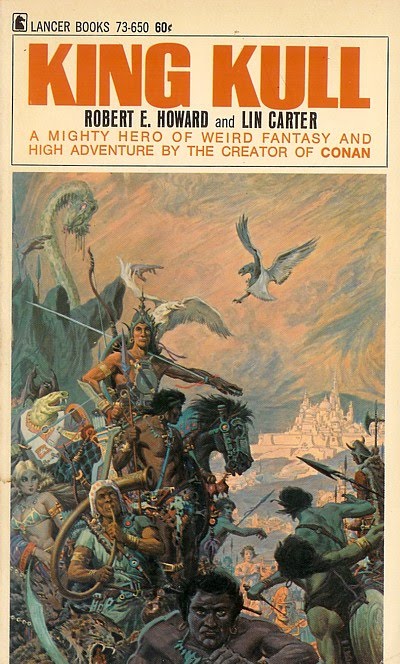
(Roy Krenkel)

Lin Carter's Thongor of Lemuria, and John Jakes Brak the Barbarian would be given the nod. But clearly the best first choice was found in Howard's own works, specifically the hero who had preceded and was in many ways exceedingly similar to Conan, the answer was King Kull.


They tried him out in one of their monster comics. The title had been Tower of Shadows and it had debuted alongside its companion Chamber of Darkness a few years previous as EC-style horror mags featuring new stories and art from the Marvel Bullpen. But that didn't seem to be successful, so the decision was made to turn Tower of Shadows into the Creatures on the Loose and feature reprints of vintage Marvel/Atlas monsters from the classic days.


But during that transition, there had been plans apparently to feature a King Kull story written by Roy Thomas and drawn by the young talent Berni Wrightson. Wrightson would make his reputation a year later at DC when he and Len Wein co-created Swamp Thing, but at that moment he was doing covers for Marvel, specifically the aforementioned horror mags Tower of Shadows and Chamber of Darkness. Wrightson was graduated from covers to a complete story with King Kull.


This story was an adaptation of a Howard story which had only recently been uncovered and published. It speaks for itself, and you can read the adaptation of "The Skull of Silence" in its entirety here.


But what's curious is how Wrightson's original cover for the story was shelved in favor of the Marie Severin version eventually used. Marie's is more kinetic in a classic comic book way, but Wrightson's is the better cover, more obviously in keeping with the story it advertises. Maybe it was the title change that prompted the new Severin cover, as it seems to have been made very quickly, since ads about Kull being in Tower of Shadows had already been published. Maybe Kull's back is too much to the reader, but whatever the cause, the cover was changed, and Wrightson's Kull was hidden behind a rather "superheroesque" cover.


I've always liked Kull. Robert E. Howard's other sword and sorcery hero, the prototype to the much more financially successful Conan is at once the same and different from his more famous glowering brother-creation. He is a King of Valusia, and with that comes age and maturity and a greater comfort with the supernatural than Conan ever displayed. Conan as King of Aquilonia is familiar with dark magic but it still makes him bristle, while Kull battling black magic always was opposed but never quite dismayed by it. Kull was a bit more learned perhaps than Conan, at least I always imagined it so. Kull's Atlantis was less barbaric by a small bit than Conan's Cimmeria maybe. His was a civilization soon to crash which Conan's is one still gathering its strength. 


Above you can get a great look at two very distinctive takes on a fantastic debut cover for the debut of Kull the Conqueror. 


Howard's surly king got his own title with scripts by Roy Thomas and art by Ross Andru and Wally Wood. But that team didn't last as while Thomas lingered a bit, the art was taken on by the brother-sister act of Marie and John Severin. This duo is what makes these early issues of Marvel's Kull the Conqueror so memorable.


Marie offered up some muscular pencils in the brawny Marvel style while John inked them in a way that evoked more classic comics like the work of Hal Foster and others. The synthesis of these two was remarkable and made for good comics. Gerry Conway took over for Roy after a short time and Kull rumbled along with a hiatus here and there. The sales weren't great, and Kull became a sidebar in Marvel's black and white line where sword and sorcery could really show its stuff. 


Dark Horse reprinted those Marvel comics, though I have to say the artwork was not as clean as I'd have hoped. Maybe it's the original materials but the work seems a bit muddy to me compared to the other volumes Dark Horse has reproduced. The stories are still great though, and they offered up many fine moments of pleasure and dallied with the trade for a few days.


A very good sword and sorcery read. But that's not all. 


Dark Horse has done a pretty dang good job collecting up Marvel's REH material. The run of Conan trades has been pretty awesome and now that the series is into issues, I didn't get off the stands, I have beautiful "new" John Buscema artwork to look forward to a few times a year.


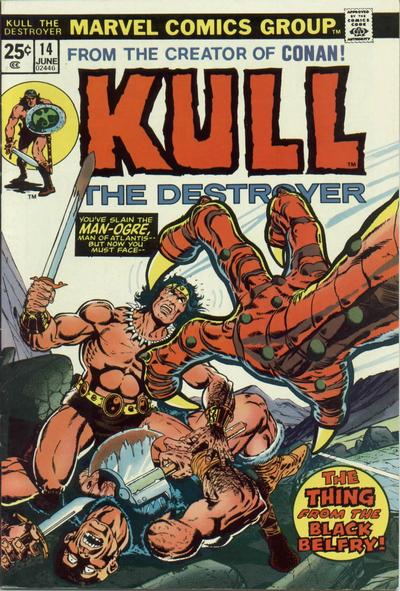
One of the runs I yearned for them to get to was the King Kull material. The first volume featured great comics by Marie and John Severin, even if the reproduction was a bit muddy in places. The second volume caps off that classic run.


But the big news is it gives us the lush revision by Mike Ploog. It's a shame Ploog couldn't do more of these, as issue eleven of the newly dubbed "Kull the Destroyer" is as good as S&S comics get. But with the very next issue, the inking by Sal Buscema while perfectly fine lacked the luster of the earlier installment and things go downhill from there.


Ploog and Steve Englehart left the book after a handful of issues and are replaced by Doug Moench, Ed Hannigan and the great Alfredo Alcala. But while all of those talents are great in other times and places, the final result here looks rushed and muddled.


It doesn't help that there is a two-year break in the run between issues fifteen and sixteen. Kull had some B&W adventures in between there and they are key to understanding the subsequent stuff. It's not included though there are some obligatory explanations.


Marvel apparently thought that the failure of Kull was due to his being a King, as they cast him down off the throne and make him a wannabe again. This served to make him more like Conan, but it sadly also took away much that made him distinctive. In the later issues of this run, it might as well be Conan in the mix as the distinctive personality of Kull, reflective and less reflexively violent is gone.

It's a shame, but I'm still glad this material is finding a new audience. I just hope that audience is a forgiving one.

Rip Off