Showing posts with label Harvey Comics. Show all posts

Friday, January 2, 2026

Ditko In 3-D!


For any fan of the work Joe Simon and Jack Kirby one oddity that always pops up is the single issue of Harvey's Captain 3-D from 1953. What we have is a full-blown superhero adventure, the first costumed hero the team had produced since the ill-fated Stuntman for Harvey many years before. What we have is a comic which makes pretty good use of a trendy technique which from time to time captures the whimsy of pop culture. Sadly, what we don't have is a very good comic book story.


Captain 3-D was one of several 3-D offerings from the company when the technique caught fire in the early 50's. But just as fast as it blazed into being it sputtered out. Harvey comics went away from the idea arguably because the craze was short-lived but also because they came under legal scrutiny for the way in which they used the technology which other comics publishers claimed was poaching. Whatever the reasons, the story of Captain 3-D lasted one single issue.

Briefly the tale is about a young lad named Danny Davis who is given a mysterious book by a mysterious man who is promptly melted into nothingness by another mysterious figure who likewise goes up in smoke, thus making Danny's pleas to the police seem like tomfoolery. But soon when he is alone, he activates "The Book of D" by putting on some weird glasses and out of the pages leaps a costumed hero named Captain 3-D who immediately battles some thugs who are breaking into Danny's digs. After dispatching the baddies, the Captain explains to Danny that the book is a relic of an ancient time and place dubbed "The Land of D" when the Captain's people (of whom he is the last survivor) and the "Cat People" battled for control of the world. Both were seemingly destroyed but not before the Captain was hidden as a safeguard in the book which had been passed down for generations beginning in mankind's prehistoric past. In the two remaining stories Captain 3-D emerges to battle Tigra the queen of the Cat People and a mobster by the name of "Ironhat McGinty" (because he has an iron cap surgically implanted in his noggin no less).


This issue is of particular interest right now because it is among the very first professional comics work of Steve Ditko who was part of the Simon and Kirby staff at the time and in particular was enamored with the work of Mort Meskin.
 
And that was that. To read the complete issue check this, but bring your handy 3-D specs if you want to enjoy it completely.


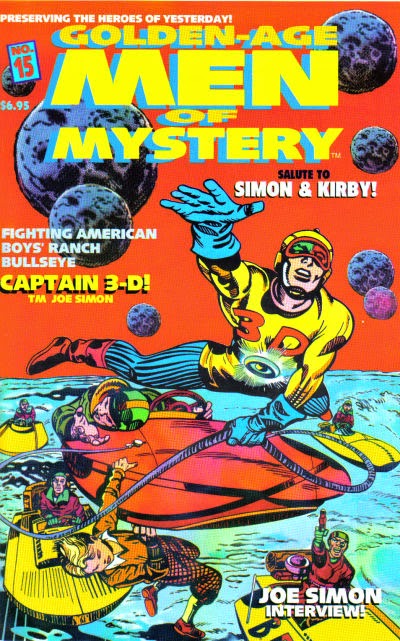
There was going to be a second issue of Captain 3-D but it was scotched when the bottom fell out of the extremely hot but extremely brief 3-D trend. The artwork for the cover of that never was comic was at long last published in 1999 by AC Comics for an issue of Golden Age Men of Mystery. The issue featured a lot of unpublished art for that book as well other features on the work of Simon and Kirby for Harvey Comics. It seems Greg Theakston had the unfinished artwork for one story from the issue and sent it to Ditko's studio since he had been scheduled all those decades before to ink the Mort Meskin pencils. Ditko though decided to pin up the pages around his studio for others to take their pick to ink and many of the pages went missing. You can see the penciled pages in small format in this issue from copies which were made. 

The character was impactful for more than a few future pros such as Roy Thomas, Bill Black and Grass Green among others. And he proved to inspire other creations as seen below. 


And that sums up how I feel about Captain 3-D too, an interesting curiosity, but less effective because of the special effects than without them. Reading the story sans the 3-D effects the panels are woefully static (for logical reasons) and that undermines the general fluid tendencies of the usual Simon and Kirby effort. Also, the story of Captain 3-D himself is in places robust but overall cumbersome and if it had been given a few more outings would've in my opinion worn itself out purely in narrative terms.

Captain 3-D is a lovely image, a great icon of a long-lost time when we like to imagine life was simpler to understand, but aside from that nostalgic impulse, he's a mildly mediocre hero, and not up to the usual standards of Simon and Kirby. But it did give Steve Ditko a place to begin. 


In the 90's Ditko produced two 3-D comics of his own. Both were written by Jack C. Harris and produced by 3-D Zone. I hope to review both of these later this year. I own one, but I still need to acquire the other. 

Rip Off

Sunday, December 21, 2025

The Spirit Archives Volume Twenty-Six!


The twenty-sixty and final volume of DC's Will Eisner's The Spirit Archives features work done by Eisner for the character from the 1950's through his final work on his most famous character in the early 2000's. That quite a range of time, but this volume delivers. This one will read quite quickly because the bulk of the page count is made up of artwork and covers produced by Eisner for Kitchen Sink. The importance of Denis Kitchen and his Kitchen Sink independent underground brand cannot be overstated. Let's take it decade by decade as does the book. 

1950s 

We get two pieces from the 50's, the thumbnails by Jules Feiffer for the story labeled "Outer Space" which tells what happened to the farmer and the alien who kidnapped him in the final published Spirit tale. And we get the typed script for a story about a cigar-smoking villain and his henchmen who try to kidnap Professor Skol and Captain Delf, two of the survivors who traveled to the Moon with The Spirit. 

1960's


This section starts out with a five-page story produced for The New York Herald Tribune Sunday Magazine. In this story The Spirit lives and works in the actual New York City and not its fictional counterpart "Central City". This story sounds very much like a typical Spirit story but deals with the real mayoral race between candidates John Lindsey, Abe Beame, and William F. Buckley. My favorite moment comes when The Spirit tries to recruit Ebony only to find him fifteen years older and working as an executive and having no desire to follow on after his former pal. We even get appearances by Ellen Dolan and an eighty-seven-year-old Eustace Dolan. 


Then we focus on the Harvey Comics reprints from the mid 60's. The superhero boom was beginning, and Harvey was looking for heroes and snatched up The Spirit and cajoled Eisner to do some new stories. In the first issue we get a new version of his origin story and in the second we get an origin story for the archfiend The Octopus. Both issues also feature short two-page efforts called "Spirit Lab" in which a scientist pitches keen gimmicks to enhance The Spirit's crime-fighting skills, but ends up contacting a parody of the UNCLE organization. 

1970's


The 70's begin with The Spirit and Commissioner Dolan making a cameo appearance on a 1972 cover of the underground comic SNARF. This is the first of many appearances The Spirit will make for Kitchen Sink Comics. 


Then in 1973 we get what are called the "Underground Spirits" from Kitchen Sink. In the first of these collections which gather vintage tales we get four new Eisner pages, each a spoof of sorts about changing times and attitudes toward crime. Ebony does an interview with black journalist and attempts to kill the notion that he was demeaned by his role in the stories. In the second issue, Eisner uses his four new pages to give us a stunning P'Gell yarn in which she plays The Spirit as well as her two lovers against one another in a bid for a jewel. 


Then again in 1973 we get "The Invader", a full-color story from Tabloid Press which resulted from a class Eisner taught at the Sheridan College in Canada. This the story of a man from outer space who is the vanguard of an invading force but who finds life difficult on the Earth when he's mugged and then manhandled by various gangs before being saved by The Spirit. 


In 1974 we are treated to The Spirit Coloring Book from Eisner's own Poorhouse Press. This book takes classic Spirit splash pages and offers them up to the reader to color for themselves. I could never do that to a book and have never even thought of doing that to my copy. 


We then are treated to quite a bit of vintage Spirit artwork, including the The Spirit Portfolio plates as well as many pages of pencil drafts for that project. 


One thing not included in this volume are the covers from the Warren run of the series. It's an unfortunate oversight and I cannot fathom aside from page count why they didn't include what are some of Eisner's strongest images of the classic hero. 


But we are treated to ALL of the Kitchen Sink covers beginning with issue seventeen of the series which continued the Warren numbering. This includes a few pages by Eisner and Kitchen. 

1980's


We also get ALL of the covers for The Spirit comics produced by Kitchen Sink both for the magazine and the later comic. 


We also get the pages Eisner created for the "Spirit Jam" issue of the magazine's run in which other creators were invited to create a story. We also get four pages created by both Eisner and Dave Sim for a mash-up of Cerebus the Aardvark and The Spirit. 


Some novelty items like the cover of Will Eisner's 3-D Classics are included. Other bits of artwork that Eisner produced using The Spirit to promote things like conventions and other good causes pop up as well. 

1990's


We are treated to the rest of the Kitchen Sink covers as well as sundry spot art for various events such as the eightieth anniversary of Batman. 

2000's 


We get Will Eisner's final work on The Spirit with a few great illustrations and a story in which The Spirit joins forces with Michael Chabon's The Escapist. This is the final Spirit story produced by Eisner. 


This is an exceedingly fun volume, a proper peek at some of the more obscure Spirit artwork over the decades. There are pieces not included, save for the Warren oversight nothing too significant. And that's a wrap on my year-long look at these archive editions...almost. 


Next time we take a gander at the unofficial twenty-seventh volume of the series which was produced by Dark Horse Comics and gathers together the Will Eisner sanctioned stories by various talents from Kitchen Sink in the late 90's. 

Rip Off

Thursday, July 10, 2025

Rocket Riders And Bulleteers!


Getting all that power between your legs has lots of implications, many of which I will not be exploring. But the cowboy bronco buster is an iconic American image and to attempt to translate that image into the modern world, we find a great number of cartoon characters astride rockets and missiles and all manner of ballistic entities. It's a symbol of man's attempt to control technology and consequently his world, but at the same time shows just how precarious man's control of these great energies really is.


Whether it's Kirk Alyn as Superman atop a missile with a smile on his face in a sky-high frolic in the serial Superman,


Or Slim Pickens as Major "King" Kong riding a nuclear bomb in a nihilistic joyride to oblivion in Dr.Strangelove, the image of a man atop such a device tickles the deep imagination of us all.


Even The Three Stooges evoke a sense of adventure when they ride a rocket in Have Rocket, Will Travel

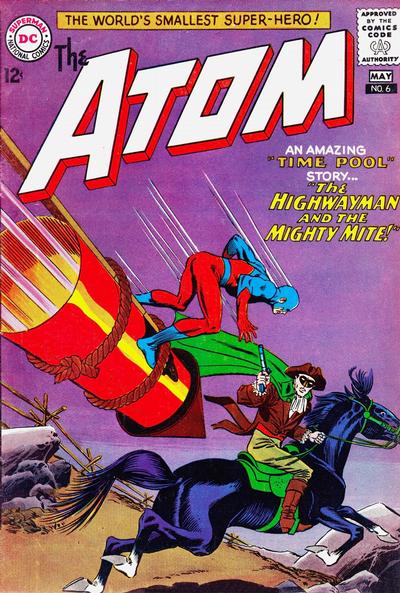
Here are some comic book covers which play around with this imagery in some entertaining and sometimes thought-provoking ways.


Rip Off