Showing posts with label Chuck Dixon. Show all posts

Tuesday, December 10, 2024

Claw The Unconquered!


Conan the Barbarian was a hit. Marvel was sopping up sales with the color comic and the black and white version. Barbarians were selling it seemed in 1975, so the call went out at DC to bring more barbarians to the table. And that's how we got Claw the Unconquered. 


The book was written by David Michelinie and was originally drawn by Ernie Chan who had just left his gig at Marvel inking the Conan comics. It is to be noted that Chan drew under the name "Ernie Chua" when he first started in U.S. comics because of a typo on his immigration documents. Chan is assisted on art chores by Pat Boyette. Claw was apparently supposed to be called "Talon", but Jim Steranko had dibs on that name. The first nine issues were all edited by Joe Orlando.   


Claw is the one character in DC's "All-New Adventure Line" that looks like Conan. That the series lasted twice as long as most of its companions and three times as long as more than few it's possibly due to that resemblance. In the first Claw story we meet our hero, a man who suffers a bit of amnesia yet is still a potent warrior. Possessed of a red gauntlet which overs a furry claw, he is a man prophecy suggests will bring down King Occulus of Pytharia. The King orders his underlings to kill Claw, but that proves more difficult than one might've thought. 
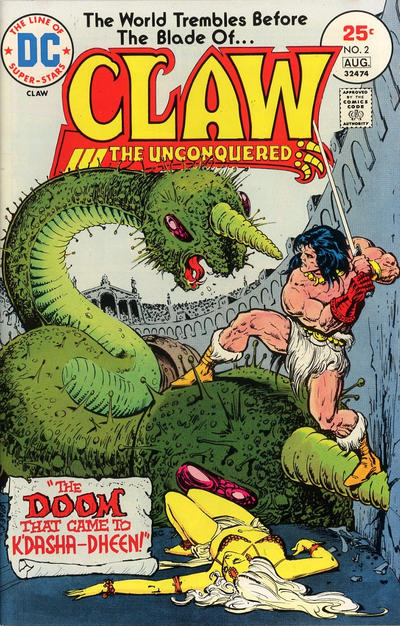

The first several issues follow a familiar pattern as Claw will encounter an individual, save them from some threat and then see them turn on him either for reward or other recompense. His "Claw" seems to have a will of its own, and moves to save him in circumstances in which he is oblivious to the threat. This is the best cover of the series. 


He also confronts giant creatures with names such as Kann the All-Consuming , often referred to as gods and is able in most instances to kill them or at least escape their clutches. The look of the earliest Claw comics seemed especially designed to evoke the Conan comics being produced over at Marvel. 


In the fourth issue he meets Ghylkin, a warrior from another dimension who sought adventure and so came to our world, but not before he got a nifty pair of horns. Claw and his new ally battle N'Hflhss, an ogre-like demon called down to Earth. The story stays open as the threat is not ended, and leads to the first multi-part epic. A prophecy from Asvitar the Burning Man causes the duo to seek the Moonthorn, a sword which will be effective against the threat of N'Hflhss and will give Claw much needed info as well. 


"The Gemstone Trilogy" begins the search for the Moonthorn, a sword which will reveal great secrets to Claw. But before they can find the Moonthorn, they must find the Gristone and that's divided into three parts. The first takes them to a territory guarded by strange women with a bizarre secret, the second has them battling a teenager who comes into possession of great magical powers, and the third is found at the bottom of the sea among a society of passivists. King Occulus and his court magician are keeping an eye on Claw and making things none too easy for him. 


The cover of issue eight is Ernie Chan's last contribution to the series. He headed back to Marvel, leaving Claw in the hands up new talent Keith Giffen who is aided by a bevy of inkers. 


Alas, Claw the Unconquered number nine is the only issue of the run I actually bought off the stands at the time of publication. I must have had some extra quarters in my pocket when it hit the spinner rack. Giffen is inked by Bob Layton in this issue. 


Claw the Unconquered returns to the stands after a one and six-month hiatus. Joe Kubert joins the book's regular team of Michelinie and Giffen as the cover artist for the final three issues. So, at long last we are about to get a face-off between Claw and Occulus, foes who battled but never met in the many issues previous. But not before Claw must confront the weird trio of "Those Who Must Abide". This issue was edited by Paul Levitz. 


The actual confrontation between Claw and Occulus is in issue eleven and it's an Occulus made even  more powerful by the magic of Miftig. To avoid Claw, the palace is even lifted into the air, but that doesn't stop our hero and he finally gets to see the man behind the death of his parents pay a price. This would've been an ideal place to end the series, but we get one more issue. Joe Orlando returns as editor. 


In the final issue drawn by Giffen and Layton, Claw is robbed of his red gauntlet and later when he hooks up with a group of fighters, he finds he loses control and the violence gets out of hand, so to speak. We see that Occulus is rescued so to speak from the wreckage of his palace and there are hints of battles to come. Without his protective glove, the Claw we are left with is a man who fears himself, so much so that in the final panels of the story he makes a tragic decision. Larry Hama is the third editor in three issues, probably one good reason this revival didn't get off the ground. 


Apparently two more issues of Claw the Unconquered were prepared but went unpublished. I note that the price on issue thirteen is for fifty cents so there might've been discussion of bumping up the price and adding a back-up, like another of the Adventure line. I haven't read these, but those Kubert covers are incredibly suggestive. 


Claw made DC's Who's Who line-up in the 80's, suggesting that he wasn't forgotten about. In fact, he makes a few cameos in comics over the years, but nothing of real substance. 


Claw the Unconquered was brought back to comic life in a cross-over with Dynamite's Red Sonja. The two shared two issues in 2006 which initiated a revival of Claw in his tittle from the Wildstorm brand. I love the cover Alex Ross produced for the crossover event. 


Wildstorm gave us a full-blown Claw the Unconquered limited which featured the slightly reimagined hero, with a full name -- Valcan Scaramax. In this story we are reminded that Claw cut off his hand (again) in the Red Sonja appearance, but the hand refuses to die and in fact regrows on Claw's arm. The abandoned hand also grows and develops into a full-blown copy of Claw but more savage. (Reminded me of the plot to Frankenstein Versus the World.) Claw is recruited by a sorceress and is led to her compound by a gang of werewolves. I'm not  that taken with Andy Smith's artwork on this one. The series seems to lack the elaborate detail I like in my fantasy yarns which creates that other world. Sadly, this presentation reeks of those bad old Image days when muscles mattered more than storytelling. They are im freezing temps in much of this story, so put some darn clothes on! I will give the story credit for a bold ending. 

Below is a short gallery of the  Wildstorm issues. 


Next time we meet Stalker - The Man with No Soul. 

Rip Off

Friday, May 17, 2024

The Eclipse Hobbit!


As far as I can remember the Eclipse Comics adaptation of J.R.R. Tolkien's The Hobbit came out of left field. I don't remember much buzz about it at the time, but it was a period when I was less connected to comics overall. After the burst of interest in fantasy in the 70's, largely as a result of the success of Tolkien's epic works, the story had gotten an animated treatment in both television and in the cinema. There had been a radio play or two, but things seemed relatively quiet in Middle-Earth. 


The adaptation by writers Chuck Dixon and Sean Deming was illustrated with consummate skill by artist David Wenzel. I had run across Wenzel on some Marvel comics and his name didn't evoke great confidence, but his work in this version of the story is at once distinctive and delicate. His vision of Middle-Earth is not derivative to my eye. Eclipse issued the story in three installments and then in collaboration with Unwin, the longtime publishers of the story produced a graphic novel. 


Wenzel's version of Gandalf is a potent one, as he seems far from fragile and is presented with strong features. He's less the wizened old man of other adaptations. Bilbo Baggins is a surprise as well, shown as quite chubby and with a haircut that frankly reminds me of Moe from the Three Stooges. The Dwarves look great, and distinctive as far as that's necessary in this tome. Unlike the bloated trilogy of recent years, it was less important to distinguish them in all sorts of peculiar ways. 


Gollum is quite different as well. Wearing pants makes him immediately more civilized than his counterparts in other media. He's less a creature and more a crazy and withered person. People love the Riddle Game in Bilbo's encounter with Gollum and it plays well in the novel, but I found it seemed to drag Jist a bit in this presentation. I was happy that this adaptation kept Beorn and his wonderful lodge, something abandoned in other renditions not unlike Tom Bombadil in adaptation of the grander The Lord of the Rings.
 

Smaug is outstanding! That said, the reading becomes quite dense as the band of dwarves enter the final stages of the story. The creators are clearly feeling the pinch of trying to keep all of the story from the novel and the panels get smaller as the captions get larger. This clearly needed to be at least one issue longer. The Battle of the Five Armies barely has enough pages to showcase it, though Wenzel does produce some stellar images. One complaint I have is that the elves don't look much different than the humans, and in some respects even more drab. But overall, the art has a lovely calm to it, that fits the atmosphere of the story being told. 


The adaptation has proven quite durable and is available sundry languages across the globe. I found a modern version on the stands of my local bookstore just a few weeks ago. If you're a fan of the Tolkien tales, this is a charming way to interact with these classic characters. 

Rip Off

Saturday, November 25, 2023

The Spider Chronicles!


This is a heady collection of Spider tales from Moonstone. The Spider Chronicles kicks off with an introduction from Denny O'Neil and features fantastic illustrations from Tom Floyd throughout. Doug Kaluba's cover is a powerful introduction to the proceedings. As with any anthology, the quality of the stories vary, but most of all of them successfully tap into that Spider magic in some ghastly way. 

"City of the Melting Dead" by Martin Powell is a heady tale by one of my favorite writers which pits the Spider against a malevolent foe dubbed "The Crucible" who has a deadly and horrific formula that melts human flesh. This murderous enemy is put down in the most distinctive of ways. 

"King of the City" by C.J. Henderson shows how the Spider is able to use the forces of gangland against each other in their mad scramble of greed and avarice. The true king of the city is revealed by the story's bloody finale. 

"Death from a Blood Red Sky" by Elizabeth Massie features death from above as a murderous woman uses an autogyro to wreak havoc and murder from the safety of the skies. Her killing method is singluar and savage. Her rampage is put down by the Spider with great cost to himself. 

"Death Reign of the Zombie Queen" by Howard Hopkins has Nita fall victim to the powers of a deadly woman seeking power and revenge on men for the crimes committed against her. She has created deadly cannibalistic zombies to support her deadly play for power. 


"March of the Murder Mummy" by Will Murray is a wild story which delivers on the title. We have a murderous mummy who seems to have an insatiable lust for gold. The Spider is taxed to the limit to bring down this seemingly ancient menace that can shrivel men in its grasp. 

"Regrets Only " by Chuck Dixon is a story focused on Nita Van Sloan. She is in attendance at a dinner party which turns into a potential massacre when brutal thieves and murderers overwhelm the city's elite. The Spider is seemingly occupied with another crime and Nita fears she is all alone. 

"The Marching Madmen" by Bill Crider is a wild story about an insane mob which in defiance of death and seemingly impervious to pain attack a collection of the city's most important folks. The Spider is at a loss how to deal with this threat, even to the point of seeming to lead the maddened mob at one point. 

"Fear Itself" by Joel Friedman and C.J. Henderson sets the Spider against the most ancient threat of Set and of Monks older than time. Also on hand are deadly giant reptilian beasts all too ready to rend people apart for food. These monsters are under the thrall of the Serpent Men. The Spider needs magical help to solve this case. 

"Blazing Barrels at the Reich House" by James Anthony Kuhoric is set just as WWII is coming to an end, but while the Third Reich might seem to have fallen, a mysterious zeppelin delivers deadly Nazi agents with jet packs to a Washington party at which the President is scheduled to appear. The Spider is all that stands between the President and death, and I haven't even mentioned the odd leader of the pack. 

"Senor Suicide" by Steve Englehart is a bizarre tale which begins when the Spider shoots himself in the face. We learn that the whole of the city is consumed by the rays of a device which creates emotions, especially those leading to deadly behaviors. People commit suicide by the thousands and even airplanes fall from the sky. It's all the Spider can do to save himself let alone his fellow citizens. 

"Wheelman for Terror" by Shannon Eric Denton and John Helfers is an unusual Spider story told from the perspective of a simple thug named Len who just wants to make his way in the mob. He's diligent if decidedly uncaring about his fellow man, but he makes a name for himself when he seemingly kills the Spider. While he feels he's at last a success, his fame carries a cost. 

"More Souls for Hell" by C.J. Henderson puts the spotlight on Ram Singh when he finds himself all alone having to defend the Wentworth Estate from a gang of thieves decked out in black. With blades only he cuts a lusty and savage swatch through the interlopers and so ends his boredom at having to stay behind when The Spider was elsewhere. 


"Caught in the Crossfire" by Ann Nocenti finds Wentworth and Nita in the Bahamas aboard a gambling boat which finds itself accosted by classic gangsters and real-world pirates led by a fascinating creature called "The Red Slash". It's bloody mayhem as a Monopoly game becomes a real contest between deadly agents from several quarters. This one really gets inside the mind of The Spider. 

"The Invisible Gang" by Ron Fortier features a malignant female Fagan who uses her youthful charges to carry out murderous robberies of gangsters setting off a bloody gang war. The Spider is busy dealing with the bloody consequences and has little time to find out the true nature of this invisible menace. 

"The Devil's Druggist" by Robert Weinberg focuses on a horrifying mystery of poisonous aspirin which seems to find its way into all brands. The real secret of how the poison is being delivered sets up a wild finale which pits the Spider against some exotic and quite deadly enemies. 

"The Mad Gasser of Mantoon" by Joe Gentile tells the tale of a small town which suffers from a madman who silently sneaks around and silently pumps a weird gas into the homes of various citizens. The connection between victims is hard to fathom and the motive for the crime maybe even more complex. And then there's the problem with the FBI men who seem to want to frustrate the investigation. 

"The Calling of The Spider" by Mort Castle is a story from the early days of the Spider in which Dick Wentworth might have had less lethal aspirations for his crusade against crime. In a story set among the music industry as well as a deadly drug culture, this story perhaps explains why The Spider deals out justice with such ferocious intensity. 

"The Spider and the Monster Makers" by Christopher Mills is the story of a madman who infects young women with a horrific disfiguring disease and uses that threat to blackmail the rich and well-to-do of the city. The true secret of the villain known only as "Proteus" is even more horrific than we at first are led to believe. 

"Banquets for the Damned" by John Jakes wraps up the collection as Jakes pays homage to his favorite pulp hero with a story set in Hell's Kitchen, and never has that name been more accurate. A wave of madness and murder sweeps through the city when a foreign chef sets up shop in town. His ultimate motives are sadly even more of the times. 

These are pretty dang good stories overall. The beauty of a collection like this is that if a certain story isn't really thrilling you, there's the pleasure of knowing a new one is just a few pages away. The sad part is that when a tale is really potent, you know it will wrap more quickly than you might prefer. Moonstone published a lot of these kinds of collections and this one is the best one I've read so far. 

Rip Off


 Rip Off

Sunday, November 5, 2023

Argosy's Blazing Comics!


The Argosy comic book line (if you want to call it that) is one of the most bewildering I've ever come across. We begin with the Blazing Comics G-8 and his Battle Aces #1 featuring the story of "Grun the Primeval". There is never an explanation why Grun is primeval or why he's green. This is a flip comic with a Web-Man back up story on the reverse. 


The cover is by Tim Truman and is an homage to an issue of G-8 and his Battle Aces from 1940 titled "The Green Scourge of the Sky Raiders", and having not read that issue I can only assume Grun is original to that book. I don't remember buying this one, but no doubt it was because of the interior artwork of Sam Glanzman. The story is by Chuck Dixon. This team produces both stories in this issue. 

(Sam Glanzman)

What we have is a twenty-one-page story in which G-8 and his allies battle Grun and injure him. He is then sent by his superiors to work with a mad scientist named Krueger who has invented a lightning gun which Grum makes use of once before it is destroyed by G-8. Surviving his plane crash, Grun is captured by G-8, but then escapes in a mindless fog and returns to the scientist's lair. There Grun wanders through a time machine and disappears for a moment or two much to Krueger's chagrin. When he returns his wits (such as they are) have returned but now he has no memory of the events which have just taken place or where he went in time. 


It turns out that Grun traveled through time to the then present day of 1991 and confronted Web-Man, a superhero spun off from Argosy's very violent The Spider. The Spider's Web starring Web-Man is the title of this section. The story is titled "The Web of Time". Web-Man is really a young man named Rick Worth and his friends with Eva Zane who happens to be the daughter of the scientist Dr. Leonard T. Zane. Zane figures out that Grun is from the past and works to return him while Grun shows up and takes Eva hostage, but is saved when Web-Man fires his "Weblee" gun which disgorges sticky webs. Grun has disappeared in a flash of light (to return to the past) and while trying to free Eva, Rick brushes her breast which embarrasses him but she seems to enjoy. The almost kiss when her Dad shows up. 


We would have to wait two years until 1993 for the sequel which is titled Web-Man #1 (and Time Warrior as the back up on the flip side). Chuck Dixon returns as the writer, but the artist is Greg Luzniak, who draws in the wildly popular (at the time) style of Image Comics. The lead story has two big villains, a French masked man named Vermillion and Dr. Kraken, a villain who has deadly tentacles. Rick Worth is on the outs with Eva but still has hopes and she for her part is partial to Web-Man. In the course of their crimes Vermillion and Kraken capture Eva but she is saved when another "hero" named Blue Steel shows up. He seems to be a Punisher rip-off just as the creators are trying to make Web-Man as much like Spider-Man as they can. The two villains escape but their plot is foiled. 


The back up story for a series titled Time Warrior is titled "The Face of Time" and begins with Grun back in the skies of WWI where he encounters a man who looks much like him save for the green skin. This turns out to be a story Grun is telling his psychiatrist who looks a lot like Freud. Grun is grounded and sent to work with Dr. Krueger who sends him to meet up with Albert Einstein. Later two characters named Stahlmaske and Razorfist, the Scourge of the Cossacks show up at Krueger's lab and confront Grun before getting sent into the time machine. This seems to send Grun into time as well, but as the story ends we are not sure. And sadly we will never learn more, but it does set up the premise that Grun now can travel through time whenever he encounters a big electrical charge. 


The next comic in the Argosy series doesn't show up until later that same year but now Web-Man is called The Spider and the comic is drawn by Gray Morrow. A new writer named Jason Daly takes the helm. The cover is by Greg Luzniak and Bob Wiacek who also produced a two-page "super action" poster inside the issue. The title seems to be The Spider Presents Quiver. 

(Gray Morrow)

"Quiver in the Night" begins with the Spider in the morgue where he confronts to villains before finding Eva on a slab as naked as the day she was born. How she got there is unexplained. The Spider takes Eva with him and in the car offers her an old Web-Man outfit to cover her nakedness. She puts that on, including the mask and the Weblee gun for some reason as well. Then we enter her dream where she is confronted by a killer named the Pumpkin Man who turns people into pumpkins. She awakens and feels the need to summon Web-Man and with a strange green light in her eyes goes on the prowl. Pumpkin Man kills a few more people such as television cook, a mugger, and two newlyweds before he is tracked down by our new heroine. She snaps out of her trance and lets him go. The comic closes with several page of Luzniak art from the earlier Web-man issue and has a back cover which names our new heroine "Quiver", though the story never actually does that. 


Now we skip forward to 2002 and a book titled A Gene Colan Film Starring The Spider. This is a weird wordless graphic story developed from Colan's pencil art which takes us into the subways of NYC where the Spider encounters a strange Bat-Man creature and attempts to stop him with blazing automatic firepower. He fails but as the segment ends does manage to snag the flying creature with a line and is whisked down the subway tunnel. Meanwhile a subway car appears with trapped people and it seems to be operated by The Spider's foe The Kraken. 

(Gene Colan)

And that's pretty much it. There are two pages of Gray Morrow artwork featuring a fetching babe which doesn't seem to connect to anything, and we get a reprint of first chapter of the Spider story "Death Reign of the Vampire King" which apparently is the source material for Colan's work here. (I'll have more on this novel in a later post.) The story is credited to Jason Daly though there is not a single word uttered in this page yarn other than the girl saying "Gasp. Hang on!". This is one of the weirdest books I own but it's not without its charms. Gene Colan was a master, and this sequence showcases his ability to tell a story. 


Also out about this same time was The Spider #1 Sneak  Preview Webman which features a Gene Colan cover with a redesigned Webman along with the Kraken and Vermillion. Beneath this cover though is a reprint of the Dixon and Luzniak story from 1993. 

These are strange comics spread over several years but they are near totality of the output for Argosy Comics save for some material produced in the last ten years which I don't have. I bought all of these in the second-hand market and it wasn't for the story. Artists like Glanzman, Morrow, and Colan always get my attention, even on bizarre material like this. I don't recommend these really, but they are strange enough to hold the interest. 

Rip Off