Showing posts with label Jesse Marsh. Show all posts

Tuesday, May 31, 2022

Tarzan - The Jesse Marsh Years Omnibus - Volume One!


By the time Dell Comics entered the realm of Tarzan of the Apes, Edgar Rice Burroughs' greatest creation had become a small industry. Tarzan had conquered printed prose with twenty novels in evidence by ERB, and had conquered comic strips under the guidance of talents like Hal Foster and Burne Hogarth. Tarzan was a steady entertainment on the big screen with decades of films on the roster. And there had been Tarzan comics but mostly they were reprints of the strips. When Dell picked up the character and tried it out in the venerable Four Color series they created new stories and featured new artwork by an talent who would be associated with the character for  many years to come -- Jesse Marsh. 


Tarzan debuted at Dell in Four Color #134 in early 1947. The story was written by longtime comic strip scribe Robert Thompson and Marsh drew the Ape Man for the very first time. The story is humdinger as are most all these early Dell outings. They are fitted with enough plot and doings for a small movie feature, and likely that was the idea. "Tarzan and the Devil Ogre" has Tarzan meet a woman looking for her lost father who himself was seeking gold. Tarzan and D'Arnot join the safari to find and rescue this man led by a white hunter who turns out to be untrustworthy. The expedition ends up in forbidden territory in which a savage tribe worships a powerful "ogre". There is death and destruction before Tarzan is able to finally save not only himself but some of his allies. 


Four Color #161 was released later in 1947 and again Thompson and Marsh are the creative team. This time Tarzan and D'Arnot are again helping a father and daughter in a lost safari find their way to the lost city of Tohr. They encounter many dangers but none so ferocious and cruel as the woman who leads the people of Tohr and who uses ancient sacrificial practices to enforce her rule. This one had all the elements one would expect of a Burroughs novel and some hair-raising action to boot. This apparently was an adaptation of a radio script by Thompson. 


Dell decides pretty quickly that Tarzan deserves his own title and Edgar Rice Burroughs' Tarzan #1 is on the stands by early 1948. In this story by Thompson featuring more handsome Marsh art Tarzan meets the "White Savages of Vari'". This is another lost civilization of brutish men led for the moment by an evil witch doctor. The rightful queen is a prisoner, but Tarzan soon brings his will to bear and the situation is changed but not without significant violence and conflict. 


The second issue of Tarzan brings on a new writer in the Dell standby Gaylord Dubois. This time it is a young boy seeking his father and Tarzan helps him to do just that. There is still that epic feel to the story and more significant interplay with the animals of the territory. Apes play a big part in this story. The presence of a young lad in the yarn was paving the way for a change in the nature of the stories that Dell planned to tell. Dell also had initiated in the first issue and continued in this one a feature which listed many of the words from "Tarzan's Ape-English" dictionary. These words presented in alphabetical order offer up the names of the creatures along with some very handsome Marsh illustrations. It should be noted that not only the front covers, but the back covers as well of these Tarzan comics featured original art Marsh not repeated in the book. Wonderful stuff, a solid package. 


"The Dwarves of Didona" is the story from the third Tarzan comic and introduces a new family situation for ERB's King of the Jungle. Jane is brought into the story (though never named) and "Boy" makes his first appearance. The family live in the treehouse much as they did in the classic MGM movies and it's a very homespun atmosphere. Dell was intent in their comics to make sure they were producing family-friendly material and the introduction of this kinder and somewhat gentler Tarzan certainly served that desire. Tarzan has to go to a hidden island inhabited by deadly dwarves when his son Boy accidentally ends up there after being carried by witless baboons. 


"Tarzan and the Lone Hunter" introduces the region of Pal-Ul-Don to the pages of Dell's Tarzan universe. This territory of strange people and dinosaurs is very popular in the novels with Tarzan making more than a few excursions to it. Here a lone member of the strange race from the territory comes to Tarzan to seek his help in finding his mate who was chased by outlaws and seemingly escaped but might well be dead. Tarzan obliges. The cover showcases a nigh Eden-like atmosphere for Tarzan and his family. 


"Tarzan and the Men of Greed" is a title that could fit many a jungle yarn starring ERB's King of the Apes. In this instance Tarzan is forced to lead an expedition to the lost city of Opar. Despite the fact the savage men of Opar are all dead along with their queen La, the greedy men run afoul of savage apes who guard the vast treasury of gold. Only Tarzan and his family return. The deadly violence is cleverly hidden by Marsh in his panel designs, but the story makes little secret of what happens to the men. 


"Tarzan and the Outlaws of Pal-ul-Don" brings back the strange territory. This time Tarzan and Boy head there, crossing a desert and some forbidding snowy peaks to enter the land of roaming Triceratops and Sabre-tooth Tigers. They are seeking to rescue Jane who has been kidnapped by the aforementioned outlaws. Tarzan enlists of the help of his many allies in the land he rescues Jane from the clutches of the criminals. Boy is along every step of the way. 


In "Tarzan in The Valley of the Monsters" Boy and a friend Dombie launch a balloon which haplessly floats into a strange valley filled with dinosaurs. Tarzan and Dombie's Dad used a plane to try and catch up to the boys but all of them end up crashed in the deadly valley. They find allies in people who live among the dinosaurs but when they are able to at least escape the valley enshrouded by a volcanic cloud. 


"Tarzan and The White Pygmies" picks up right after the last issue as Tarzan and Boy and their allies try to walk back home. They encounter a tribe of pygmies who are having difficulties with giant buzzards. Tarzan devises a scheme to help them help themselves in that regard. One note is that Morris Gollub takes on the cover duties with this issue creating an Eden-like image of Tarzan and assorted wild creatures. Gollub will create the next several covers. 


"Tarzan and the Men of A -Lur" has the King of the Jungle involved in an uprising in Pal-Ul-Don between various important cities and their leaders. Tarzan calls upon his allies in that strange dinosaur-laden land to help. He also makes effective use of an enormous elephant that travels into the region. The Ape-English Dictionary nears its alphabetical end and is reduced to a single inside cover page. The other is used for a subscription ad for the comic. 


"Tarzan and the Treasure of the Bolgani" is a truly strange tale in which Tarzan combats a city full of intelligent gorillas (Gorilla Grodd anyone?). These hostile apes enslave human beings to work for them by shrinking them in a strange device. Tarzan though while small retains his strength and becomes less vulnerable to weapons. He is able to lead a revolt against these strange creatures. 


"Tarzan and the Sable Lion" begins with Tarzan battling and then to some extent taming a ferocious lion. Then he discovers that a village has been captured by slavers and just by chance so have Jane and Boy. Collecting what allies he can from the wild he goes to free the captives and wreak some hard justice on the slavers themselves. 


"Tarzan and the Price of Peace" is all about love. Tarzan stumbles across a forlorn lover who tells Tarzan how he cannot afford to win the hand of the girl who loves him also. Tarzan intervenes and arranges for the couple to escape their village. As they are doing this they encounter more slavers and free the captives. Then all of these displaced people find a home on an isolated island when Tarzan is able to negotiate a peace with the existing tribe of Mangani. 


Things change up with the thirteenth issue. Mo Gollub has move on from cover duties. Instead, a photo of Lex Barker the then current film Tarzan is used alongside the faithful Cheeta. Some Jesse Mash drawings help fill out the space. This shift was probably seen as wise to move more comics, but it's a shame since the covers produced by Marsh and later Gollub had been handsome indeed. This approach will be used for all of the remaining covers in this collection. There are two stories in this comic. The first is "The Knight of Lyonesse" and has Tarzan stumble across a young knight from the usual lost city who is hot to kill a Saracen and take his beard to win his honey. Tarzan saves the knight from baboons and helps him get his trophy without bloodshed when they break up a gang of slavers. This story reveals that La of Opar is not dead as had been reported in an earlier comic story. In "The Ape Hunter" Tarzan must stop a brazen American who wants to kill apes for sport. He of course doesn't get his way. The last remant of the Ape-English Dictionary appears on the inside cover of this issue. 


Again, there are two stories, which will become standard. "The Lost Legion" is yet another lost civilization in the classic ERB tradition. This time it's Romans who have a city and are living much as they did long ago. Tarzan and D'Arnot with Boy tagging along are flying to map the Monster Valley they'd found some few issues before and crash, then are captured by an evil king. But soon they are able to ally with the rightful ruler and the tyrant is pitched out. "The Flying Chief" has some young folks in an airplane run afoul of a scheming tribal chief who wants to fly a plane. He does so but it turns out poorly for him when Tarzan gets involved. A new feature called "Jungle World" shows up, this again illustrated by Marsh. 


"Tarzan and the Cave Men" reintroduces La of Opar. This time she is on the verge of being sacrificed by the males of the society but Tarzan saves her. With nowhere to go, Tazan recommends Pal-Ul-Don and off they head riding atop Tantor. When they get this land of dinosaurs they are waylaid by a caveman who captures La and takes her back to his village. There is a struggle for her attentions but Tarzan brings an end to that and La seems to have a found another place she can rule. "Tarzan and the Hunter's Reward" is another variation on the classic Romeo and Juliet theme with two young lovers frustrated by their culture. Tarzan helps bring about a happier ending. 


The sixteenth and final issue from 1950 in this immense collection starts off with "Tarzan and the Beasts of Armor" Tarzan is flying to the Valley of Monsters and Boy sneaks aboard the plane. They end up fighting some mighty dinosaurs and saving a man from Pal-Ul-Don who tells them that his city has been taken over by white gangsters. Tarzan and Boy join the fellow and they head to the lost territory where Tarzan uses his wits and muscles to defeat the criminals. Then it's back to the plane and home. "Tarzan and the Giant Eland" is the last story in this collection and true to its title Tarzan finds and tames a giant eland which proves handy when he must save a native girl from ritual sacrifice. 

I was much surprised by the nature of these tales. They were much more willing to engage ERB's mythology of Africa than I expected. Pal-Ul-Don and Opar are key parts of many of these stories, especially the former. I chagrined when the series suggested La was most likely dead and pleased as punch when she turned up for two more appearances. The use of Jane and Boy following the template of the movies was smart as well by DuBois and Marsh. It made the series familiar to young fans who came to the comic by way of the movies. And the use of ERB's mythic landscape supplied the same flush of familiarity for fans of the novels. These Dell Comics did a great job of making these Tarzan comics accessible to all fans of Tarzan.

Rip Off

Saturday, May 7, 2022

To The Moon Maid And Back!


That's a lovely pair of Moons don't you think. (That Frankie Frazetta was a scamp.) As it turns out the Dojo is going to the Moon. Specifically, we are visiting the fictional Moon of the savage "Va-Gas" and the brutal "Kalkars" as imagined by Edgar Rice Burroughs for a trio of yarns that reveal a tragic and terrifying invasion in Earth's future. This saga of the Moon Maid is not only wild science fiction and bizarre adventure but really a striking political commentary as well. 


The main focus will be on ERB's most famous creation --Tarzan of the Apes. In particular on Saturdays this month the Dojo will feature those Tarzan stores drawn by Tom Yeates. Yeates has been illustrating Tarzan stories for decades and every outing offers an inviting fresh take on the classic Ape Man. Tarzan as rendered by Yeates feels more like a real man than a noble hero, though he's that too. 


And speaking of noble heroes, I will wrap up my look at Burne Hogarth's Tarzan of the Apes work on the comics strips as well as the stunning work he did in the 70's for graphic albums intended primarily for overseas markets. Look for these glimpses of some great art on Sundays. 


During the weekdays, I will be dusting off and revising some vintage reviews of the Tarzan movies from the 1930's. In addition to the famous Johnny Weissmuller take on ERB's classic hero in the MGM classics, look for Tarzan as interpreted by other actors such as Herman Brix, Glenn Morris and Buster Crabbe. The world was never quite so rich in Tarzan goodness as it was during the Great Depression years when escaping into the wilds of darkest Africa might've seemed even more appealing. 


I'm also reading Tarzan adventures as drawn by Jesse Marsh. Marsh was the artist who first rendered the Ape Man on Edgar Rice Burrough's Tarzan for Dell Comics back in the late 40's. He was considered the definitive comic book Tarzan artist until the arrival of a chap named Manning a few decades later. Not everyone cottons to Marsh's take on the character, but I like it just fine. 


And there might be other jungle surprises along the way as we slowly wend our way to Summer. 

Rip Off

Saturday, February 5, 2022

Brothers Of The Spear Volume One!


The 1950's were hardly an era of racial harmony in these United States. In fact, the opposite was the case with Black men and women fighting every day for the opportunity to engage fully and fairly in the larger society which had promised them so much in its founding documents but had delivered so very little. For a sense of what race relations were like then check out this informative link for a glimpse. 


Comic books, at the time one of the most popular entertainments in the nation had hardly been a region apart from the greater society, promoting a greater sense of racial equality. In fact the opposite was true, with racism not a bug but a feature of most comics of the short history of the form. Comics such as All-Negro Comics #1 were beyond rare because retailers would not stock such publications on their racks for the population, a population which in the South still were forced to drink at separate water fountains.  So it's a surprise indeed when a comic appears which suggests with a sublime nobility that the races can indeed co-exist in harmony and even become family of sorts. That comic feature was Brothers of the Spear. 


One reason Brothers of the Spear could find a footing in the market is that never in the long history of the series did it ever get a cover in the 1950's and rarely in the 1960's. The series thrived in the back pages of the popular Tarzan comic book from Dell Comics and later from Gold Key Comics. The lead feature at the time was supportive of the long-standing film franchise which offered up a gaggle of handsome white men in the role of ERB's most famous creation. Behind those acceptable white faces, a drama featuring two young men, one white and one black, could unfold in a calm reliable fashion month after month beginning in Edgar Rice Burroughs' Tarzan #25 from 1951.


I maintain that comic book readers are more liberal than those who have not sampled the four-color delights. We as a breed are more open to varying ideas about human identity. At least it was the case in the 1960's when I first stumbled into the hobby and was presented a wide range of black men and women who were capable of the same selfless heroics that white heroes demonstrated month in and month out. Sometimes those liberal intentions could be a bit self-consciously ham-fisted such as Gardner Fox's story in Justice League of America #57. (Total credit to Carmine Infantino's and Murphy Anderson's landmark cover which I'm sure rankled more than a few newsstand operators in the day.)


And by the time the Black Panther debuted in Fantastic Four #52 in 1966, Gaylord Dubois and artists Jesse Marsh and Russ Manning had been spinning tales of a noble black warrior in the heart of Africa for fifteen years. And further that black man, a prince of his land was the blood brother of a white man who treated him as an equal and not a sidekick. While the Black Panther was still cloaked from racist eyes behind his full-face mask the "Brothers of the Spear" were still shielded from racists behind the stalwart white icon of Tarzan. 

Jesse Marsh's First Page

The two brothers who are the "Brothers of the Spear" are a young white man named Dan-El who was adopted by the Zulu tribe when his father appeared with him from a far-off unknown mountain land Natongo the son of the Zulu chief who raised the young men together in such a way that they made were devoted comrades and not rivals save perhaps when it came to spear throwing. The first story shows the two men passing a test of accuracy to earn a the role of sub-chief which indicates that Dan-El's skill might be fractionally better than Natongo's though not so much as to matter in real situations. Natongo graciously shares his role and his symbolic feathers with his "brother".  Both decide that now that they have become sub-chiefs and for all intents and purposes fully-grown men that they will together attempt to find the lost land from Dan-El originates. The clues are two keys, one a golden key which Dan-El's father brought with him and another a birthmark on Dan-El's shoulder which matches one his father had. With this information they strike out but quickly run into trouble from various quarters. But they meet good people and bad and are taken captive on more than one instance, but always they are able to use their wits and skills to work together to continue the journey. Natongo seems to be a bit wiser than Dan-El, or at least more cautious. Dan-El can be impulsive and perhaps a bit too trusting. Natongo seems to have a keen understanding of the world. 

Russ Manning's First Page

We follow the two young men on their trek thanks to the writing of Dubois and the deceptively simple artwork of Jesse Marsh. Marsh was an artist in the Caniff school who used broad rough lines to chisel out his images but to grand effect. He draws all of the chapters which show the first quest of the titular Brothers as they seek Dan-El's home. When they arrive a new artist by the name of Russ Manning takes the helm. And it's thanks to the fame and renown of Russ Manning that we have the collection of these wonderful adventures in three volumes from Dark Horse. It's interesting to see Manning in this early stage of his career when his sleek style was not yet fully honed. The celebrated artist of Tarzan of the Apes and Magnus Robot Fighter (pitched as a Tarzan of the future) came to the attention of the editors at Dell and Gold Key on the strength of his work on this series. 


When they do find Aba-Zulu, the kingdom from which Dan-El came from and which his keys make him the king of, the storytelling switches a bit. We go from a quest to a series of weird and wild court intrigues as the throne is contested between Dan-El and Kongoni, the regent who had waited and hoped for the return of Dan-El and his father or both and the pretender to the throne Han-Ool who is supported by the wicked witch-doctor Nagopa. Dan-El ably assisted by Natongo and others of the kingdom loyal to the old king battle against many plots to kill him and steal away the throne. Eventually Dan-El and Natongo are able to kill Han-Ool and chase the desperate but wily Nagopa into a hidden valley behind some caverns where they get stranded. They seek their way back to the land of the Aba-Zulu but it is a winding trail filled with slavers and many dangerous creatures and men. In his absence Kongoni's daughter Tavane rules in his stead with her father now killed and the true heir lost. It is a hair-raising journey for Dan-El and Natongo to get back to Aba-Zulu and even then the threats are not gone since Nagopa still lurks within the kingdom. And that's where volume one leaves off with the installment from Edgar Rice Burrouighs' Tarzan #67 from 1955. 


There is a wonderful naturalism to the storytelling of Dubois in this series, which is a long, connected tale that continues month after month and year after year. It must've been remarkable to follow this saga in real time, though I'm exceedingly happy I'm able to consume it at much quicker pace. Not unlike Tarzan, the lead feature, the Brothers are rarely flustered by the complications they encounter and remain cool and confident they will overcome the obstacles. This too is a great lesson for young readers and old ones too. 

To begin reading the Brothers of the Spear online at ERBZine check out this link.

More to come next week. 

Rip Off

Saturday, January 15, 2022

Dell's John Carter Of Mars!


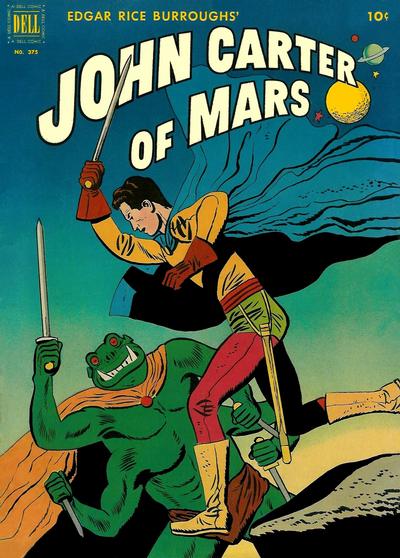
A decade ago, when the movie John Carter was just hitting the theaters the comic audience was treated to several wonderful collections of comic adaptations of the character. The first of these came from Dell Comics in their sprawling and varied Four Color comics line, and featured the artistry of Jesse Marsh, an artist long associated with the Tarzan comic book. Like any adaptation there are changes necessitated by the nature and length of a typical comic book. Writer Paul S. Newman adapted the first three novels featuring John Carter which tell the primary story of how Carter came to Mars known by its inhabitants as "Barsoom", not once but at least twice, and how he became a respected warrior among a four-armed tribe of green giants called the Tharks. He later met and wooed the Princess Dejah Thoris of the Martian city of Helium and battled many monstrous creatures and wicked men and women to keep her and all of Mars safe. As I discus each installment I'll mention how the comics diverge from the novels, which I've been fortunate enough to recently finish reading again after too many years. 


To begin in ERB's novel Princess of Mars John Carter is a Civil War soldier who is seeking a path and gold out West when he is attacked by Indians and forced to hide in a cave which turns out to be a path of sorts to Mars by way of astral projection. The story from 1952's Four Color #375 updates that and makes Carter a soldier fighting what I believe to be the Korean War though the comic is canny to keep this vague. The plot of him finding success and allies among the Tharks especially the brave Tars Tarkus is kept much the same though pared down and when he finally meets Dejah Thoris much of the folderol in the novel is ejected to keep the momentum. Carter and his Princess of Mars escape the Tharks and eventually find their way to Zodanga, a rival city of Helium. The pair had gotten separated and while seeking his love once again Carter encounters the vast air factory which keeps Mars (never called Barsoom in the story) livable. He learns its secrets but for what purpose is unclear since unlike the novel he never needs to use the information save to save himself. He rescues his damsel and the story ends as they arrive above Helium. 


Several things are changed but most distressing was the updating of the Martian ships which become defacto jets. Sadly the great white apes of Mars are present but somehow are lacking those extra arms that make them so weird and strangely menacing. 


Like the novels the second story from 1952's Four Color #437 adapted from Gods of Mars begins after Carter has been away from Mars for ten years. His time on Mars living with Dejah for a decade is glossed over and no explanation is given as to why he left nor how he returned. He arrives in the Valley of Dor the "Heaven" of the Martians. But he finds his ally Tars Tarkus there and also that this heaven is a hell run by the Therns, another race of Martians who prey on those who travel down the River Is in what most believe to be a journey to the afterlife. It's actually a journey to grisly death or brutal slavery or both. Carter and Tars battle for their lives and save a woman named Thuvia who shows the way to escape. But then they are attacked by Black Pirates of Omean who are themselves followers of the supposed goddess Issus,who turns out to be merely a cruel and decrepti woman of advanced age. They have kidnapped Dejah Thoris and Carter is intent on getting her free. He battles the Black Pirates and wins the day. 


Much is cut away from this second novel. The white apes are part of the deadly tableau that greets devout Martians. Much of the dilemma which sorts out the end of the novel are removed from this story to give it a sense of completion. The Black Pirates in the novel are yet another race and are ebony skinned peoples. This was deemed a problem I guess, and they are white like the Therns and Carter himself. But far and away the biggest change is the absence of Cathoris, John Carters son who fights alongside his long-lost Dad for much of the novel. He's just not here and never referred to. 


The third and final issue of John Carter of Mars was published a year later in Four Color #488 and picks up the story of The Warlord of Mars the third novel by ERB. It has been simplified quite a bit since much of the first part of the story picked up almost immediately from Gods of Mars. Carter and Dejah Thoris find themselves battling Thurid a member of the Black Pirates and Phaidor the princess of same. They try to kill Carter, Dejah and Tars Tarkus as they are leaving for Helium and in the ensuing crash Dejah and Thuvia of Ptarth are kidnapped. Being saved by Woola Carter and Tars go to the hideout of Matar Shang and they are able to save Thuvia. Thurid escapes with Dejah once again and heads to the distant realm of the Golden Men called Okar. Thuvia, Tars and Carter follow and pass through the Carrion Caves and must confront the Pit of Plenty before they are able to rescue Dejah Thoris once and for all. Carter must also defeat Solon the keeper of the deadly magnetic machine that serves to wreck flying ships who enter the remote land of ice and snow. 


This story has the most changes of any but some are actual improvements on the meandering plot of ERB's original novel. I also like that Thuvia was not a captive as in the novel but a helper for John Carter as he made his way to the north to save Dejah. It made better use of her as a character which was largely redundant in the novel. We get to see the deadly Apts, true monsters who roam the Carrion Caves. The comics update the clothes, as in giving the characters clothes to wear. Often the characters in the Mars novels are nearly naked and that of course would've been a problem for Dell Comics. 


In 1964 Gold Key which had inherited the ERB properties when Western Publishing broke from Dell, reprinted the three stellar John Carter of Mars books. And you can read them online. Here is a link to the first issue. 


Gold Key though screws up in that they published the third story in the second issue. To read that installment go to this link. 


And finally, the second story is reprinted in the third issue. To read this one (and you should do it before you read the second) go to this link. 

The three issues of John Carter of Mars are tasty attempts to get ERB's first hero into comics format. Unlike Tarzan of the Apes, John Carter has had a limited profile in comics. His next port of call in the four-color format would take him to DC, the house that Superman built. More on that next week. 

Rip Off