Showing posts with label Douglas Adams. Show all posts

Monday, February 27, 2023

The Hitchhiker's Guide To The Galaxy - The Radio Shows!


After reading all the novels, listening to the LP recordings, watching the television show, and viewing the big screen movie, I can safely say that the finest and best presentation of The Hitchhiker's Guide to the Galaxy is the original radio shows which kicked all off way back in the late 70's. The mischievous energy lurking in these recordings is the ideal voice for the low-grade, slow-rolling insurrection which lives at the center of this epic yarn. 


For clarification, the six-part trilogy has had its parts labeled "phases". I guess it works, at least well enough to keep the parts in their separate CD cases. 


The Primary Phase is the original radio series which kicked off the phenomenon. This is the sources which the LP could only emulate, the TV show evoke, and the movie aspire to. It fairly bristles with wit and is that best of all stories, one so filled with ideas that they battle to come out. It's not unlike Silver Age Jack Kirby comics, full of concepts which are touched on before getting slapped aside to make way for another. The brutal commentary on the modern world is not done with much charity but the humor makes the dose drop more easily for those offended readily. The eventual quest for the question for the answer is "42" is as always, a delight. 


For all intents and purposes, the Secondary Phase is a coherent part (as much as anything is coherent in this saga) follow up to the first six episodes and we find out who actually gave the order for Earth to be demolished. This series was produced very quickly, so quickly in fact that not all the sound effects were put in before it was time to broadcast.  If you've read the second novel, from which adapts this radio play, you will find many differences, and not small ones either. The first series was a shot in the dark and had the freedom which comes from few expectations, this one was created under the gun of deadline and high expectations. It's not as good. 


The Tertiary Phase of the radio drama was not created until this century and while the late Douglas Adams had input in 1993 when this adaption of the third novel was first proposed, he was long dead before it was actually recorded early in this century. This production moves the Hitchhiker's Guide from its rowdy roots to a fully developed production with more modern techniques. It succeeds in many ways because they were able to reassemble the original cast. The loss of Peter Jones as the voice of the Guide is the only real change and the substitute serves well despite lacking the wonderous tone of lamentation which informed the original performances by Jones. 
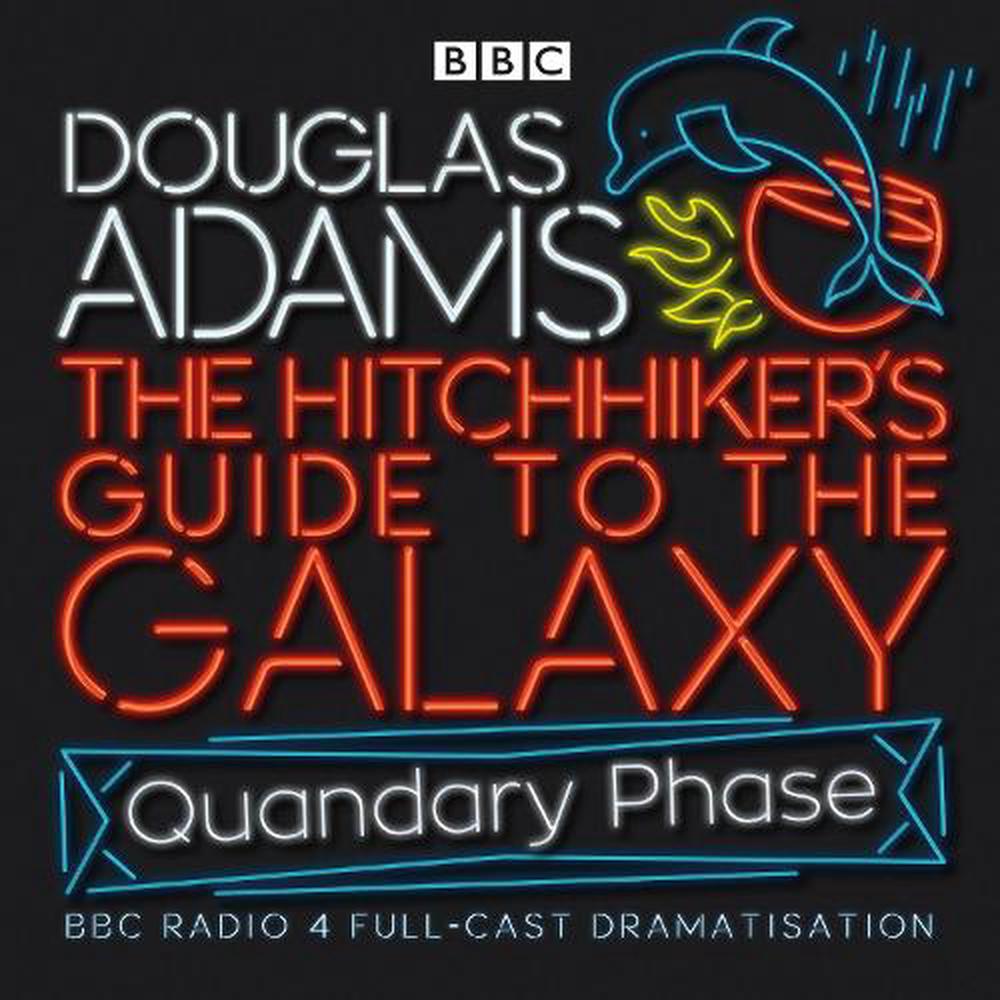

The Quandary Phase gives us a story with a rather different tone. In this one our hero Arthur Dent finds romance with a woman named Fenchurch, the very girl who had seen enlightenment just before the Earth was destroyed in the original story. Her existence is a mystery as it the very Earth on which they both find themselves. This is based on the novel by Adams which reads the most traditional and that shows up in this radio adaptation. Unlike the other Hitchhiker stories the audience is encouraged to feel for the characters as approximates of real people. There's a sadness to this one that the others miss. I'm not sure it's a good thing either. 


The makers of the Quinteseential Phase, the penultimate show is indicative of this last set of radio plays felt comfortable making changes to Adams' story and mostly it was to make the yarns a tad more consistent. None of the radio plays beyond the first two have the energy, and even the second one is let potent than the first, but this one is close. We see Megadodo lose control of the Hitchhiker's Guide as Ford searches for corruption (he wants to join in I think), Arthur makes sandwiches, and we meet another Trillian (I think) who presents Arthur with a daughter named "Random" (not conceived in the way you think).  to be replaced by the There's a sense that the series has been riding the momentum of that amazing first impression for quite a while and the gas has all but left the balloon so to speak. 


The Hexagonal Phase of The Hitchhiker's Guide to the Galaxy is based on a novel Douglas Adams did not write. It is based on ideas he put forth, but a chap by the name of Eoin Colfer actually wrote the book. I've never read the book, so I cannot compare it to the radio play, but I suspect that there like in the radio show there's an effort to tie up the story a bit (as if the plot really ever mattered). There is not one novel or television production as good as the radio shows (again I haven't read the sixth one). I don't view the "trilogy" as a narrative really, but a continuing series of events, not unlike life itself which almost never make sense in the end, nor have the best ending possible. One issue to remember with this final installment is that it was made in 2018, forty years after the first one and nearly fifteen years after the later phases. Many cast changes had to be made. Still, the radio shows present this seemingly haphazard quality better than any of the other formats. To that extent the six radio dramas are successful in the extreme. 


And that wraps my month-long look at The Hitchhiker's Guide to the Galaxy. Until next time remember -- DON'T PANIC!

Rip Off

Sunday, February 26, 2023

Mostly Harmless!


Mostly Harmless is the last Hitchhiker novel by Douglas Adams. (There is one more but I have little interest in right now.) And by all accounts, even that of Adams, it's the least of the batch. This one is one most structured like a traditional novel, evoking the classic Edgar Rice Burroughs technique of bouncing back and forth between characters chapter by chapter. I was most disappointed in this one because it fails to bring forth the character of Fenchurch, the love of Arthur Dent's life who he found int he previous book. Thanks to the wonder of multiple realities she is done away with in a sentence, an ignoble end to a character I found very charming. 


The plot is pretty simple really. Trisha McMillan regrets not going into space with Zaphod Beeblebrox. The Trillian of another universe did that. She's a reporter looking for scoop and finds one when a tenth planet named Rupert appears in the solar system. Meanwhile Arthur ends up on a primitive planet as the resident sandwich maker, a role he relishes, and he seems happy. That is until Trillian (of that other universe) shows up and presents him with a daughter named Random. He tries to make the best of being a dad, but it's made more difficult when Ford Prefect shows up after a escaping the clutches of the Vogons who have taken over the offices which produce the Hitchhiker's Guide to the Galaxy. It's more complicated of course but by the end of the book everyone is back on an Earth just before it is once again destroyed. And weirdly the characters seem relatively fine with oblivion. Strange. 


I can see that Adams wanted to make this ending dovetail with the beginning of the first story. It created an elegant worm ourboros affair for the stories, not totally befitting the series, but I have to admit it is a downer. Adams was apparently going through some stuff, and it's reflected in the general grimness of this story. I didn't really detect anything new in this one, save for the section where Arthur is content. I'm glad he found that, at least for a time. I guess that some fans were disappointed we get no more of Zaphod in this one, but I actually pleased by that as he's my least favorite character. A better title for this one might've been "Mostly Pointless", which seems to me to be the main point of this final Adams Hitchhiker yarn. 

Rip Off

Young Zaphod Plays It Safe!


The short story "Young Zaphod Plays It Safe" pretty much delivers what the title suggests. It's a solo story featuring Zaphod Beeblebrox before the events of The Hitchhiker's Guide to the Galaxy. In this tale a less abrasive Zaphod takes some officials to an underwater crash site. The wrecked ship is filled terrible things such as chemicals for warfare, equipment to mine the past, and so forth. But the worst thing has escaped, one of three synthetic people who have gone to Earth. The nature of this false creature is that they seem harmless but are terrifically dangerous for just that reason. It is implied but not stated explicitly in this version of the story that the synthetic person is Ronald Reagan. These notions are explored further in the fifth novel Mostly Harmless. I'll get around to that later today. 


Rip Off

Saturday, February 25, 2023

So Long, And Thanks For All The Fish!


I was disappointed in the fourth novel in the Hitchhiker's Guide to the Galaxy trilogy. So Long, and Thanks for All the Fish feels much too normal to be a Hitchhiker book. It's a romance and is full of naturalistic scenes of relatively normal conversation. There is the occasional oddment but by and large the book seems pretty normal. And that's a worry. 


We follow our hero Arthur Dent back to Earth where he finds things startlingly normal on Earth. Even his house is ready for habitation, though it shows evidence he's been gone for a long time. The center of the story is Fenchurch or Fenny as he is also called by her brother. Fenchurch is the woman who is referenced in the very first novel who came to an incredible enlightenment just before the Vogons destroyed the Earth. Now we find her alive as are all of the earthlings with no memory of the Vogons. But she has hallucinations. Arthur falls in love with her and seeks her out. They discover they both can fly and we get scenes of them having sex among the clouds. Then the clue of a fishbowl sent to both of them sends them to California to consult a man who is generally considered nuts. With his help they find out why the Earth is returned. Then they get a hankering to leave Earth and just then Ford Prefect shows up. And poor old Marvin even puts in an appearance. 


It's as if Adams was taking that all-purpose towel and wringing it out yet one more time. The viable fluid is getting thinner and thinner. For all the wild inventiveness which makes the original radio play such a delight (and the early novels as well) there seems to little of it here. Adams seems to be happier with life and that comes through as well. Good for him, I'm glad he found some measure of delight. But the brew which wrought the Hitchhiker's Guide was not a brew concocted of happiness, but of world weariness with heaping helpings of sarcasm. This is true love it seems, and good for them. But it left me a bit flat. 


There is one more novel and before that a single short story. More on those later. 

Rip Off

Sunday, February 19, 2023

Hitchhiker's Guide To The Galaxy - The Movie!


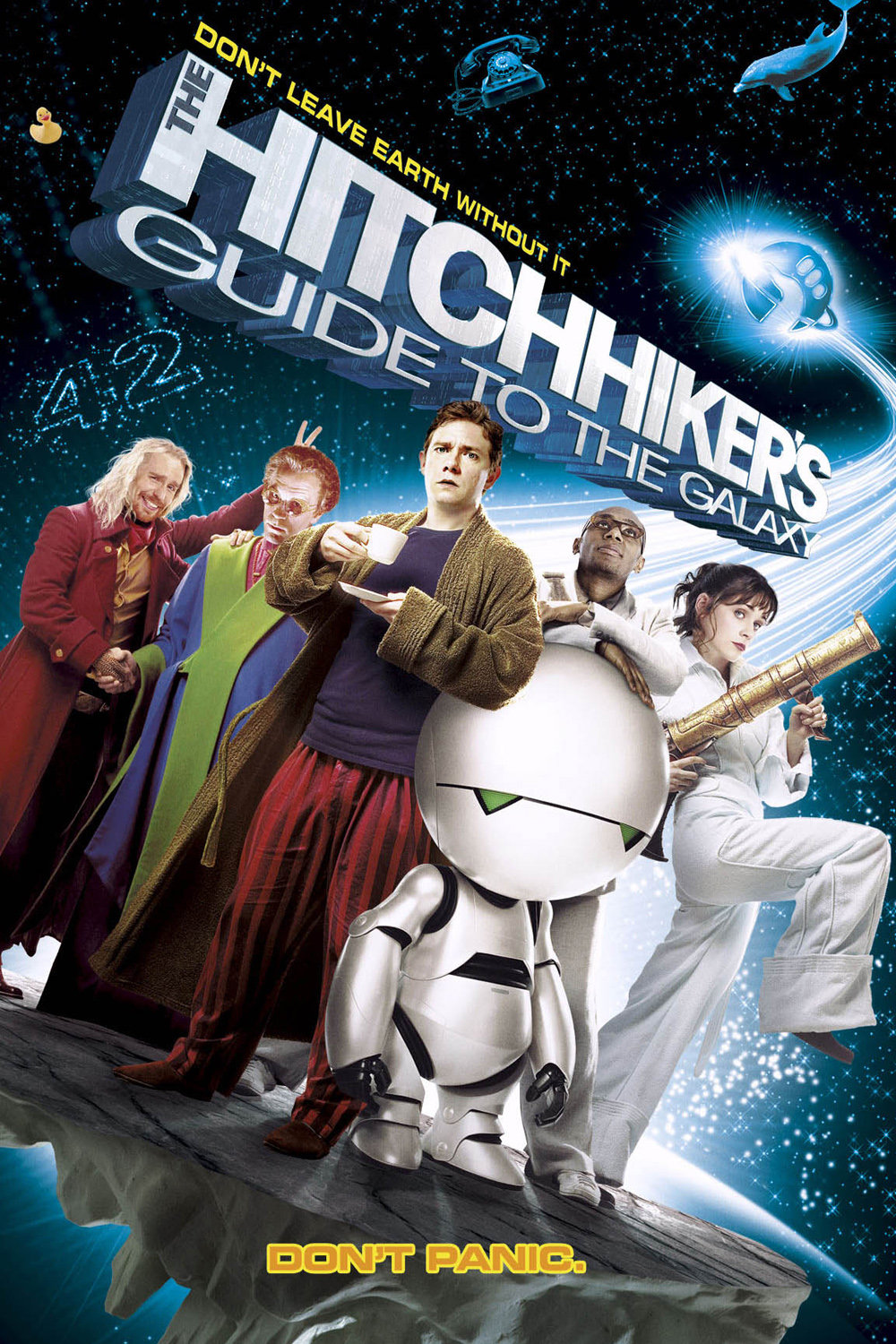
This movie was a major disappointment for me when I first saw it and still is upon a more recent viewing. Most likely it's because I have already seen the television series and that is imprinted on my mind as the "correct" visual interpretation of the story. But it's not just limited to that. Frankly the biggest problem this movie has is there just not enough of the Hitchhiker's Guide to the Galaxy in the movie which wears that title. The movie seems to be afraid to interrupt its apparent momentum to offer up the satirical asides the Guide provides. But that's just what the original play was like, and that's just what the television show was like. The plot was not the point, but in this movie it is. 

Also, they felt the need to add a full-blown romance to the storyline, and a fulfilled one at that. Nothing could be further from the essence of the original source material than the idea of "true love". Arthur (Martin Freeman) and Trillian (Zooey Deschanel) are not meant to be lovers in this story. Arthur is too dense, and Trillian is a woman who makes her own decisions about love and sex, and it hurts to see the characters shoehorned into the trite Hollywood romance duo. Both the actors are great, but their material was misguided. Marvin is not well developed as well. 


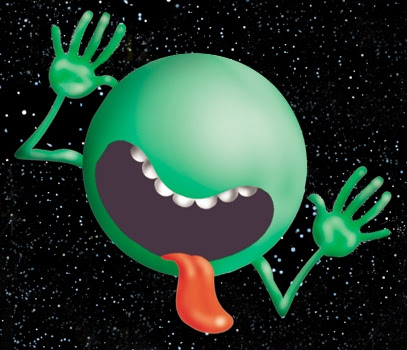
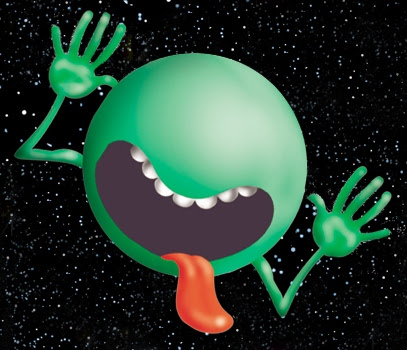
While I rather like the style of the animation used to represent the Guide, I must say there was much less of it than expected. Again, they creators were stranded on their classic expectations of a story and so eschewed the interruptions which are very essence of what makes the original gleam so brightly. Mos Def as Ford Prefect is a fail, not because he's black but because he's rather dull. Making the character black was an improvement, as it points out his "alien" nature before he's actually revealed to be one. (Shades of Brother from Another Planet) But the moviemakers seem not to be aware of his or seem to not want to take advantage of it. Sam Rockwell is quite good as Zaphod, though the two head problem still exists. Bill Nighy as Slartibartfast was delightful, ideal casting. 


All in all, this is the least presentation of the Hitchhiker's Guide to the Galaxy when we all hoped it might be the finest. 

Rip Off

Saturday, February 18, 2023

Life, The Universe And Everything!


Douglas Adams wrote a conclusion to the Hitchhiker's Guide to Universe series with Life, the Universe and Everything in 1982. This story has an origin unlike any of the other Hitchhiker novels in that it began as a Doctor Who adventure titled "Doctor Who and the  Krikkitmen". When that didn't develop the elements of this story were then translated into the third Hitchhiker yarn. As such this novel has much more plot than its two predecessors which are more gambols than true novels given a radio play origin. One can tell from the get-go that this book knows where its heading, though as with any Adams work it is possible it might not get there. 


Our heroes Arthur Dent and Ford Prefect are gathered together from Earth's prehistoric past by Slartibartfast to confront the menace of the Krikkit robots who are gathering various items from across space to combine into a great key which will unlock a pocket universe in which live the people of the planet Krikkit. These chaps are properly mad, who having seen evidence of life outside their world for the first time proceed to eradicate all such life in a jihad of sorts across the whole of the universe. To that end they develop a weapon that can end all life but are locked up before they can use it. We follow Arthur Dent when he is cut off from his allies and must confront the lifeform which once inhabited the bowl of petunias destroyed in the first novel, among other things. Eventually all the protagonists are gathered together as they lose the effort stop the Krikkit robots but then it is up to Trillian to save the day.


I'm being a bit more vague about this story because unlike the previous two yarns, the plot does actually matter. The loveliness of the original story is that we know all along that the events are in and of themselves meaningless, which speaks to the nihilism of the book, though that is ultimately rejected. What you do in the Hitchhiker universe doesn't really matter, because things only make sense rhetorically. This novel is different in that the events must happen as they do for any of the story the work. As it turns out of course this third part of the trilogy is hardly the end. Part four is looming next time. 

Rip Off

Sunday, February 12, 2023

The Hitchhiker's Guide To The Galaxy - Special Edition!


The television adaptation is the version of The Hitchhiker's Guide to the Galaxy which first springs to mind. Unlike the radio play which I think is better, I have come across this version several times over the years. Thanks to its outstanding animation, it does a excellent job of transmitting the essence of the actual Guide itself. It doesn't hurt that actors from the radio play are cast in this delightful little series.


This is the form of the story with which I am most familiar, having seen it several times over the decades. I find it charming and the Doctor Who-like special effects are just what I'm used to in a vintage sci-fi outing. Zaphod's second head didn't really work back then and it doesn't really work now, but it does its best to bring the radio drama to the small screen. I'm a bit surprised how well this ages, though there are some visual gags and lines which of course are of the era. Trillian looks a little too chintzy in retrospect (though Sandra Dickinson is very sexy), but once again she was of her time. Ford is pretty good, and Arthur Dent remains ideal. 


I'm not quite sure why they felt the need to recast David Dixon as Ford Prefect, but the change is acceptable. Getting Mark Wing-Davey as Zaphod and Simon Jones as Arthur. I think seeing the characters as well as getting to hear them allows for more empathy on the part of the viewer. We identify more with Arthur as his house is demolished just before his world is destroyed. Getting to see Marvin mope along as well listen to that glorious moan of his really makes the character pop, the best ever evocation of Marvin, the radio show included. The TV show also adds bits which were originally developed in the stage plays such as the animal which desires to eaten at the Restaurant at the End of the Universe. (I didn't know that the critter was played by John Davison, of Doctor Who fame by the way. He was married to Dickinson.)


And then there's the actual Hitchhiker's Guide to the Galaxy, the book which gives us the title for the series. The animation created for the show is simply magnificent and has never aged.  Old school animation with a hip twist that was stunning when I first watched the show and still impresses me. Combined with the narration of Peter Jones it is what sets this show apart from the myriad sci-fi shows of the 80's. The feature movie (more next week) really falls down in this arena weirdly. The Guide never has looked better than on this show. 

Rip Off

Saturday, February 11, 2023

The Restaurant At The End Of The Universe!


The saga of Arthur Dent and his allies resumes in The Restaurant at the End of the Universe. The bizarre qualities and salty nature of commentary on the human condition which informed the original novel continue here. Douglas Adams has not run out of targets for his acerbic satire. 


The story picks up as our heroes leave Magrathea having uncovered the singularly strange reason for Earth's existence. But soon enough Zaphod Beeblebrox and Marvin the Depressed Robot are separated from his allies and finds himself on the home world of the publishers of the Hitchhiker's Guide to the Universe. There he finds danger as he is sent on a mission to find the the true "Ruler of the Universe" by the editor of the Guide, a chap named Zarniwoop. Alien forces attack him and the homeworld of the Guide in an attempt to stop Zaphod. After much ballyhoo he ends up eventually reunited with Arthur Dent, Ford Prefect, and Trillian aboard the Heart of Gold. They end up at Milliways, the titular restaurant and there meet some folks they know such Hotblack Dasiato, the leader of a band called Disaster Area, the loudest band in the universe. The quartet are contacted by Marvin who has been waiting for them for millions of years and the five of them get into a handsome black vehicle which it turns out is intended to enter a sun. They escape but are separated and we follow Arthur and Ford as they find themselves on the "B Ark" of a race called the Golgafrinchams. The art is filled with silly people who served little purpose in society and with that lot our boys end up crashlanding on a planet which as it turns out is Earth, still young. The search for the ultimate question proves frustrating and our two heroes resign themselves to a life under very primitive conditions.


I'm of course leaving out a lot of stuff here, and that's intentional. Adams doesn't write stories which are rich in plot necessarily, but merely some thread of a plot that he can hang his weird characters on which gives him an outlet for his caustic comments on humanity. The harsh truth though is that this sequel is not as good as the original. From what I can learn Adams had a very frenetic creative process and writing these novels was not high on his list. The story here feels frankly padded to make it come out to a short novel length. The early stuff with Zaphod (much of which I skipped over in my quick reprise) was rather confusing and frankly less interesting because to me Zaphod is not a character I invest in. Arthur is the centerpiece and when the stories stray from him, they lose that everyman perspective that makes the oddities feel even more odd.

Rip Off 

Sunday, February 5, 2023

Don't Panic - The Original Albums!


The Hitchhiker's Guide to the Galaxy began its very fruitful existence as a radio play on the BBC. Even before it was adapted to novel form, the essence of that presentation was translated to record albums, an ideal way for people to experience the story, superseded only by the original play itself in its real time. I reckon I first encountered the show on NPR when versions of the original radio show played soon after the BBC presentations. It wasn't long until I got to grok the TV show run and that's been the version that's mostly in my head to this day, though I prefer the audio renditions really. 


The story which Douglas Adams concocted (with the help of John Lloyd on a few chapters) is so very vivid as a sound-only production. The voices are lively and the world they describe is exceedingly brilliant. It's difficult after seeing a few visual adaptations to bring a new vision to the ear, but I try mightily to do so. The word is unlimited in its ability to weave fantastic visions in the mind's eye, the brilliance of radio from its inception. Always the listener it asked to flesh out the descriptions with details only that one person can bring. None of us sees things quite the same way on radio, making it a much more personal experience. 


One of the most appealing aspects of revisiting these recordings is that reflecting on them takes me back to my early days, a time when I was freshly married to my lovely bride, and we were just trying to figure out how get from day to day and were beginning to raise our family. Those were heady days, filled with energy and trust in the future, as bleak as that future could seem with nuclear destruction looming. We didn't know it then, but Reagan was ushering in a new era of neglect in government that would continue to run rampant down to the modern day. All that said, the words "Don't Panic" carry a great deal of weight in retrospect. It's not just a gag, but good advice back in the day. 


And while we're talking albums, it's a good place to discuss one of the most vital and memorable elements of the production, one which Douglas Adams had no hand in. The music for the theme is at once eerie and compelling, and the song is "Journey of the Sorcerer" by Bernie Leadon of Eagles fame. It's from the album One of the These Nights. 


It's a somewhat convoluted path by which it became and stayed the signature music for Hitchhiker's Guide to the Galaxy, but there's no denying that the music is ideal. I loved it when I heard it originally and I love it still. Let's take a listen to whole tune. 


Of its time and more. I never seem to tire of listening to this tune. 

Rip Off

Saturday, February 4, 2023

The Hitchhiker's Guide To The Galaxy!


The Hitchhiker's Guide to the Galaxy by Douglas Adams is a novel that is at once frivolous and profound. It hides pertinent comments on society behind a thicket of snarky gags and jokes. It drives its point home by making sure the reader is almost always caught off guard. And as often as Adams pulls off this stunt, the reader (or at least this reader) falls for it again and again. This novel is the first of a five-part trilogy (that's not a mistake) which spanned the 1980's, a decade which had grim tidings for most all of us on this planet Earth. When this novel was written (based upon a radio play on the BBC) it was a time when the world was under constant threat of nuclear devastation and was reminded of that on a nigh daily basis. Absurdity was a proper response to this situation, that or nihilism or simple forgetfulness. I'll take absurdity for two hundred please. 


If by chance you don't know the story, it goes as follows. An Earthman named Arthur Dent is saved by an alien named Ford Prefect (who is working to update the titular Hitchhiker's Guide to Galaxy) just before the Earth itself is demolished to make way for an intergalactic bypass. Arthur and Ford then are whisked into a series of misadventures which bring them in contact with the two-headed alien and runaway President of the Universe, Zaphod Beebelbrox and a lovely Earth girl named Trillian, on their stolen spaceship the Heart of Gold. Also, on board this most fascinating ship is Marvin, a depressed robot who performs his duties with maximum complaint and weariness. They end up on Magrathea, a planet on which all other planets were manufactured and meet Slartibartfast, a technician who worked on the fiords on Earth and is now helping to rebuild the planet Earth. It turns out the Earth was not what we all thought but was built for a specifice purpose, a purpose frustrated when it abruptly destroyed. 


While we spend time most of these characters, Arthur is our point of contact. He is the "Alice" figure in this interstellar wonderland, and his world-weary perspective is the one that matters to us as the insanity unfolds page after page. I am loathe to reveal to many of the book's secrets, but the joy of reading is the snide asides and references to concepts which toast the reality we all take for granted. But the saga doesn't end here, next our intrepid protagonists head to the Restaurant at the End of the Universe. But that's for next time. 


In the meantime. follow the advice on the cover of the The Hitchhiker's Guide to the Galaxy and "Don't Panic". 

Rip Off

Wednesday, February 1, 2023

Don't Panic!


This month at the Dojo it's all about outer space. But outer space with sarcastic bent. I'm currently reading The Ultimate Hitchhiker's Guide to the Galaxy which includes all five novels by Douglas Adams along with a solo short story, detailing the misadventures of Arthur Dent, the last human being left after out dear planet Earth is demolished to make way for an intergalactic bypass. He is saved from destruction by an alien named Ford Prefect who just happens to work for The Hitchhiker's Guide the Galaxy, and uses its copious information to explain (or confuse) the proceedings.  


This snarky bit of weirdness struck a nerve in the 1980's and resulted in several radio plays, novels. albums, a television show, and a big-screen film. I'm tuning up my "Babel Fish" and planning to imbibe as much raw Hitchhiker's Guide as I can in the merry month February. I will issue frequent reports.


While I'm in orbit with that project I also want to read some vintage Adam Strange stories from the pages of DC's Showcase and Mysteries in Space. Adam Strange was written Gardner Fox and drawn by Mike Sekowsky and later by Carmine Infantino. The folks on the planet Rann can always count on Adam to appear regularly thanks to the Zeta Beam and save them the barrage of menaces which seem always poised to attack. 


And a book I have had for quite a spell, but have never gotten around to is Don Simpson's space epic Border Worlds. This saga originally appeared in comic books from Kitchen Sink and give us Don Simpson fans a look into the Megaton Man creator's more serious side. 


And in between those all-new posts I'll be reaching back into the most remote corners of the Dojo to dust off and revise some other space related items. Space Eagle from Whitman books was a childhood favorite in particular. 


On my TV screen this month will be a lot of episodes of Space:1999. I had to replace my original set of DVD's when they started acting up. This new set looks cleaner overall. Likely I will not have time to revisit the comic books from Charlton. 


So "Don't Panic!" The Dojo will be celebrating one of the most delicious entertainments of the 80's this month, and a bit more. 

Rip Off