Showing posts with label Klaus Janson. Show all posts

Saturday, February 20, 2021

The Incompleat Howard - Volume Three!


The third volume of Howard the Duck The Complete Series the focus shifts to the black and white magazine which followed on after the cancellation of the original color series. In these pages it was assumed I guess that the writers and artists could be more frank about the notions and ideas the series explored and about the exact nature of the relationship between Howard and Beverly. It's evident and flatly stated they are lovers and the incongruity of that circumstance becomes a constant of the of the stories going forward. 


Under a cover by Howard co-creator Val Mayerik and Pete Ledger we have two stories. Both are written by Bill Mantlo and drawn by Gene Colan. Inking Colan on the first is Klaus Janson and on the second Dave Simons. The first story titled "Animal Indecency" we meet Wally Sidney an ill-disguised variation of Walt Disney who in this incarnation is a clothing store magnate and as such has promulgated a campaign against the nudity of animals in order to sell more clothes. Howard becomes a target and as a consequence is forced to add pants to his permanent wardrobe. The spin that it was Disney which sued about Howard's proposed similarity to Donald Duck is of course the basis for this lampoon. The second story is titled "The Crash of '79" and pits Howard and Beverly once again against Pro Rata the Financial Wizard who lures the duo to a famous Cleveland location with a phantom movie picture production which vanishes when he no longer needs it. Instead Howard and Beverly must battle against a quickened Breakfast Special made up a evil eggs, bacon, toast, coffee, and juice. They battle these creatures of the table but in the end frustrated Pro Rata's attempts to get the cosmic key and so his outstanding debt is called in and him along with it. 


Under a raucous Jack Davis cover we have a story by the regular Mantlo, Colan, and Simons team titled "A Christmas for Carol". The Carol of the story turns out to be a little girl and despite his better judgment Howard attempts to pick up her spirits during the holiday since she is gloomy about the world and her parents who are divorced. Quickly the pair encounter Santa himself and an elf named Sunquist (he's from Florida) and their broken down sleigh. It seems Santa has sold out to OPEC and he's running short of fuel. They get the sleigh going but back at the North Pole a villain named Pinball Lizard has led a work stoppage and general uprising to shut down the  Christmas operations. It turns out that Pinball Lizard himself is a pawn in the plans of a greater villain named Greedy Killerwatt, a mutated human who resembles a lightbulb. Once again of course Howard despite his unheroic nature finds a way to save the day and Christmas and lifts Carol's spirits as well. The mag ends with a text feature by Mantlo titled "Duck Soup" which reprises of the long history of Howard for new readers. 


The fourth issue offers up a parody of Playboy with not only the cover by John Pound but also several features inside (including a double-page pin-up by John Byrne) showing what the magazine might look like on Duckworld. The lead story by Mantlo, Colan and Simons is a send-up of The Maltese Falcon with a giant insect named "Hemlock Shoals" taking Howard on a quick magical trip to NYC in his cab to follow the trail of the cosmic key again which is also being pursued by the villainous Cockroach. After much ballyhoo they universe is saved again and Howard ends up back in Cleveland but going against traffic as usual, but this time literally. The second story titled "The Dreadcliff Cuckoos" by Mantlo again welcomes John Buscema and Klaus Janson on the art chores. The gang (Howard, Beverly, Winda, and Paul) wind a vacation to a remote resort which is pretty spooky all things being equal, but they soon learn it's all a ploy to get access to Winda's psychic powers. It's a who's who of old Howard villains as the Reverand Jun Moon Yuk and the Sinister SOOFI join others to extract the information. The leader seems to be Adolph Hitler himself who at one time in the series seemed to operate a hospital Winda was in, but who is revealed at the end to have been merely Hitler's dentist with delusions of grandeur. This story seemed a clear attempt to tie up some old plot threads. 


The next issue of Howard the Duck gives us another of Marvel's 70's hit characters -- The Prince of Darkness Dracula. Howard had already famously battled the Hellcow, one of Dracula's lesser offspring, but this time it's Howard himself who gets the bite and becomes something of a sympathetic vampire (as opposed to a real one) in a story titled "The Tomb of Drakula" by Mantlo, Michael Golden and Bob McLeod. Under an experimental cover by Larry Fredericks, it is needless to say after much vampiric action Howard comes to his senses, more or less. In the story "Captain Ameicana" Howard loses cabbie gig when his cab is demolished and seeking work offers up his skills as a babysitter of sorts to a family which prides itself on its dedication if not deification of mythic American norms. This platoon of two parents and two and a half kids (one is slow) threaten Howard when he tries to bring a bit of sanity to the natural order of  the American Dream. This story by the regular team of Mantlo, Colan and Simons had the "Good Housekeeping" seal of approval. At the end though Winda tells Howard she can send him home and he hops at the chance and Beverly goes with him. The magazine closes with an "Interview with The Duck by Lynn Graeme" (the editor) and "A Fond Look At Fowl Friend" which highlights the characters from Howard stories past. 


Howard at long last returns to his old paddling ponds in a story dubbed simply "Duckworld". Written by Bill Manto, this one marks the return of Michael Golden and Bob McLeod on the art. (Lynn Graeme admits in the next issue that she had over-burdened regular artist Gene Colan and that's why we get this nifty fill-in.) But they are more than up to the task and we find on Duckworld, a world proportioned to Howard-size a land teeming with  ducks of all kinds, but many if not most of them inspired by one single mythic figure -- the ascended Howard the Duck. It turns out that Howard's disappearance, coming at a media-covered event similar in many grim details to the Kent University shootings, had created the basis for a whole new relgion of sorts built around the phrase "Get Down!" But it had been used by those in power to cause folks to relinquish their free will and so Howard is both stunned and appalled that anyone has taken his life as some model to guide life as it should be lived. He makes his feelings known and causes the downfall of the very religion he unintentionally had triggered. At his side throughout his time on Duckworld is Beverly, who is a statuesque "hairless ape" and in a state of undress for much of the story. She finds that being the only human being in a world of ducks is much more alienating that she expected and her empathy for Howard is only increased and they realize that no matter where they are they don't fit in but have each other. With that goal in mind Howard digs up the local "Sorcerer Supreme" and has him magic them back to Earth, leaving Duckworld a less controlled but more independent land. The mag rounds out with a new feature called "Street Peeple" which as far as I can tell does factor into the Howard story at all. John Pound executes one of his best covers for the series. 


After Duckworld Beverly and Howard the Duck find themselves back in that old Okefenokee Swamp where his misadventures on Earth had started so long ago. Showing up quickly enough is the Man-Thing who grabs up Beverly and takes away. In a story titled "Of Dice and Ducks" by Mantlo, Colan and Simons (the regular crew) Howard pursues his kidnapped flame and finds in the middle of the swamp a town with a familiar and highly geometric layout. As he searches for Beverly, Howard is given an obligatory $200 and speeds along the streets in a race car finding himself lost in low rent areas, crisscrossed by railroads, and with a jail keen to catch up folks of all kinds. There are nifty little men who offer chances and opportunities but Howard must break a few rules and dodge some giant dice which repeatedly get in his way as makes way to Beverly across Oriental Ave to the ultimate goal of Boardwalk. There he finds a gorilla by the name of "Monk Kee" who runs the local "Kong Glomerate" after catching for himself the lovely Ann Darrow. Howard chases the baddie up a tower of consumer goods where ultimately the head of "Kong Glomerate" falls to his death and where Howard proclaims that "Booty killed the beast." Rewarded with money which is no good outside of the small town he and Beverly hit the road headed north for more adventures we can only hope. The magazine is rounded out with some tasty full-page pinups of Howard by Marie Severin, Howie Chaykin, John Byrne, Walt Simonson and Marshall Rogers. The "Street Peeple" make their second appearance as well. To my eye this cover for issue seven is the best of John Pound's covers for the series. 


This volume also begins to reprint some of Howard's appearances in Crazy, Marvel's MAD-like humor magazine of the 70's. We have stories by Michael Weiss and Roger Stern with art by Vincente Alacazar and Pat Broderick. One page appears to cobbled together with art from other sources by Colan and Frank Brunner. 

Here are some of the pin-ups featured in this issue and others. 


The key to these stories is the relationship between Howard and Beverly. The antics created by Mantlo and rendered by Colan and others are wild and raucous and funny but at the core is the true caring between the two protagonists. They not only need each other at times, but want each other. Gerber put the two together, but I have to say that Mantlo really makes the romance between these two have some pop and zing and some reality. Where it will end we'll find out next time. 

Rip Off

Saturday, February 6, 2021

The Incompleat Howard - Volume One!


Howard the Duck is easily one of the most fascinating and distinctive creations in the long history of the comic book format. On the surface this wiseacre duck is just one more in a lengthy parade of funny animals which have populated comics and cartoons for decades. Anthropomorphic critters are staple of literature and in America are represented by Uncle Remus who is in a tradition as old or older than Aesop's Fables.  


We're so used to talking animals such as Mickey Mouse, Bugs Bunny, Woody Woodpecker, Pogo Possum, and Marvel's own Zippy the Seal that we don't really blink when we stumble across the conceit. But to some degree Howard changed that when for the first time in a talking animal we were presented not with a just a trickster but with a full-fledged personality which was whipsawed into a world he never made and in which he was constantly on the verge of going quaking mad. Mickey had tenderness, Bugs had brashness, Pogo had thoughtfulness, but Howard had something nearly all funny animals lacked up to that time -- depth. 


The yet-to-be-named Howard stumbled out of the bushes in a Man-Thing story by Steve Gerber and Val Mayerik. He was instantly salty and unlike the mute star of that comic more than able to express his attitudes about the madness he was witnessing. Reading comics for a long time can do strange things to a person and one problem is that the bizarre and the absurd become hard to distinguish in worlds filled with insanely super-powered mystery men dedicated to some abrupt form of justice. It's a four-color world which descends deeper and deeper down its own rabbit hole until the reader becomes somewhat numb to oddness. Howard as a commentator on the weird events engulfing him was able to brighten the flavor of the truly strange for readers too accustomed to it. I count myself in that number. 


Almost as quickly as he was given a name he was killed off in the debut issue of Man-Thing beneath a lush Frank Brunner cover, in a moment of carelessness which pointed up at once the capriciousness of life and death itself. Howard we hardly knew ye! 


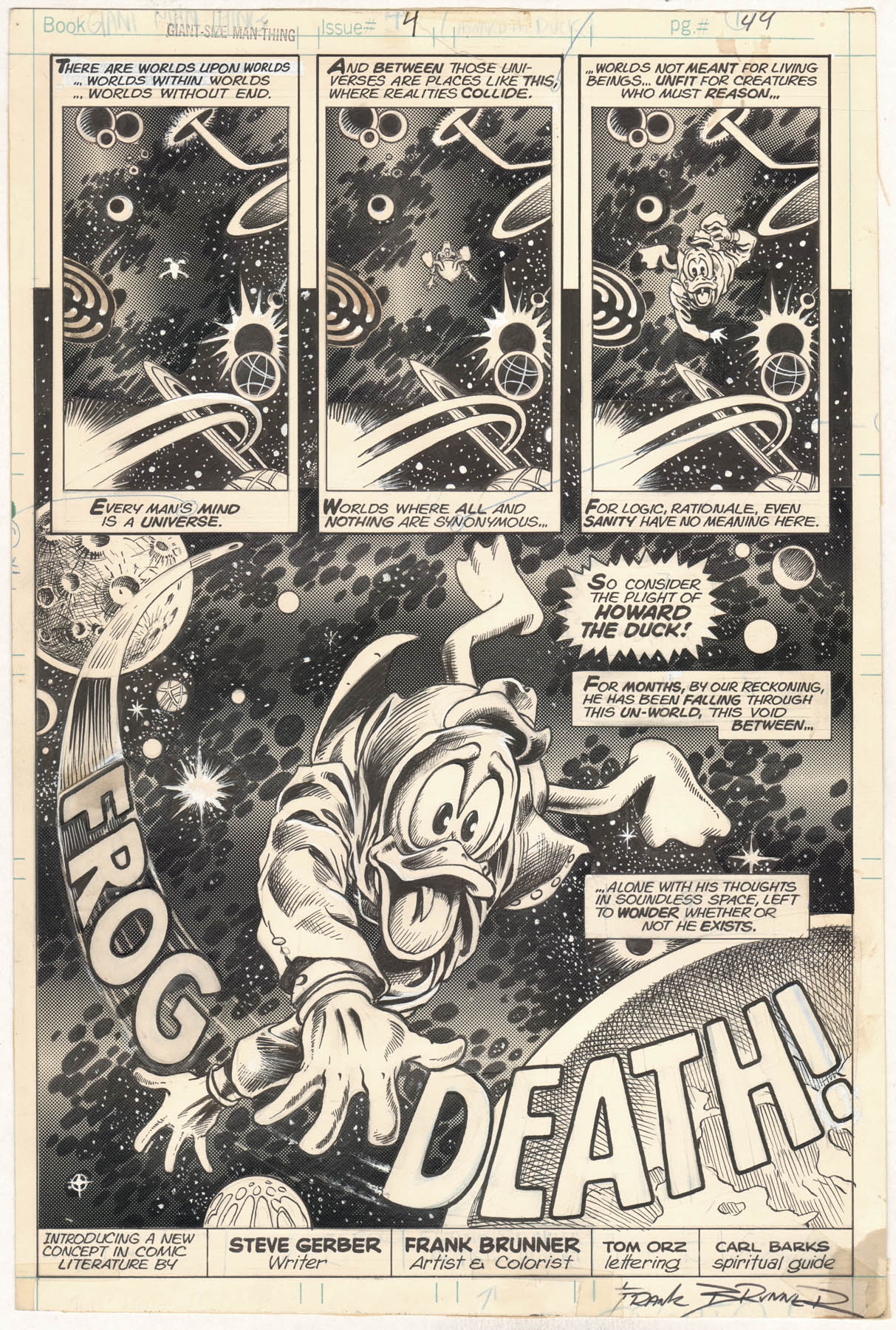
But the hue and cry went up and we fans wanted more of this oddball displaced duck. We wanted more of his relentless critique of our own society and our own hobby. And we got it at last when Howard the Duck debuted in his own back-up series in the pages of the awesomely named Giant-Size Man-Thing #4. He was written by his creator Steve "Baby" Gerber and drawn by the aforementioned Frank Brunner to magnificent effect. His seeming death was merely a long trip which landed him in Cleveland of all places and he came face to face with the menace of the Garko the Man-Frog (the cover gets the name wrong). Howard doesn't like much of what he finds in the land of the "hairless apes" and despite saving the day ends up in jail. 


It's in jail we next meet him in the very next and very last issue of the amazingly titled Giant-Size Man-Thing. This time the menace is an ancient one when one of Dracula's victims has risen from the the inevitability of death and has become the menacing Hellcow. Dispatching a vampire is difficult enough but doing when the vampire is on the hoof might we be harder still. 


But as the Man-Thing series reaches its conclusion Howard the Duck steps into the void. Gerber and Brunner stay aboard and Howard meets the most important person in his new world -- the bodacious Beverly Switzler. With the assistance of the web-spinning Spider-Man they defeat the schemes of a literal financial wizard and as the story ends Howard and Beverly find themselves with signficant others. 


The nature (or perhaps "un-nature") of their relationship is revealed in the very next issue when we see that Beverly and Howard share a bed. What these two consenting adults do it up to them, but the Comics Code didn't want the fact that anything which might be considered "bestiality" was in progress. But we all knew and it was hilarious to think that in a mere comic book there was some duck-on-dame hanky-panky, and shockingly it was being handled largely in an adult manner. In this issue Howard battles a superhero/villain with an outer space turnip theme and meets for the first time the crazy-as-a-loon Kidney Lady. 


With the third issue Brunner steps away from the character and the ruggedly reliable John Buscema is able to perform admirably in a story which has Howard acquire a lifetime's worth of martial arts training an afternoon making him the "Master of Quack Fu". This kind of on-the-nose satire would always be a part of the Howard act, but as the series developed become less and less important. 


The fourth issue finds the debut of the art team of Gene Colan and Steve Leialoha and Howard is poised for his march forward. The series is a hit critically with fans and I'm assuming was dong financially well too as within the year a comic strip Gerber and Colan would be a reality. In this issue we meet Paul Same, a young man overcome with society's expectations of what a man should be and so was forced to find his true power in slumber. 


The book begins to take on its full rich character with the next issue which has Howard tagging in against a brutal heavyweight to make some bread for himself and Beverly. They've decided that Cleveland is not a place they are going to be able find success and so strike out for the "Big Apple". 


The trip is an arduous one and soon enough Howard's rough-hewn personality has them walking along the highway in a downpour. They find some respite in a house riddled with the pseudo-gothic trappings of a romance novel and up for sale. There are also some "Yuckies" (Moonies). Not interested in that, they find that the locals operate much like the mobs from those classic Universal movies when they suspect a monster in their midst. 


Turns out they were right when an enormous Gingerbread Cookie Man shambles forth and proves to menacing as well as delicious. This story though is a short one and ends with blast.  The focus shifts to one Dreyfuss Gultch a country singing star and member of the "All-Night Party" who are casting about for a candidate for the highest office in the land. They think they've found their "man" in the duck named Howard. 


In 1976 having funny and bogus candidates for president of these United States was a harmless lark. Howard was just one more of many who got a name on the ballot in a feigned attempt to poke a bit of fun at a process which was mired in cynicism. In recent years we've learned the dangers of actually electing cartoon characters to the office and frankly this tomfoolery ain't quite as much fun anymore. 


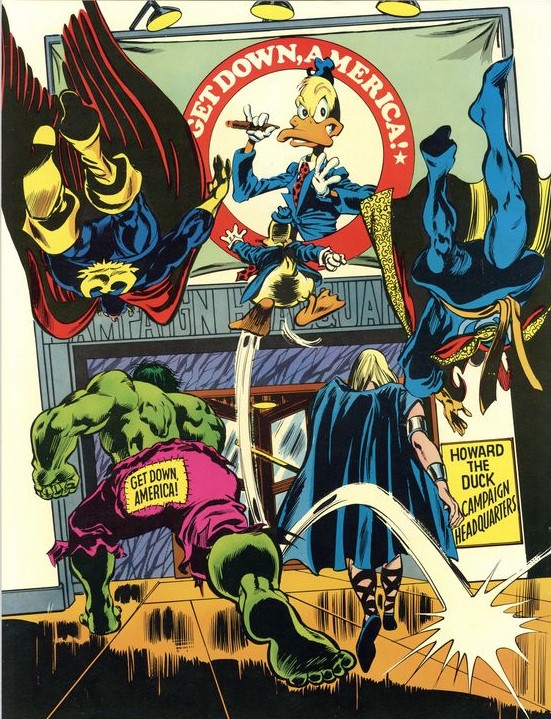
Another sign of Howard's success is that the "Get Down America" campaign gets treasury-sized when the Duck non-joins the non-team called The Defenders. Typical for the Gerber era, the villains are lame and this time intentionally so. The covers by Gene Colan are some of the finest and funniest in the whole run of treasury books from Marvel. 


But a scandal rocks the campaign when bogus photos of Howard and Beverly in a bathtub together are published. Howard's exceedingly slim chances of winning are doomed and he and Bev head to Canada to find out more about who might be behind this scheme. There they meet a Canadian super-patriot and an exceedingly agitated bellhop. A plan to change the course of Niagara Falls  is foiled when Howard is able to defeat the villain called "The Beaver". 


And then things really get complicated. The stress of living in a "world-he-never-made" has at long last unstrung our hero. In fact being a "hero" has stressed him out and Howard has a nervous breakdown. We get to share his hallucinations as most all of the cast we've met to date check to have a word. We even get a peek at Geber's other baby -- Omega the Unknown


The wildness continues as a crazed Howard escapes his caretakers, grabs a bus to Cleveland, and has it out with Kidney Lady at long last and meets a possessed young woman named "Winda Wester" who might or might not be possessed by demons. 


The brawl lands Howard and Winda in a sanitarium where the care is suspect at best and Howard confronts his demonds as it were. 


Winda's demons come out and we discover they resemble a famous rock band from Detroit. (The fact Gerber was working on a KISS comic magazine at this same time had nothing to do with this offbeat crossover I'm sure.)


With demons about the Son of Satan makes an appearance but circumstances have Howard become a bit devilish himself. The sanitarium is rocked to its core and the head of the operation reveals himself and he looks like someone Captain America once popped in the chin. 


Howard, Beverly, Winda and Paul are sharing an apartment in Cleveland when a magic carpet takes the ladies to Bagmom.  It's an Arabian Nights misadventure from a time when the Arabian sands could still be fun. 


As this first collection closes out we see Beverly and Howard together again just as they find themselves on a cruise ship attacked by the hallucinatory images of the mysterious Dr. Bong. 


We think we're going to find out what and who Dr. Bong is but the "Dreaded Dealine Doom" makes necessary one of the strangest "comic books" that Marvel ever published. With illustrations by the likes of John Buscema, Mike Nasser, Ed Hannigan, and Alan Lee Weiss we get an essay or two, a short modern parable and some analysis of same, and I suppose an apology for why Steve Gerber was late getting Gene "The Dean" Colan the script making this an issue ripe for reprints. Not wanting to do that we get a strange hybrid entertainment. 

 
This volume is also chock full of extras from the back pages of Howard comics as well as some pages from Crazy and an interview with Gerber from FOOM. And this is only the beginning, the first of four hefty tomes telling the saga (mostly) of one Howard the Duck. More Duck next week.

Rip Off

Wednesday, February 22, 2017

Panther's Rage - Cold Wastes!


After the counter attack on the home village of Erik Killmonger, the Black Panther tries to take the initiative in this ongoing war in his kingdom. He leaves his aides and Monica Lynne behind and heads into to the frozen mountains led by two of Killmonger's less capable solidiers, the comedic duo of Tayete and Kazibe. The press into the mountains,  the domain of the mythical White Apes. He finds Killmonger's forces and the secret of his weird allies, an altar errected over the radioactive output of a long-forgotten meteor.  But in a battle with his foe and his weird ally Sombre he is diverted by attacks from deadly wolves which stalk the frozen landscape. Left for dead he fights off the attacks but his fate is left hanging.


Surviving the wolf attacks and using their pelts to survive the deadly cold the Panther returns to the weird altar and confronts Killmonger's ally Sombre who captures him and puts him in the lair of the deadly White Gorillas, a small band of the creatures made ferocious by having long been fed the unfortunates who died on the altar which bred Killmonger's bizarre allies.


The Panther is in for the fight of his life as the Gorillas are ferocious, but once again he survives to pursue Killmonger who has left the coldness of the mountains for a different land altogether.


It's in these issues that we bet more of a glimpse into the background of Killmonger's operations and for me it shows what a deadly cult of personality he had constructed across the broad and diverse landscape of Wakanda. Sombre is his high priest, a deadly fanatic who is more than ready to kill to progress his agenda. That lack of concern for others is what makes him a villain and it's what defines Killmonger too.

"Panther's Rage" continues tomorrow.

Rip Off

Tuesday, February 21, 2017

Panther's Rage - Cemetery Plots!


After Rich Buckler stepped away from the "Panther's Rage" saga he was replaced for on the ninth issue of Jungle Action by the reliable Gil Kane. Frankly I'd forgotten this was the case, but I clearly see that Kane would've been a worthy replacement had he stayed on the book longer. He and Don McGregor tell a tale here which has a proper atmosphere of horror.


T'Challa investigates tales of the walking dead in a village cemetery and finds Jumbak one of his loyal citizens dead, This is a death which will resonate throughout the rest of the saga by the way. And the Panther also finds a strange opponent in Baron Macabre, a weirdly tall figure who fires lasers from his wrists. The Panther escapes this weird opponent with is life.


Returning to the cemetery a day later, his return stalled because of the murder of Zatama and Monica Lynne is implicated, the Panther gets to the bottom of the problem and finds not only Baron Macabre but his seeming master King Cadaver. While it is shown that Macabre is a fraud to some extent, the weird mind powers of Cadaver seem to emanate from his repulsive head. The Panther again survives the fight and defeats Macabre for the moment. But he learns that Killmonger's people are getting the technology the use from the very technological jungle he himself had created beneath Wakanda.


With Monica cleared of her crime, the Panther leads a counter attack against the forces of Killmonger in the village N'Jadaka (the original name of Killmonger himself) and find there not only Baron Macabre and the deadly Malice but a new villain named Lord Karnaj. It seems Killmonger fancies these dramatic names for his henchmen. The battle is ferocious and people die but the village is taken and Killmonger's men are captured.


These last two issues were drawn by the late Billy Graham, a rarity in the comic book business, a black man. While many will come into the fold in the following decades only a few had made any mark to this point and time. Richard "Grass" Green was having some success in the independent market and Wayne Howard had made quite a mark at Charlton, Many years earlier Matt Baker had been regarded as one of the best "good girl" artists in comics. But like the heroes themselves, black faces were relatively rare. Graham had made his mark at Warren Publishing with horror stories and would also draw Marvel's first American-born superhero title Hero for Hire. Getting him on this series was a major coup, and he and McGregor seemed to find a synthesis which brought out the best in both of them.


More "Panther's Rage" tomorrow.

Rip Off