Showing posts with label Bill Schelly. Show all posts

Saturday, April 10, 2021

Alter-Ego - The Legendary Fanzine!


We live in interesting times when it comes to being a fan of anything. If you fancy a particular style of storytelling or a particular kind of music or a particular brand of films it's not only easy to get access to avalanches of information about your chosen interest, but it is in fact difficult to get out of the way of tsunamis of data that wash over you before you know it. Getting spoiled about some upcoming project is so easy it requires real dedication and focused effort to keep from it. It's a far different world than existed in the early 1960's when comic books and in particular superhero comic books began to regain some of the footing and success of a few decades past during WWII. It was a time when comic books were seen as much as plague as an investment and few and far between were the dedicated fans who harbored an abiding affection for the masked marvels of an earlier age. It was a time ripe for a fanzine called Alter Ego


Alter Ego was the invention of  Dr. Jerry Bails, a professor of science and a comics fan from Missouri with a passion for collecting and collating data, especially data about his favorite superhero team the Justice Society of America. He exchanged letters with Julius Schwartz, editor at DC Comics who was in the process of reviving the old Golden Age masked men and reshaping them for a modern post-nuclear American audience of kids and others eager to read about heroes again. These letters both informed and provoked both men and they became friends of a sort and eventually it occurred to Bails that he might like to discover and communicate with likeminded fans and how best to do that but get some addresses of same and begin a little newsletter about the subject. That turned into Alter Ego, a humble mimeographed publication which used both erudite understanding and humor to find a ready audience. The humor came from an unsettled Missouri teacher of English named Roy Thomas who had in his spare time concocted a zany parody of the shiny new Justice League of America called "The Bestest League of America". They graced the cover of the first issue of Alter Ego and were included in the first three issues in a continuing story. 


The first three Alter Ego issues, the one produced on spirit duplicating machines all appear in 1961 and their make up was pretty standard for fanzines that wanted to motivate fan interaction and also advertise and promote new publications from the likes of DC mostly but eventually Marvel as well. The Golden Age focus of Jerry Bails is evident in these seminal issues as he writes about a vintage JSA villain the Wizard as well as the Golden Age Green Lantern. Roy Thomas offers up his trio of "Bestest League of America" spoofs which rip on the burgeoning Silver Age revival at DC as well as writing new fiction starring The Spectre. Creating buzz for heroes they wanted to see revived such as the Spectre and the Atom feels a mainstay focus of the early Alter Egos. There are letters from the likes of Steve Gerber, Ted White, Don Thomposon and others. To read the "Bestest League of America" trilogy check out this odd link


It is almost a year later in 1962 when the fourth and final Jerry Bails issue of Alter Ego, this done on photo-offset, hits the grubby hands of the subscribers. And in it Bails announces his departure and that a team called "The Triad" will be taking over. (More on them in a moment.) This issue also features the first Alley Awards, a selection of the best that comic books had to offer the superhero fans and as one might expect in this early era, DC mopped up the competition. Bails offers up a detailed look at the MLJ heroes and Roy Thomas describes the elaborate electoral process for the Alleys (which were actual fragile figurines of the famous comic strip cave man no less). Paul Reinman contributes a piece talking about his process and his studio and there's art from Jack "King" Kirby. The fanzines have been noticed and some pros see value in helping this fledgling group along their way. 


The fifth and sixth issues of Alter Ego take a tremendous leap forward in their visual quality when they finally arrive in 1963 and 1964 respectively. "The Triad" had been fan artist Ronn Foss, his wife Myra and artist Richard "Grass' Green. Sadly the latter two fell away after great hopes and Foss fended pretty much alone as publisher but with much help from Green as an artist and Biljo White another fine fan artist. Foss brought his creation "The Eclipse" to the pages of Alter Ego and these are delightful superhero yarns in a slick style which was almost professional about a hero who was an updated Dr.Mid-Nite (Foss couldn't get DC to let actually do Mid-Nite) who can walk through walls in shadow. There are professional contributions in theses issues by Carmine Infantino, Curt Swan, Russ Manning, and Steve Ditko as well as an interview with artwork with Joe Kubert. Articles range from how to build a worthwhile collection (of mostly Golden Age stuff) and about the movie serials by Ron Haydock (a rockabilly singer and partime actor as well -- Rat Pfink anyone?). More Alley Award results finally come in and the Fantastic Four are starting to point the way to the future. The Bestest League returns but this time drawn by "Grass" Green and the team meets the "Frantic Four". 


Roy Thomas takes up the reins after Foss has to move on and Roy gets together three issues in late 1964 and through 1965. These are mature fanzines with good artwork and even a titular superhero yarn titled "Alter and Captain Ego" by Biljo White. This is a Captain Marvel variant and the first issue of the three focuses like a laser on the Fawcett Marvel Family with articles by Roy and some tremendous contributions from Captain Marvel writer Otto Binder. The next issue takes a gander at the Blackhawks as well as a long two-part article on Mexican comics and some of the original superheroes from below the border. Ron Foss is back with more Eclipse and there is even some promise of an adaptation of Gardner Fox's Warrior of Llarn, though that doesn't actually make print until Bill Schelly rescued it decades later. some of the gems are actual pages from Otto Binder about unpublished Captain Marvel stories and some comic strips by him and C.C. Beck starring the talking tiger "Mr.Tawny". More pro contributions by Steve Ditko help make these remarkable zines of the time. After these three issues though Alter Ego goes dark for some time and for a simple reason. Roy Thomas becomes a professional writer, first at Charlton and then briefly at DC before landing at Marvel where he becomes a major architect alongside Stan and the rest of the Bullpen. He wants to do more Alter Ego issues but it doesn't happen until 1969 and by then its a prozine through and through. 


Alter Ego ten is an issue I remember being advertised in the comics of the day. With support from professionals like Roy Thomas, Sol Brodsky, and Marie Severin (she did the portrait), it 's no wonder this is a fondly remembered magazine. It features perhaps the finest piece Alter Ego ever produced in its nascent incarnation, and that's an amazing interview with sometimes maverick artist Gil "Sugar Lips" Kane. Kane was a mainstay at DC and then he turns up at Marvel and was making an impression there, but like Jack Kirby and others wanted to take comics into new formats. He was in the process of making his magazine Kane...His Name is Savage when he did the interview that both enlightens fans and fired up a few pros. It's insightful and provocative and if you haven't been convinced you need this reprint collection before now, then this interview is almost worth the price alone. There is also material from Joe Kubert, unseen Tor pages and Tor even makes the back cover. One of the funniest articles in the issue (or any) is delightful piece by Roy Thomas in which he attempts to explain the Trina Robbins theory that Jim Steranko died after SHIELD #3 and that a doppleganger was responsible for the work thereafter, a doppleganger by the name of Paul McCartney. 


And that's it for Alter Ego until almost a decade later in 1978 when finally Mike Friedrich, at the time publisher of Star*Reach, a groundbreaking independent comic, sought and got permission to publish the elements that were to have been the eleventh issue which focused on artist Bill Everett and had a lengthy interview done by Roy Thomas as well as a remembrance of the artist who died too young in the early 70's. This issue also features an interview the Moebius and at that time he was among the most avant garde of artists in the field. 


And that's that for Alter Ego until decades later in the later 1990's still Roy Thomas dusts off the title and brings it to Twomorrows Publications where it finds a home it has enjoyed ever since. I've rarely missed an issue and never because I wanted to. I don't get through all of them but I enjoy almost all that I do get around to. The magazine has done a fine job of documenting a generation of talents who have all but left this world and left comics and comics history to younger hands.  For an amazing issue by issue breakdown of the contents of the Alter Ego issues check out this link

Next week --more Alter Ego

Rip Off 

Saturday, January 30, 2021

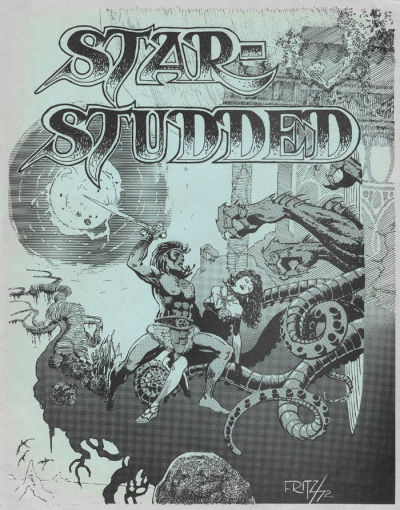
The Best Of Star*Studded Comics!


Star*Studded Comics was arguably the finest of the classic fanzines dedicated to just presenting amateur art and story. Fantasy Illustrated was in that class but was more catholic in the kinds of strips it offered. Star*Studded was able to get the best of the up and coming talents and get them to draw good old fashioned superhero strips with a few exceptions. The fanzine was the product of the "Texas Trio" which was primarily comprised of Harry Keltner, Larry Herndon and Buddy Saunders. In actual fact there were more than three in this "trio" with guys like Gary Accord and Howard Waldrop among others providing critical help in the practical nature of getting a zine manufactured and delivered. 


Bill Schelly's book attempts to offer up what he sees as the very finest of the work offered in Star*Studded while at the same time providing a range of the various kinds of items offered and all the while focusing on several fan artists of note. Alan Lee Weiss is interviewed and four of his stories are offered up. But I'd have to say this book is dedicated, if not literally, then practically to the compelling comics talent Richard "Grass" Green who had passed away while this volume was being composed. There are five "Grass" Green pieces included, some of his best stuff. 


The volume begins with an issue by issue breakdown of the contents of the sixteen issues of Star*Studded produced between 1963 and 1972. Then we go on to two stories which have been collected by Schelly before but which he felt were crucial to any collection hoping to represent what Star*Studded had been about. The first is the Liberty Legion story which brought together many heroes as well as top fan talents to tell a story reminiscent of a vintage Justice Society story or the more recent Justice League. Also we get a story about The Eye by Biljo White. 


After that the focus shifts to a Xal-Kor the Human Cat story by Richard "Grass" Green and then a very nice Dr. Weird story drawn by Landon Chesney. There are some splash pages and covers featuring other characters tucked in between these dandy tales as well. 


The first of several interviews is next focusing on Gary Acord, considered the "fourth member" of the Texas Trio. That is followed by another Biljo White effort, this story starring The Blade a hero in the classic swashbuckling style. Then it's the first of two Powerman stories featuring his battle with "The Transmuter" drawn by Bill DuBay and written by Dave Kirby. 


A prose story titled "The White Dragon Strikes Back" written by John Wright is included to represent the prose which did appear at times in the fanzine. This is followed by another "Grass" Green Xal-Kor story and then the second Powerman story, this one drawn by Larry Hutchinson from a Larry Herndon script. Powerman is forced to kill his opponent and this proves to be a moral dilemma for him. The second Dr. Weird story is next, but this one is really different as it's drawn by future Underground artist George Metzger. 


What follows is a big section dedicated to Alan Lee Weiss. First is an interview with Weiss about his fanzine days and then we get five stories of a wide variety. There are two more Dr. Weird stories in which the "Golden Ghost"  takes on first two mystical foes and then has to have a second bout with the scary Skullwing. That first encounter had been reprinted by Schelly in an earlier volume. My favorite piece is a western by Weiss titled "The Battle of Credibility Gap" which shows off some of Weiss's art chops to great effect. The section ends with another superhero, this one called Dragonfly


Following this heady section we get some more vintage "Grass" Green and his two sturdy superheroes Wildman and Rubber Boy. After that there's a Roy Thomas interview in which he discusses how he came to adapt Gardner Fox's novel Warrior Llarn. Ronn Foss was supposed to do the adaptation but dropped out when some money issues over possible overseas reprints came up clearing the way for Sam Grainger to step in. We have the entire twelve-page adaptation here in all its glory. This first section wraps with a Ron Foss story titled Excel, a truly fine yarn and one that had been reprinted by Schelly before. 


Schelly wraps up this book with some high-quality fan stories that actually did not appear in Star*Studded Comics, but in Schelly's mind were good enough and to do so and too good leave out of what proved to be his final fanzine anthology. There's a story written by Mike Vosburg featuring his hero named The Cowl as drawn by Ronn Foss who is at his finest here. Then we get more Biljo White with The Lion, a one-shot hero who had appeared in ditto form, but we get an inked version this time. There's a character named Ace of Spades with his sidekick Joker who fight crime in stories written by Mike Kelez and drawn by Mickey Schawberow. Next is a MAD-like yarn starring a vampire named only "The Count" by Steve and Dave Herring. The Spook by James and Alan Hanley calls to mind Eisner's Spirit. There's a story of Powerman drawn by Jim Starlin. 


The finale of the rich tome brings us back to Richard "Grass" Green. Green had passed away recently before this book was wrapped and as a tribute Schelly gives us one more story by him starring a hero named Crime Crusher who fights a vintage Yellow Peril type baddie dubbed the Black Dragon. And after a few closing comments that wraps up this look back at a great fanzine from which nearly spanned the entirety of the Silver Age of Comics. It's a fun read for fans of old-fashioned comic yarns.


Here the rest of the covers from that Star*Studded illustrious run. 


Rip Off

Saturday, January 23, 2021

Giant Labors Of Love!


Fanzines of any era are "labors of love" produced by fans who want desperately to express themselves about a hobby they love or in some measure to participate in the production of the works that make up that hobby. In the case of comics, there were scores of low-print fanzines manufactured cheaply  which were distributed to only a few hundred fellow fans at most. Fanzines of this type were well served by the antique production process of ditto or spirit duplication. 


"Ditto" copying was a standard technique for cheap duplication of documents in many smaller outfits like churches and schools and such since its invention in the 1920's. It was once standard practice to see purple-tipped fingers on many folks who made use of the process. When I first started my teaching career Ditto was still a regular way to make sufficient copies of teaching materials for distribution to students in a classroom. I've administered more than a few tests committed to the spirit duplication format. And as it turns out I used the process  when I briefly took part in comic fanzine publication in the late 70's long after most publications had switched to offset printing. I had access to that too, but much of the work developed by members of my APA (Amateur Press Association) came to me via Ditto masters. Learning to use Ditto and even to draw on it took practice and there were even some slight advantages at the time because of certain shading effects common to the technique. The smells of Spirit Duplication were distinctive and not necessarily unpleasant.  

That's the method used by all of the stories collected in Bill Schelly's Giant Labors of Love. I'm taking a look at the "Revised and Expanded Edition" released in 2000. It's the smallest of the collections Schelly published under his Hamster Press brand both in page count (112 pages) and overall dimensions (7 inches by just under 10 inches). There are ten stories and many examples of small spot art work. 


The collection leads off with not one but two stories starring the most visually iconic of the fanzine heroes -- Bijo White's The Eye. White was adept at using the Ditto process to get effective art and it shows her with two stories that first introduce the enigmatic underworld  hitman and then a second which reveals his true heroic nature. This is followed by Richard "Grass" Green's Speed Marvel a light hearted funny strip that has a hero who gets the job done and has a laugh at the same time. The art here evoked those fantastic Terrytoons character styles. 


Next up is Dimension Man by Ronn Foss and of particular note in this story is the lovely dame rendered by Foss, a fetching chick from Venus where women rule and men serve. Foss seems to be okay with that idea, forward thinking for the 60's when "feminism" was just aborning. 


The Demon by Buddy Saunders (one of the "Texas Trio") a strip in which this magical powered hero is assisted by another superhero who doesn't survive the adventure. Death and dying are all too commonplace in comics today, but to kill any character in the 60's was a huge deal. Doc Darkness by Rick  Buckler is next and this is a complete story with this Doctor Mid-Nite knockoff battling some particularly nasty villains who want to use religion to shield themselves from justice. The O'Brian Gang is by Bill Schelly himself from 1972 and in his into he indicates there is some Fourth World influence on this story. That influence is mostly seen in the face and manners of the matriarch of the gang who looks more than bit like Granny Goodness. This is a wild fracas that actually draws you in quite effectively. 


Now we turn to the "Expanded" part of the book and we kick off with The Black Scorpion, a female hero by Larry Herndon. This is followed by The Defender by Herndon and Green with inks by Howard Keltner. Both Herndon and Keltner were the other two members of the "Texas Trio" alongside Saunders. 


The Viper by Ronn Foss is almost certainly the best drawn piece in the book featuring another heroine who this time uses a great costume and a whip made from snake skin to enforce her will on a devious criminal. The book wraps up with yet another Biljo White item starring The Lion, a hero who comes into being to help save a lowly pressman's job after he conjures up the hero out of nothing. The Lion's debut is novel for certain. 

These are not the most refined examples of comic art, even among the fanzine variety but they are filled with that furious enthusiasm which makes these kinds of collections so much fun to explore. 

Rip Off

Saturday, January 16, 2021

Fandom's Finest Comics Two!


In Fandom's Finest Comics Volume Two editor Bill Schelly takes advantage of this space to organize the stories in categories. This gives him the ability to focus on themes and to give added attention to individual artists of note from the fanzine days. Based on the outstanding Jerry Ordway cover featuring Biljo White's iconic The Eye, it's no question who one of those talents will be. 


The volume though is bracketed by a two-part Adam Link story. Created by Eando Binder for the science fiction pulps the story "Adam Link's Vengeance" was adapted for the debut issue of Fantasy Illustrated by Bill Spicer. The story is adapted by Spicer and drawn by D. Bruce Berry. It's a professional level job and it's a story with some depth of character. The second chapter is located at the very back of this collection. 


The first section is dedicated to Star-Studded Comics, arguably the most prodigious of the fanzines dedicated fan stories. Many stories from this long-running series appeared in the first volume as well. Here we get stories from a wide range of genres. In the superhero category we have "The Astral Man Vs. The Adder" by Howard Keltner (one of the Texas Trio who published the comic) and the amazing Sam Grainger. Landon Chesney steps in with a horror/superhero outing starring Dr. Weird called "The Thing out of  Time". "The House where Terror Lived" is drawn by  Rich Buckler and written by Larry Herndon (a second member of the Trio). Alan Weiss steps up with a rarity in the fanzines, a western and this is humdinger titled "Boy, You Sure Don't Look Like a Hero!'. Closing out this section is an adaptation of Robert E. Howard's "Gods of the North" by Herndon and artists Steve Kelez and Alan Hutchinson. 


The next section is dedicated to Biljo White and we get along with a profile of the great fanzine artist and publisher of Batmania, three stories. The first is an early offering starring a hero named The Fog and the other two star White's iconic hero The Eye. Included here are the stories "The Eye" (done as a newspaper strip) and "The Return of the Eye" a follow up to the story from the first volume. 

Schelly turns his attention to lighter offerings with some parody and humor strips. He get "Whatever Happened to Lance Lightning?" by James Toran, Bill Spicer, and the great fan artist Grass Green. Landon Chesney is back, this time with a light look at a team-up between the Flashes of two worlds, as they battle the Purple Slagheap. Robert Crumb's brother Charles gives us a spoof of Zorro with the story "Xorro!". The humor section is closed out by "The Wishing World", a story by writer Mark Evanier and artist John Pound taking a scornful eye at some classic cliches in vintage EC Comics stories. 


Yet more superheroes arrive in the next section which starts off with a bio of Bill Black and then showcases one of his best early tales about the Vietnam vet turned psychic hero The Shade. "Night of the Shade" is a darn good story and we get another Shade story titled "Dream Walker" as well. "Skyline Robbers" is a story starring Ron Foss's hero The Eclipse, but this time the story is by Martin Grein and Foss is assisted on the art by Gary Kato. "The Web" is a comic strip style spoof of the spy stories of the day and gives the reader a parody of both James Bond and The Man from UNCLE. "The Prize...America" is a full-length story (twenty pages) by Jim Starlin and Keltner and it teams up two heroes -- The Eagle and the previously seen Astral Man. Starlin is very close here to his form in his earliest Marvel work. 


"Graphic Story Gallery" offers up a bevy of one and two page glimpses of work by George Barr, Michael T. Gilbert, Mike Kaluta, Jeff Jones, Jim Shooter, among others. Rounding out this collection is a section dedicated to other genres such as "Thundersaber" by Dave Cockrum an adventure in the ERB tradition, "Call It Karma" by Frank Miller about a mysterious murder and crime, "A Study in Horror" by Bob Overstreet and Landon Chesney (for the third time), "The Demon of the Dark Glass" by Martin Greim and Dan Adkins (this is pro level art by the way), and "What Happened to Jory" by Gary Henry and artist Marc Hempel. The final one is the strongest alongside the Chesney piece. 

As previously mentioned Adam Link shows up to close it out and the second heaping volume comes to an end. 

Rip Off

Saturday, January 9, 2021

Fandom's Finest Comics!


Bill Schelly's Fandom's Finest Comics tome is a hefty volume when does its job mighty well -- to showcase a heaping helping of fan comic art and storytelling from that period of the 60's and early 70's  which Schell dubbed the "Golden Age of Comic Fandom". I won't dispute that finding, but will just remark that there are darn entertaining stories in this collection. 

The stories here were selected both for their significance and for their quality. Many get high marks in both categories but of course most fall short in one or the other. The book leads off with a vintage Robert Crumb effort called "My Encounter -- With Dracula!" from 1958 which is a harbinger of the strips to come. This one sends up the classic Stoker tale with aplomb.


The Bestest League in America is here mostly because Roy Thomas wrote and drew it for the debut issue of Alter Ego. It's not a fantastic bit of draftsmanship, but it does a sturdy job of sending up the DC superteam. It's followed by a somber piece called "Super Human" by Roger Brand which is a mildly clumsy but still effective tale of a man coming to grips with his changed status. 


Two of the best offerings are "The Eclipse" by Ron Foss and "The Eye" by Biljo White. Foss might well be the most gifted artist in the collection, his take on the stylings of a young Joe Kubert tempered with some apt Carmine Infantino makes for a handsome comic book page. Foss had the chops to be a pro, but seems never to have wanted that enough at any point in his long association with comics fandom. The Eclipse is a variation on Dr. Mid-Nite and to my eye an improvement. Biljo White's The Eye is arguably the most successful of the fan characters (Dr. Weird comes to mind) and we get two stories here, his debut nad his actual origin.  White has a lively entertaining style mindful of the Golden Age artists. 


Landon Chesney is an artist singled out for special recognition and the story used to spotlight his work is "The Life Battery" written originally by Eando Binder and adapted by Chesney and writer Bill Spicer for comics. It's a story which calls to mind the classic EC stuff and you can read it here when it reprinted in the 70's in color. Also we get some other Chesney work such as his Shadow-like hero The Cloak and and even some heretofore unpublished roughs for a Cloak story.  


Star-Studded Comics was the most successful of the fanzines that specialized in fan art stories and many of the stories here came from there.  We get a whopper from its pages featuring many of the fanzine's greatest talent joining forces in a story which is like those classic Justice Society stories which featured a team but showed them working in duos to beat a sprawling world-beater of a threat. This time the team is dubbed the "Liberty Legion" and it's members are Mr. Weird, The Defender, Astral Man, Mercury, The Changling, and Powerman. All of these were established fanzine stars by the likes of Foss, White and the "Texas Trio". The trio was comprised  of Larry Herndon, Buddy Saunders and another. "The Riddle of the Runaway Rocket" starring Powerman  was written by Herndon and drawn by respected fan D. Bruce Berry. 


Next we get Xal-Kor the Human Cat by Richard "Grass" Green, two stories actually. He get his origin which tells of another dimension where Cat-people battle Rat-people for control of civilization and a second which focuses on that war when it shifts to this Earth of ours. Green is one of the fan artists who went pro with some mild success. 


Dr. Weird has been mentioned a few times now and we get one of his stories by creator Larry Herndon and up and coming fan artist Alan Weiss titled "The Curse of the Skullwing!". It's not my favorite Dr. Weird story who later would be written George R.R. Martin and drawn by Jim Starlin --quite a duo. He's a spin on the old ghostly Mr. Justice character. 


"Ku! Primordial" was both written and drawn by Jeffrey Jones who was clearly just on the cusp of his distinctive artistic style. Anther offbeat story written by Marv Wolfman and drawn by Dave Herring pops wise at Irwin Allen's Lost in Space and does it quite well. Herring also shows up with a nifty one-page effort called "Suicide" which is much funnier than it sounds. 


"The End of Bukawai" is arguably the best crafted of all the stories in this collection. It adapts one of the Jungle Tales of Tarzan by ERB (at the point in time when some of these Burroughs stories were thought to have fallen into public domain ). Drawn by Harry Habblitz over Bill Spicer's breakdowns it's a work of such polish that it could easily have appeared in a professional comic without question. 


C.C. Beck's "The Big Red Cheese" gets his due when a version of him dubbed "Goodguy" by Alan Hanley is added to this set. All the Marvels are present albeit under different names. "Introducing Altron-Boy" by Larry Ivie evokes the classic Mac Raboy Captain Marvel Jr. and was actually printed in Ivie's Monsters and Heroes which actually hit the stands. 


George Metzger gets the fanzines into the psychedelic with an art style on "Master Tyme and Mobius Tripp" that evokes the Underground comics of the 70's. It was in fact the Underground publishing ventures that was partially to blame for fanzines giving way eventually. "Munch" is another such story, this time by Mark Wheatley and is from 1974 featuring a hero that looks a lot like Turok to me. "Betrayed" by Jerry Ordway is the latest work originally published in the era with a 1975 date and features a typical superhero tale. 

Schelly includes a gallery of single pages to capture other work of the era such as early work by John Byrne, Jim Starlin, Bill Black and Wendy Pini among others. My favorite page in the whole collection is a beautiful lively page by Sam Grainger over a Roy Thomas script for a revised version of Charlton's Son of Vulcan. This was apparently submitted to Charlton but not picked up on. The collection closes with two new pieces (previously unpublished at least) - a story by Biljo White about another Shazam-like superhero called "Great Scott" and Schelly himself presents a story he'd written earlier called "The Immortal Corpse". 

All in all a delightful anthology that offers a broad overview of what was available and giving the reader some dandy delights and even a few thrills. It's so good there is a second volume and that's for next time. 

Rip Off