Showing posts with label Daredevil. Show all posts

Saturday, September 19, 2026

Daredevil Battles The God Of Storms!


First mentioned, to my knowledge at least, in the pages of The Great Comic Book Heroes by Jules Feiffer is the legendary tale of how a Golden Age comic book was created in a single weekend, one in which the survival of the artists themselves was in some meager doubt. The comic book in question is the second issue of Daredevil Comics from Lev Gleason Publishing which hit the stands in the summer of 1941.


This tale has been told in several venues and even immortalized in fictional form in Michael Chabon's The Amazing Adventures of Kavalier and Clay. It kindles the imagination for a number of reasons, one it speaks to the helter skelter nature of comic book creation in its infant days, how raw energy often substituted for craftsmanship and care. How comics are an art, but they are also a product for sale which are fashioned within the demanding rigors of a deliberate and often unforgiving schedule.


Things have changed nowadays with comics having been reduced to a minor art and no longer a true mass medium, but throughout most of the history of the comic book, we fans want our comics to be good of course, but first and foremost we wanted them to simply be. We were eager to buy and publishers were sure to have it available so that the opportunity would not slip by.


I most recently ran across this legendary yarn in the biography Jerry Robinson - Ambassador of Comics, in which the story is told from the perspective of one of the men who was there on that prodigious weekend of March seventeenth.  The story goes that a gaggle of young energetic artists and writers assembled at a sparsely furnished New York City apartment rented for that very reason. Charles Biro has learned that because of a need to use up their allotment of paper they needed a new comic ready for the presses and they needed it by the following Monday. To that end the talent was assembled and given largely carte blanche to create stories to fill the needed sixty-four pages.

Charles Biro would handle the lead feature Daredevil which accounted for the first thirteen pages. After that it was every man for himself as a ferocious binge of creation ignited. Bernard Klein created "The Whirlwind" about boxing, and other talents such as George Roussos and Dick Wood contributed "Nightro". Jerry Robinson himself created "London", a masked hero who was involved with the Blitz. Dick Briefer wrote and drew "Real American". Others did what they could, creating characters, some which would only appear in this single comic, in the mad rush to hit the deadline.

New York City under snow in March, 1941

The story then takes a dangerous turn when, while the artists are furiously creating in the apartment a heavy winter storm strikes the city, closing down everything save the subways, and forcing stores to close. Getting something to eat was problematic, and Bernie Klein was sent off into the white wastes to find sustenance. He returned hours later with only some eggs and a can of beans. The artists desperately pried loose ceramic bathroom tiles and created a fire to cook the eggs and heat the beans, which staved off fits until the streets quickened with life once again.

Needless to say, the book was completed and assembled and sent to the printer on time. This story shows not only the ruthless nature of publishing but also the wild bristling energy which informed the earliest days of comics, an art form still in its infancy and eager to please the audience which fondled it with such devotion.

The story is made more poignant in that Bernie Klein, a talent with much promise was one of those multitude of young men who lost their lives defeating the Axis powers on the battlefields of Europe. His death made all the more tragic, because as the legendary weekend showed he was like so many of his peers a man filled with spirit and life.


Daredevil must break out the boomerang and confront an evil from ancient history when a deadly mummy is revived. Charles Biro presides. 


Terry Turner is a powerful boxer, but he might have met his match in Jean Jacques, a savage lumberjack. Dick Wood and Bernie Klein do the honors.


Nightro isa rather nifty version of Dr. Mid-Nite when Hugh Goddard is blinded in a radiation accident. He can see in the dark thanks to special lenses and mops up the criminals who attacked him. Dick Wood writes and George Roussos draws this one. 


Dash Dillon at Hale (not Yale I notice) is a sports natural and is recruited by a young woman to join the team and save the season for her school and her dad, the coach. Ed Ashe is both writer and artist. 


Pioneer is a naive young man who lives in a remote valley and is lured to civilization by some thugs who see riches. He turns the tables. Bob Woods wrote this one for Jay Gahr. 


The Bronze Terror is "Real American #1". He's a denizen of the Indian territory and uses his strengths to save the chief from villains who want to prey on the people. Dick Briefer is man for this one. 


London is the hero and London is the place where a brave young man fights against the Nazis for the sake of us all. This one is all Jerry Robinson. 


Pat Patriot is born when a brave young woman stands up for her overworked companions and discovers a smuggling ring. Bob Wood likely wrote and Reed Crandall might well have drawn it. 


The Claw is in fine malicious form as he steals a train and all the men aboard it. He tries to blackmail the government, but one brave man has an idea which might defeat the towering menace. This one is by Bob Wood. 

To read this epic iconic comic in its glorious totality check this out. They don't make like that anymore.


I enjoyed this wild yarn in the pages of The Original Daredevil  Archives. Tomorrow. we back things up a bit, as the Dojo takes a look at the debut issue of this comic book series. 

Rip Off

Saturday, September 12, 2026

Daredevil And The Man Of Hate!


Once upon a time in America, Adolph Hitler was the epitome of evil. He was the loathsome skunk who forced two of my uncles to go to war to protect the civil order of the Western world itself. Once upon a time we all hated him. And we have the comic books to prove it. Arguably the most infamous is the cover above for the debut of the Daredevil series from Lev Gleason which has the one-off title of Daredevil Battles Hitler! Signing as "Woodro" the infamous cover above was created by Charles Biro. 


In this absolute riot of a comic book Daredevil battles Hitler and his minions on many fronts, and he is helped by other Lev Gleason heroes of all kinds in this comic dated July 1941. (For the record, I love comic images which showcase heroes coming out of the very pages of book or even bursting through the cover.)


Daredevil joins forces with Silver Streak to combat the malevolent dictator. This splash page showcases Hitler as a giant crushing regular folks under his boot and crashing buildings to the ground. Charles Biro produces both story and art for this initial chapter. 


One the biggest "stars" for the company was actually the villain the Claw, who is a maniacal giant with fangs. He seems like an ideal choice to help the little dictator but as the title suggests there's little honor among malevolent maniacs. The villains team-up but then fall-out as Daredevil does his best to wind the day. Writer Biro was joined by the great artist Jack Cole for weird outing. 


The action switches to the jungle where Daredevil joins up with Lance Hale, a Tarzan inspired hero. The duo drive the Nazis out of this little corner of deepest darkest Africa. It's assumed Biro wrote this one, bt the artist's name is lost to time. 


I love this double-page spread which advertises the various heroes Lev Gleason publishes. Not all of them get featured in this comic. 


When Dickie Dean invents a new decoding machine, the news reaches the ears of Joseph Goebbels who sends out his henchmen to kidnap Dickie and his friend Zip Todd. Daredevil seeks them out in enemy territory and the heroes not only return with the machine but do some harm to the Nazis as well. Biro and Cole team up again for this story. 


Next Daredevil takes to the skies as he teams up with Cloud Curtis to battle Herman Goering's dangerous fighter planes. It takes more than a dash of derring-do to subdue the enemy. Sadly, again the artist for this story is unknown. As we learned yesterday, they produced them fast at Lev Gleason. 


In perhaps the strangest of the adventures Daredevil is in conflict with Grand Admiral Von Roeder who is attacking shipping. The Pirate Prince appears from the mists of time to assist in putting down this threat and then he and his sailing ship disappear just as mysteriously. Harry Anderson supplies the artwork for this Biro story. 


The comic takes a turn by leaving off with these focuses instead on Adolph Hitler himself and muses upon how his vile man came to power. The story is both written and drawn by Bob Davis. 


Hitler's notorious biography is tracked in a two-page prose offering which details many of how he came to prominence and ultimately a threat to the world. 


We then get some potent pages showing how Hitler and his forces moved beyond their borders and became an immediate menace to all of Europe and beyond. The story has the Roman god of war Mars join Hitler in his predations. 


The story "Man of Hate" was reprinted in 2001 in All-Hitler Comics from Bill  Black's AC Comics. 


This is a wild comic book, published before the beginning of the war and so it could be argued was needlessly provocative. Those arguments are largely hogwash. Recognizing the immensity of a menace, whether overseas or in one's own homeland, it's necessary to face up to the task of defeating evil. 


I read this story in The Original Daredevil Archives from Dark Horse. If you can't wait and I haven't spoiled too much, you can read it here. 

Rip Off

Saturday, November 1, 2025

The Man Without Fear!

(The dates for 1975 and 2025 are identical.)


Daredevil was the comic without fear. Marvel was on a dandy run, creating new heroes every month and growing in response to fan demand. Stan Lee had found a formula for success which leaned heavily on artists Jack Kirby and Steve Ditko for the hits which changed the face of comics and made the Silver Age profoundly different and profoundly modern. 


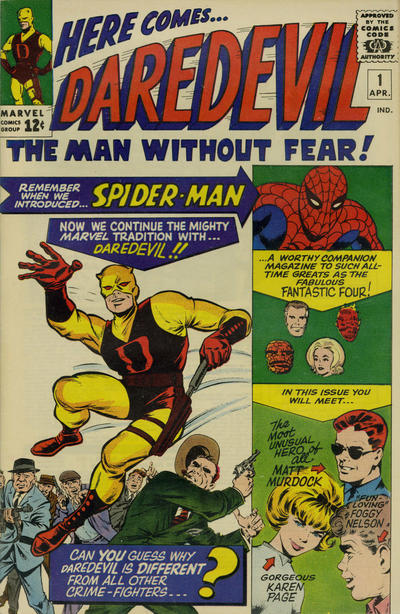
Taking the approach which had worked on Fantastic Four and Spider-Man, Lee turned to Bill Everett, the Golden Age creator of the Sub-Mariner. That lasted exactly one issue. Everett was a master in his time but his Daredevil look positively antique, well-crafted but of a different era.


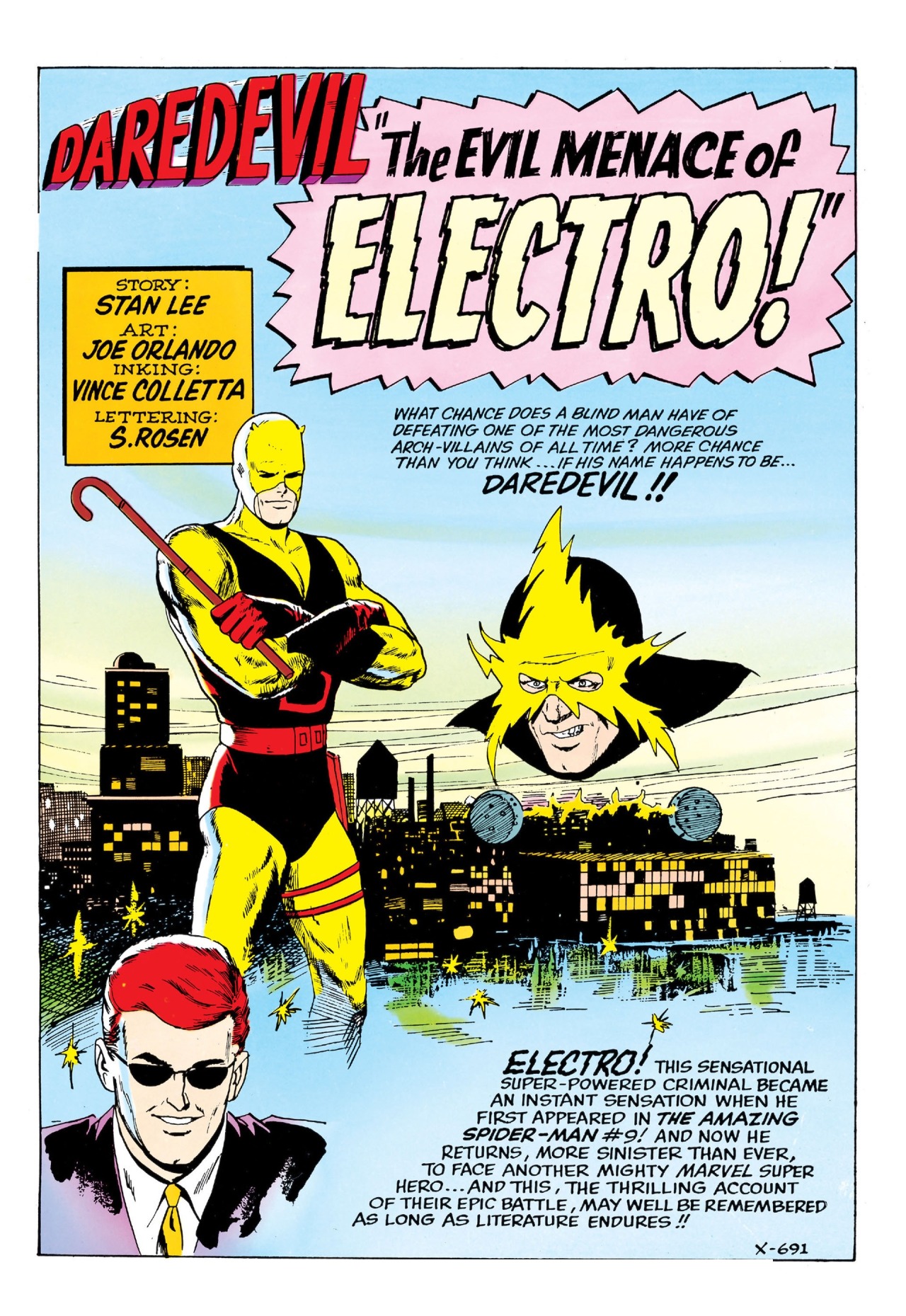
Lee turned to EC veteran Joe Orlando to take up the slack and inked by Vince Colletta the comics looked more like what Marvel was doing elsewhere. 

Marvel Comics Title Pages — Daredevil vol.1 #2 (1964) - The Evil ...
Despite battling the borrowed Spidey villain Electro and running up against new foes like The Owl and The Purple Man, Daredevil seemed to be a comic which was sputtering. 


Even the soon-to-be-obligatory crossover with Spider-Man himself under the penciling hand of Steve Ditko himself only showed what might be missing from the Daredevil comic itself. The stories were good, but felt like stories which might've been produced a decade before. 


And then Joe Orlando's old partner Wally Wood took the helm of the book and brought a true-blue big name feel to a book which in truth had been put together by many qualified veterans. Wood brought something which had been missing despite all the good intentions -- excitement. Admittedly the Matador was an opponent inspired by Daredevil's little horns, but he did look good. Mr. Fear and his partners the Ox and the Eel were a blend of old and new but looked fresh nonetheless. 


But most importantly Wally Wood identified the problem with Daredevil pretty quickly -- the costume. The yellow and black and red fighting togs which DD had put together were right out of the Golden Age of comics, something you'd see someone on the Justice Society of America wear maybe. Quickly  Wood added a bit of dash with another "D" to the chest symbol. Now Daredevil was "DD" formally for all the world to see. But Wally Wood wasn't done yet. More later today when a second helping of DD is served. 


As important as fine talents the likes of Gene Colan and Frank Miller have been to the development of the Daredevil comic book, it's easily arguable to me that the single most important artist in the history of the was Wally Wood. What Wood did was simply transform Daredevil from a musty looking superhero who might've dropped in out of the Golden Age into a sleek modern hero literally suited for the Silver Age. He did it with a single color -- red.


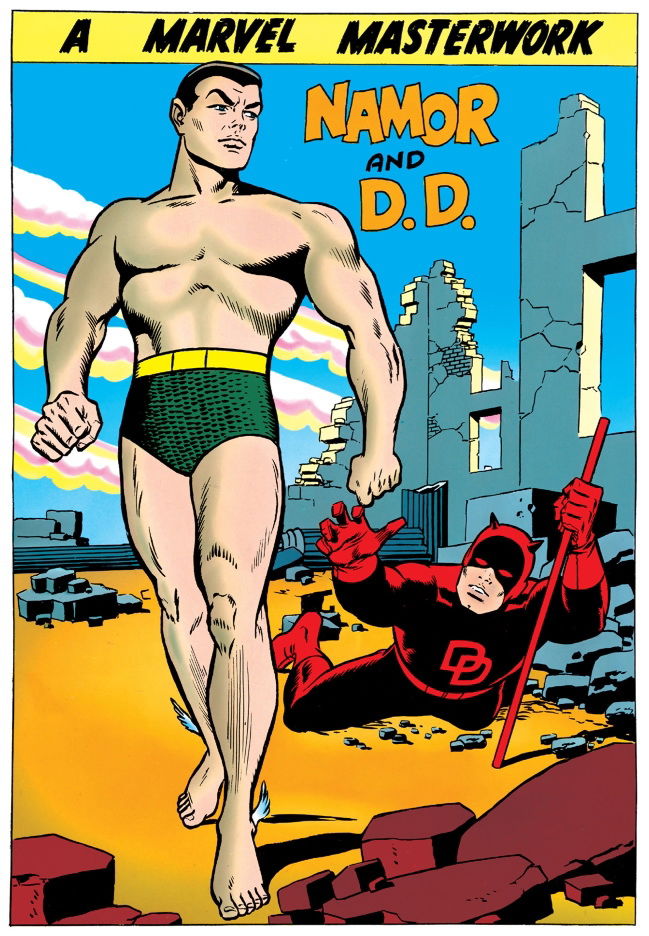
From his inception the design of Daredevil had played off his name by adorning his cowl with little horns. What Wally Wood did was to take that notion and give the character named "Devil" a deep rich color which evoked his name in all its glory. Soon after taking the helm Wood started diddling with the look and along with Stan Lee even made sure the hero got some high profile exposure in the Fantastic Four of all places and by fighting one of the greatest of all Marvel battles ever against the indomitable Prince Namor, the Sub-Mariner. "The Man Without Fear" earned his nickname when he put it all on the line against the Sea King and there was no going back.


Despite small-ball but visually spectacular villains like the Stilt-Man, the comic was secure because watching DD in battle was exciting in itself.


Not all the stories made sense, but getting there was nearly all the fun. Daredevil was establishing himself as a hero who took on all comers and looked good doing it.


Wally Wood's tenure was brief though and ended when Bob Powell was brought aboard to finish Wood's layouts in the terrific two-parter featuring the debut of the villains who would be called the Ani-Men. These guys are all Wood, who wrote the first half of the two-part adventure. With that Wood left the book and a fellow named John Romita took the helm, no slouch himself.


Wally Wood stepped aboard the Daredevil comic book one more time, inking Frank Miller in a story from his epic run. It was a hearty reminder of the early days when Wally Wood had saved the comic from the dustbin of history.

daredevil # 7 pin - up / 1965 - acetate color, in red raven's ...

It was then that Daredevil was established as the comic without fear.

Rip Off

Wednesday, January 1, 2025

Your Friendly Fighting Neighborhood Spider-Man!

(The dates for 1975 and 2025 are identical.)

The month kicks things off with the Amazing Spider-Man and the rather expansive cast of characters which shared his book in the 70's. Spider-Man was and is a powerhouse character who has developed a popularity out of all reason really. In a decade in which superheroes were only starting to regain their footing in the comic format, he came charging to the fore, becoming Marvel's flagship character and more. Today I want to take a look the character and how he interacted with other Marvel heroes over the decades and maybe discover the secret sauce that made Marvel so attractive to readers in those years. 


Unexpectedly this volume of Marvel's Decades series has proven to be my favorite. Documenting as it does one of the most elegant aspects of the Marvel Universe, that it is indeed a universe, a mostly coherent environment in which heroes and villains live and fight on a landscape very similar to our actual reality. The linchpin in this tome is Spidey, the teenage hero who was incredibly successful and soon became the "Mickey Mouse" of the Marvel Universe.


Spidey meets the Fantastic Four in the very first issue of his very own comic. But after a brief tussle in which he showcases his powers to the team, he loses interest when he learns there is no paycheck for the gig. Steve Ditko drew that first meeting, but Jack Kirby did the cover with Ditko inks. 


Spidey then meets the Fab 4 for the first time again in the pages of the first Fantastic Four Annual. Apparently, Stan didn't think the meeting in the pages of Spider-Man sufficient to tell the story, so we get a fuller tale with art by Jack Kirby this time. 


We get to see that happen as Spidey drops in here and there and seemingly everywhere to add his obnoxious observations to the struggles against evil. It's a trope that Marvel heroes always fight when they encounter one another and in these hallowed pages, we see that's actually mostly true. Since both  Spidey and the Human Torch were youthful, Marvel wasted little time getting the two together, both as antagonists and allies. The first time was on the Human Torch's territory in the second Strange Tales Annual. 


They hook up again in the eighth issue of The Amazing Spider-Man. Kirby and Ditko had drawn the Strange Tales encounter, and they likewise do the honors on this one. Spidey is developing a jealousy of the Torch, because as a public hero with ready access to money he's living the life Peter Parker can only dream about. 


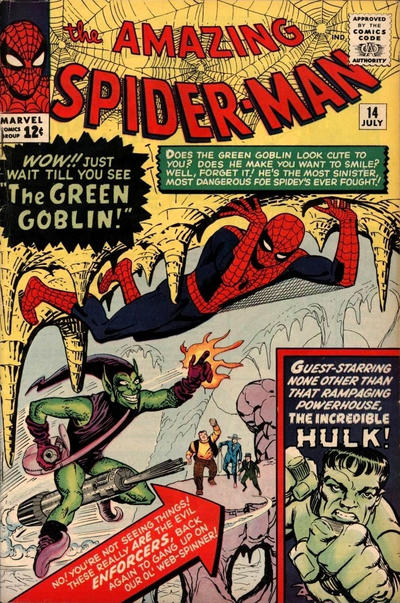
We are also treated to a few pages from the important fourteenth issue of Spider-Man when he tumbles across the Hulk of all people. This is in a period when the Hulk is without a regular feature and Stan is trying to keep him in the public eye by guest-starring him all over the place. 


It seemed a natural to have Marvel's two insect-inspired characters duke it out. Spider-Man was a hero on the rise, and sadly Giant-Man was on the wane. As was unfortunately true of most of Giant-Man's stories from this period this one lacks a bit of luster. 


Spidey for his part had a natural rivalry with the Human Torch from his earliest days and later he finds Daredevil more a man of his liking. This is one of Ditko's best and it gave DD some much needed exposure. It would be years before Daredevil began to approach Spidey's popularity. The duo battle against the always entertaining Circus of Crime in that outfit's second outing, after they got their big top butts beat by the Hulk. 


The Avengers and Spidey never blended well I always thought and that is showcased as well. These days he's a key part of their success, but when I was reading comics, he was not a public hero in such a way as to make assembling a real possibility.


Steve Ditko's two creations mixed it up in the second Spider-Man King-Size Annual in a bizarre little story. The cover is a classic, but it doesn't do justice to the way-out story inside where Doc Strange and Spidey take on Xandu over the ultra-magical Wand of Watoomb.  


Doffing his yellow tights and putting on his iconic red suit, Daredevil proved a worthy ally and opponent for the Wall-Crawler time and again. This time out they take on the Masked Marauder, one of Marvel's lesser creations. 


Spidey gets disappointed in his bid to join the Avengers, first by the Hulk who gets into the mix and then later when he learns there's no salary for being an Avenger. (Years later they did start getting stipends or something, so it worked out in the end.) This one is fun and I'm always up to seeing Goliath in his yellow and blue costume, perhaps my favorite all-time. 


Spidey joins DD once again when the Masked Marauder creates more trouble over in Daredevil's book. The art this time is by Gene Colan and might be his first try at the Web-Slinger. 


Spider-Man has a hard time with the X-Men, at the time quite a mysterious group, operating in the shadows thanks to the machinations of Professor X. As usual a misunderstanding creates friction. 


And this is a wonderful image, as the Fab 3 face off against the combined might of Thor, Daredevil and Spidey. They make for a great cover, but not so great a team. This gem by Kirby and Sinnott really showcases that pugnaciousness which defined early Marvel and which I feel was the strain that attracted so many readers. 


On Saturday there will be more about what to expect this year as the Dojo takes a very spiritual turn. 

Rip Off