Wednesday, December 25, 2024

Mr. Magoo's Christmas Carol!


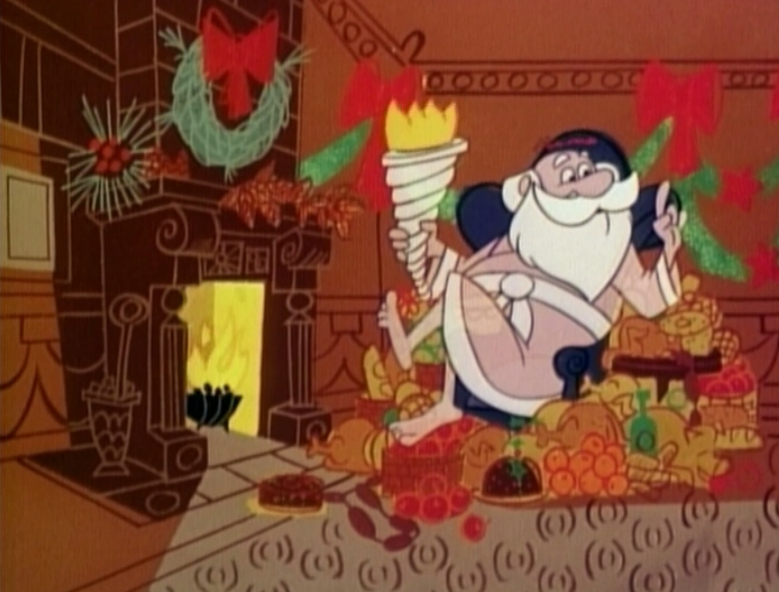
Mr. Magoo's Christmas Carol has long been the holiday special I most enjoy! The nostalgic goofiness of casting the irascible Magoo as Scrooge was inspired, and further transforming Gerald McBoing-Boing into a version of Tiny Tim a fantastic idea. 


There are more grandiose and more elaborate interpretations of the Charles Dickens holiday classic, but few that pierce the essence of the famous literary work with more precision or more fun than does this 1962 bit of witty animation. This is the one that kicked off the tradition of holiday-themed animation for television. 


Jim Backus is as always amazing as the myopic blundering Magoo. While once a radio, movie and television personality of some note, it's clear that Mr. Magoo has become his lasting legacy to us all. 


Certainly no one needs to be told this story of a greedy miser who lives only for his wealth, wealth accumulated at the expense of all those around him and even, as he learns, himself.


A man we see and who sees himself as a young boy and young man disappointed by those around him and who seeks solace in his vast wealth and relative if limited comfort.


He discovers that others enjoy the holiday despite their meager incomes and circumstances, and they celebrate those parts of life which are not dependent upon the cold vagaries of the marketplace.


And of course, he learns that he himself will die alone and little remembered at all, save as selfish old man who put himself above all else. 


But it is the miracle of this classic that Scrooge learns his lesson and changes his ways to become a different man who supposedly will live into a very different future. It is the kind of miracle that we can, each and every one of us choose each day to make a difference. It is a timeless tale, which speaks to all of us who get caught up in our own lives and forget that so many others in this world need our help and our attention.


So, you've unwrapped your presents, now enjoy the day and see to it that others do likewise. I'm going to try to myself. Merry Christmas and Happy Holidays to one and all! 


NOTE: This is an Annual Dojo Holiday Classic. Sword and Sorcery will resume tomorrow! 

Rip Off

The Joy Of Sects!


I wrap up my year-long overview of the late great Neal Adams as well pay some proper heed to the holiday with one of his more audacious co-creations -- Son-O-God Comics. The image above by Adams is one of the most brilliant single-image take-downs of the hoary religiosity which has come to stand in for Christianity. Co-created with writers Sean Kelly and Michel Choquette, Neal Adams and company give organized religion quite the bashing in a series of stories in the pages of the iconoclastic National Lampoon. If you're of a mind and want to read more of this savage take on Christendom's holiest figure, then check out this highly potent link. 


National Lampoon, at least in its earliest days was the home to some savage satire about many of societies most sacred cows. The above cover by Mara Mcafee is perhaps my favorite from all their long catalog. It speaks to the holiday and at the same time makes it feel of the moment. At a time when Christianity is being use by some of its own adherents to promote singularly un-Christ-like agendas, scraping beneath the familiar ancient tales to get a fresh understanding seems a wise and prudent way forward. Have a Merry Christmas and a Happy Holiday! 

More Christmas fun coming later today. 

Rip Off

The Red-Nosed Reindeer!

1950

1951

1952

1953

1954

1955

1956

1957

1958

1959

1960

1961

1962

1972

1973

1975

Spring 1976

Winter 1976

Winter 1978

Summer 1978

1980

Without question one of the most charming creations in all of comics is DC's Rudolph the Red-Nosed Reindeer. Of course DC didn't "create" Rudolph at all. Rudolph was the creation of Robert May who worked for Montgomery Ward. A guy named Denver Gillen drew the first Rudolph and Montgomery Ward realized what a marketing goldmine Rudolph could be. Rudolph was adapted to cartoon form in 1944 by Max Fleisher and later in 1947 or thereabouts Johnny Marks wrote the song recorded by the great Gene Autry. The song was a blockbuster and in 1950 DC came out with its first annual issue of The Brand New Adventures of Rudolph the Red-Nosed Reindeer.

The series lasted for the entire decade of the 50's and into the 60's until ending with the 1962 "Giant" issue. A decade later DC revived the series for its tabloid size Limited Collector's Editions series and Rudolph again appeared somewhat regularly through the 70's. Rube Grossman handled most of the work on Rudolph in his original 50's run and Sheldon Mayer took the helm in the 70's. The final issue of a Rudolph comic by DC was a Best of DC digest in 1980. I especially love Rudolph's snow-topped logo (doubtless by Ira Schnapp) which I notice they ditched for his inexplicable "summer fun" issue (which seems to be the work of Gaspar Saldino to my eye).

Here is a delightful adaptation of the very first DC issue from 1950 transformed into a cartoon of sorts. 


Below is some original artwork by Sheldon Mayer featuring Rudolph, Santa, and the whole North Pole gang.


There is a charm and a whimsy to Rudolph which is hard resist. DC would be well-served to dig up the character and issue some reprints for the modern market. I don't know what the license issue might be (and licensed characters seem not to be something the Warner bosses want to deal with) but it wold make a delicious trade.

The management of the Dojo (me) hopes Santa (and Rudolph of course) brings everyone what they wish for this Christmas. 

More Christmas fun coming later today. 

Rip Off

Tuesday, December 24, 2024

The Adventures Of The Snow Man!


One of the more unusual things I've read this month is The Adventures of the Snow Man from Dark Horse. 


And the story has nothing to do with the more famous Frosty the Snowman first introduced to the world in 1950 by singers Gene Autry and Jimmy Durante. Nope, this Snow Man is a bad ass. 

This tiny little tale reads quickly and is the earliest Frank Frazetta story I've ever read. The great man concocted this when he was barely a teenager for his own amusement in the 1940's. The war was raging, and Japanese hatred was awash in the country, which accounts for the villains of his piece. The Snow Man is just as you see him and inexplicably so, a small figure who treads the white wastes of the Yukon, with his axe in hand looking for baddies and rounding them up. Apparently immune to the elements he proves to be a reliable hunter for the authorities. In this story made up of individual single images, the Snow Man hunts down some criminals and then turns his attention to Japanese spies who work for a mysterious figure called "Skull". 


This is raw stuff, produced from a booklet gifted to Frazetta's son. It's a rare insight into the energetic genesis of one of pop culture's greatest artists. 


The Snow Man finds his way into one actual comic book and that's Tally-Ho Comics #1, the only issue ever published. This story was produced in late 1944 with the assistance of veteran John Giunta, but once again Frazetta is involved in every page, learning his craft. Skull has become "Fang" in this second story. 


In this story we get some sense of what Snow Man is, as he rouses again to battle Fang. We learn how Fang left Desolation Island and came to the snowy wastes of the Arctic, and we learn how Snow Man rose up to fight him the very first time. This story then predates the original tale by Frazetta himself. So maybe Skull is just a relative of Fang's. 

You can read this story by checking out this snowy link.


There were apparently other Snow Man stories created as I've seen them for sale on various sites on the internet. One of the strangest creations of a man called Frazetta. 

Merry Christmas Everybody! 

Rip Off

Monday, December 23, 2024

The Last Unicorn!


 Charming is the ideal word to describe Peter Beagle's classic The Last Unicorn. First published in 1968, story by Beagle's account is the continuation of a story he told as a young boy. Admittedly with a great deal more wit and social awareness.  Fantasy was a hot commodity in 1968 as Tolkien's The Lord of the Rings available in paperback and was inspiring imitators. The Last Unicorn is not one of those. I first bought the paperback in 1975 and read it then. I don't know that I've read it since. 


We are introduced to the last Unicorn of the title just as she is becoming aware of her singular status. Since unicorns live outside of time, being immortal, the fact that the numbers were dwindling was not of great moment. Nothing was or is exactly. Once realizing the possibility she might be the last she leaves the security of her protected and isolated wood and heads into an impossible world of fantasy and modern cultural reference. 


The characters in this story are aware of fairy tales and to greater and lesser degrees attempt to fit into these classic roles. Beagle punctures the texture of the world he creates with modern references just often enough to keep the reader from relaxing and treating the story in a classic fantasy way. Anyway, the Unicorn is captured by a traveling sideshow and shown off for what she is, though it takes a false horn to allow regular folks to see the myth. She meets a magician named Schmendrick, there who does recognize here helps her to escape though that is a dangerous thing as well. The Unicorn is not the only real mythical beast in the show and the other is downright dangerous. 


One of Beagle's stated inspirations for the novel is The Colt from Moon Mountain by Dorothy Lathrop from 1941 which put a unicorn in Kansas of all places. 


The Unicorn and the Magician meet up with a gang of bandits and out of that group they hook up with a woman named Molly Grue who also can see the Unicorn for what she is. They travel to castle of King Haggard, who it seems is the man who has used a magical Red Bull to gather and imprison all the unicorns. To keep the Unicorn from becoming his next victim Magician changes her into a woman he names  Alamathea. The trio end up in Haggard's castle and eventually do find their way to the lair of the Red Bull and discover the secret of the missing unicorns. 


I found the book surprisingly challenging to read this time. Some of that had to do with me not getting enough sleep, but also it is that the text demands your full attention. It's well worth the effort. Beagle has written a smattering of sequel short stories which have appeared here and there. 


In 1982 the Rankin/Bass animation outfit joined forces with ITC Films to produce a perfectly fine adaptation of the novel. It's more geared for the younger set than is the novel, as nearly all the social commentary is removed. The core story remains and it's not unpleasant to watch. Although I did specifically have to watch something a bit tougher afterwards to get the some of the saccharin off. 

Rip Off