Friday, July 8, 2011

Bloody Valiant!


This Nemo cover by Hal Foster depicts the noble prince in quite a bloody way. That leer on his mug is rather disturbing I must say.

Outstanding image though!

And here's another outstanding image.


This is one of 1000 limited edition posters. Here's a link with more details on it.

Rip Off

Thursday, July 7, 2011

Crisis Part 2 - Through The Crystal Ball!


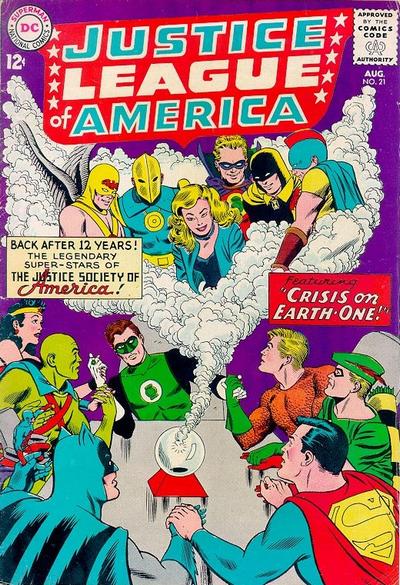
Justice League of America #21 and #22 showcase the first "Crisis" between Earths 1 and 2. For the first time ever the JLofA meets its Golden Age counterparts the Justice Society of America. It's a convoluted tale of traps and the coniving creations of criminal masterminds.


"Crisis on Earth-One!" written by Gardner Fox and drawn by Mike Sekowsky and Bernard Sachs begins as three villains who have dubbed themselves the "Crime-Champions" offer up a challenge to nine Justice Leaguers of Earth-1 to stop their intended robberies. Felix Faust, Chronos, and Dr.Alchemy throw down the gauntlet and three squads of the JLofA set out to meet the challenge. Likewise on Earth-2 the Justice Society meets again for the first time in twelve years and find themselves confronted with a challenge from the Wizard, the Icicle, and the Fiddler. Dr.Fate, Hourman, Black Canary, Atom, Green Lantern, Hawkman and the Flash form the JSofA and charge off to meet the challenge.

Felix Faust is confronted by Martian Manhunter, Atom, and Aquaman. Chronos is met by Superman, Green Arrow, and Flash. Dr.Alchemy is challenged by Batman, Green Lantern, and Wonder Woman. During each of the three battles the heroes turn away threats and ultimately defeat the villain only to see each of the three vanish. Likewise the Flash also disappears. As it turns out on Earth-2 when Green Lantern and Black Canary confront the Wizard, Hawkman, Atom, and Flash battle the Fiddler, and Dr.Fate and Hourman confront the Icicle they likewise see their enemies disappear, and likewise the Flash disappears also.

As it turns out all six villains have been working in concert from the beginning, since the Fiddler who has already battled Earth-1's Flash knew of the twin Earths and took his two companions away from Earth-2 after a jailbreak only to be met by Felix Faust and company. The six "Crime-Champions" schemed to confront their opponents in order to capture the Flashes who are held prisoner in twin globes of force in a borderland between the two Earths. The villains decide to switch Earths so they can enjoy their booty without scrutiny. But as it turns out the foolproof scheme is undone when the Earth-2 trio cannot pass up the opportunity for crime and impersonate the Earth-1 trio. They are confronted by the JLofA but are prepared for them by setting up an elaborate magical trap that will ultimately strand the heroes in their Secret Sanctuary.

In order to escape the trap, the Leaguers use a crystal ball they confiscated from Felix Faust to have a defacto seance in which they learn of the Flashes' fate. They then summon the members of the Society to Earth-1 and a historic meeting takes place for the very first time. The heroes then decide to also switch Earths and the stage is set for part two of the initial Crisis.


"Crisis on Earth-Two!" finds the story already in progress as the JSofA confronts their trio of Crime-Champions. Hourman and Atom win against the Fiddler, Dr.Fate defeats the Icicle, and Hawkman and Black Canary take out the Wizard. On Earth-2 Martian Manhunter, Atom, and Green Lantern take out Felix Faust, Batman and Wonder Woman defeat Dr.Alchemy, while Chronos is taken down by Superman and Aquaman. Meanwhile the Green Lanterns travel to the borderland to free the Flashes.

But once again the Crime-Champions have planned a twist and when the Flashes are freed all the heroes of both Earths find themselves caged in space. Quickly enough they escape thanks to the power of the Lanterns, and the final battle finds the conjoined forces of the League and Society taking out the Crime-Champions once and for all before the villains can escape to a hypothetical Earth-3.

The battle won the heroes celebrate the end of this first crisis.


The power of this story is the mere fact that so many disparate heroes find their way together. The story is really just an elaborate excuse to have these two august teams meet and shake hands. Mike Sekowsky's two-page spread of the final battle is not something that might impress the modern reader, but I'd imagine that in 1963 it was something of a spectacular in and of itself.

It's hard to imagine what sheer fun it must have been to see fifteen heroes assembled to battle evil. That's a mighty crowd indeed, and Fox's plot requires some close attention. There is much shifting about and many twists and turns as the villains reveal plots withing plots within plots.

My favorite twist is when it is revealed that Crime-Champions have been working together from the get-go. It adds a level of suspicion to all aspects of the story. The reader is put on warning that what is happening might not be real, and that pervades the story right through both parts. Fox depends on contrivance a bunch, but can forgiven for his overwrought solutions given how many characters he has to juggle. There's little if any of what modern readers might consider character development. Both the League and the Society are noble and brave. The Champions are invaribly scheming and seem almost addicted to crime in a weird way.

Mike Sekowsky is an artist I like a lot. His chaotic style has a vivid quality that overcomes whatever clumsiness might be detected. Sachs gives the whole affair an edge. Murphy Anderson inks both covers and of course his elegant line makes everyone look very noble indeed.

These stories are a success in that they showcase the heroes. But next time something more will be needed. And the hint is in this story with the mention of a possible Earth-Three.


Rip Off

All-American Kirby Heroes!


I stumbled across this purported Jack Kirby image. It features his many patriotic heroes. I don't know the source of the image though. It seems far too composed to be a convention offering and frankly it seems too derivative to be by the King himself actually. It feels traced to me, but I could very well be wrong on that score.

Here are the sources I located for three of the figures. The Captain America, Fighting American and Speedboy figures seem somewhat too exact to me. I don't recollect Kirby ever repeating himself quite this way.


The Private Strong image seems a modern update of this pose.


And I've not been able to locate the Bucky template, though the pose is a classic Kirbyesque pose.

Was this produced for the Heroes & Villains portfolio perhaps? I'm sure someone knows.

UPDATE: I found the image here and it credits Mike Royer as the artist. That might explain things.

Here's a link with the details about this bit of artwork.

Rip Off

Wednesday, July 6, 2011

Crisis Part 1 - Flashes Of Two Worlds!


For us old comic book fans, the summer once meant over-sized annuals filled with extra adventures of our favorite heroes, and over at DC it meant that the Justice League of America would soon meet up again with the Golden Age's own Justice Society of America. My very first issue of JLofA was a crossover, the first issue of the series drawn by Dick Dillin and it introduced me not only to the League, but to the older and sometimes wiser Society. I've loved the JSofA since.

I miss those crossovers, eliminated because DC wanted to spruce up their universe and modernize it back in the 80's for a audience that was slipping away.

What I've got planned for the month of July is a careful and chronological reading of the beautiful trades DC published over the last several years showcasing these crossovers, as well as the one-on-one team-ups that various heroes such as Flash, Green Lantern, and Atom had with their counterparts.

Famously the whole Earth-2 concept was born in The Flash #123 when Barry Allen met his comic book inspiration. The team-up was popular enough to spawn a sequel the next year and another the year after that. I'll begin my overview of the JLofA-JSofA sagas with these first three Flash tales.


From 1961,"The Flash of Two Worlds" in The Flash #123 was written by Gardner Fox and drawn by Carmine Infantino and Joe Giella. Under an iconic Infantino and Murphy Anderson cover, we meet Barry Allen who while doing a benefit for Iris West and some unfortunate kids accidently vibrates himself out of his world onto what will be dubbed "Earth-2". He soon enough realizes that Keystone City, in which he finds himself, is the home of his boyhood comic book hero Jay Garrick, the Flash of the Golden Age.

He looks up Garrick in the phone book and soon enough he finds himself sitting in the Garrick home explaining things to Jay and his wife Joan. We discover that Gardner Fox must have been tuned into Earth-2 to create the adventures of the Golden Age Flash, who being several years older than Barry Allen has gone into retirement along with all of the Justice Society of America.

But as happens so often in these tales, a threat, specifically the alliance of three classic Flash villains, the Fiddler, the Thinker, and the Shade cause Barry and Jay to team up and predictably defeat the baddies who are shocked to find two Flashes in the way of their schemes to rob and plunder.

What is most striking about this story is its gentility. Barry finds himself on another world and very logically and simply finds his counterpart. They meet without rancor or suspicion and with a politeness only seen at the time in a DC comic they meticulously defeat the baddies. It's a whimsical and charming encounter.


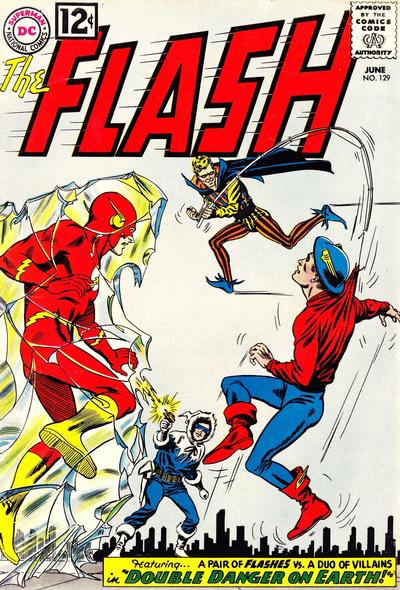
"Double Danger on Earth" by Fox and the Infantino-Giella team in 1962's The Flash #129 it's Jay Garrick's turn to make the vibrational trip to another Earth as he leaves Earth-2 which is suffering a radiation threat from space and is missing a key meteorite to solve it. He goes to perhaps discover if a similar meteorite is available to solve Earth-2's crisis and he goes about it in a logical way by actually talking first to Barry Allen and then the powers that be to arrange help.

There is surprisingly little shock when the government and the world at large learn of Earth-2. But that doesn't stop Captain Cold and The Trickster from plotting crimes. Jay helps Barry battle the baddies, but has to then turn his attention on the global threat he's come to solve while Barry focuses on the robbers. This is the one aspect of this story that rings hollow. Clearly the threat to Earth-2 is far more grave than the shenanigans of the rogues, but somehow both are treated with the same level of significance. It makes Barry come off a bit unaware to be frank. Fox would've been better served to have had the Rogues' crimes more directly linked to the other threat. As it is, they seem a distraction in a much more serious adventure.

Not surprisingly Jay solves the problem of mining and transporting the meteorite and then he and Barry wrap up the rogues. It's a fun tale, and the threat of the radiation is a worthy one, but despite its elegant craftsmanship the lack of focus does make this story seem a tad sillier than it needs to.


1963 saw another team up of the two Flashes and this time a Golden Age villain with some real heft shows up -- Vandal Savage.

"Vengeance of the Immortal Villain" in The Flash #137 again by Fox and the Infantino-Giella team give us another tale of Barry Allen going to Earth-2 after noticing a coincidence about some mysterious lights and some city names. He digs out his old Justice Society of America comics and checks that he's correct, the names are associated with the vintage group and so off he vibrates to Earth-2.

It turns out that the mysterious lights are the work of Vandal Savage, and Jay is already on the case. He reveals that his colleagues in the JSofA have vanished. Soon enough the means of that mystery is revealed when Jay is bound in a cube of transparent material and transported across the sky. Barry rescues him and they confront the immortal Cro-Magnon Vandal Savage who quickly captures both Flashes after revealing he's already kidnapped the other JSofA members.

The two Flashes are pitted against each other, but Barry's quick thinking reveals Savage's tricks and soon enough his plot is foiled and Justice Society members (Hawkman, Wonder Woman, Dr.Mid-Nite, Atom, Green Lantern, and Johnny Thunder) are out and about and thinking that a reunion might be in order.

The stage is set.

These are some whopping fun tales. They are sometimes burdened by Fox's intricate over-plotting, but somehow it all gels for the most part. It's clear that each of the three adventures adds a new dash to the mix. The first meeting is novel enough on its own with Earth-1 finding Earth-2, the second turns that on its head, and the third has the heroes battle each other for the first time. A Marvel comic of the time would've had them beating the stuffing out of each other in all three tales, and that speaks to key difference in the two companies and their approach to heroism.

The comics of DC's Silver Age were pleasant and orderly and polite and polished. All of those traits are evident to a grand degree in all three of these Flash stories. Marvel was more vigorous and visceral at the time, latching onto fans left and right. This would be a problem eventually, but in 1963 it was only a small one.

Next stop is the very first JLofA-JSofA crossover. See you then.

Finally here's a small cover gallery of some of the reprints of these stories.


My first ever Flash comic book


Rip Off

Falcon Fashions!


Here's a piece of original artwork that gives us a glimpse of what The Falcon's original costume might've looked like. I've always been a fan of the original green and gold Falcon costume, but I don't think I'd have liked the short pants evident on this Gene Colan and Joe Sinnott original.


And here we see the original cover by John Romita when Falcon first donned his red and white gear. He doesn't have wings yet and he still has his exceedingly cool falconer's glove.

Rip Off

Tuesday, July 5, 2011

Dicks!


Driving a school bus has been among the most challenging jobs I've ever had. I did it for nearly a decade and the pressure in that job to keep a busload of kids safe is immense. Rules of the road have to be followed, a pattern of drop-offs has to be followed without fail depsite the fact it might change from day to day, and bored kids of all ages need to be managed. I often tell people that it's like teaching a one-room school full of kids at forty miles an hour backwards. If you can do that you are fine.


The job can call for some rough justice from time to time, and some kids don't cotton to it. One student once called me a "Dick" in response to some admonition I delivered to him. I wasn't staggered by the name, I've heard a lot of them, but maintaining discipline meant I had to respond and I wrote the kid up. The Principal said to him (in my presence) that while I might be a "dick" the kid couldn't call me one. I smiled and the kid smiled. It spoke to the moment perfectly, allowed the kid to keep his dignity and solved the issue.


The recent "controversy" over Mark Halperin, a longtime journalist with significant credentials and history, calling the President a "Dick" on The Morning Joe on MSNBC has me nonplussed. Halperin has been suspended indefinitely merely because he used the one-time phrase after asking specifically if there was a seven second delay. His intention was clearly to make the remark off the record, and a technical snafu caused him to deliver the comment over the air. At once, Joe Scarborough and Mika Brezinski had twin attacks of the vapors after both specifically having encouraged Halperin to make the remark. Halperin apologized immediately and I assumed that would be that. When I read that he'd been suspended I was very surprised.


If ever there was a tempest in a teapot this is it. That such a mild slur could cause such uproar speaks not to the truth of the moment, but the goals of those who critique the situation. Rudeness is a commonplace in the world we live in, and maintaining some decorum is necessary. But to get your shorts in a wad over something as meager as this seems stupid.


I'm supporter of the President by and large, though his policies on education and the war in Afghanistan don't sit well with me. But when I voted for him, I knew what both those policies were likely to be. He was quite clear on them during the campaign, and I'm often bemused by pundits today who seem not to remember that. But if President Obama really got so miffed about this comment that he felt suspension was necessary I'm disappointed. I'd hope if he's even heard the remark he merely smiled. Probably it's just MSNBC covering their collective asses on this one, hoping their access to the White House doesn't get diminished.

I heard the President's press conference that prompted the comment and while I agree with almost every point of policy and procedure he identified, his tone was a tad sarcastic and well... "dickish". The Chattering Class seems not to be able to handle these truths. I'd like to remind them all, that just because no one calls you a name, it doesn't mean the name doesn't apply.

Rip Off

The Kangpin!


I ran across this French comic book cover featuring Spidey and a baddie I can only refer to as "Kangpin".


Based on the original Spidey cover featuring a very dynamic clash between Kingpin and the Web-Slinger, that's one offbeat way to adapt the artwork by "Jazzy" John Romita.


In a later issue of Vengeur the real Kang shows up, also by Romita.

Rip Off