Thursday, June 9, 2011

The Hour Of The Dragon -- Chapter Nine!


The Hour of the Dragon
Chapter 9: "It Is the King or His Ghost!"
by Robert E. Howard


MANY MEN PASSED through the great arched gates of Tarantia between sunset and midnight--belated travelers, merchants from afar with heavily laden mules, free workmen from the surrounding farms and vineyards. Now that Valerius was supreme in the central provinces, there was no rigid scrutiny of the folk who flowed in a steady stream through the wide gates. Discipline had been relaxed. The Nemedian soldiers who stood on guard were half drunk, and much too busy watching for handsome peasant girls and rich merchants who could be bullied to notice workmen or dusty travelers, even one tall wayfarer whose worn cloak could not conceal the hard lines of his powerful frame.

This man carried himself with an erect, aggressive bearing that was too natural for him to realise it himself, much less dissemble it. A great patch covered one eye, and his leather coif, drawn low over his brows, shadowed his features. With a long thick staff in his muscular brown hand, he strode leisurely through the arch where the torches flared and guttered, and, ignored by the tipsy guardsmen, emerged upon the wide streets of Tarantia.

Upon these well-lighted thoroughfares the usual throngs went about their business, and shops and stalls stood open, with their wares displayed. One thread ran a constant theme through the pattern. Nemedian soldiers, singly or in clumps, swaggered through the throngs, shouldering their way with studied arrogance. Women scurried from their path, and men stepped aside with darkened brows and clenched fists. The Aquilonians were a proud race, and these were their hereditary enemies.

The knuckles of the tall traveler knotted on his staff, but, like the others, he stepped aside to let the men in armor have the way. Among the motley and varied crowd he did not attract much attention in his drab, dusty garments. But once, as he passed a sword-seller's stall and the light that streamed from its wide door fell full upon him, he thought he felt an intense stare upon him, and turning quickly, saw a man in the brown jerkin of a free workman regarding him fixedly. This man turned away with undue haste, and vanished in the shifting throng. But Conan turned into a narrow bystreet and quickened his pace. It might have been mere idle curiosity; but he could take no chances.

The grim Iron Tower stood apart from the citadel, amid a maze of narrow streets and crowding houses where the meaner structures, appropriating a space from which the more fastidious shrank, had invaded a portion of the city ordinarily alien to them. The Tower was in reality a castle, an ancient, formidable pile of heavy stone and black iron, which had itself served as the citadel in an earlier, ruder century.

Not a long distance from it, lost in a tangle of partly deserted tenements and warehouses, stood an ancient watchtower, so old and forgotten that it did not appear on the maps of the city for a hundred years back. Its original purpose had been forgotten, and nobody, of such as saw it at all, noticed that the apparently ancient lock which kept it from being appropriated as sleeping-quarters by beggars and thieves, was in reality comparatively new and extremely powerful, cunningly disguised into an appearance of rusty antiquity. Not half a dozen men in the kingdom had ever known the secret of that tower.

No keyhole showed in the massive, green-crusted lock. But Conan's practised fingers, stealing over it, pressed here and there knobs invisible to the casual eye. The door silently opened inward and he entered solid blackness, pushing the door shut behind him, A light would have showed the tower empty, a bare, cylindrical shaft of massive stone.

Groping in a corner with the sureness of familiarity, he found the projections for which he was feeling on a slab of the stone that composed the floor. Quickly he lifted it, and without hesitation lowered himself into the aperture beneath. His feet felt stone steps leading downward into what he knew was a narrow tunnel that ran straight toward the foundations of the Iron Tower, three streets away.

The bell on the citadel, which tolled only at the midnight hour or for the death of a king, boomed suddenly. In a dimly lighted chamber in the Iron Tower a door opened and a form emerged into a corridor. The interior of the Tower was as forbidding as its external appearance. Its massive stone walls were rough, unadorned. The flags of the floor were worn deep by generations of faltering feet, and the vault of the ceiling was gloomy in the dim light of torches set in niches.

The man who trudged down that grim corridor was in appearance in keeping with his surroundings. He was a tall, powerfully-built man, clad in close-fitting black silk. Over his head was drawn a black hood which fell about his shoulders, having two holes for his eyes. From his shoulders hung a loose black cloak, and over one shoulder he bore a heavy ax, the shape of which was that of neither tool nor weapon.

As he went down the corridor, a figure came hobbling up it, a bent, surly old man, stooping under the weight of his pike and a lantern he bore in one hand.

"You are not as prompt as your predecessor, master headsman," he grumbled. "Midnight has just struck, and masked men have gone to milady's cell. They await you."

"The tones of the bell still echo among the towers," answered the executioner. "If I am not so quick to leap and run at the beck of Aquilonians as was the dog who held this office before me, they shall find my arm no less ready. Get you to your duties, old watchman, and leave me to mine. I think mine is the sweeter trade, by Mitra, for you tramp cold corridors and peer at rusty dungeon doors, while I lop off the fairest head in Tarantia this night."

The watchman limped on down the corridor, still grumbling, and the headsman resumed his leisurely way. A few strides carried him around a turn in the corridor, and he absently noted that at his left a door stood partly open. If he had thought, he would have known that that door had been opened since the watchman passed; but thinking was not his trade. He was passing the unlocked door before he realized that aught was amiss, and then it was too late.

A soft tigerish step and the rustle of a cloak warned him, but before he could turn, a heavy arm hooked about his throat from behind, crushing the cry before it could reach his lips. In the brief instant that was allowed him he realized with a surge of panic the strength of his attacker, against which his own brawny thews were helpless. He sensed without seeing the poised dagger.

"Nemedian dog!" muttered a voice thick with passion in his ear. "You've cut off your last Aquilonian head!"

And that was the last thing he ever heard.

In a dank dungeon, lighted only by a guttering torch, three men stood about a young woman who knelt on the rush-strewn flags staring wildly up at them. She was clad only in a scanty shift; her golden hair fell in lustrous ripples about her white shoulders, and her wrists were bound behind her. Even in the uncertain torchlight, and in spite of her disheveled condition and pallor of fear, her beauty was striking. She knelt mutely, staring with wide eyes up at her tormentors. The men were closely masked and cloaked. Such a deed as this needed masks, even in a conquered land. She knew them all nevertheless; but what she knew would harm no one--after that night.

"Our merciful sovereign offers you one more chance, Countess," said the tallest of the three, and he spoke Aquilonian without an accent. "He bids me say that if you soften your proud, rebellious spirit, he will still open his arms to you. If not--" he gestured toward a grim wooden block in the center of the cell. It was blackly stained, and showed many deep nicks as if a keen edge, cutting through some yielding substance, had sunk into the wood.

Albiona shuddered and turned pale, shrinking back. Every fiber in her vigorous young body quivered with the urge of life. Valerius was young, too, and handsome. Many women loved him, she told herself, fighting with herself for life. But she could not speak the word that would ransom her soft young body from the block and the dripping ax. She could not reason the matter. She only knew that when she thought of the clasp of Valerius' arms, her flesh crawled with an abhorrence greater than the fear of death. She shook her head helplessly, compelled by an impulsion more irresistible than the instinct to live.

"Then there is no more to be said!" exclaimed one of the others impatiently, and he spoke with a Nemedian accent. "Where is the headsman?"

As if summoned by the word, the dungeon door opened silently, and a great figure stood framed in it, like a black shadow from the underworld.

Albiona voiced a low, involuntary cry at the sight of that grim shape, and the others stared silently for a moment, perhaps themselves daunted with superstitious awe at the silent, hooded figure. Through the coif the eyes blazed like coals of blue fire, and as these eyes rested on each man in turn, he felt a curious chill travel down his spine.

Then the tall Aquilonian roughly seized the girl and dragged her to the block. She screamed uncontrollably and fought hopelessly against him, frantic with terror, but he ruthlessly forced her to her knees, and bent her yellow head down to the bloody block.

"Why do you delay, headsman?" he exclaimed angrily. "Perform your task!"

He was answered by a short, gusty boom of laughter that was indescribably menacing. All in the dungeon froze in their places, staring at the hooded shape--the two cloaked figures, the masked man bending over the girl, the girl herself on her knees, twisting her imprisoned head to look upward.

"What means this unseemly mirth, dog?" demanded the Aquilonian uneasily.

The man in the black garb tore his hood from his head and flung it to the ground; he set his back to the closed door and lifted the headsman's ax.

"Do you know me, dogs?" he rumbled. "Do you know me?"

The breathless silence was broken by a scream.

"The king!" shrieked Albiona, wrenching herself free from the slackened grasp of her captor. "Oh, Mitra, the king!"

The three men stood like statues, and then the Aquilonian started and spoke, like a man who doubts his own senses.

"Conan!" he ejaculated. "It is the king, or his ghost! What devil's work is this?"

"Devil's work to match devils!" mocked Conan, his lips laughing but Hell flaming in his eyes. "Come, fall to, my gentlemen. You have your swords, and I this cleaver. Nay, I think this butcher's tool fits the work at hand, my fair lords!"

"At him!" muttered the Aquilonian, drawing his sword. "It is Conan and we must kill or be killed!"

And like men waking from a trance, the Nemedians drew their blades and rushed on the king.

The headsman's ax was not made for such work, but the king wielded the heavy, clumsy weapon as lightly as a hatchet, and his quickness of foot, as he constantly shifted his position, defeated their purpose of engaging him all three at once.

He caught the sword of the first man on his ax-head and crushed in the wielder's breast with a murderous counterstroke before he could step back or parry. The remaining Nemedian, missing a savage swipe, had his brains dashed out before he could recover his balance, and an instant later the Aquilonian was backed into a corner, desperately parrying the crashing strokes that rained about him, lacking opportunity even to scream for help.

Suddenly Conan's long left arm shot out and ripped the mask from the man's head, disclosing the pallid features.

"Dog!" grated the king. "I thought I knew you. Traitor! Damned renegade! Even this base steel is too honorable for your foul head. Nay, die as thieves die!"

The ax fell in a devastating arc, and the Aquilonian cried out and went to his knees, grasping the severed stump of his right arm from which blood spouted. It had been shorn away at the elbow, and the ax, unchecked in its descent, had gashed deeply into his side, so that his entrails bulged out.

"Lie there and bleed to death," grunted Conan, casting the ax away disgustedly. "Come, Countess!"

Stooping, he slashed the cords that bound her wrists and lifting her as if she had been a child, strode from the dungeon. She was sobbing hysterically, with her arms thrown about his corded neck in a frenzied embrace.

"Easy all," he muttered. "We're not out of this yet. If we can reach the dungeon where the secret door opens on stairs that lead to the tunnel--devil take it, they've heard that noise, even through these walls."

Down the corridor arms clanged and the tramp and shouting of men echoed under the vaulted roof. A bent figure came hobbling swiftly along, lantern held high, and its light shone full on Conan and the girl. With a curse the Cimmerian sprang toward him, but the old watchman, abandoning both lantern and pike, scuttled away down the corridor, screeching for help at the top of his cracked voice. Deeper shouts answered him.

Conan turned swiftly and ran the other way. He was cut off from the dungeon with the secret lock and the hidden door through which he had entered the Tower, and by which he had hoped to leave, but he knew this grim building well. Before he was king he had been imprisoned in it.

He turned off into a side passage and quickly emerged into another, broader corridor, which ran parallel to the one down which he had come, and which was at the moment deserted. He followed this only a few yards, when he again turned back, down another side passage. This brought him back into the corridor he had left, but at a strategic point. A few feet farther up the corridor there was a heavy bolted door, and before it stood a bearded Nemedian in corselet and helmet his back to Conan as he peered up the corridor in the direction of the growing tumult and wildly waving lanterns.

Conan did not hesitate. Slipping the girl to the ground, he ran at the guard swiftly and silently, sword in hand. The man turned just as the king reached him, bawled in surprize and fright and lifted his pike; but before he could bring the clumsy weapon into play, Conan brought down his sword on the fellow's helmet with a force that would have felled an ox. Helmet and skull gave way together and the guard crumpled to the floor.

In an instant Conan had drawn the massive bolt that barred the door-- too heavy for one ordinary man to have manipulated--and called hastily to Albiona, who ran staggering to him. Catching her up unceremoniously with one arm, he bore her through the door and into the outer darkness.

They had come into a narrow alley, black as pitch, walled by the side of the Tower on one hand, and the sheer stone back of a row of buildings on the other. Conan, hurrying through the darkness as swiftly as he dared, felt the latter wall for doors or windows, but found none.

The great door clanged open behind them, and men poured out, with torches gleaming on breastplates and naked swords. They glared about, bellowing, unable to penetrate the darkness which their torches served to illuminate for only a few feet in any direction, and then rushed down the alley at random--heading in the direction opposite to that taken by Conan and Albiona.

"They'll learn their mistake quick enough," he muttered, increasing his pace. "If we ever find a crack in this infernal wall--damn! The street watch!"

Ahead of them a faint glow became apparent, where the alley opened into a narrow street, and he saw dim figures looming against it with a glimmer of steel. It was indeed the street watch, investigating the noise they had heard echoing down the alley.

"Who goes here?" they shouted, and Conan grit his teeth at the hated Nemedian accent.

"Keep behind me," he ordered the girl. "We've got to cut our way through before the prison guards come back and pin us between them."

And grasping his sword, he ran straight at the oncoming figures.

The advantage of surprize was his. He could see them, limned against the distant glow, and they could not see him coming at them out of the black depths of the alley. He was among them before they knew it, smiting with the silent fury of a wounded lion.

His one chance lay in hacking through before they could gather their wits. But there were half a score of them, in full mail, hard-bitten veterans of the border wars, in whom the instinct for battle could take the place of bemused wits. Three of them were down before they realized that it was only one man who was attacking them, but even so their reaction was instantaneous. The clangor of steel rose deafeningly, and sparks flew as Conan's sword crashed on basinet and hauberk. He could see better than they, and in the dim light his swiftly moving figure was an uncertain mark. Flailing swords cut empty air or glanced from his blade, and when he struck, it was with the fury and certainty of a hurricane.

But behind him sounded the shouts of the prison guards, returning up the alley at a run, and still the mailed figures before him barred his way with a bristling wall of steel. In an instant the guards would be on his back--in desperation he redoubled his strokes, flailing like a smith on an anvil, and then was suddenly aware of a diversion. Out of nowhere behind the watchmen rose a score of black figures and there was a sound of blows, murderously driven. Steel glinted in the gloom, and men cried out, struck mortally from behind. In an instant the alley was littered with writhing forms. A dark, cloaked shape sprang toward Conan, who heaved up his sword, catching a gleam of steel in the right hand. But the other was extended to him empty and a voice hissed urgently: "This way, Your Majesty! Quickly!"

With a muttered oath of surprize, Conan caught up Albiona in one massive arm, and followed his unknown befriender. He was not inclined to hesitate, with thirty prison guardsmen closing in behind him.

Surrounded by mysterious figures he hurried down the alley, carrying the countess as if she had been a child. He could tell nothing of his rescuers except that they wore dark cloaks and hoods. Doubt and suspicion crossed his mind, but at least they had struck down his enemies, and he saw no better course than to follow them.

As if sensing his doubt, the leader touched his arm lightly and said: "Fear not, King Conan; we are your loyal subjects." The voice was not familiar, but the accent was Aquilonian of the central provinces.

Behind them the guards were yelling as they stumbled over the shambles in the mud, and they came pelting vengefully down the alley, seeing the vague dark mass moving between them and the light of the distant street. But the hooded men turned suddenly toward the seemingly blank wall, and Conan saw a door gape there. He muttered a curse. He had traversed that alley by day, in times past, and had never noticed a door there. But through it they went, and the door closed behind them with the click of a lock. The sound was not reassuring, but his guides were hurrying him on, moving with the precision of familiarity, guiding Conan with a hand at either elbow. It was like traversing a tunnel, and Conan felt Albiona's lithe limbs trembling in his arms. Then somewhere ahead of them an opening was faintly visible, merely a somewhat less black arch in the blackness, and through this they filed.

After that there was a bewildering succession of dim courts and shadowy alleys and winding corridors, all traversed in utter silence, until at last they emerged into a broad lighted chamber, the location of which Conan could not even guess, for their devious route had confused even his primitive sense of direction.

Be here next time for Chapter Ten.

Rip Off

Wednesday, June 8, 2011

The Pop-Up Spirit!


I wish I'd have an extra $35 bucks to drop on this neat bit of Spirit ephemera when I chanced across it at my local Borders. It's a fun thing, but it's hard to justify on any terms other than novelty.


They at least selected a solid Spirit tale to adapt into this peculiar format. The Sand Saref story was the basis of the ill-fated movie. It was adapted from another bit of work Eisner did titled original "John Law".


For a quick comparison see this link.


The cover itself comes from this iconic Spirit section. This is part of the John Law adaptation which became the Sand Saref story.


And of course it inspired the first Warren Spirit cover by Basil Gogos.

Rip Off

X-Men Is First Class!


Just went yesterday to catch this latest installment in the X-Men movie franchise, and I won't mince words. It's the best one yet! I loved it through and through. I think it's one of the most complete cinematic experiences I've had with a "superhero" movie in many years.

The energy of the movie is fantastic, the period settings giving the whole shebang a real sizzle and snap, a distinctly James Bond feel. The actors are first rate and for the first time I'm convinced of what Stan and Jack wanted to sell all those decades ago, these are kids drawn into a conflict more dangerous than anything most of them have contemplated. The X-Men of the earlier flicks are adults by and large with a token kid thrown in for flavor, but these X-Men are kids with relatively minor adult supervision. The sequence where the mutants are gathered is delightful, reminding me of Oceans 11.

The exceptions are Magneto and Professor X. Michael Fassbender who portrays Magneto is fantastic, the kind of presence you watch constantly on the screen. His early scenes are spectacular and my daughter who is an absolute X-novice found him the most impressive of all the characters. James McAvoy as Professor X is compelling and convincing as is the charming girl who plays Mystique. The other "X-Men" are Banshee, Havok, Dragonfly (not called that in the movie), and Beast. On the other side of the coin are some great characters, many new to me since I've paid little attention to the X-franchise for nearly twenty years now. Azazel was compelling as was Riptide, two baddies who assist Sebastian Shaw played to the hilt by Kevin Bacon. Emma Frost performed by January Jones is beautiful and dangerous too. One of the X-candidates was a new one to me too, a guy called Darwin.

This is a movie that won't suffer discussion too much, so I'll stay off the plot points, save to talk about what you might already know. The storyline, set against the Cuban Missile Crisis is brilliant and offers perhaps the most spectacular and convincing superpower work I've seen on film. This a fast-paced and engaging movie, with a wonderful score.

I give this one the highest recommendation.


Rip Off

The Hour Of The Dragon -- Chapter Eight!


The Hour of the Dragon
Chapter 8: Dying Embers
by Robert E. Howard


THE COUNTRYSIDE ABOUT Tarantia had escaped the fearful ravaging of the more easterly provinces. There were evidences of the march of a conquering army in broken hedges, plundered fields and looted granaries, but torch and steel had not been loosed wholesale.

There was but one grim splotch on the landscape--a charred expanse of ashes and blackened stone, where, Conan knew, had once stood the stately villa of one of his staunchest supporters.

The king dared not openly approach the Galannus farm, which lay only a few miles from the city. In the twilight he rode through an extensive woodland, until he sighted a keeper's lodge through the trees. Dismounting and tying his horse, he approached the thick, arched door with the intention of sending the keeper after Servius. He did not know what enemies the manor house might be sheltering. He had seen no troops, but they might be quartered all over the countryside. But as he drew near, he saw the door open and a compact figure in silk hose and richly embroidered doublet stride forth and turn up a path that wound away through the woods.

"Servius!"

At the low call the master of the plantation wheeled with a startled exclamation. His hand flew to the short hunting sword at his hip, and he recoiled from the tall gray steel figure standing in the dusk before him.

"Who are you?" he demanded. "What is your--Mitra!"

His breath hissed inward and his ruddy face paled. "Avaunt!" he ejaculated. "Why have you come back from the gray lands of death to terrify me? I was always your true liegeman in your lifetime--"

"As I still expect you to be," answered Conan. "Stop trembling, man; I'm flesh and blood."

Sweating with uncertainty Servius approached and stared into the face of the mail-clad giant, and then, convinced of the reality of what he saw, he dropped to one knee and doffed his plumed cap.

"Your Majesty! Truly, this is a miracle passing belief! The great bell in the citadel has tolled your dirge, days agone. Men said you died at Valkia, crushed under a million tons of earth and broken granite."

"It was another in my harness," grunted Conan. "But let us talk later. If there is such a thing as a joint of beef on your board--"

"Forgive me, my lord!" cried Servius, springing to his feet. "The dust of travel is gray on your mail, and I keep you standing here without rest or sup! Mitra! I see well enough now that you are alive, but I swear, when I turned and saw you standing all gray and dim in the twilight, the marrow of my knees turned to water. It is an ill thing to meet a man you thought dead in the woodland at dusk."

"Bid the keeper see to my steed which is tied behind yonder oak," requested Conan, and Servius nodded, drawing the king up the path. The patrician, recovering from his supernatural fright, had become extremely nervous.

"I will send a servant from the manor," he said. "The keeper is in his lodge--but I dare not trust even my servants in these days. It is better that only I know of your presence."

Approaching the great house that glimmered dimly through the trees, he turned aside into a little-used path that ran between close-set oaks whose intertwining branches formed a vault overhead, shutting out the dim light of the gathering dusk. Servius hurried on through the darkness without speaking, and with something resembling panic in his manner, and presently led Conan through a small side door into a narrow, dimly illuminated corridor. They traversed this in haste and silence, and Servius brought the king into a spacious chamber with a high, oak-beamed ceiling and richly paneled walls. Logs flamed in the wide fireplace, for there was a frosty edge to the air, and a great meat pasty in a stone platter stood smoking on a broad mahogany board. Servius locked the massive door and extinguished the candles that stood in a silver candlestick on the table, leaving the chamber illuminated only by the fire on the hearth.

"Your pardon, Your Majesty," he apologized. "These are perilous times; spies lurk everywhere. It were better that none be able to peer through the windows and recognize you. This pasty, however, is just from the oven, as I intended supping on my return from talk with my keeper. If Your Majesty would deign--"

"The light is sufficient," grunted Conan, seating himself with scant ceremony, and drawing his poniard.

He dug ravenously into the luscious dish, and washed it down with great gulps of wine from grapes grown in Servius's vineyards. He seemed oblivious to any sense of peril, but Servius shifted uneasily on his settle by the fire, nervously fingering the heavy gold chain about his neck. He glanced continually at the diamond panes of the casement, gleaming dimly in the firelight, and cocked his ear toward the door, as if half expecting to hear the pad of furtive feet in the corridor without.

Finishing his meal, Conan rose and seated himself on another settle before the fire.

"I won't jeopardize you long by my presence, Servius," he said abruptly. "Dawn will find me far from your plantation."

"My lord--" Servius lifted his hands in expostulation, but Conan waved his protests aside.

"I know your loyalty and your courage. Both are above reproach. But if Valerius has usurped my throne, it would be death for you to shelter me, if you were discovered."

"I am not strong enough to defy him openly," admitted Servius. "The fifty men-at-arms I could lead to battle would be but a handful of straws. You saw the ruins of Emilius Scavonus' plantation?"

Conan nodded, frowning darkly.

"He was the strongest patrician in this province, as you know. He refused to give his allegiance to Valerius. The Nemedians burned him in the ruins of his own villa. After that the rest of us saw the futility of resistance, especially as the people of Tarantia refused to fight. We submitted and Valerius spared our lives, though he levied a tax upon us that will ruin many. But what could we do? We thought you were dead. Many of the barons had been slain, others taken prisoner. The army was shattered and scattered. You have no heir to take the crown. There was no one to lead us--"

"Was there not Count Trocero of Poitain?" demanded Conan harshly.

Servius spread his hands helplessly.

"It is true that his general Prospero was in the field with a small army. Retreating before Amalric, he urged men to rally to his banner. But with Your Majesty dead, men remembered old wars and civil brawls, and how Trocero and his Poitanians once rode through these provinces even as Amalric was riding now, with torch and sword. The barons were jealous of Trocero. Some men--spies of Valerius perhaps--shouted that the Count of Poitain intended seizing the crown for himself. Old sectional hates flared up again. If we had had one man with dynastic blood in his veins, we would have crowned and followed him against Nemedia. But we had none.

"The barons who followed you loyally would not follow one of their own number, each holding himself as good as his neighbor, each fearing the ambitions of the others. You were the cord that held the fagots together. When the cord was cut, the fagots fell apart. If you had had a son, the barons would have rallied loyally to him. But there was no point for their patriotism to focus upon.

"The merchants and commoners, dreading anarchy and a return of feudal days when each baron was his own law, cried out that any king was better than none, even Valerius, who was at least of the blood of the old dynasty. There was no one to oppose him when he rode up at the head of his steel-clad hosts, with the scarlet dragon of Nemedia floating over him, and rang his lance against the gates of Tarantia.

"Nay, the people threw open the gates and knelt in the dust before him. They had refused to aid Prospero in holding the city. They said they had rather be ruled by Valerius than by Trocero. They said-- truthfully--that the barons would not rally to Trocero, but that many would accept Valerius. They said that by yielding to Valerius they would escape the devastation of civil war, and the fury of the Nemedians. Prospero rode southward with his ten thousand knights, and the horsemen of the Nemedians entered the city a few hours later. They did not follow him. They remained to see that Valerius was crowned in Tarantia."

"Then the old witch's smoke showed the truth," muttered Conan, feeling a queer chill along his spine. "Amalric crowned Valerius?"

"Aye, in the coronation hall, with the blood of slaughter scarcely dried on his hands."

"And do the people thrive under his benevolent rule?" asked Conan with angry irony.

"He lives like a foreign prince in the midst of a conquered land," answered Servius bitterly. "His court is filled with Nemedians, the palace troops are of the same breed, and a large garrison of them occupy the citadel. Aye, the hour of the Dragon has come at last.

"Nemedians swagger like lords through the streets. Women are outraged and merchants plundered daily, and Valerius either can, or will, make no attempt to curb them. Nay, he is but their puppet, their figurehead. Men of sense knew he would be, and the people are beginning to find it out.

"Amalric has ridden forth with a strong army to reduce the outlying provinces where some of the barons have defied him. But there is no unity among them. Their jealousy of each other is stronger than their fear of Amalric. He will crush them one by one. Many castles and cities, realizing that, have sent in their submission. Those who resist fare miserably. The Nemedians are glutting their long hatred. And their ranks are swelled by Aquilonians whom fear, gold, or necessity of occupation are forcing into their armies. It is a natural consequence."

Conan nodded somberly, staring at the red reflections of the firelight on the richly carved oaken panels.

"Aquilonia has a king instead of the anarchy they feared," said Servius at last. "Valerius does not protect his subjects against his allies. Hundreds who could not pay the ransom imposed upon them have been sold to the Kothic slave-traders."

Conan's head jerked up and a lethal flame lit his blue eyes. He swore gustily, his mighty hands knotting into iron hammers.

"Aye, white men sell white men and white women, as it was in the feudal days. In the palaces of Shem and of Turan, they will live out the lives of slaves. Valerius is king, but the unity for which the people looked, even though of the sword, is not complete.

"Gunderland in the north and Poitain in the south are yet unconquered, and there are unsubdued provinces in the west, where the border barons have the backing of Bossonian bowmen. Yet these outlying provinces are no real menace to Valerius. They must remain on the defensive, and will be lucky if they are able to keep their independence. Here Valerius and his foreign knights are supreme."

"Let him make the best of it then," said Conan grimly. "His time is short. The people will rise when they learn that I'm alive. We'll take Tarantia back before Amalric can return with his army. Then we'll sweep these dogs from the kingdom."

Servius was silent. The crackle of the fire was loud in the stillness.

"Well," exclaimed Conan impatiently, "why do you sit with your head bent, staring at the hearth? Do you doubt what I have said?"

Servius avoided the king's eye.

"What mortal man can do, you will do, Your Majesty," he answered. "I have ridden behind you in battle, and I know that no mortal being can stand before your sword."

"What, then?"

Servius drew his fur-trimmed jupon closer about him, and shivered in spite of the flame.

"Men say your fall was occasioned by sorcery," he said presently.

"What then?"

"What mortal can fight against sorcery? Who is this veiled man who communes at midnight with Valerius and his allies, as men say, who appears and disappears so mysteriously? Men say in whispers that he is a great magician who died thousands of years ago, but has returned from death's gray lands to overthrow the king of Aquilonia and restore the dynasty of which Valerius is heir."

"What matter?" exclaimed Conan angrily. "I escaped from the devil- haunted pits of Belverus, and from diabolism in the mountains. If the people rise--"

Servius shook his head.

"Your staunchest supporters in the eastern and central provinces are dead, fled or imprisoned. Gunderland is far to the north, Poitain far to the south. The Bossonians have retired to their marches far to the west. It would take weeks to gather and concentrate these forces, and before that could be done, each levy would be attacked separately by Amalric and destroyed."

"But an uprising in the central provinces would tip the scales for us!" exclaimed Conan. "We could seize Tarantia and hold it against Amalric until the Gundermen and Poitanians could get here."

Servius hesitated, and his voice sank to a whisper.

"Men say you died accursed. Men say this veiled stranger cast a spell upon you to slay you and break your army. The great bell has tolled your dirge. Men believe you to be dead. And the central provinces would not rise, even if they knew you lived. They would not dare. Sorcery defeated you at Valkia. Sorcery brought the news to Tarantia, for that very night men were shouting of it in the streets.

"A Nemedian priest loosed black magic again in the streets of Tarantia to slay men who still were loyal to your memory. I myself saw it. Armed men dropped like flies and died in the streets in a manner no man could understand. And the lean priest laughed and said: 'I am only Altaro, only an acolyte of Orastes, who is but an acolyte of him who wears the veil; not mine is the power; the power but works through me.'"

"Well," said Conan harshly, "is it not better to die honorably than to live in infamy? Is death worse than oppression, slavery and ultimate destruction?"

"When the fear of sorcery is in, reason is out," replied Servius. "The fear of the central provinces is too great to allow them to rise for you. The outlying provinces would fight for you--but the same sorcery that smote your army at Valkia would smite you again. The Nemedians hold the broadest, richest and most thickly populated sections of Aquilonia, and they cannot be defeated by the forces which might still be at your command. You would be sacrificing your loyal subjects uselessly. In sorrow I say it, but it is true: King Conan, you are a king without a kingdom."

Conan stared into the fire without replying. A smoldering log crashed down among the flames without a bursting shower of sparks. It might have been the crashing ruin of his kingdom.

Again Conan felt the presence of a grim reality behind the veil of material illusion. He sensed again the inexorable drive of a ruthless fate. A feeling of furious panic tugged at his soul, a sense of being trapped, and a red rage that burned to destroy and kill.

"Where are the officials of my court?" he demanded at last.

"Pallantides was sorely wounded at Valkia, was ransomed by his family, and now lies in his castle in Attains. He will be fortunate if he ever rides again. Publius, the chancellor, has fled the kingdom in disguise, no man knows whither. The council has been disbanded. Some were imprisoned, some banished. Many of your loyal subjects have been put to death. Tonight, for instance, the Countess Albiona dies under the headsman's ax."

Conan started and stared at Servius with such anger smoldering in his blue eyes that the patrician shrank back.

"Why?"

"Because she would not become the mistress of Valerius. Her lands are forfeit, her henchmen sold into slavery, and at midnight, in the Iron Tower, her head must fall. Be advised, my king--to me you will ever be my king--and flee before you are discovered. In these days none is safe. Spies and informers creep among us, betraying the slightest deed or word of discontent as treason and rebellion. If you make yourself known to your subjects, it will only end in your capture and death.

"My horses and all the men that I can trust are at your disposal. Before dawn we can be far from Tarantia, and well on our way toward the border. If I cannot aid you to recover your kingdom, I can at least follow you into exile."

Conan shook his head. Servius glanced uneasily at him as he sat staring into the fire, his chin propped on his mighty fist. The firelight gleamed redly on his steel mail, on his baleful eyes. They burned in the firelight like the eyes of a wolf. Servius was again aware, as in the past, and now more strongly than ever, of something alien about the king. That great frame under the mail mesh was too hard and supple for a civilized man; the elemental fire of the primitive burned in those smoldering eyes. Now the barbaric suggestion about the king was more pronounced, as if in his extremity the outward aspects of civilization were stripped away, to reveal the primordial core. Conan was reverting to his pristine type. He did not act as a civilized man would act under the same conditions, nor did his thoughts run in the same channels. He was unpredictable. It was only a stride from the king of Aquilonia to the skin-clad slayer of the Cimmerian hills.

"I'll ride to Poitain, if it may be," Conan said at last. "But I'll ride alone. And I have one last duty to perform as king of Aquilonia."

"What do you mean, your Majesty?" asked Servius, shaken by a premonition.

"I'm going into Tarantia after Albiona tonight," answered the king. "I've failed all my other loyal subjects, it seems--if they take her head, they can have mine too."

"This is madness!" cried Servius, staggering up and clutching his throat, as if he already felt the noose closing about it.

"There are secrets to the Tower which few know," said Conan. "Anyway, I'd be a dog to leave Albiona to die because of her loyalty to me. I may be a king without a kingdom, but I'm not a man without honor."

"It will ruin us all!" whispered Servius.

"It will ruin no one but me if I fail. You've risked enough. I ride alone tonight. This is all I want you to do: procure me a patch for my eye, a staff for my hand, and garments such as travelers wear."

Be here next time for Chapter Nine.

Rip Off
Tuesday, June 7, 2011

The Full Warren Spirit!


Warren Magazines, the publisher of Creepy, Eerie,and Vampirella offered a window to many fans my age to the greatness of Will Eisner's The Spirit. I'd read how good Eisner's comic was, and I'd even seen a sample in The Great Comic Book Heroes, but somehow that early version of the series didn't communicate to me how awesome the strip had been. That would have to wait for Warren's black and white version to hit the stands. That series changed how I saw comics forever, and it gave me immense respect for the mature talent of Will Eisner.


Rip Off

The Hour Of The Dragon -- Chapter Seven!


The Hour of the Dragon
Chapter 7: The Rending of the Veil
by Robert E. Howard


CONAN KNEW HIS only chance of escape lay in speed. He did not even consider hiding somewhere near Belverus until the chase passed on; he was certain that the uncanny ally of Tarascus would be able to ferret him out. Besides, he was not one to skulk and hide; an open fight or an open chase, either suited his temperament better. He had a long start, he knew. He would lead them a grinding race for the border.

Zenobia had chosen well to selecting the white horse. His speed, toughness and endurance were obvious. The girl knew weapons and horses, and, Conan reflected with some satisfaction, she knew men. He rode westward at a gait that ate up the miles.

It was a sleeping land through which he rode, past grove-sheltered villages and white-walled villas amid spacious fields and orchards that grew sparser as he fared westward. As the villages thinned, the land grew more rugged, and the keeps that frowned from eminences told of centuries of border war. But none rode down from those castles to challenge or halt him. The lords of the keeps were following the banner of Amalric; the pennons that were wont to wave over these towers were now floating over the Aquilonian plains.

When the last huddled village fell behind him, Conan left the road, which was beginning to bend toward the northwest, toward the distant passes. To keep to the road would mean to pass by border towers, still garrisoned with armed men who would not allow him to pass unquestioned. He knew there would be no patrols riding the border marches on either side, as to ordinary times, but there were those towers, and with dawn there would probably be cavalcades of returning soldiers with wounded men to ox-carts.

This road from Belverus was the only road that crossed the border for fifty miles from north to south. It followed a series of passes through the hills, and on either hand lay a wide expanse of a wild, sparsely inhabited mountains. He maintained his due westerly direction, intending to cross the border deep to the wilds of the hills that lay to the south of the passes. It was a shorter route, more arduous, but safer for a hunted fugitive. One man on a horse could traverse country an army would find impassable.

But at dawn he had not reached the hills; they were a long, low, blue rampart stretching along the horizon ahead of him. Here there were neither farms nor villages, no white-walled villas loomed among clustering trees. The dawn wind stirred the tall stiff grass, and there was nothing but the long rolling swells of brown earth, covered with dry grass, and to the distance the gaunt walls of a stronghold on a low hill. Too many Aquilonian raiders had crossed the mountains to not too-distant days for the countryside to be thickly settled as it was farther to the east.

Dawn ran like a prairie fire across the grasslands, and high overhead sounded a weird crying as a straggling wedge of wild geese winged swiftly southward. In a grassy swale Conan halted and unsaddled his mount. Its sides were heaving, its coat plastered with sweat. He had pushed it unmercifully through the hours before dawn.

While it munched the brittle grass and rolled, he lay at the crest of the low slope, staring eastward. Far away to the northward he could see the road he had left, streaming like a white ribbon over a distant rise. No black dots moved along that glistening ribbon. There was no sign about the castle to the distance to indicate that the keepers had noticed the lone wayfarer.

An hour later the land still stretched bare. The only sign of life was a glint of steel on the far-off battlements, a raven to the sky that wheeled backward and forth, dipping and rising as if seeking something. Conan saddled and rode westward at a more leisurely gait.

As he topped the farther crest of the slope, a raucous screaming burst out over his head, and looking up, he saw the raven flapping high above him, cawing incessantly. As he rode on, it followed him, maintaining its position and making the morning hideous with its strident cries, heedless of his efforts to drive it away.

This kept up for hours, until Conan's teeth were on edge, and he felt that he would give half his kingdom to be allowed to wring that black neck.

"Devils of hell!" he roared to futile rage, shaking his mailed fist at the frantic bird. "Why do you harry me with your squawking? Begone, you black spawn of perdition, and peck for wheat to the farmers' fields!"

He was ascending the first pitch of the hills, and he seemed to hear an echo of the bird's clamor far behind him. Turning to his saddle, he presently made out another black dot against the blue. Beyond that again he caught the glint of the afternoon sun on steel. That could mean only one thing: armed men. And they were not riding along the beaten road, which was out of his sight beyond the horizon. They were following him. His face grew grim and he shivered slightly as he stared at the raven that wheeled high above him.

"So it is more than the whim of a brainless beast?" he muttered. "Those riders cannot see you, spawn of Hell; but the other bird can see you, and they can see him. You follow me, he follows you, and they follow him. Are you only a craftily trained feathered creature, or some devil in the form of a bird? Did Xaltotun set you on my trail? Are you Xaltotun?"

Only a strident screech answered him, a screech vibrating with harsh mockery.

Conan wasted no more breath on his dusky betrayer. Grimly he settled to the long grind of the hills, he dared not push the horse too hard; the rest he had allowed it had not been enough to freshen it. He was still far ahead of his pursuers, but they would cut down that lead steadily. It was almost a certainty that their horses were fresher than his, for they had undoubtedly changed mounts at that castle he had passed.

The going grew rougher, the scenery more rugged, steep grassy slopes pitching up to densely timbered mountainsides. Here, he knew, he might elude his hunters, but for that hellish bird that squalled incessantly above him. He could no longer see them in this broken country, but he was certain that they still followed him, guided unerringly by their feathered allies. That black shape became like a demoniac incubus, hounding him through measureless hells. The stones he hurled with a curse went wide or fell harmless, though in his youth he had felled hawks on the wing.

The horse was tiring fast. Conan recognized the grim finality of his position. He sensed an inexorable driving fate behind all this. He could not escape. He was as much a captive as he had been in the pits of Belverus. But he was no son of the Orient to yield passively to what seemed inevitable. If he could not escape, he would at least take some of his foes into eternity with him. He turned into a wide thicket of larches that masked a slope, looking for a place to turn at bay.

Then ahead of him there rang a strange, shrill scream, human yet weirdly timbred. An instant later he had pushed through a screen of branches, and saw the source of that eldritch cry. In a small glade below him four soldiers in Nemedian chain mail were binding a noose about the neck of a gaunt old woman in peasant garb. A heap of fagots, bound with cord on the ground near by, showed what her occupation had been when surprized by these stragglers.

Conan felt slow fury swell his heart as he looked silently down and saw the ruffians dragging her toward a tree whose low-spreading branches were obviously intended to act as a gibbet. He had crossed the frontier an hour ago. He was standing on his own soil, watching the murder of one of his own subjects. The old woman was struggling with surprizing strength and energy, and as he watched, she lifted her head and voiced again the strange, weird, far-carrying call he had heard before. It was echoed as if in mockery by the raven flapping above the trees. The soldiers laughed roughly, and one struck her in the mouth.

Conan swung from his weary steed and dropped down the face of the rocks, landing with a clang of mail on the grass. The four men wheeled at the sound and drew their swords, gaping at the mailed giant who faced them, sword in hand.

Conan laughed harshly. His eyes were bleak as flint.

"Dogs!" he said without passion and without mercy. "Do Nemedian jackals set themselves up as executioners and hang my subjects at will? First you must take the head of their king. Here I stand, awaiting your lordly pleasure!"

The soldiers stared at him uncertainly as he strode toward them.

"Who is this madman?" growled a bearded ruffian. "He wears Nemedian mail, but speaks with an Aquilonian accent."

"No matter," quoth another. "Cut him down, and then we'll hang the old hag."

And so saying he ran at Conan, lifting his sword. But before he could strike, the king's great blade lashed down, splitting helmet and skull. The man fell before him, but the others were hardy rogues. They gave tongue like wolves and surged about the lone figure in the gray mail, and the clamor and din of steel drowned the cries of the circling raven.

Conan did not shout. His eyes coals of blue fire and his lips smiling bleakly, he lashed right and left with his two-handed sword. For all his size he was quick as a cat on his feet, and he was constantly in motion, presenting a moving target so that thrusts and swings cut empty air oftener than not. Yet when he struck he was perfectly balanced, and his blows fell with devastating power. Three of the four were down, dying in their own blood, and the fourth was bleeding from half a dozen wounds, stumbling in headlong retreat as he parried frantically, when Conan's spur caught in the surcoat of one of the fallen men.

The king stumbled, and before he could catch himself the Nemedian, with the frenzy of desperation, rushed him so savagely that Conan staggered and fell sprawling over the corpse. The Nemedian croaked in triumph and sprang forward, lifting his great sword with both hands over his right shoulder, as he braced his legs wide for the stroke--and then, over the prostrate king, something huge and hairy shot like a thunderbolt full on the soldier's breast, and his yelp of triumph changed to a shriek of death.

Conan, scrambling up, saw the man lying dead with his throat torn out, and a great gray wolf stood over him, head sunk as it smelt the blood that formed a pool on the grass.

The king turned as the old woman spoke to him. She stood straight and tall before him, and in spite of her ragged garb, her features, clear- cut and aquiline, and her keen black eyes, were not those of a common peasant woman. She called to the wolf and it trotted to her side like a great dog and rubbed its giant shoulder against her knee, while it gazed at Conan with great green lambent eyes. Absently she laid her hand upon its mighty neck, and so the two stood regarding the king of Aquilonia. He found their steady gaze disquieting, though there was no hostility in it.

"Men say King Conan died beneath the stones and dirt when the cliffs crumbled by Valkia," she said in a deep, strong, resonant voice.

"So they say," he growled. He was in no mood for controversy, and he thought of those armored riders who were pushing nearer every moment. The raven above him cawed stridently, and he cast an involuntary glare upward, grinding his teeth in a spasm of nervous irritation.

Up on the ledge the white horse stood with drooping head. The old woman looked at it, and then at the raven; and then she lifted a strange weird cry as she had before. As if recognizing the call, the raven wheeled, suddenly mute, and raced eastward. But before it had got out of sight, the shadow of mighty wings fell across it. An eagle soared up from the tangle of trees, and rising above it, swooped and struck the black messenger to the earth. The strident voice of betrayal was stilled for ever.

"Crom!" muttered Conan, staring at the old woman. "Are you a magician, too?"

"I am Zeiata," she said. "The people of the valleys call me a witch. Was that child of the night guiding armed men on your trail?"

"Aye." She did not seem to think the answer fantastic. "They cannot be far behind me."

"Lead your horse and follow me, King Conan," she said briefly.

Without comment he mounted the rocks and brought his horse down to the glade by a circuitous path. As he came he saw the eagle reappear, dropping lazily down from the sky, and rest an instant on Zeiata's shoulder, spreading its great wings lightly so as not to crush her with its weight.

Without a word she led the way, the great wolf trotting at her side, the eagle soaring above her. Through deep thickets and along tortuous ledges poised over deep ravines she led him, and finally along a narrow precipice-edged path to a curious dwelling of stone, half hut, half cavern, beneath a cliff hidden among the gorges and crags. The eagle flew to the pinnacle of this cliff, and perched there like a motionless sentinel.

Still silent, Zeiata stabled the horse in a near-by cave, with leaves and grass piled high for provender, and a tiny spring bubbling in the dim recesses.

In the hut she seated the king on a rude, hide-covered bench, and she herself sat upon a low stool before the tiny fireplace, while she made a fire of tamarisk chunks and prepared a frugal meal. The great wolf drowsed beside her, facing the fire, his huge head sunk on his paws, his ears twitching in his dreams.

"You do not fear to sit in the hut of a witch?" she asked, breaking her silence at last.

An impatient shrug of his gray-mailed shoulders was her guest's only reply. She gave into his hands a wooden dish heaped with dried fruits, cheese and barley bread, and a great pot of the heady upland beer, brewed from barley grown in the high valleys.

"I have found the brooding silence of the glens more pleasing than the babble of city streets," she said. "The children of the wild are kinder than the children of men." Her hand briefly stroked the ruff of the sleeping wolf. "My children were afar from me today, or I had not needed your sword, my king. They were coming at my call."

"What grudge had those Nemedian dogs against you?" Conan demanded.

"Skulkers from the invading army straggle all over the countryside, from the frontier to Tarantia," she answered. "The foolish villagers in the valleys told them that I had a store of gold hidden away, so as to divert their attentions from their villages. They demanded treasure from me, and my answers angered them. But neither skulkers nor the men who pursue you, nor any raven will find you here."

He shook his head, eating ravenously.

"I'm for Tarantia."

She shook her head.

"You thrust your head into the dragon's jaws. Best seek refuge abroad. The heart is gone from your kingdom."

"What do you mean?" he demanded. "Battles have been lost before, yet wars won. A kingdom is not lost by a single defeat."

"And you will go to Tarantia?"

"Aye. Prospero will be holding it against Amalric."

"Are you sure?"

"Hell's devils, woman!" he exclaimed wrathfully. "What else?"

She shook her head. "I feel that it is otherwise. Let us see. Not lightly is the veil rent; yet I will rend it a little, and show you your capital city."

Conan did not see what she cast upon the fire, but the wolf whimpered in his dreams, and a green smoke gathered and billowed up into the hut. And as he watched, the walls and ceiling of the hut seemed to widen, to grow remote and vanish, merging with infinite immensities; the smoke rolled about him, blotting out everything. And in it forms moved and faded, and stood out in startling clarity.

He stared at the familiar towers and streets of Tarantia, where a mob seethed and screamed, and at the same time he was somehow able to see the banners of Nemedia moving inexorably westward through the smoke and flame of a pillaged land. In the great square of Tarantia the frantic throng milled and yammered, screaming that the king was dead, that the barons were girding themselves to divide the land between them, and that the rule of a king, even of Valerius, was better than anarchy. Prospero, shining in his armor, rode among them, trying to pacify them, bidding them trust Count Trocero, urging them to man the wall and aid his knights in defending the city. They turned on him, shrieking with fear and unreasoning rage, howling that he was Trocero's butcher, a more evil foe than Amalric himself. Offal and stones were hurled at his knights.

A slight blurring of the picture, that might have denoted a passing of time, and then Conan saw Prospero and his knights filing out of the gates and spurring southward. Behind him the city was in an uproar.

"Fools!" muttered Conan thickly. "Fools! Why could they not trust Prospero? Zelita, if you are making game of me, with some trickery--"

"This has passed," answered Zelata imperturbably, though somberly. "It was the evening of the day that has passed,when Prospero rode out of Tarantia, with the hosts of Amalric almost within sight. From the walls men saw the flame of their pillaging. So I read it in the smoke. At sunset the Nemedians rode into Tarantia, unopposed. Look! Even now, in the royal hall of Tarantia--"

Abruptly Conan was looking into the great coronation hall. Valerius stood on the regal dais, clad in ermine robes, and Amalric, still in his dusty, bloodstained armor, placed a rich and gleaming circlet on his yellow locks--the crown of Aquilonia! The people cheered; long lines of steel-clad Nemedian warriors looked grimly on, and nobles long in disfavor at Conan's court strutted and swaggered with the emblem of Valerius on their sleeves.

"Crom!" It was an explosive imprecation from Conan's lips as he started up, his great fists clenched into hammers, his veins on his temples knotting, his features convulsed. "A Nemedian placing the crown of Aquilonia on that renegade--in the royal hall of Tarantia!"

As if dispelled by his violence, the smoke faded, and he saw Zeiata's black eyes gleaming at him through the mist.

"You have seen--the people of your capital have forfeited the freedom you won for them by sweat and blood; they have sold themselves to the slavers and the butchers. They have shown that they do not trust their destiny. Can you rely upon them for the winning back of your kingdom?"

"They thought I was dead," he grunted, recovering some of his poise. "I have no son. Men can't be governed by a memory. What if the Nemedians have taken Tarantia? There still remain the provinces, the barons, and the people of the countrysides. Valerius has won an empty glory."

"You are stubborn, as befits a fighter. I cannot show you the future, I cannot show you all the past. Nay, I show you nothing. I merely make you see windows opened in the veil by powers un-guessed. Would you look into the past for a clue of the present?"

"Aye." He seated himself abruptly.

Again the green smoke rose and billowed. Again images unfolded before him, this time alien and seemingly irrelevant. He saw great towering black walls, pedestals half hidden in the shadows upholding images of hideous, half-bestial gods. Men moved in the shadows, dark, wiry men, clad in red, silken loincloths. They were bearing a green jade sarcophagus along a gigantic black corridor. But before he could tell much about what he saw, the scene shifted. He saw a cavern, dim, shadowy and haunted with a strange intangible horror. On an altar of black stone stood a curious golden vessel, shaped like the shell of a scallop. Into this cavern came some of the same dark, wiry men who had borne the mummy-case. They seized the golden vessel, and then the shadows swirled around them and what happened he could not say. But he saw a glimmer in a whorl of darkness, like a ball of living fire. Then the smoke was only smoke, drifting up from the fire of tamarisk chunks, thinning and fading.

"But what does this portend?" he demanded, bewildered. "What I saw in Tarantia I can understand. But what means this glimpse of Zamorian thieves sneaking through a subterranean temple of Set, in Stygia? And that cavern-I've never seen or heard of anything like it, in all my wanderings. If you can show me that much, these shreds of vision which mean nothing, disjointed, why can you not show me all that is to occur?"

Zeiata stirred the fire without replying.

"These things are governed by immutable laws," she said at last. "I can not make you understand; I do not altogether understand myself, though I have sought wisdom in the silences of the high places for more years than I can remember. I cannot save you, though I would if I might. Man must, at last, work out his own salvation. Yet perhaps wisdom may come to me in dreams, and in the morn I may be able to give you the clue to the enigma."

"What enigma?" he demanded.

"The mystery that confronts you, whereby you have lost a kingdom," she answered. And then she spread a sheepskin upon the floor before the hearth. "Sleep," she said briefly. Without a word he stretched himself upon it, and sank into restless but deep sleep through which phantoms moved silently and monstrous shapeless shadows crept. Once, limned against a purple sunless horizon, he saw the mighty walls and towers of a great city of such as rose nowhere on the waking earth he knew. Its colossal pylons and purple minarets lifted toward the stars, and over it, floating like a giant mirage, hovered the bearded countenance of the man Xaltotun.

Conan woke in the chill whiteness of early dawn, to see Zelata crouched beside the tiny fire. He had not awakened once in the night, and the sound of the great wolf leaving or entering should have roused him. Yet the wolf was there, beside the hearth, with its shaggy coat wet with dew, and with more than dew. Blood glistened wetly amid the thick fell, and there was a cut upon his shoulder.

Zeiata nodded, without looking around, as if reading the thoughts of her royal guest.

"He has hunted before dawn, and red was the hunting. I think the man who hunted a king will hunt no more, neither man nor beast."

Conan stared at the great beast with strange fascination as he moved to take the food Zelata offered him.

"When I come to my throne again I won't forget," he said briefly. "You've befriended me--by Crom, I can't remember when I've lain down and slept at the mercy of man or woman as I did last night. But what of the riddle you would read me this morn?"

A long silence ensued, in which the crackle of the tamarisks was loud on the hearth.

"Find the heart of your kingdom," she said at last. "There lies your defeat and your power. You fight more than mortal man. You will not possess the throne again unless you find the heart of your kingdom."

"Do you mean the city of Tarantia?"

She shook her head. "I am but an oracle, through whose lips the gods speak. My lips are sealed by them lest I speak too much. You must find the heart of your kingdom. I can say no more. My lips are opened and sealed by the gods."

Dawn was still white on the peaks when Conan rode westward. A glance back showed him Zelata standing in the door of her hut, inscrutable as ever, the great wolf beside her.

A gray sky arched overhead, and a moaning wind was chill with a promise of winter. Brown leaves fluttered slowly down from the bare branches, sifting upon his mailed shoulders.

All day he pushed through the hills, avoiding roads and villages. Toward nightfall he began to drop down from the heights, tier by tier, and saw the broad plains of Aquilonia spread out beneath him.

Villages and farms lay close to the foot of the hills on the western side of the mountains for, for half a century, most of the raiding across the frontier had been done by the Aquilonians. But now only embers and ashes showed where farm huts and villas had stood.

In the gathering darkness Conan rode slowly on. There was little fear of discovery, which he dreaded from friend as well as from foe. The Nemedians had remembered old scores on their westward drive, and Valerius had made no attempt to restrain his allies. He did not count on winning the love of the common people. A vast swath of desolation had been cut through the country from the foothills westward. Conan cursed as he rode over blackened expanses that had been rich fields, and saw the gaunt gable ends of burned houses jutting against the sky. He moved through an empty and deserted land, like a ghost out of a forgotten and outworn past.

The speed with which the army had traversed the land showed what little resistance it had encountered. Yet had Conan been leading his Aquilonians the invading army would have been forced to buy every foot they gained with their blood. The bitter realization permeated his soul; he was not the representative of a dynasty. He was only a lone adventurer. Even the drop of dynastic blood Valerius boasted had more hold on the minds of men than the memory of Conan and the freedom and power he had given the kingdom.

No pursuers followed him down out of the hills. He watched for wandering or returning Nemedian troops, but met none. Skulkers gave him a wide path, supposing him to be one of the conquerors, what of his harness. Groves and rivers were far more plentiful on the western side of the mountains, and coverts for concealment were not lacking.

So he moved across the pillaged land, halting only to rest his horse, eating frugally of the food Zeiata had given him, until, on a dawn when he lay hidden on a river bank where willows and oaks grew thickly, he glimpsed, afar, across the rolling plains dotted with rich groves, the blue and golden towers of Tarantia.

He was no longer in a deserted land, but one teeming with varied life. His progress thenceforth was slow and cautious, through thick woods and unfrequented byways. It was dusk when he reached the plantation of Servius Galannus.

Check in next time for Chapter Eight.

Rip Off

Monday, June 6, 2011

Nature Boy!

John Buscema

Though they are mostly known as a genre publisher, Charlton Comics dabbled in superheroes off and on over the decades. The Action Heroes of the 60's under editor Dick Giordano are the most famous, but in the 50's the company also had some super types. One of those was Nature Boy the Master of Rain, Wind and Fire who debuted in 1956, one year before yours truly!

Rocke Mastroserio

Dick Giordano & Vince Alascia

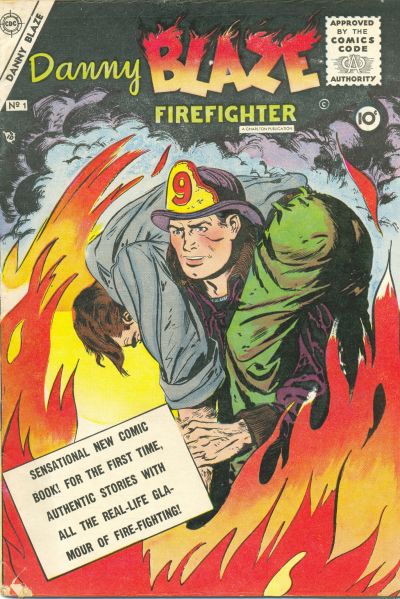
Nature Boy had a three issue run (issues #3 through #5) following on after a couple of issues of Danny Blaze Firefighter.


The title was changed again to Li'l Rascal Twins with issue #6 and ran for thirteen more issues.


Nature Boy was created by Jerry Seigel and drawn in the first issue by John Buscema. There are echoes of Captain Marvel in the origin story, but despite that similarity or perhaps because of it and the strength of Buscema's artwork, the debut story a good read. Rocke Mastroserio would do the artwork on many subsequent stories, but it's all Buscema in the debut issue.

Here's Nature Boy's origin story from issue #3.


Rip Off