Showing posts with label Sub-Mariner. Show all posts

Monday, July 8, 2024

Favorite Covers - Young Men!


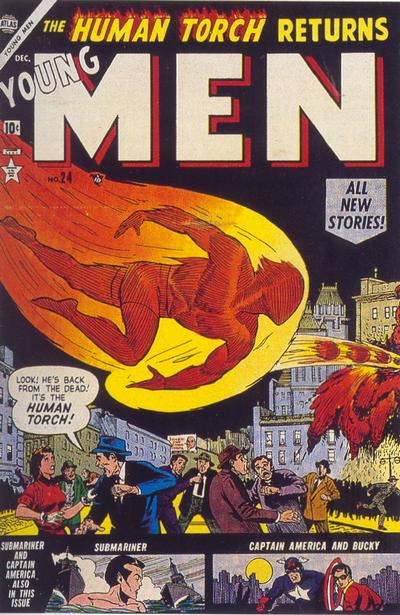
One of the most important comics, a real gem is Young Men #24 published in 1953. Sparked by the success of DC's Superman on the new-fangled televisions across the nation, Martin Goodman, as always on the lookout for the latest fad, decided it was time to rekindle the Human Torch as well as his Timely cohorts Captain America and the Sub-Mariner. To that end the trio are gathered together in one big comic which tells the world what they've been up to since last seen some four to five years earlier. 


The Human Torch had been buried by gangsters after they found a way to stifle his flames. But they'd imprudently used Yucca Flats as the burial ground and the eventual atomic tests there allowed the Torch to awaken, this time with a radioactive snap to his original flame profile. He quickly finds the thugs who had tried to salt him away, but then cannot find his partner Toro. It turns out Toro had been traded to the Commies and a quick flight to Korea allows the Torch to see a mysterious jet streaking across the sky as his partner who brainwashed fought for the Communist forces. Torch brings him home and soon he's cured, and the duo work together to rescue an FBI agent's daughter from the clutches of the mob.


A lot is piled into a very briskly paced story. But its real impact was a visual one. Russ Heath was the artist of record despite the cover of the comic and the splash page for the Torch story having been done by Torch creator Carl Burgos. Heath's version of the Torch while aflame is different from the classic Burgos version which had been the template for many later renditions.


This sleeker version would be adopted for The Fantastic Four's Johnny Storm when Roy Thomas took control of that book after Stan Lee departed to the west coast to see to Marvel's movie needs. I've always thought this particular rendering of the Torch to be about the best one there is.


Captain America and Bucky get revived too. With artwork by John Romita (and Mort Lawrence on the splash panel) the duo have been playing it cool as Steve Rogers is now a professor teaching at the (ahem) Lee School. Bucky is one of his students and gets fired up when other boys seem to imagine that Cap and Bucky are the stuff of legend. Soon though the return of the Red Skull, this time an agent for the Communists, and a plot to take over the United Nations building are scotched when Steve and Bucky again suit up and dive in fists flying.


In a later story in a later issue of Young Men, Cap, the Torch, and the Sub-Mariner actually share an adventure sort of in a story dedicated to Cap. The trio lasts only briefly as seen in this panel.


The real significance of this 1953 revival though is not sorted out until the early 70's when Steve Englehart takes it up as a plot point. Of course, since in the then current Marvel continuity Cap had been on ice since before the end of WWII, the presence of a Cap and a Bucky during the Cold War was a conundrum. It turns out this duo were wannabes who got hold of a bad batch of the Super-Soldier serum which enhanced their already racist and jingoistic attitudes. This bad Cap battled the real Steve Rogers in a memorable four-parter by Englehart and Sal Buscema. (More on this tomorrow.) 


The third story in this great comic features Prince Namor, the Sub-Mariner. The story is written and drawn by his creator Bill Everett. And Namor's absence is handled in the most off-hand way possible. He's just been out of town. When Betty Dean becomes curious about some ships which have gone missing, she makes some calls and soon enough the Sub-Mariner knocks on her door.


I love the way Namor fills out that suit, looking downright dapper and surprisingly urbane. He's far from the berserker he's often portrayed as in other stories, before and after. (The story goes that Namor lasted longer than the others during this revival phase because TV was interested in bringing him to the small screen. It never happened, but this smooth operator would've been right at home.)Namor and Betty find out the ships are being sunk by alien robots from Venus and end the threat, though no one in the official channels believes them.


Bill Everett was a great artist, one of the polished ever to tackle a page in the Golden Age. He seemed only to ever get better, each time he took on his prize creation showing more and more sophistication. His final run on the Sub-Mariner ended when Everett passed away too soon.


I first ran across Young Men #24 in the back of Marvel Super-Heroes #20 which was fronted by a Doc Doom story. The reprint blew me away back then, the polish and sophistication of the artwork was a real eye-opener.


Later still I picked up a copy of Marvel Masterworks - Atlas Era Heroes. I got it for the Marvel Boy stories, but was delighted to find all of the Young Men issues featuring the "Big Three" included.


I read it this time in the trade paper The Golden Age of Marvel Comics Volume One, a beautiful package with a nice overview of comics of the era.


Final Issues

The Timely revivals in 1953 were unsuccessful. The Sub-Mariner lasted the longest because of TV interest, but despite a legitimate push the heroes found no firm footing and by 1955 were back in the bin of forgotten heroes, until the next time they were needed.

This is a Revised Red, White, and Blue Dojo Classic. 

Rip Off

Thursday, November 25, 2021

The Blind Man Sees Red!


As important as fine talents the likes of Gene Colan and Frank Miller have been to the development of the Daredevil comic book, it's easily arguable to me that the single most important artist in the history of the was Wally Wood. What Wood did was simply transform Daredevil from a musty looking superhero who might've dropped in out of the Golden Age into a sleek modern hero literally suited for the Silver Age. He did it with a single color -- red.


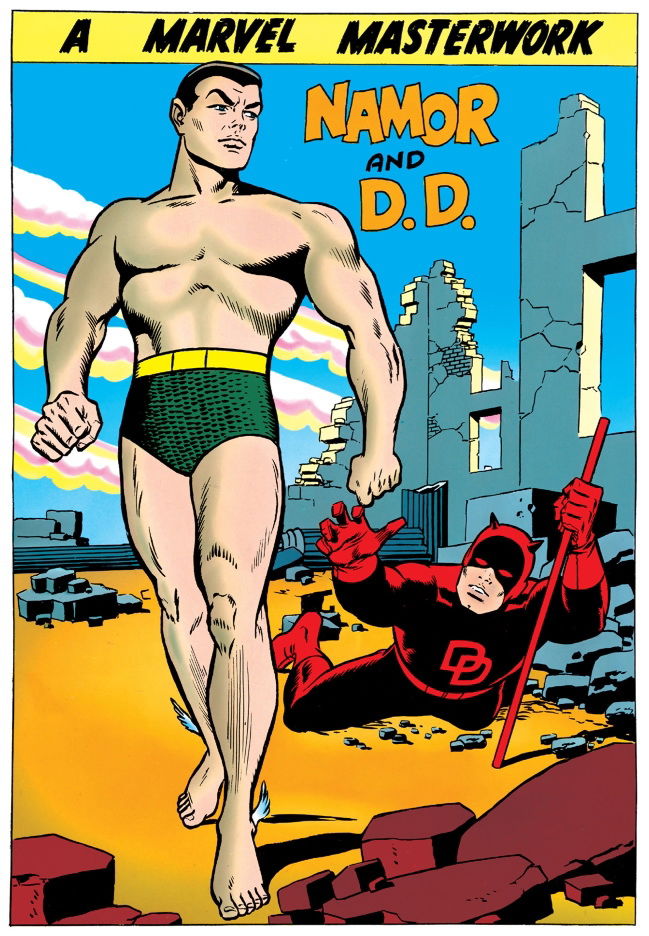
From his inception the design of Daredevil had played off his name by adorning his cowl with little horns. What Wally Wood did was to take that notion and give the character named "Devil" a deep rich color which evoked his name in all its glory. Soon after taking the helm Wood started diddling with the look and along with Stan Lee even made sure the hero got some high profile exposure in the Fantastic Four of all places and by fighting one of the greatest of all Marvel battles ever against the indomitable Prince Namor, the Sub-Mariner. "The Man Without Fear" earned his nickname when he put it all on the line against the Sea King and there was no going back.


Despite small-ball but visually spectacular villains like the Stilt-Man, the comic was secure because watching DD in battle was exciting in itself.


Not all the stories made sense, but getting there was nearly all the fun. Daredevil was establishing himself as a hero who took on all comers and looked good doing it.


Wally Wood's tenure was brief though and ended when Bob Powell was brought aboard to finish Wood's layouts in the terrific two-parter featuring the debut of the villains who would be called the Ani-Men. These guys are all Wood, who wrote the first half of the two-part adventure. With that Wood left the book and a fellow named John Romita took the helm, no slouch himself.


Wally Wood stepped aboard the Daredevil comic book one more time, inking Frank Miller in a story from his epic run. It was a hearty reminder of the early days when Wally Wood had saved the comic from the dustbin of history.

daredevil # 7 pin - up / 1965 - acetate color, in red raven's ...

It was then that Daredevil was established as the comic without fear.

Note: This post originally appeared at Rip Jagger's Other Dojo. I will be transferring some of those posts over here as the month goes on. 

Rip Off

Thursday, September 30, 2021

A Marvelous Ret-Con Cover Gallery!


From the very beginnings of the Marvel Universe, Stan and the gang wisely chose to resurrect some of the more successful characters from the halcyon days of Timely and Atlas. The most notorious revival was of the Sub-Mariner who had proven to be a quite successful character for the company in earlier times and was even considered for a television show in the 50's. The Namor we meet in the pages of Fantastic Four #4 is rowdy character who is quickly smitten by Sue Storm, a quasi-romance that will linger in the comic for several years, even after Namor rediscovers his lost kingdom of Atlantis. 


But even before Namor there was the reimagining of the Human Torch who for the first time actually lived up to the name. Where as Namor was the same character as we'd seen in the Golden and Atomic ages of comics, albeit with an altered story line, this new Human Torch was Johnny Storm, a new character altogether, though Marvel immediately saw that he might be a headliner as he hand been in decades past. The Torch was quickly given a solo slot in Strange Tales to attempt to maximize his popularity such as it was. 


The next revival at Marvel was a bit of a surprise, as it came in the pages of the short-lived original Hulk series. It was of the villainous Ringmaster and his Circus of Crime. The Golden Age original had been Nazis and these are just clever thieves. Later it was suggested the Nazi Ringmaster had been the father of the Silver Age one, but who knows what the story is today, if the Circus of Crime can even be a thing in these modern days. 


Next was the third of the "Big Three" from Timely. Captain America is unfrozen in Avengers #4 and goes on to become a mainstay of the book and eventual titular leader. He of course will get his own series before long. I've always found it odd that Marvel was so tenuous about his revival, having done a false one in the pages of Strange Tales before the actual for real Cap joined the MU. 


The next revival and retro-continuity character is actually two, one a villain and the other a hero. The Black Knight was a high profile character for Atlas and a bad version was dreamed up in the modern day for Giant-Man to battle. He went on to fight Iron Man before his untimely death. His equipment was inherited by Dane Whitman who chose to use it as a hero and not a villain and eventually the Atlas Knight was tied into all of this in the pages of various Avengers comics. 


Ka-Zar is likely the revival and ret-conning of the oldest character in the Marvel mythos as his precursor was a Tarzan wannabe from the pages of vintage pulps published by Martin Goodman's outfit even before they dabbled in  comic books. Never having read them myself I cannot say if Zabu is likewise a revival or a brand new character. Anyway we are introduced to the Lord of the Savage Land in X-Men #10. 


Another villain returns from the Golden Age when Captain America's most memorable opponent (if you don't count Hitler) returns to scheme and plot anew. The Red Skull had returned in a manner of speaking in stories while being new were set in WWII, but then he comes into the 20th Century when he awakens and seeks the Cosmic Cube. Tales of Suspense housed this revival.  


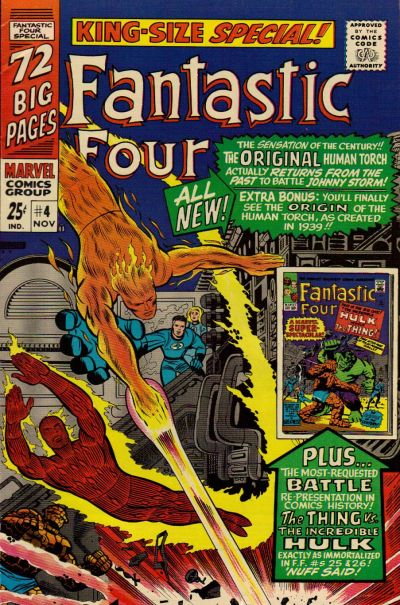
Now things get a bit dicey, because as it turns out Carl Burgos was trying to get control of the character he'd created so long ago for Marvel. To stave off his attempts the actual Human Torch, the android, was revived and given a new back story of sorts in Fantastic Four Annual #4. This story was then used to show that Marvel had indeed made use of the character and ironically Jack Kirby, who later battled for recognition and some level of ownership of the myriad characters he'd created was the artist on this tale. 


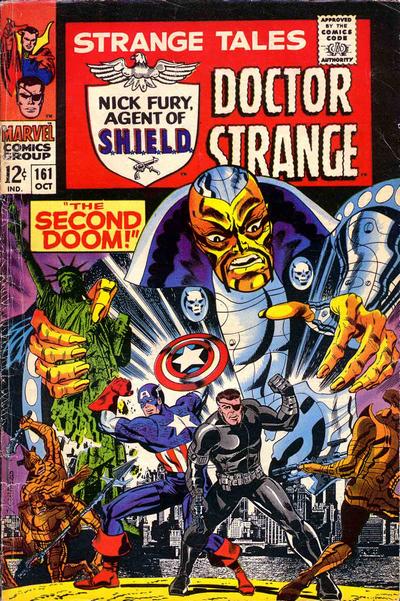
Reaching back into the 1950's Nick Fury battled the Yellow Claw in the pages of Strange Tales. Coming with the classic "Yellow Peril" villain was his arch nemesis Jimmy Woo who eventually became a member of SHIELD.


Red Raven #1 is a weird comic book from Timely's Golden Age and it features the first work by Jack Kirby for the company that will become Marvel. But Kirby had no hand in the revival of the Red Raven in the pages of X-Men #44 when the Angel encountered his Golden Age winged counterpart while on a mission to save his comrades. This story was by Roy Thomas and Don Heck. 


The Human Torch had been revived twice, once as Johnny Storm in a new persona and then as the original (or at least a version of same). Now it was time for Toro to get his due in the pages of Sub-Mariner #14 by Roy Thomas and Marie Severin and we find out how he's lived since those days when he was partnered with the world's most heroic Golden Age android. This is a tragic tale as Toro also dies in this very same appearance. 


Roy "The Boy" Thomas loved the Golden Age of comics and he loved bringing back versions of these characters. One such example and arguably the most successful was The Vision who debuted in Avengers #57. As far as I know this Vision, remarkably rendered by John Buscema had no connections to his Golden Age inspiration save for sharing a name. 


Thomas was at bat again when he and Sal Buscema decided to send a trio of Avengers back in time to WWII to confront a team who were soon to become The Invaders. The Human Torch, Sub-Mariner and Captain America had joined forces before as part of the All-Winners Squad, but here we see the Big Three as they take on Black Panther and the newly minted Vision and Yellowjacket. This happened in Avengers #71.


One of the conundrums of comics is that heroes are owned by companies who make wide use of them. Captain America had been revived before in the 1950's and that revival was at direct odds with the tale told so skillfully in the Avengers. So how to account for it? Steve Englehart decided that the Cap and Bucky of the 50's were do-gooders who were inspired by the originals, but in the stunning four-part series beginning in Captain America #153 we find that they also ingested the racist and xenophobic attitudes of their era. 


It's Roy Thomas again, this time assisted by Rick Buckler who bring back the rest of the All-Winners Squad -- The Whizzer and Miss America. In the pages of Giant-Size Avengers #1 we meet their son "Nuklo" who sadly was affected by the things that gave them powers and becomes a monstrous threat. It's a heartbreaking tale. 


The Invaders finally get sanctioned in 1975 when Roy and artist Frank Robbins tell brand new stories of the adventures of the Golden Age Big Three as they battled Hitler and his allies. I adored this series and while it's a masterwork of retro-continuity it does bother folks who are fans of the original Golden Age stories for the liberties it takes with time frames and whatnot. But for me it was pure fun from the moment they debuted in Giant-Size Invaders #1. 


We'll wrap this up with another return and ret-con from the 1950's. Marvel Boy was a moderate hit in the Atlas years and got some exposure as a reprint Marvel Tales. We find out what really happened in the pages of Fantastic Four #164 by George Perez. The "Crusader" is Marvel Boy by another name, and sadly he's not a hero any longer. Marvel has never stopped ret-conning its characters and we see that endlessly as the amount of time Captain America was in the ice increases as the years roll by. Things must always change alas. Even Bucky came back to life. If I've forgotten anyone please let me know. 


Tomorrow something completely different as October arrives. 

Rip Off

Monday, July 8, 2019

The Bahamas Triangle!


I did the rare thing and picked up an actual comic book this week at my local shop. The reason was quite simple -- two of my favorite talents hooked up to knock off another classic yarn of one of my favorite super teams -- The Invaders. Those talents are Roy Thomas and Jerry Ordway and the two of them have given us vintage fans a blast from the past. I just wish I liked it more.


Roy Thomas is near the top of my favorite writers list, but his tendency, in fact seeming compulsion to delve deep into the histories of the Golden Age heroes can get wearisome. Roy is so exceedingly concerned with continuity that he will forgo the full potential of a single story. This a perfect example. But I shouldn't be surprised.


The Invaders began in the pages of The Avengers and the obvious notion of teaming up Marvel's Golden Age icons into a single fighting force was eventually formalized. But along the way Roy's passion for history and weaving the comics into that at once gave the stories a heft and glory, but often made them feel less exciting than they might have. That happens here.


The problem is that The Invaders are not a team here. This is yet another story of a battle in which the icons contributed to the result but stayed ignorant of one another's contribution. Even the spectacle of Cap getting to take on Baron Zemo doesn't help really as these are heroes passing in the night. I ache for some lush "Haneyverse" logic to save the day, but that's not to be.


But it looks great due to Ordway's always outstanding work. I can only recommend this one-shot to Invaders buffs as it will add one more mote to the saga. But the small-mindedness doesn't allow this one fulfill its potential.


Rip Off