Showing posts with label Sam Glanzman. Show all posts

Monday, October 26, 2026

Thirteen Faces Of Winnie The Witch!


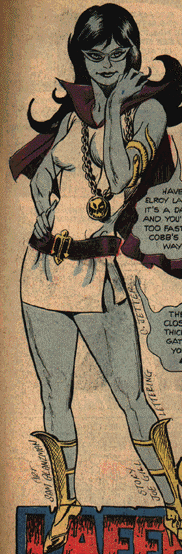
Winnie the Witch debuted in Ghost Manor #13, an unlucky number for anyone but a ghost host of a comic book I'd reckon. She added something to the Charlton ghost host roster that had been woefully missing to that point--sex appeal.


Winnie was a looker. She was probably inspired by Warren's sultry horror hostess and heroine Vampirella. With her brilliant blue skin, her long green tresses, her sometimes green and sometimes white mini-dress, and those mod glasses, she was a total babe for sure. Winnie was a winner and hung around Charlton for the duration pretty much, the resident babe. Even after the arrival of Baroness R.H. Von Bludd a few years later, it was still Winnie who had won my heart.

Here's a gallery of the winsome witch by a twelve of Charlton art greats. The final image is something a bit different.

Charles Nicholas & Vince Alascia

Pat Boyette

Steve Ditko

Sam Glanzman

Fred Himes

Wayne Howard

Sanho Kim

Pete Morisi

Don Perlin

Warren Sattler

Joe Staton

Tom Sutton


And finally, we have this.


It's a bit blurry, but this is what Winnie might look like in real life if she attended a comic book convention. I prefer to think the camera operator is just quivering with the thrill of meeting such a classic character.

Rip Off

Wednesday, October 21, 2026

Hercules - The Armor Of The Gods!


Hercules #13 is the last original issue of the run from Charlton. The comic is dated September 1969. The cover is by Sam Glanzman, the guy who has done all the covers for the series. The comic is edited by Sal Gentile.

The lead story of Hercules is untitled this time out unless you use the title on the cover "Hercules Wears the Armor of the Gods". It was written by Joe Gill and illustrated by Sam Glanzman. It begins with a symbolic splash page showing Hercules and Mars fighting with Zeus and Hera looking on. The story begins in Greece with Hercules being hassled by some soldiers who clearly don't seem to know who he is. The battle is one whe Mars hurls his war hammer to Earth literally zapping Hercules. The soldiers run off and Mars materializes and faces off against Hercules. They wrestle and fight for a time after Zeus gives the okay and then Mars offers Hercules a free punch at his jaw. Hercules takes advantage and knocks the War God out. Hera is unhappy but Zeus tells her to be quiet about it, though she doesn't comply. Diana the goddess of the hunt agrees with Zeus and tells Hera so. Later she appears at the camp of Hercules where he's eating some captured game and takes him by means of riding a moonbeam to Olympus for another feast among the gods. But quickly a fight between Hercules and Mars erupts ending with Mars throwing Hercules out of Olympus down through some clouds. Zeus intervenes though and brings the Man God back to Olympus. He then arranges for Hercules to get some of the armor of the gods manufactured by Vulcan. With his new gear Hercules is able to withstand the attacks of Mars and in fact Mars breaks his sword against the body of Hecules, specifically his face. This stops the fight and Hercules gives back his godly armor and returns to Earth await the day he will be among the gods of Olympus permanently. The story ends with Hercules sitting contented around his humble campfire.

"Mountain Man Morgan in New War Dance" is yet another tall tale of the giant who helped build the railroads. This one is pretty imaginative, and has Morgan get his friends the Indians to literally war dance on the stones that form the rockbed for the railroad. Their dancing breaks up the stones so the rails will seat properly. Morgan meanwhile shattes boulders to help supply stone. The Indians seem quite happy about this solution and indicate at the end of the story they want some payment for their work for new wigwams.

Thane of Bagarth is titled "Chapter Thirteen: Revenge" and is written by Steve Skeates and illustrated by Sanho Kim. The story begins with the Time Traveler who is lost in a dark cave. He finds himself in the dream of Hrothelac, the banished Thane of Bagarth and the two meet. Then another green four-armed monster attacks and Hrothelac kills it. Then just as quickly as he arrived the Time Traveler disappears. Hrothelac is then told by a voice that he must battle more monsters and such before he can have his revenge. The scene shifts to the Celts battling against invading Vikings and losing. The final shift in scene for the series features the Time Traveler again and this time he finds himself trillion of miles away from Earth opn another planet in another galaxy, and he is most confused. The next chapter is supposed to feature Eowanda, but it will never be.

"Letters to the Editor -- Hercules" features three letters this time, one by Tony Isabella. One compliments the series to date, while Isabella runs down several series he's following from Charlton. The editors even note that they cut his letter down quite a bit. Their response to him indicates the future of Charlton as they say that superheroes have seen their day for the time being but that war, romance, and westerns are the consistent sellers for the company.

This final Hercules issue is a very different experience from the debut issue two years earlier. Most dramatically is the shift in the classical myth approach taken early on. The stories have gotten more and more modern in their feel and character as the series has developed, and that seems to be the result of clear editorial mandate. The artwork of Sam Glanzman has really undergone a transformation with this final issue really opening up in terms of layout design. Much is done with words indicating mood and emotion and the layouts seem to thematically inform the work itself such as the use of a peace symbol to frame the moments when Hercules gets his armor.


This series is one of my childhood delights. I've not read these issues through probably since I first got them before these reviews, though I've taken them out many times and read an issue here and there. The confused saga of Bagarth is sad really given the immense promise of the scenario initiated by Steve Skeates early on. A sequel to Beowulf is a clever notion, but it becomes a bit of mush as the series introduces odd elements of sci-fi and seems to become bogged down in its own misguided plot.

It's clear that once they finished the Twelve Labors the staff of Charlton really didn't know what to do with Hercules. The last several issues have been mostly stories about dinner parties and sibling strife. Surely if the series had continued they would've shifted the story line forward, but we'll never know.


As I've noted the series has been reprinted many times by ACG/Avalon. I even found a "new" reprint version of the series a few weeks ago I didn't know about. These stories have a real modern feel to them that stands out from much of the material Charlton produced at the time. They are at once timeless and of their time.


This is a great series and is currently available in a handy reprint volume from Dark Horse. 

Rip Off

Tuesday, October 20, 2026

Hercules - The Wrath Of The Gods!


Hercules #12 is dated July 1969. The cover is another excellent one by Sam Glanzman, and the issue is again edited by Sal Gentile.

The Hercules story this time is titled "The Wrath of the Gods" and it was written by Joe Gill and illustrated by Sam Glanzman. As this story opens, Hercules has completed his Twelve Labors (though we've only seen eleven in the series to date) and he is demanding that he be elevated to Olympus. Mars takes objection but is chastened by Zeus with a burst of fire. Hera shows up and suggests a banquet in the honor of Hercules and she goes to Earth and personally invites the Man God who is of course suspicious but accepts anyway when Zeus speaks up. Hercules then dashes off to cleanse himself in a bath for the feast then awaits his ride, the Chariot of Apollo shows up and takes him to Olympus. At the feast Hercules is invited to tell the tale of his Twelve Labors which he does though he gets the order of their accomplishment different than what we've seen in the series so far. His story though proves somewhat dull to the guests who nod off, then Mars in a rage calls Hercules a liar for claiming to have done such great things. Hercules in respect for his host ignores this challenge, but finally Mars splashes him with wine and even Zeus wonders why his son won't retaliate, then he gives them express permission to battle and the fight is on. The battle through the castle of the gods and then Mars uses his godly powers to hit Hercules with a lightning bolt. Hercules is stunned and despairs since he doesn't have such powers. Then Zeus gives him such power and he throws a bolt back at Mars stunning him. The two lock up in a show of strength that causes havoc on Earth until finally Mars lands a blow to Hercules that sends him flying down through the clouds out of Olympus itself. Hercules lands on Earth and remarks about what a grand party it was and how he'll have to stay longer next time.

"Man Mountain Morgan in Tough Tommy Turner" offers up another prose tall tale of the giant who assisted the railroads. This time there's a ruffian named Tommy Turner and his gang who are stealing supplies. Morgan goes to find them, and using a special sound sends their horses running. He then bundles the wagons together and drags the stolen supplies back to the railroad camp, and then turns the thieves over to the law.

Thane of Bagarth is titled "Chapter Twelve: Melting in the Dark" and it was written by Steve Skeates and illustrated by Sanho Kim. It begins with the "dead" body of Hrothelac, the banished Thane of Bagarth in the Celtic village. But in another world, a dream world Hrothelac is awake and full armored. He is told by a voice that he must seek out strange creatures and battle to gain his revenge. A giant green four-armed monster stalks from the shadows and Hrothelac battles it finally slaying it with a thrown sword. Meanwhile the Celts are amazed that the dead body of Hrothelac is moving in the real world. At this moment a warning comes that Vikings are invading the village and the Celts rise to the defense. The scene changes to a misty nowhere in which the Time Traveler is once again flying to a new location in time and space, finding himself in front of a cave and a sorceress, but before the sorceress can strike him with a spell he disappears again. The last scene show Eowanda, the current Thane of Bagarth plotting in his castle.

"Letters to the Editor -- Hercules" offers up two letters this time. One talks extensively about the defunct Action Hero line and how they should be broght back. The editors agree but say that's the way of publishing. They repeat a claim made in many letters pages that Hercules is selling very well and in fact seems to do better each month. The second letter speculate on why Hera hates Hercules so. Also included on this page is a neat design by Steve Ditko featuring both the new Blue Beetle and the redesined Captain Atom.

The series reaches its climax of sorts with this issue. The Labors are done, and though the Augean Stables is not shown in the series it is mentioned here when Hercules relates his experiences. The new pattern in the series seems to be to pit Hercules against Mars each issue. Their enmity has been growing steadily and this issue seems to be all about that struggle between these two sons of Zeus. Glanzman's artwork continues to loosen with more experimentation in layout each issue. The Thane of Bagarth storyline is becoming more and more fantastical as the Time Traveler jets all over and the dream battles of Hrothelac at least get our hero up and moving. He's been remarkably passive during the series.


This issue has been reprinted a few times I think by ACG/Avalon. For sure it was reprinted in Hercules #1 and I think it also was reprinted in Tales of the Man-God Hercules #1. The Hercules versus Mars stories are good for this since they are self-contained for the most part unlike the Twelve Labors. The Thane of Bagarth story has not been reprinted to my knowledge.

One more to come.

Rip Off

Monday, October 19, 2026

Hercules - The Trophy Hunter!


Hercules #11 is dated May 1969. It features one of Sam Glanzman's best covers for the series. The comic was edited by Sal Gentile.

The lead Hercules story is titled "The Trophy Hunter" and it's divided into two parts. The story was written by Joe Gill and illustrated by Sam Glanzman. The first part opens with Hercules knocking out some nameless opponent and deals with a ploy of Hera's to lure Hercules to Olympus to embarass him. She invites him and he's so overcome with pride he beats his chest creating an avalanche. His response to this is "Aww, I done it again!". Hera and all the gods of Olympus look forward to the feast celebrating Hercules and even Zeus seems fooled by Hera's plot. Zeus sends Apollo on his chariot to fetch the Man-God who suffers as they pass the sun. In Olympus he bows to Zeus and gets into a contest of grips with Mars that creates a thunderstorm on Earth. During the meal Hera uses her magic to make Hercules clumsy and then pretends to be a serving girl to make him look boorish and rude. Mars and Hercules face off and Hercules lands a solid punch on the War God who responds by sending Hercules back to Earth to face his cousin King Eurystheus for his next labor.

Part II is titled "The Prey" and it begins with view of the mountains between Arcadia and Achaia where stands a robust and magnificent Hind. Hercules comes from the shadows to leap on the giant deer but it escapes and the chase continues out of the mountains into the desert where the stifling heat causes Hercules to collapse. The Hind though returns to the Man God and uses it hooves to dig up water for the man chasing it. Hercules then uses his rope to snare the Hind and eventually subdues it. He carries it to the court of King Eurystheus but then unleashes it allowing it escape. He has done what was asked and no more. If Hera wants the beast, then it will have to captured again.

"Mountain Man Morgan -- Tame The Tracks" offers up another text story, a tall tale about the railroad and the giant Morgan's efforts to help it succeed. In this story he has to tear up some tracks and replace them so that the two ends will meet. He does so, once again saving the railroad from ruin.

Thane of Bagarth undergoes a big change this time. The story is again written by Steve Skeates but the art this time is taken on by Sanho Kim. The tale is titled "Chapter Eleven: Beowulf's Decision" and opens in the year 2174 where the Time Traveler's daughter and her boyfriend find his notes and debate how best to rebuild his machine and hopefully save him. There is a brief glimpse of the Time Traveler before the scene shifts to the still unconscious Hrothelac, the banished Thane of Bagarth who is being tended in a Celtic village. The scene shifts again to the Land of the Geats where the current Thane of Bagarth the treacherous Eowanda plots to take over the warriors of Beowulf and perhaps takes Beowulf's place entirely. Beowulf fearing Eowanda's ambition leads his troops into battle despite his age and illness. As they head to battle, Beowulf's man Eadstan with the serf girl Freahulf ride back to the Land of the Geats but encounter a Swede who is dispatched by Eadstan. Back in the Celtic village Hrothelac has a dream in which he battles Eowanda, Beowulf, and Eadstan. As he battles in his dreams he gets out of bed and collapses. The Celts tending him annnounce that he is dead.

"Letters to the Editor -- Hercules" features three letters this time, and all of them talk not only about Herc but about other cancelled Charlton comics. There seems to be a great demand to bring back the Action Heroes. One letter writer complains again about Herc's "oriental" look but the editors say it's what Sam Glanzman wants and that's it. On a sad note, the death of Rocke Mastroserio in February 1968 is noted.

This issue of Hercules continues the changes in the series. The artwork by Glanzman on the lead feature gets more and more experimental as he plays with panel design and even changes up his style within the story. It's really quite attractive. One new trick is using words like "Anger" and such to surround characters as they argue, an attempt to heighten I suppose the emotional impact of the stories. This apparently will be the last of the Hercules stories to deal with his Twelve Labors despite the fact he's only done eleven of them. The cleaning of the Augean Stables I guess wasn't considered dramatic enough for a comic presentation. The storyline will shift a bit next time.


This comic was mostly reprinted in Modern Comics Hercules #11.

More to come.

Rip Off

Friday, October 16, 2026

Hercules - The Ninth Head That Couldn't Die!


Hercules #10 is dated April 1969. It features a dynamic cover by Sam Glanzman and the comic is edited by Sal Gentile.


The lead story featuring Hercules is titled "The Ninth Head That Couldn't Die" and it was written by Joe Gill and illstrated by Sam Glanzman. The story opens with Hercules pleading to the gods but when Mars and Hera rain a storm on him he girds up and seeks out King Eurystheus for his next labor. Eurystheus sends him to kill a monster near the well of Amymone in the Argosian Swamp. Hercules is surprised he will be allowed to use weapons and so goes to the Oracle of Plaeceum to find out more about his mysterious task. When he tries to enter the cave of the Oracle he's confronted with horrific fire-breathing monster but he doesn't back down and the creature transforms into a beautiful black-tressed woman but then her hair begins to strangle Hercules and he attacks her with is sword saying "Touche'". She transforms again into a hag and then tells him of the Lernaen Hydra the monster with nine heads, one of them immortal. The scene cuts to Olympus where Zeus enjoys a repast and he learns of the task set before his son. Hercules goes to the swamp and almost immediately confronts the Hydra and begins to cut off its heads only to see each one he severs replaced by two more. Finally he tries to sever the main head and his sword clangs off in futiltiy. Hercules responds with a "Oh, Golly!". Meanwhile an ally of Hercules, a boy named Iolaus shows up with a torch and Hercules borrows it to burn off the heads he severs and this seems to work. Then a giant crab attacks but Hercules dispatches this beast sent by Hera. Turning his attention back to the Hydra he cuts off more heads then climbs a giant boulder and finally is able to cut the main head. He then takes the boulder and crashes it down on the monster defeating it. The story closes with Hercules leaving the swamp triumphant and Mars saying to Hera "Gee, Ma I hate that Kid."


"Mountain Man Morgan in Tornado Trouble" relates a tall tale about the giant Mountain Man Morgan and how he shows up to help the railroad lay tracks by various means using his great strength. Ultimately she stops a tornado by using his lungs to create a counterforce wind. This tale is very similar to the previous text story about Morgan.


Thane of Bagarth is titled "Chapter Ten: From The Future!" and was written by Steve Skeates and illustrated by Jim Aparo. The story begins with fallen form of Hrothelac, the banished Thane of Bagarth, as he is found by Celts and taken to their village and tended to. The scene cuts to the Time Traveler as he lands in England and eludes some warriors. Anther scene shift takes us back to the land of the Swedes where King Beowfulf's man Eadstan discovers his men have left the area, so he finds a horse and takes the beautiful Freahulf and they ride back to the land of the Geats. In that land the traitor Eowand, the current Thane of Bagarth plots to use the absence of Eadstan to further his ambitions.


"Letters to the Editor -- Hercules" features three letters this time. One is from Sam Glanzman himself and he addresses the question of the slanted eyes of Hercules, pointing out that the slanted eyes he gives to Hercules originate from the designs on Greek vases and have nothing to do with Asians and "Asian villains", who by the way don't have "slanted" eyes anyway. He offers up a chart to prove his point. The other letters compliment the book but complain that it's difficult to find back issues of the comic. The editors say they'll pass this on to the distribution guys.

This is a really offbeat issue. Sam Glanzman is clearly exerting himself trying to make the book more exotic in its design. Many of the pages use very baroque and detailed elements to break up the panel structure. The word "Mod" is used by the editors in the letters page at one point and I assume that's what they are trying to do with the comic, make it more hip somehow. The changes are also seen in the dialogue. As noted some of the lines in the lead Hercules story have a very different tone, very modern. It's a bit jarring, but clearly they are trying to pitch this comic to a more sophisticated crowd. The changes in the Thane of Bagarth storyline presumably come from the same motivation. There's not doubt that the comic is changing.


This comic was largely reprinted under the Modern Comics label in the 1970's.

More to come.

Rip Off

Thursday, October 15, 2026

Hercules - Diomedes' Curse!


Hercules #9 is dated February 1969. It's edited by Sal Gentile and the cover as always is by Sam Glanzman.

The lead story is titled "Diomedes' Curse" and it was written by Joe Gill and illustrated by Sam Glanzman. The story begins with a splash page with Mars the God of War threatening Hercules as he battles the carnivorous horses of Diomedes. After a summary of the feats of the Man-God from the last few issues, the scene shifts to the forge of Vulcan who is fashioning a new sword for Mars who says he's going to use it to frustrate the godly aspirations of Hercules and Vulcan reminds him he cannot take direct action by rule of Zeus himself. The scene shifts to the court of King Eurystheus who is giving an angry Hercules his next task, to retrieve the ferocious horse of King Diomedes of Thrace. Diomedes is tipped off by Mars that Hercules is coming. A storm is assaulting the ship Hercules is using to get to Thrace as Mars encourages Poseidon to sink it. He refuses but does let free a fire-breathing sea-dragon which does attack the ship only to be repelled by Hercules, much impressing the God of the Sea. After reaching Thrace Hercules is arrested and seeks a sign from Zeus as to what he should do. Zeus lets slip a thunderbolt which Hercules interprets as a sign and he breaks his chains and battles face to face Diomedes the King of Thrace. He defeats Diomedes then proceeds to find the savage horses. These he does find and defeats in quick order by binding their fanged snouts, and taking them to King Eurystheus much to the latter's great regret.

Next up is "The Hero Huang Gho" which is a text story telling of how the great Genghis Khan ultimately failed to defeat the city of Cheng-Tse because it was defended by a forty-foot giant named Haugn Gho who was quite strong and could emit flames from his fingers. Khan sees the giant and decides to move his army around the city. There is speculation that the giant was mechanical.

Thane of Bagarth is again written by Steve Skeates and illustrated by Jim Aparo. The story picks up on a battlefield where King Beowulf's man Eadstan is recoving from being knocked out only to find a beautiful girl standing over him. It turns out to be Freahulf, the daughter of Daeghred the Scholar who had been taken captive by the Swedes but had escaped. Eadstan orders her to follow him and they seek escape from the land of the Swedes. Meanwile the Geats fear Eadstan is dead and retreat. Then the story takes a most unexpected turn as we shift forward in time (and genre) to the year 2147 and meet a Time Traveler and his daughter and her boyfriend John. Despite rules against it, the old man wants to travel to the past using his newly created equipment. Despite warnings he does travel into the past, but his machine explodes leaving it to John and his daughter to repair it. Meanwhile (or earlier in time actually) the Traveller finds himself adrift but headed towards what appears to the Medieval past.

"Letters to the Editor -- Hercules" closes out the comic this time. There are three letters, most complimentary of the comic especially Thane of Bagarth. One writer does wonder what happened to the old Action Heroes, and is told they are cancelled but may return some day. Another wishes Herucles would fight fewer animals in the countryside and spent some more time in cities. The editors say they'll pass the request to Gill and Glanzman.

This is a weird issue. The lead Hercules story is becoming very formulaic. Hercules gets task, completes task after some interference from either Hera or Mars or both, then agrivates Eurystheus by bringing his prize back to court. This is at least the third time this formula has been used. Glanzman's artwork is still exquisite and his panel arrangement is getting more experimental. Thane of Bagarth on the other hand spins completely away from its presumed heading and introduces a science-fiction concept completely alien to what has gone on before. Despite comments that the Hercules book is selling well, changes like that in Thane of Bagarth suggest otherwise. The artwork is superb still though.


One fun thing about this comic is the inclusion of a Joe Weider ad featuring muscle man Dave Draper. Seeing this in a Hercules comic is fun.


The lead story was reprinted in Charlton Classics #9, the last issue of that 1980's run. To my knowledge the Thane of Bagarth story has not been reprinted.

More to come.

Rip Off

Wednesday, October 14, 2026

Hercules -The Boar!


Hercules #8 is in many ways the most peculiar of the run. The issue is dated December 1968 and the cover is by Sam Glanzman. The comic is edited by Sal Gentile.

The lead story is titled "The Boar" and was written by Joe Gill and illustrated by Sam Glanzman. Hercules goes to Hera's agent on Earth King Eurystheus for his next task and is instructed that he must bring back the giant Boar of Mount Erymanthus and return the beast to the court of Eurytheus, and further Hercules is only allowed to use the strength of his own hands to subdue the the monster. Hercules heads off on this task and climbs into the mountains. There he is attacked by giant monster birds with poisonous talons, creations of Hera, but these disappear when Zeus orders her to cease her attack. High in the snowy mountains Hercules comes across an encampment of warriors, one of whom calls him a fool for taking on the Boar. Hercules cuffs the mocker and then heads higher still to seek the Boar, which he is told will be easy since the monster will be hunting him. He finds the tracks but after following them for a while he gets concerned when it appears the beast is circling around behind. Almost immediately the giant Boar attacks and Hercules wrestles it, finally getting atop its back. Sliding up and down the mountainside Hercules rides the Boar bareback for a week until he at last tames the monster. This newly trained creature he rides back to Eurytheus in triumph.

This lead story is shorter than usual coming in at twelve pages.

Next is the letters page "Letters to the Editor -- Hercules". It features two letters, one asking for original artwork. The response indicates either it's policy not to release the originals or there's a legal liability for doing it, the editors seem confused on that point. One letter writer makes note that Dick Giordano is gone on the DC.

"The Legend of Hercules" is a one-shot feature this issue. It's presumably written by Joe Gill and is certainly illustrated by Sam Glanzman. It relates the classic origin of Herucles, telling the story of how he killed serpents in his crib and how he was trained by the centaurs in warcraft. There's a spectacular full-page shot of Hercules in battle alongside Zeus and Hera against the Titans. Also it says that Hercules was on the voyage with Jason and his Argonauts for the Golden Fleece. It is after this that Hercules seeks atonement, but it's unclear why, save that he seems ashamed he's human at all and not a full god. He goes to the Oracle of Delphi who sends him to Eurytheus. The six-page feature concludes with a summary of the previous seven tasks Hercules had performed (Lion of Nemea, Gerion the Giant, Cerebus the Hound of Hades, Apples of Hesperides alongside Atlas, Amazons, Stymphalian Birds, and the Bull of Minos).

Thane of Bagarth is written by Steve Skeates and illustrated by Jim Aparo. This installment is titled "Chapter Eight: Escape". It begins with the alchemist Mordwain administering a drug to Hrothelac to give him strength, which promptly knocks him out. The scene cuts to Beowulf's man Eadstan who leads the Geats agains the Swedes in battle. The battle is brutal and at last Eadstan is struck down, but is found by a Swedish servant girl. Back in England in the dungeon Hrothelac is awake and full of furious energy as he attacks the door to his jail. The guards enter and Hrothelac attacks them escaping. Mordwain escapes too. Hrothelac heads to the shore where another Viking ship approaches. But he collapses and is found by a band of Celtic villagers.


The lead story was reprinted in Charlton Classics #8.


Now Hercules #8 is unique. In addition to the four-color version I've detailed above, there was issued presumably at the same time a magazine-size black and white version of the comic. It's similar but not identical to the color version. It's also dated December 1968. The cover is developed from a panel by Sam Glanzman inside the story, and added is a figure of Hrothelac Thane of Bagarth by Jim Aparo. (This is the only cover appearance by Thane of Bagarth in its orignal run.) The lead story is titled "The Fantastic Giant Boar" and is largely the same story written by Joe Gill and illustrated by Sam Glanzman from the color comic. The story though is reformatted and the twelve page story is expanded to twenty. This is done by blowing up certain panels and suchlike.


The rest of the contents are comprised of reprinted material from early issues of Hercules. Next is the first Thane of Bagarth chapter followed by the first Hercules story from Hercules #1. Then two additional chapters of Thane of Bagarth (Chapters Two and Three) close out the magazine.

I don't really know what Charlton was trying to do here. I presume they were exploring to see if Hercules would sell in other venues using the material they'd developed. 1968 saw Marvel experiment with magazines, specifically the Spectacular Spider-Man books. And of course there was the relatively ongoing success of Warren's line of books. There is not editorial in the magazine to explain it. Charlton already had a reasonably strong cadre of magazines and perhaps simply wanted to add to that line-up. One small note though is that Sal Gentile is listed as the editor, despite the fact that most of the material in the magazine was produced when Dick Giordano was editor of the line.

I didn't get a copy of this magazine until many years after the fact, though I have a vague recollection of seeing it on stands at the time. It's a curiosity for sure, a real oddball relic from Charlton's oddball history.

More to come.

Rip Off

Tuesday, October 13, 2026

Hercules - The Bull Of Minos!


Hercules #7 is dated November 1968. The cover is by Sam Glanzman. The comic was edited by Sal Gentile. The lead story is titled "The Bull of Minos" and was written by Joe Gill and illustrated by Sam Glanzman.

The first story begins with King Eurystheus being confronted by Hera who demands he find a task that will frustrate Hercules in his attempt to ascend to Olympus as a full-fledged god. She suggest he be sent to get the Bull of Minos. Eurystheus commands it so and Hercules heads off, but not before Hera afflicts him with a magic spell that robs him of his strength. Hercules is smacked to the ground by a girl and robbed as he was helpless on the ground. Hercules at last through sheer will overcomes the spell and gets aboard a ship and heads to Minos with the blessing of Poseidon. Before they get to Minos the ship has to make land for repairs and Hercules goes for a stroll. He meets up with Anteus, a giant warrior who challenges the Man-God. Hercules battles the giant only to discover that Anteus only grows stronger and larger when he makes contact with the ground. Finally Hercules knocks him out with a giant column to the noggin and then throws him into the sea. He joins up again with his mates and heads to Minos. King Minos hears of Hercules and sends the Minotaur to intercept him. After making landfall Hercules encounters the Minotaur but defeats him and makes the monster take him to the Bull of Minos. The Minotaur complies and Hercules then confronts the giant bull. He finds he cannot defeat the beast by hand but digs a pit, fills it with water and then gets the Bull into it where he at last can bind it and drag it back to the ship. He takes the Bull to Eurytheus and unleashes the brute to rampage through his court. The story ends with Hercules and Zeus exchanging warm thoughts.


There are three letters in "Letters to the Editor -- Hercules", and ironcially one of them comments on the text stories that have been running in the series. The editors say they are necessary to meet postal regulations, but ironically there is no such story in this issue. One strange comment though is elicited from the editors in response to a criticism that Charlton had cancelled many of their hero books. The comment suggests that matters other than sales had to do with the cancellations. I can only assume the departure of Dick Giordano is the reason, but that's speculation. Another letter objects to the design of Herc's eyes by Glanzman, and after a very politically correct response about Asians, they editors seem to agree that Hercules should not have "slanted" eyes, though based on the comic Glanzman does what he wants in that regard.

Thane of Bagarth is titled "Chapter Seven: The Captive" and it is written by Steve Skeates and drawn by Jim Aparo. The story begins with Freahulf being captured by raiding Swedes as they kill the royal envoy from Beowulf sent to fetch her. We then cut to Hrothelac in a dungeon in England for a moment before cutting back to the Swedes who ride past Garmscio, Thane of Rothfor who hides from the raiders. The scene changes to the castle of King Beowulf who orders an attack on the Swedes to revenge their raids, but before he can make the order specific he collapses in agony. He's not dead, but sorely ill. Meanwhile the scholar Daeghred, father of Freahulf, finds the dead envoy and discovers his daughter is missing. He goes to the Thane of Bagarth, Eowanda but is summarily rebuffed. Eowanda then gets news of Beowulf's illness and begins to plot. The scent shifts again to Beowulf's castle where the sickened King has recovered but cannot lead his soldiers and so orders his First Councilman Eadstan to do so and to also be wary of Eowanda. We are reminded of Beowulf's vision that Eowanda would lead his troops in battle. Eadstan heads off with warriors to complete his mission.

This is a solid issue. The Hercules story has plenty of action in it and some neat humor involving the gods as they look down on Hercules.
The stories do have a certain predictability to them at this point, though the addition of the battle with Anteus was unexpected. Hera's spell was a neat touch and offered up some surprises. The Thane of Bagarth story is rich with plot, but Hrothelac is barely seen. The complexity of the story only grows.


The lead story was reprinted in Charlton Classics #7.

More to come.

Rip Off

Monday, October 12, 2026

Hercules - Hercules' Choice!


Hercules #6 is dated September 1968, and is something of a turning point for the series. In the previous issue Sal Gentile had taken over as editor and in this issue Sergius O'Shaugnessy (Denny O'Neil) gives way as writer to Charlton stalwart Joe Gill. Sam Glanzman remains on the the art chores.

The title of the lead story is "Hercules' Choice" and it begins quite literally with Hercules having to choose a path, one leading to pleasure and joy and the other to hardship and duty. These paths are marked on a sign and each has a lovely woman marking its beginning. Zeus and Hera look on while Hercules ponders his choice. But Hera is interrupted by Mars, the God of War who is mad at Hercules because he stopped a war that Mars was sure would last a good long time. Mars hurls a spear at Hercules which brings down a hillside on him. Thinking this the work of Zeus, Hercules chooses the path of duty and hardship. That road takes him to King Eurystheus, who was mentioned in the first adventure but is seen now for the first time. He gives Hercules the task of slaying the Birds of Stymphalus, birds which are the pets of Mars no less. Hercules takes on the task and Mars is most upset looking down from Olympus. Going to Stymphalus, Hercules finds it deserted save for a woman who seeks to warn Hercules of the danger of the Birds. It seems they are giants, and very dangerous. Hercules escapes the talons and falls into a cellar where he finds the villagers cowering from the monsters. Taking his weapons he goes up to fight the Birds but finds them proof agains his spear and his sword. He does manage to break the neck of one of them swinging a giant timber. Then the Birds show another power and fire some of their nigh-metallic feathers like arrows at Hercules who protects himself with a giant rock slab. He then strings his bow, a gift from Vulcan, but the Birds fly out of range. Hercules is at a loss. But in Olympus Aphrodite goes to Minerva who sens a magic rattle to Hercules, which draws in the Birds which he then uses his bow and arrows to dispatch. Triumphant he travels on the road of hardship looking for his next task. Meanwhile in Olympus Zeus invites Hera and Mars to dine with him on a scrumptious meal of Bird gotten he says from the Stymphalus region. They are both nauseated by the invitation.

The text story this issue is titled "Mountain Man Morgan in Sandstorm". It is a tall tale of a railroad crew besieged by Indians who seek help. The get that help from a giant named Mountain Man Morgan who is empowered by Indian magic. He is reluctant to kill the Indians despite the evil nature of their leader, and uses his massive lungs to blow up a sandstorm which drives the Indians away far into Mexico making it possible for the railroad to finish.

There are two letters in "Letters to the Editor -- Hercules". Both are by writers who would make impact in the field. The first from David Singer praises the comic and the second from Duffy Vohland is a broad letter commenting not only on Hercules but three other Charlton books as well.

Thane of Bagarth this time is presumably written by Steve Skeates though for the first time there are no credits. The artwork is by the all-purpose Charlton team of Nicholas and Alascia. The story is titled "Chapter Six: The Queen" and finds Hrothelac captured after escaping his Viking captors in England. He is taken to the dungeon and there is tended by another prisoner named Mordwain who is in jail for speaking out against his Queen. We meet the Queen and the King as they hear news of a possible pact with the Mercians which the Queen rejects. She is clearly the one in charge. Another scene change takes us back to the Land of the Geats and King Beowulf's castle as he gets word the Swedes are raiding the territory. Thane of Bagarth Eowanda, Hrothelac's disloyal brother sends an envoy to get the lovely Freahulf for him. While on their way back to Eowanda's castle, the pair meet a party of Swedes. Back in England Mordwain treats Hrothelac's wounds but the two cannot converse yet. The story closes with the threat of war in England.

This issue as I say is a transitional one. Mars is introduced in the main Hercules story and he will have an increasing role in the trials of Herucles. As drawn by Sam Glanzman, Mars is a vivid character with his exotic armor. Also in this story Hercules seems more a frail man with desires and weaknesses of spirit. It's been hinted at in other stories, but is a focus here. In the Thane of Bagarth the story is pretty static really, as Hrothelac is pretty passive in most of it. In fact that's been something of a flaw in the story all along.


The main story here was reprinted in Charlton Classics #6.


The backup story was reprinted in Thane of Bagarth #25.

More to come.

Rip Off

Friday, October 9, 2026

Hercules - Land Of The Amazons!


Hercules #5 is dated July 1968. The issue is edited by Sal Gentile who took over from Dick Giordano who was beginning his tenure at DC. There seems little evidence of his hand in this issue though.


The first story starring Hercules is written by Sergius O'Shaugnessy (Denny O'Neil) and drawn by Sam Glanzman whose name appears in full for the first time in the credits. The story is titled "The Land of the Amazons". Hercules is fighting two bulls in the arena for the entertainment of some locals. He then is interrupted by Zeus and Hera the latter giving him his next task, to bring to her the Golden Girdle of Hippolyta the Queen of the Amazons. Hercules takes up the task readily and heads off. He soon chances across a beautiful young blonde maiden chained to a stake being threatened by a giant lizard. He battles the lizard and saves the girl only to learn that this was seen by Queen Hippolyta who had staked the girl out to begin with for her amusement. Hippolyta is impressed by Hercules and invites him to her palace where she attempts to woo him. When he balks she shows him the young maiden trapped on a platform over a firey trap. Hercules is himself then imprisoned. He asks Zeus for aid who is ready to give it until Hera intercedes. Hercules then takes matters into his own hands and breaks out of his jail, climbs to a connecting rope and swings out to the trapped girl and rescues her from her danger. The two of them battle through Hippolyta's forces, Hercules even toppling some columns but it is to little avail when they find themselves confronted by her whole army. Hercules prepares to fight the Queen but is stopped by a command from Hera ordering him not to battle a woman. His dilemma is solved when the blonde maiden chucks a rock at Hippolyta knocking her out. Hercules takes her Golden belt and the army is freed from her influence. They thanks Hercules who takes the Girdle to Hera who doesn't seem that happy that he's succeeded. The maiden wants to thank Hercules but he says he must continue with his quest and he leaves.

The "Letters to the Editor -- Hercules" page features two letters this time out. Both praise the book for its staying to true to the mythological details of Hercules and both single out Glanzman for praise.

The text story "Mogo the Mighty" tells a tale of a village threatened by a evil warrior chief named Gogo. The villagers go to a wizened old man on the mountain who takes from each man in the village some hair, some nails, and some drops of blood to fashion a super warrior named Mogo the Mighty. Mogo defeats Gogo and vanishes telling the villagers that next time they should battle evil themselves.

Thane of Bagarth is again written by Steve Skeates and once again drawn by Jim Aparo. The title of this installment is "Chapter Five: The Battle Lost". Hrothelac the banished Thane of Bagarth finds himself a slave aboard a Viking ship. He's beginning to adapt to his role when the ship runs aground and he finds his chains freed by the melee. He tries to get clear of the ship, fights a Viking and both are thrown into the sea, the Viking sinking because of his armor. Hrothelac swims to shore only to see the ship itself finding purchase on the shore. But the land is England and Celts long under attack by Vikings immediately assault the weary Vikings and soon kill them, including the chief Figlaf. Meanwhile Hrothelac wanders this new land thinking of those he left behind when he chances upon a castle. Unknown to Hrothelac a warrior approaches him from behind.


This is really solid issue. Hippolyta is a beautiful and well-defined villain for Hercules. In fact the characterization in the series is really becoming sharp. Visually Herucles is really becoming more fully realized. Glanzman gives him a more exotic look this issue by angling his eyes not unlike those you find on Greek pottery. Some of the pages featuring the Amazons are very neatly designed and Hippolyta is actually a ravishing creature as presented in this story. The Thane of Bagarth story reverts to its Prince Valiant roots eschewing any use of word balloons in this installment. All in all a very solid and enjoyable issue.


The lead story was reprinted in Charlton Classics #5.


The Thane of Bagarth story reprinted in Thane of Bagarth #25.

Rip Off

Thursday, October 8, 2026

Hercules - Land Of Menace!


The fourth issue of Hercules from Charlton is dated June 1968, several months after the previous issue. It is the last issue edited by Dick Giordano and probably this shake-up is the reason for the delay.

The Hercules story is titled "Land of Menace" and is attributed to Sergius O'Shaugnessy (Denny O'Neil) and is drawn by Sam Glanzman (who signs his work here and in previous issues as "S.J.G"). The issue begins with a splash of Hercules battling what appear to be green flying monkeys.

The story itself starts with Hercules walking through a storm and seeking shelter in a cave. In the cave in the smoke of his fire Zeus and Hera appear. Hera reviews the successes Hercules has had battling the Nemean Lion, Gerion the Three-bodied Giant, and Cerberus of the Underworld. She then offers up a fourth task, to get her something to eat. She wants Golden Apples only found in the other-dimensional world of Nul. She opens a portal for Hercules and tells him he has three days. He leaps into the portal and moves through a psychedelic zone to come out in a desert landscape. He starts to eat some of what looks like a giant cactus but the plant attacks him and he has to uproot it. Then his attention is taken by young boy crying for help, but this turns out to be a Harpy in disguise. The Harpies look like green flying monkeys with spikes for hair. Hercules battles many of these Harpies before being overcome by a magic net that puts him to sleep. He's taken before King Poov, leader of the Harpies and is told he will be a slave. Hercules takes Poov's staff and shatters the light escapting into the desert. There he meets a giant named Atlas who is chained and holding up a giant stone slab to give shade and protection to the Harpy village. Meanwhile the Harpies uncork a magic urn filled with weapons and attack Hercules again with exploding rocks. Hercules throws the chain of Atlas into one of these rocks and frees the giant. Then Atlas takes the slab and covers the mouth of the cave in which the Harpies dwell. A fire leaks out of the magic urn and destroys the Harpies. Atlas then takes Hercules to the Golden Apples and then tells him that time is different in Nul and he's almost out of time and throws him through the portal before it closes. Hercules returns with the prize much to Hera's displeasure but Zeus is very happy.

The text story this issue is titled "The Goddess of Mercy" and tells of a wicked warrior named Nicherin who steals a jewel from the Goddess of Mercy and summarily punished for his impudence transforming him into a tiny stone statue.

"Letters to the Editor -- Hercules" features four letters, two by Canadians. There is the usual praise for the Hercules and Thane of Bagarth and recommendations. One letter writer would like to see Son of Vulcan replace Thane of Bagarth but the editors reject this idea and point out that reading nothing but superheroes would be dull. There is a great little thumbnail portrait of Hercules by Glanzman done in a more realistic style.

Thane of Bargarth is titled "Chapter Four: The Galley" and is written by Steve Skeates and drawn by Jim Aparo. The story starts with Hrothelac captured by Vikings and chained aboard a Viking galley as a slave. After several lashes of the whip he begins to row. The leader of the Vikings is Figlaf and he imagines where they are headed, a new world beyond the great ocean and he wishes to explore it for his king. Hrothelac despairs. Meanwhile King Beowulf seeks out a Hag who can tell the future who reveals to him in magic mists that Eowanda the new Thane of Bagarth will lead Beowulf's forces in battle and get great fame. Beowulf is at once confused and threatened by this prediction. He rides back to his castles as Hrothelac suffers under the lash. A storm is building as the chapter closes.

There is also a house ad for Charlton's war books.

This issue is a real milestone for me personally. This is one of my very first comic books. I knew Hercules from myth and loved this grand tale blending the story of the Golden Apples with action and zest. O'Neil and Glanzman do a wonderful job telling this story and giving it some new twists. Atlas is magnificent and the full page panel revealing him is very dramatic. Today these panels are commonplace but then not so much, especially in a Charlton book. The Harpies evoke the flying monkeys of the Wizard of Oz and are very creepy. The story has a wonderfully brisk pace. This is a great comic book, and arguably the best installment of the series. I didn't know when I was reading this way back when, that it was the end of a great era at Charlton with the departure of Dick Giordano, a name I would see again over at DC.


The lead story was reprinted in Charlton Classics #4.


The back up tale was reprinted in Thane of Bagarth #2.

More to come.

Rip Off