Martian Manhunter is the first Silver Age superhero. His earliest adventures as a Martian trapped on Earth are contained in Showcase Presents Martian Manhunter Volume One. Most comics historians mark the beginning of the Silver Age of Comics with the publication of Showcase #4 which debuted a brand-new version of the Golden Age hero The Flash in the summer of 1956.

But I'd have to give the nod to the Martian Manhunter's debut in the back pages of the venerable Detective Comics #225 nearly a year before. With only a small cover blurb to announce his coming we get a brand-spanking-new superhero with science fiction roots who also just happens to operate pretty well in the crime genre which was a dominant one in the decade. J'onn J'onzz was from Mars, brought to the planet Earth against his will by a well-meaning but short-sighted scientist named Erdel who promptly died taking with him the possibility of returning J'onn to his Martian home. So he became "John Jones" and took up sleuthing for the local police department in his unnamed city.

The Manhunter was first written by Joe Samachson and drawn for the entirety of his epic run in Detective and elsewhere by Joe Certa. Jack Miller took over the writing chores with the second adventure and stayed on the strip for many years. Now tucked away in the pages of Detective Comics, hidden from the eyes of only those who already wanted to read a Batman story, the Martian Manhunter proved an able back up. He battled mostly regular criminals in his guise as John Jones a detective working under Chief Harding. He surreptitiously used his myriad Martian superpowers to help his goal of stopping crime. But often he was undone by his singular weakness, one shared by all Martians, an inability to abide fire. A single match could render the Manhunter helpless.

The series plugged along with its comfortable format which often had Jones trying to stop crime and keep his secret at the same time. The stories at first were more crime than science fiction tales but as the series progressed the science fiction and superhero elements became more and more pronounced. And the Manhunter's Martian visage softened with time, becoming less and less alien and more human until he was essentially rendered as a bald human being albeit a bright green one. He had a vast array of powers such as invisibility, x-ray vision, super breath, shape-changing, super strength, and the ability to fly. Essentially if Superman could do it, the Martian Manhunter could do it, everything save have a barbecue for his buddies.

Policewoman Diane Meade (the Commissioner's daughter we are always reminded) joined the case in 1957 and was supposed to be a minor love interest for Jones, though precious little is made of that. With just six and later seven pages to tell their stories Miller and Certa had little time for too much soap opera. A typical story had Jones get his assignment from Harding and quickly find that he needed to use his secret powers to accomplish it. He'd do so with some alacrity but almost always had to deal with fire in some way, but would overcome that and get his kudos by story's end at which point he'd often break the fourth wall and give the reader who shared his secret a wink.

But in Detective Comics #273 in 1957 the premise was altered when Martian Manhunter was forced to reveal himself to the public. He'd operated in secret but now the world knew a heroic Martian was among them, but they did not know he was also John Jones. I suppose this change had to happen since a few years later he'd join the Justice League of America, serving nobly in the august team through most of the Silver Age. Showcase Presents Martian Manhunter Volume One gives the reader the first eighty MM adventures in its hefty five hundred and forty-two pages. Also included is weird precusor of a story from Batman #78 in which the Dynamic Duo meet a different Martian entirely. Reading these tales is not unlike eating potato chips, they well-made and go down easily and it's hard to stop at just one.

Showcase Presents Martian Manhunter Volume Two gives us the rest of J'onn J'onnz's detective adventures and follows him into the House of Mystery. But there were attempts to change up the Martian Manhunter dynamic and among those was to introduce a partner in the form of the interdimensional imp named Zook. Zook could generate extreme heat and extreme cold and was quite pliable and so he and Manhunter took to staying in a hidden cave with only a tiny slot for an opening for Zoot to slither out of. Manhunter just walked through the walls. More and more the focus shifted from his work as John Jones and more onto his work as a superhero against bizarre menaces. Before shifting from Detective Comics to House of Mystery, the identity of John Jones (the actual detective side of Manhunter) was seemingly killed off and the Martian Manhunter eschewed a civilian life for the most part leaving behind his old cast save for Zook. (Save us all.) At the same time the incredible menace of the Idol-Head of Diabolu was introduced.


It should be noted that just prior to the change of location Martian Manhunter made two appearances in the pre-Batman team-up The Brave and the Bold, once alongside Green Arrow (another hero needing a shove) and again with the Flash. The former drawn neatly by Paul Reinman and written by Bob Haney, I've read thanks to its inclusion in Showcase Presents Green Arrow, but I've never landed a copy of the latter tale.

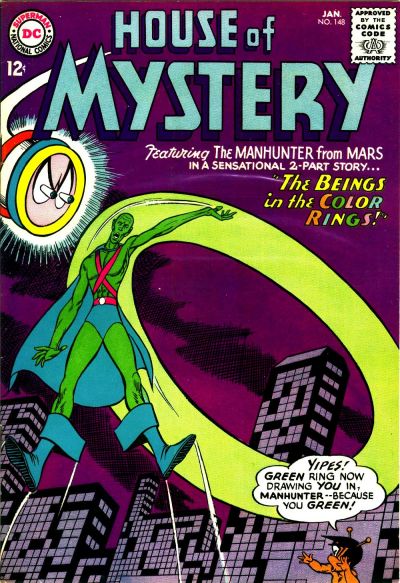
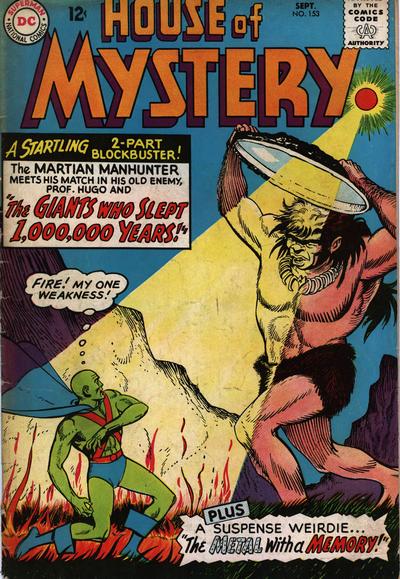
When Manhunter debuted in House of Mystery he was the lead feature and he waged a seemingly endless battle against the Idol-Head of Diabolu, an ancient artifact which had magical powers and on the first full Moon of every month unleashed a weird and deadly menace on Earth. Manhunter and Zook became sentinels of sort waiting month by month for the next weird threat to emerge. And they were some doozies as the covers above and below amply demonstrate. Martian Manhunter's feature was expanded to its largest size to give him space and time to battle the peculiar magical menaces. It seemed a genuine push to give the Martian Manhunter something he'd never had, a legitimate chance to win an audience on the newsstand by the power of his image. Alas it was unsuccessful.
After some truly bizarre covers, the mavens at DC must have crunched the numbers and decided that poor old Manhunter wasn't drawing enough readers, so he began to lose his cover slot.
Not all at once, but now and again. Sadly the Martian Manhunter who had been hidden from the world in which he lived for so many years and from the us readers on Earth-Prime was about to return to obscurity.
Three more covers and it was over. The great experiment to give Martian Manhunter a push was done. He continued to battle the Idol-Head of Diabolu and other occasional menaces. He picked up a regular baddie named Professor Arnold Hugo, a former enemy of Batman but one who became a regular foe for Manhunter.
Aside from a blurb or two the Manhunter's drift into the recesses of back-up limbo continued unabated. Jack Miller and Joe Certa kept the series rolling, with Certa's artwork getting more and more unrefined. He also seemed to be exploring new zanier page layouts in an effort to make the strip feel less old-fashioned.

With the arrival of Robby Reed and Dial H for Hero, Martian Manhunter was right back where he started so many years before, a steady reliable back-up for another regular feature. He was now just as invisible as he often became in his adventures. Those adventures did switch gears a bit as the Idol-Head of Diabolu was at long last destroyed. In its place was Vulture, an international crime syndicate headed by Mr. V who because of his opaque white mask Manhunter called "Faceless". Manhunter moved to Europe and assumed the identity of Marco Xavier, a jet-set playboy who dabbled in crime. With this identity he waged a new war against the schemes of Vulture with a few stops here and there to remind us all of Zook's existence and to handle an alien menace or three.

But with House of Mystery #173 it was over. Both Dial H for Hero and Martian Manhunter appeared for the last time. The next month would bring on new editor Joe Orlando and the House of Mystery would welcome its longtime host Cain. On an up note the Martian Manhunter did finally bring Mr.V to justice of sorts thought it came with a twist that didn't really make that much sense.

That same month of January 1968 the Martian Manhunter made his final regular appearance in Justice League of America. (This is just about the time yours truly started reading some DC comics.) In one of Mike Sekowsky's final issues Gardner Fox cooked up a seriously zany issue which had the League pretending to be Green Arrow and battling a gaggle of their old foes. Manhunter does get several pages when takes on Dr. Light. But his last appearance is in a bold two-page spread as the League put the smackdown on the villains. Manhunter disappeared without comment from the final panels and is not seen again in the pages of the book for ten issues, over a year later in March 1969.

In what became a farewell to J'onn J'onzz Martian Manhunter, Denny O'Neil and Dick Dillin cobbled together a story which tried to explain Manhunter's sudden disappearance. That it muddled his back story is unfortunate but at least they gave the old green fellow a send-off. It turns out he'd gone back to Mars at long last only to find his people having suffered a catastrophe that dwindled their numbers. He battle the villain responsible named Commander Blanx, but needed help so he went back to Earth to scare up his old teammates. The promptly go to Mars and handle the baddie but it's too late for the Martians who need a new planet and J'onn J'onzz joins his people to search for a new home. He doesn't turn up again until Justice League of America #100 which promised all the past leaguers but he's limited to a single panel on a planet far away regretting he cannot be with his mates.

We all know now that Martian Manhunter would pop up now and again over the years but it was not until many years later when he and Aquaman gave the world the Detroit Justice League that he'd again be prominent. He's had a few series since then and his look and back story have changed a few times I guess since then as well.
He even showed up at the end of Zack Snyder's Justice League movie. I was pleasantly surprised to see one of my favorite heroes in the flesh (sort of) though I was a little bummed when I read he only the got the nod because they could not use Green Lantern. Sigh, it's just the Martian Manhunter's luck. But he's still with us and that's grand. Fortunately for humanity, Zook didn't make the cut...yet.
And that's a wrap on "Mars Month" here at the Dojo. Tomorrow something completely different.
Rip Off