Showing posts with label Mo Gollub. Show all posts

Tuesday, May 31, 2022

Tarzan - The Jesse Marsh Years Omnibus - Volume One!


By the time Dell Comics entered the realm of Tarzan of the Apes, Edgar Rice Burroughs' greatest creation had become a small industry. Tarzan had conquered printed prose with twenty novels in evidence by ERB, and had conquered comic strips under the guidance of talents like Hal Foster and Burne Hogarth. Tarzan was a steady entertainment on the big screen with decades of films on the roster. And there had been Tarzan comics but mostly they were reprints of the strips. When Dell picked up the character and tried it out in the venerable Four Color series they created new stories and featured new artwork by an talent who would be associated with the character for  many years to come -- Jesse Marsh. 


Tarzan debuted at Dell in Four Color #134 in early 1947. The story was written by longtime comic strip scribe Robert Thompson and Marsh drew the Ape Man for the very first time. The story is humdinger as are most all these early Dell outings. They are fitted with enough plot and doings for a small movie feature, and likely that was the idea. "Tarzan and the Devil Ogre" has Tarzan meet a woman looking for her lost father who himself was seeking gold. Tarzan and D'Arnot join the safari to find and rescue this man led by a white hunter who turns out to be untrustworthy. The expedition ends up in forbidden territory in which a savage tribe worships a powerful "ogre". There is death and destruction before Tarzan is able to finally save not only himself but some of his allies. 


Four Color #161 was released later in 1947 and again Thompson and Marsh are the creative team. This time Tarzan and D'Arnot are again helping a father and daughter in a lost safari find their way to the lost city of Tohr. They encounter many dangers but none so ferocious and cruel as the woman who leads the people of Tohr and who uses ancient sacrificial practices to enforce her rule. This one had all the elements one would expect of a Burroughs novel and some hair-raising action to boot. This apparently was an adaptation of a radio script by Thompson. 


Dell decides pretty quickly that Tarzan deserves his own title and Edgar Rice Burroughs' Tarzan #1 is on the stands by early 1948. In this story by Thompson featuring more handsome Marsh art Tarzan meets the "White Savages of Vari'". This is another lost civilization of brutish men led for the moment by an evil witch doctor. The rightful queen is a prisoner, but Tarzan soon brings his will to bear and the situation is changed but not without significant violence and conflict. 


The second issue of Tarzan brings on a new writer in the Dell standby Gaylord Dubois. This time it is a young boy seeking his father and Tarzan helps him to do just that. There is still that epic feel to the story and more significant interplay with the animals of the territory. Apes play a big part in this story. The presence of a young lad in the yarn was paving the way for a change in the nature of the stories that Dell planned to tell. Dell also had initiated in the first issue and continued in this one a feature which listed many of the words from "Tarzan's Ape-English" dictionary. These words presented in alphabetical order offer up the names of the creatures along with some very handsome Marsh illustrations. It should be noted that not only the front covers, but the back covers as well of these Tarzan comics featured original art Marsh not repeated in the book. Wonderful stuff, a solid package. 


"The Dwarves of Didona" is the story from the third Tarzan comic and introduces a new family situation for ERB's King of the Jungle. Jane is brought into the story (though never named) and "Boy" makes his first appearance. The family live in the treehouse much as they did in the classic MGM movies and it's a very homespun atmosphere. Dell was intent in their comics to make sure they were producing family-friendly material and the introduction of this kinder and somewhat gentler Tarzan certainly served that desire. Tarzan has to go to a hidden island inhabited by deadly dwarves when his son Boy accidentally ends up there after being carried by witless baboons. 


"Tarzan and the Lone Hunter" introduces the region of Pal-Ul-Don to the pages of Dell's Tarzan universe. This territory of strange people and dinosaurs is very popular in the novels with Tarzan making more than a few excursions to it. Here a lone member of the strange race from the territory comes to Tarzan to seek his help in finding his mate who was chased by outlaws and seemingly escaped but might well be dead. Tarzan obliges. The cover showcases a nigh Eden-like atmosphere for Tarzan and his family. 


"Tarzan and the Men of Greed" is a title that could fit many a jungle yarn starring ERB's King of the Apes. In this instance Tarzan is forced to lead an expedition to the lost city of Opar. Despite the fact the savage men of Opar are all dead along with their queen La, the greedy men run afoul of savage apes who guard the vast treasury of gold. Only Tarzan and his family return. The deadly violence is cleverly hidden by Marsh in his panel designs, but the story makes little secret of what happens to the men. 


"Tarzan and the Outlaws of Pal-ul-Don" brings back the strange territory. This time Tarzan and Boy head there, crossing a desert and some forbidding snowy peaks to enter the land of roaming Triceratops and Sabre-tooth Tigers. They are seeking to rescue Jane who has been kidnapped by the aforementioned outlaws. Tarzan enlists of the help of his many allies in the land he rescues Jane from the clutches of the criminals. Boy is along every step of the way. 


In "Tarzan in The Valley of the Monsters" Boy and a friend Dombie launch a balloon which haplessly floats into a strange valley filled with dinosaurs. Tarzan and Dombie's Dad used a plane to try and catch up to the boys but all of them end up crashed in the deadly valley. They find allies in people who live among the dinosaurs but when they are able to at least escape the valley enshrouded by a volcanic cloud. 


"Tarzan and The White Pygmies" picks up right after the last issue as Tarzan and Boy and their allies try to walk back home. They encounter a tribe of pygmies who are having difficulties with giant buzzards. Tarzan devises a scheme to help them help themselves in that regard. One note is that Morris Gollub takes on the cover duties with this issue creating an Eden-like image of Tarzan and assorted wild creatures. Gollub will create the next several covers. 


"Tarzan and the Men of A -Lur" has the King of the Jungle involved in an uprising in Pal-Ul-Don between various important cities and their leaders. Tarzan calls upon his allies in that strange dinosaur-laden land to help. He also makes effective use of an enormous elephant that travels into the region. The Ape-English Dictionary nears its alphabetical end and is reduced to a single inside cover page. The other is used for a subscription ad for the comic. 


"Tarzan and the Treasure of the Bolgani" is a truly strange tale in which Tarzan combats a city full of intelligent gorillas (Gorilla Grodd anyone?). These hostile apes enslave human beings to work for them by shrinking them in a strange device. Tarzan though while small retains his strength and becomes less vulnerable to weapons. He is able to lead a revolt against these strange creatures. 


"Tarzan and the Sable Lion" begins with Tarzan battling and then to some extent taming a ferocious lion. Then he discovers that a village has been captured by slavers and just by chance so have Jane and Boy. Collecting what allies he can from the wild he goes to free the captives and wreak some hard justice on the slavers themselves. 


"Tarzan and the Price of Peace" is all about love. Tarzan stumbles across a forlorn lover who tells Tarzan how he cannot afford to win the hand of the girl who loves him also. Tarzan intervenes and arranges for the couple to escape their village. As they are doing this they encounter more slavers and free the captives. Then all of these displaced people find a home on an isolated island when Tarzan is able to negotiate a peace with the existing tribe of Mangani. 


Things change up with the thirteenth issue. Mo Gollub has move on from cover duties. Instead, a photo of Lex Barker the then current film Tarzan is used alongside the faithful Cheeta. Some Jesse Mash drawings help fill out the space. This shift was probably seen as wise to move more comics, but it's a shame since the covers produced by Marsh and later Gollub had been handsome indeed. This approach will be used for all of the remaining covers in this collection. There are two stories in this comic. The first is "The Knight of Lyonesse" and has Tarzan stumble across a young knight from the usual lost city who is hot to kill a Saracen and take his beard to win his honey. Tarzan saves the knight from baboons and helps him get his trophy without bloodshed when they break up a gang of slavers. This story reveals that La of Opar is not dead as had been reported in an earlier comic story. In "The Ape Hunter" Tarzan must stop a brazen American who wants to kill apes for sport. He of course doesn't get his way. The last remant of the Ape-English Dictionary appears on the inside cover of this issue. 


Again, there are two stories, which will become standard. "The Lost Legion" is yet another lost civilization in the classic ERB tradition. This time it's Romans who have a city and are living much as they did long ago. Tarzan and D'Arnot with Boy tagging along are flying to map the Monster Valley they'd found some few issues before and crash, then are captured by an evil king. But soon they are able to ally with the rightful ruler and the tyrant is pitched out. "The Flying Chief" has some young folks in an airplane run afoul of a scheming tribal chief who wants to fly a plane. He does so but it turns out poorly for him when Tarzan gets involved. A new feature called "Jungle World" shows up, this again illustrated by Marsh. 


"Tarzan and the Cave Men" reintroduces La of Opar. This time she is on the verge of being sacrificed by the males of the society but Tarzan saves her. With nowhere to go, Tazan recommends Pal-Ul-Don and off they head riding atop Tantor. When they get this land of dinosaurs they are waylaid by a caveman who captures La and takes her back to his village. There is a struggle for her attentions but Tarzan brings an end to that and La seems to have a found another place she can rule. "Tarzan and the Hunter's Reward" is another variation on the classic Romeo and Juliet theme with two young lovers frustrated by their culture. Tarzan helps bring about a happier ending. 


The sixteenth and final issue from 1950 in this immense collection starts off with "Tarzan and the Beasts of Armor" Tarzan is flying to the Valley of Monsters and Boy sneaks aboard the plane. They end up fighting some mighty dinosaurs and saving a man from Pal-Ul-Don who tells them that his city has been taken over by white gangsters. Tarzan and Boy join the fellow and they head to the lost territory where Tarzan uses his wits and muscles to defeat the criminals. Then it's back to the plane and home. "Tarzan and the Giant Eland" is the last story in this collection and true to its title Tarzan finds and tames a giant eland which proves handy when he must save a native girl from ritual sacrifice. 

I was much surprised by the nature of these tales. They were much more willing to engage ERB's mythology of Africa than I expected. Pal-Ul-Don and Opar are key parts of many of these stories, especially the former. I chagrined when the series suggested La was most likely dead and pleased as punch when she turned up for two more appearances. The use of Jane and Boy following the template of the movies was smart as well by DuBois and Marsh. It made the series familiar to young fans who came to the comic by way of the movies. And the use of ERB's mythic landscape supplied the same flush of familiarity for fans of the novels. These Dell Comics did a great job of making these Tarzan comics accessible to all fans of Tarzan.

Rip Off

Sunday, April 3, 2022

Sunday Of Stone -Turok Volume Four!


Turok Son of Stone has settled into a regular pattern of solid sales for Dell Comics with a quarterly schedule in 1961. The writing of Paul S. Newman remains rock solid as the personalities of both Turok and Andar are continually refined and sharpened. When the duo entered the "Lost Valley", they were both considered "youths", but as the series progressed Turok matured into a man of age and experience and a mentor to a much younger Andar. Often a story hinges on Andar failing to follow Turok's direction or advice and in his defense that advice can be somewhat inconsistent. At times Turok seems to seek the comradeship of the more primitive tribes who inhabit the territory and at others he seems quite reluctant to deal with them. 


In the nineteenth issue we start with the story "The Way Out of the Valley" in which the pair find a way out but are frustrated because they don't want to lead the savage cave men to their homeland. It is a dilemma. "The Mystery of the Rock" explains how a rock with the impressions of dinosaurs came to be and uses the tracks to tell a tale. "The Spirit Cat" is a text piece where we meet Umar who has killed a Sabre-Tooth and is stalked by another who a Medicine Man claims is a ghost. "The Return of the Giants" is just what it says and showcases the giant men who had shown up in an earlier Turok tale. This time they come in greater force and Turok must use his wits to turn back these powerful foes. Rex Maxon is the artist on all the stories. Mo Gollub supplies the dramatic cover. 


"The Eruption" leads off the next issue and Turok and Andar are battling for their very survival when a volcano threatens them and the tribes around them. The threats are many including frightened tribesmen, noxious fumes and boiling lava, and also frightened "Honkers". "Back to the Water" is the "Young Earth" tale of how a fish-lizard came to be on the land and returned to the waters. "The Buffalo Robe" is a text story about Gorun who shows his fellows how to use disguise to hunt the great beasts. "The Night People" is a creepy tale in which weird cavemen emerge at night to steal resources from other tribes but end up stealing from Turok and Andar and even capturing the latter. Turok must save his young ally from these glowing men. Again Newman is the writer and Maxon the artist. George Wilson supplies the cover art. 


Under another dandy Mo Gollub cover, Newman and artist Bob Fujitani give us the story of "The Water Seekers". In this one Turok and Andar are trying to forestall a battle between two tribes over water access by building a small canal to supply everyone. The meet quite a bit of resistance. "The Armored Ones" drawn by Rex Maxon tells of the special adaptations made by dinosaurs like Stegosaurus, the Ankylosaurus, among others. "Forbidden River" is the text story about Utur who tries to get his father Gorr to see that ingenuity can get them to the other side of the river where resources are plentiful. "The Sand Wastes" by Fujitani has Turok and Andar captured and set out on a barren desert waste and left to die. They do survive but it's a near thing. 


Mo Gollub does the cover, Paul S. Newman does the script and Rex Maxon is back on the interior art in the twenty-second issue. "The Outsiders" has Turok and Andar deal with some treacherous Cave folk as well as some particular viscous "Honkers". For the most part the dinosaurs don't give Turok much trouble unless he is undermined in some way. "The Triumph of the Egg" is the "Young Earth" story and details how eggs became more and more resilient as they came to land. "The Stone Builders" sees our heroes become slaves for a tribe who are adept at constructing with large slabs of rock. The duo must use all their wits when the thrown into a great pit with a deadly "Honker". Even then Turok is able to down it with a bolo weapon and his knife. The comic closes with a one-page piece on "The Wooly Mammoth".


The same creative team of Gollub, Newman and Maxon is on hand for the next issue. "The Cave of Fear" is the first story and Turok and Andar run into deadly trouble when they try to help a young girl condemned to death by her tribe. They are trapped in a cave containing dinosaurs and a deadly secret. "The Death of the Dinosaurs" tells how the majestic beasts came to their grisly end, giving the credit to climate change. No asteroid is mentioned in this version. "Youngling" is the text piece about Krog who uses his wits and dance to slay a deadly cat. "The Burial Grounds" has Turok and Andar forced by Cave men to seek out the legendary location of the dinosaur burial ground. They do find an answer, but it is not mystical. "The Styracosurus" is a one-pager that closes out the comics. 


The twenty-fourth issue of Turok Son of Stone is a singularly important one in that it features the debut of artists Giovanni Ticci and Alberto Giolitti on the strip. With the arrival of this artistic team from Italy Turok enters a fully mature phase. Previous artists have served well but this new team bring a power and drama to the book mostly missing to this point. The rendering of Turok in particular is impressive as he is presented as a mature man and Andar if anything is made a bit younger. "The Cliff Men" has Andar suffering delusions from drinking foul water. Turok must carry his young ally on his back and fight many "Honkers" and the people of a tribe who live on high cliffs where a cure can be found. "The Strangers" is the text piece about Havar and Rakk, two men from two different tribes who learn to work together to save themselves despite the enmity of their tribes. "The Vanished Animals" introduces several impressive mammals who have disappeared over the long ages. "Lair of Death has Turok and Andar battling deadly dinosaurs to retrieve a symbolic war club. I can find no credit for the cover but I'd guess Gollub, and it's one of my favorites. 

More prehistoric heroics next week as Ticci and Giolitti continue with some few interruptions and Turok Son of Stone is published under the Gold Key brand for the first time. 

Rip Off


Sunday, December 19, 2021

Sunday Of Stone - Turok Volume Three!


Turok Son of Stone had become a regular hit for Dell Comics and this third Dark Horse Archive volume sees the series enter the 1960's. Our heroes Turok and Andar have been stranded in the lost valley for quite some time and they seem much less interested in escape in these issues and much more focused on finding a way to live peaceably among the primitive tribes they find constantly and to live safely from the wide range of dinosaurs that roam the territory in large numbers. While the Grand Comic Database leaves many stories as having an unknown writer the only writer listed in the volume by Dark Horse is Paul S. Newman. So I assume he wrote most of the main Turok material though perhaps not all of the support pieces. As has been the case throughout the young series life, a number of artists step in to draw the adventures. 


Beneath a cover by Mo Gollub, this comic starts with a one-pager on armored dinosaurs. The first Turok story is drawn by Ray Bailey and deals with a mysterious tribe who are hide on an island and slink into other camps to steal supplies at night. Andar ignores Turok's advice the stay away from a lake shore and is captured and Turok must rescue him. This sets up a common theme in this collection of Andar disagreeing with Turok's advice and striking out on his own, usually to his detriment. What follows is a one-page text piece in which a caveman invents the bow and arrow thought his friends don't at first see its value. The "Young Earth" feature is in every issue in this collection and this first one by Newman and Rex Maxon tells the story of a cave, from its creation out of the earth by weather and of the many creatures who come to dwell in it for safety right down to the modern day. Ray Bailey returns for the final Turok story in which Turok and Andar come to see a brontosaurus egg hatch and Andar wants to make a pet and mount of it. He regrets his decision and Turok helps him solve the problem. 


Mo Gollub supplies a very dramatic cover once again. The Turok stories are again drawn by Ray Bailey and presumably written by Paul S. Newman. Newman and Rex Maxon provide another "Young Earth" feature as well. The first Turok tale has Turok and Andar help a tribe who have lived on a volcano for generations but when the territory begins to erupt around them, they must leave. The text story tells how two cavemen come to realize that working together is more effective against the threats of their time. "The Young Earth" feature is quite clever and shows how radiation from the heavens has presumably triggered evolutionary change in the ancestors of the Elephant such as the wooly Mammoth on the Earth with its myriad climate alterations. Turok and Andar kill a threatening Pterandon but some nearby primitives worship the creature and force the duo to get a replacement and so they must steal eggs. The last one-pager tells of ultra primitive lifeforms in the Cambrian Seas. 


We have another grand Mo Gollub cover for the fifteenth issue. Beneath it are stories drawn once again by Ray Bailey and presumably written by Paul S. Newman though the GCD is mum on that aspect. Andar doesn't follow Turok's advice and is kidnapped by a tribe of smaller people who protect themselvses by living beneath a pool and in a hidden cave. Turok must swim to find Andar to rescue him and of course must battle some ferocious dinosaurs. He and Andar show the people how to live more safely among the many dangers. "The Young Earth" feature shows how the meek mammals survived and changed to inherit the Earth from the dinosaurs. The text story shows how the wisdom of age must be cherished as a new chief ignores tradition and insists his predecessor live and continue to help the tribe. Turok and Andar face their greatest challenge yet when the duo choose different sides in a dispute between leaders in a primitive tribe. The first time Andar willfully disagrees with Turok and acts on those beliefs. It seems to be a story about how different generations see solutions to the world's problems and creates an ending that validates both attitudes. 


George Wilson supplies the dramatic cover for the sixteenth issue of Turok Son of Stone and it shows our heroes battling a giant caveman. The story beneath this cover by Paul S. Newman is drawn wonderfully by Bob Fujitani and the boys find a giant grave and later discover a tribe who have been threatened by two giants, one of which they killed. The second one shows up and wants his revenge but Turok and Andar win the day but wonder where more of these giants might be. "The Young Earth" is drawn by Rex Maxon and shows how birds developed from the Archaeopteryx, the first feathered serpent of sorts. The text story tells how a young man impresses his father by using his wits and the new weapon of a bolas to slay a deadly sabre-tooth cat. The second Turok story, also drawn by Fujitani shows Andar injured when against Turok's advice he tries to kill a deadly horned honker. Turok knows of herbs that will help heal Andar but a tribe prevent him from getting them until he kills the aforementioned honker for them, and all the while Andar gets sicker and sicker. The comic closes with a one-page effort about the wooly rhinoceros and we get a bonus inside-cover feature which is an ad for a Dell comic called Ingenue. 


The same creative team of George Wilson on cover art, Paul S. Newman on script and Bob Fujitani on interior art is responsible for the next issue. Wilson's cover shows Andar captured by pygmies in a Gullivar fashion. This is a nifty contrast to the previous issue's cover. The inside cover one-pager talks about an enormous ancestor of the rhino called the Baluchiterium. In the first story by Newman and Fujitani Turok and Andar find little dinosaurs and follow them into a cave when a storm strikes. While Turok sleeps Andar carelessly wanders off and gets captured by the little people, one of who wants to use the giant to enhance his own power among his people. When Turok comes to the rescue the little people try the same gambit with less success and Turok frees Andar and they are able to get away from the tiny menaces. "The Young Earth" drawn by talents unknown (probably Rex Maxon) showcases the land bridge which once existed between Asia and North America. The text story has some primitive people learn the value of trade as opposed to constant warfare. In the second Turok story he and Andar are saved from a deadly dinosaur by a brave caveman who dies in the effort and asks the duo to return his son who will be chief to his people. They of course agree but are soon lost when a flood takes them to a weird desert and far from their goal. They eventually must traverse a weird cave surrounded by honkers who are held at bay by fire before they can complete their quest. 


Mo Gollub is back on cover art for this action-filled issue. Paul S. Newman is still presumably the writer but it takes a combination of Bob Fujitani and Ray Bailey to deliver the interior artwork. The first story deals with a cunning caveman who saves the duo of Turok and Andar and demands the secret of fire in return. Reluctantly Turok gives it to him but regrets it almost immediately when the caveman uses this arcane knowledge to wield powe over his people. The caveman named Gan eventually sees Turok as a threat and wants him dead but his scheme backfires. "Young Earth" showcases how prehistoric creatures have come down to the modern day in cave after and fossils as well as living examples like the Coelacanth and the Tuatara. Once again the new weapon of the bow and arrow figure prominently in the text story about a tribe coming to grips with the new technology. Once again Andar ignores Turok's cautions and the result is that he is once again captured by primitives who live in an isolated area in homes on stilts, and who hold him hostage against Turok killing a deadly sea monster for them. They come to regret that decision. 

And that's a wrap on another tasty handful of Turok Son of Stone comics. Reading these issues, you can feel the concept maturing and finding a balance between personal drama and the struggles against the world in which they find themselves. The friction between Andar and Turok shows that they are changing and that Turok's relative maturity is something Andar sometimes feels the need to confront in his boyish enthusiasm. They remain loyal to one another but that loyalty is not untested in these stories. More next time when the series finally finds the artistic team it's been searching for. 

Note: The "Sunday Of Stone" feature will return after the holidays. 

Rip Off

Sunday, December 12, 2021

Sunday Of Stone - Turok Volume Two!


In the second archive volume of Turok Son of Stone, we really begin to see the fullness of the characters and the setting become realized. While the artwork is still a tad lackluster compared to what the Aberto Giolitti studio will bring, it's more developed. What has really become a stunning element are the covers, but more on those later. While it seems true that Turok began as a series titled "Young Hawk", I've always seen Turok himself as a mature man and Andar much his junior in need of the mentoring that Turok's sober approach to the dangers of the Lost Valley provides. Turok never panics, even when confronted with massive deadly dinosaurs well earning his title of "Son of Stone". 


Under a grand cover the comic first featues a one-pager about the Brontosaurus. Writer Gaylord  Dubois and artist Bob Correa introduce a new character of sorts into the Turok clan in the shape of a tamed wolf named "Ski-Yu". Turok seems very pleased with his new ally though the people of the Caves with which the two Native Americans have been living are less pleased. So Turok and Andar move on to a new valley (there always seems to be a new valley) and a new tribe living in houses atop high mesas. We are treated to a new "Lotor" story as the wily racoon uses the back of a Triceratops to allow his family to escape the threat of a Dimetrodon. There's a text page about hunting Mammoths. The second story takes Turok and Andar into a deadly flooding river which they are able to use to turn back raiders who threaten the Mesa People. There's plenty of action dinosaurs battle one another in the raging waters. The comic closes with "The Story of Fire" done in one page. The back cover features the Dimetrodon. 


Beneath another exciting cover we get a one-page introduction to the Duckbill. Turok and Andar are still attempting to deal with the results of the great flood from the last issue. They build a raft and head over to the Mesa despite the threat of a deadly underwater dinosaurs to rescue the stranded Mesa People. It's a struggle to save everyone but they do. The next story features a Pteranadon and we get to see how this "flying dinosaur" lives up to its description. A one-page text piece describes the search for fire. Then Dubois and Correa show Turok and Andar enter yet another canyon where Turok is able to capture a horse for his own use. He names the horse "Wind Racer". Ski-Yu the wolf is still around but he seems to be taken for granted as if Correa drew him in after Dubois left him out of the script. We learn a lot about Turok as he actually gets free of the valley, but Andar is unable to join him and so Turok returns to the deadly territory of the dinosaurs and so much more. The comic closes with a one-pager on ancient tools. 


I would argue that the immense success of Turok owes at least as much if not more to the stupendous covers by Mo Gollub such as the one above which is my all-time favorite image of Turok and Andar as they prepare to face off against a deadly Dimetrodon. The stories inside lack attribution in the Grand Comic Database at least in terms of writer but the artist is Ray Bailey. The comic begins with a one-page history of the horse. Then we follow Turok and Andar as they actually battle the Dimetrodon on the cover. Andar is injured and Turok needs shelter for the young man so his leg can heal. So he bids farewell to Wind Racer (Ski-Yu is nowhere to be seen) and he and Andar try to get access to a cave but are blocked by a scared tribe. The tribe observe them and are curious and the two are able to get into safety though there is much strife when Turok uses fire to save the tribe from invaders. A feature called "Young Earth" debuts and we follow the misadventures of a Plesiosaur as it avoids threat. There is a text piece about a brave man who fights a sabre-tooth tiger. Then Turok and Andar find a tribe who live in trees but that's dangerous and they eventually convince them to seek the safety of caves. 


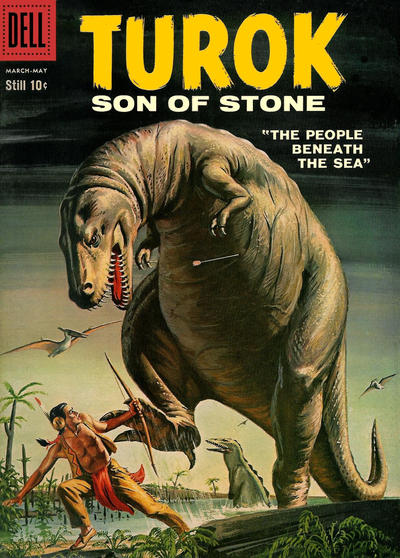
This image of Turok and Andar is a definitive one. The drama is stunning as the two braves are caught between a monster and the fires behind them. They have only spears to defend themselves but appear stalwart and resolute. I love how Turok is shown here, clearly a man in his thirties and not someone you'd call a youth though the text still does inside sometimes. He's protecting Andar, though Andar is prepared to fight as well. This is one of Mo Gollub's finest.


I first encountered the image on the cover of a Golden Comics Digest, one of my favorite Turok books. This image, even shrunk to digest size has the power to make you imagine you are there standing alongside Turok and Andar as they face down the threats. They are not fighting but like all brave people they are prepared to stand by one another. It's a delightful and important lesson. 


Under another incredibly dramatic Mo Gollub cover we begin with a one-page piece on the Coelacanthus. The lead Turok story is by an unknown writer and artist Ray Bailey. The duo are up against a deadly Triceratops who is hunting them relentlessly. To escape and find food Turok, Andar and a caveman named Alg slip out and set a trap. But Turok and Andar have to contend with a jealous Alg as well as the dinosaur. The second story has our heroes meet up with a tribe who worship a diety who supposedly exists in a bog. But Turok discovers it is actually deadly quicksand and the tribe is starving to give offerings to a god who isn't really there. The text story introduces us to Ignoo the terrible a deadly T-Rex who is defeated by a lone caveman named Gothar. "The Young Earth" feature focuses on a Notharctus an early mammal trying to live in a world ruled by giant dinosaurs. The comic closes with a one-page look at early cave man sculpture. 


Paul S. Newman takes up the writing chores with Ray Bailey still on art. After a one page look at a bird called the Hesperornis who lives beneath the water, the main story takes Turok and Andar into a strange junlgle that seems intent on eating them. They find a tribe stranded inside and together find a way to freedom. "The Meeting" is a one-page text story about a caveman named Ug-Kur who has lost all the members of his tribe and is able to find some friends at long last. "The Young Earth" tells the story of Stegocephal, an early amphibian just learning to live in that bit of land between the waters. Turok and Andar find themselve battling superstition when a caveman has convinced his peers that they can only hunt animals he first draws on the walls of the cave. Turok doesn't pay attention to this and eventually shows the tribe the truth. 


I first came across this great Mo Gollub artwork in a Gold Key Turok Son of Stone Giant Comic reprint from 1966. 


The final comic in this archive edition features another outstanding Mo Gollub cover, very dramatic. Inside there is a new artist to illustrate the scripts by Paul S. Newman. The artist is Lee Elias, a fave of mine and he does a dandy job here telling first the story of "The Conqueror". This is another Native American who finds his way into the lost valley, but this guy named Gurai looks remarkably like Germonimo and seems quite warlike. He wants to conquer the tribes of the valley but Turok and Andar stand in his way and despite several schemes they are able to stop him and though he escapes back up top no one will believe his tales of giant monsters. Saba the Mighty is a sabre-tooth tiger who meets his match when a caveman is able to bring him down in a one-page text story. "The Young Earth" tells the story of how the Archaeopterykx first learned to fly. In the second Turok story the pair find themselves on an island with few resources and among a tribe who don't know how to better themselves so they hide in the ground. Turok and Andar convince them to build weapons and tools from the bones of the dinosaurs around them and they are able to build rafts to get to the mainland where there are resources. The comic closes with a one-pager on cave art. 

In these stories it seems the focus shifts for Turok and Andar and they are less concerned with seeking escape as finding a home in these canyons which seem to roll on forever and offer endless threats. They meet and work with people and always try to work to make the life of everyone better. More next week. 

Rip Off
Saturday, March 13, 2021

Mighty Samson Volume Two!


Frank Thorne, the celebrated comic book artist is dead. He passed away this past Sunday as did his wife Marilyn of seventy years. He was ninety at the time of his death and he left behind a remarkable body of comic art. He was the the creator of Ghita of Alizar, a very sexy warrior woman in the style of Red Sonja, a character he worked on with great aplomb for Marvel Comics. Thorne's mainstream work includes Mighty Samson for Gold Key and I dedicate these posts on the vintage Gold Key series to Thorne. 


The first Otto Binder story in this collection and alas the last one drawn by Frank Thorne takes Samson, Mindor and Sharmaine into the underworld beneath the apocalyptic New Y'ark city where they find a race of humans called the Undermen. It is at first believed that the Undermen are sinking the buildings of the city, but Samson discovers that the culprit is in fact an enormous mole monster, in fact an entire mob of such creatures. But thanks to Mighty Samson, the threat is averted and the survivors of both worlds are left in relative if not long-lasting peace. 


The eighth issue of Mighty Samson marks the debut of Jack Sparling as the new artist on the series. Sparling has always been an artist I fight to like. He has a very scratchy style and was a workhorse for sure, but his storytelling can be spotty at times. Here he draws Binder's tale of the people of New Y'Ark answering the siren call of a radioactive mountain located in the deeps of the Arctic. Like lemmings the humans from all around the Northern hemisphere are drawn to this object until Samson with the help of Mindor is able to break the spell with his power, after the latter rediscovers the formula for gunpowder and uses that to blow up the offending rock. 


The ninth issue features a trip to the ruins of Washington DC as Terra of Jerz returns this time using an exceedingly powerful robot once used to protect the President of the United States. Given that JFK had been assassinated only a few years before this comic hit the stands, such an idea carried no small power for even younger readers. Samson is able to finally defeat the relentless robot, but only after battling for a long time and eventually dropping it from the top of the Washington Monument. 


Back in New Y'Ark another old villain returns when King Kull and his henchmen return., They have taken over the high rise society on what was once Staten Island and look to consolidate their power to take over all of New Y'Ark. The biggest threat though is the "Gorillasaurus" which roams the forests surrounding the high rise settlements. A new feature appears alongside the regular Samson stories -- one page items describing some of the mighty monsters which have shown up in the strip over the early issues. 
 

An insight into the complexities of trade is given in the eleventh issue when traders called "Swappers" bring food to the denizens of New Y'Ark and suddenly begin to ask exorbitant recompense. The food produced by farmers on the other side of a dark and forbidding forest who are themselves being gouged by these Swappers. Samson and Mindor work to clear "Broadway" so that a more direct arrangement can be made between the producers and the consumers cutting out the greedy middle men. But deadly sentient trees make the work very difficult. 


It's a battle on the waters around New Y'Ark as the wannabe "Queen" Terra of Jerz finds and brings back into operation a vintage gunboat. Samson, Sharmaine and Mindor have just boarded the Queen Mary which in the Mighty Samson universe never left for Long Beach California to become a resort of sorts. The fighting is furious with Samson chucking torpedoes and dodging cannon shot as well as the occasional sea monster to defeat Terra once again and send her limping back to Jerz. 


Superstition gets the skewer in the thirteenth issue of Mighty Samson. A supposed mystic named "Merlyn" invokes a god he calls "Zomzu" and ascribes various miracles to this newly discovered deity. In fact Merlyn has uncovered plans to New Y'Ark's immense electrical grid and is using his knowledge of electricity to fabricate his miracles and woo the superstitious of New Y'Ark. Mindor catches onto his scheme and helped by Samson concocts his own counter-miracles to break Merlyn's spell of the populace. It's sad that Mindor discounts telling the people the truth as he regards them as too ignorant to understand it. 


Wrapping up this second volume of Mighty Samson is the fourteenth issue which by page count is much shorter than the comic that opened the volume. Pages have been trimmed and it has made the stories read much more swiftly with fewer digressions. Sometimes that's a good thing, but mostly not. In this story the trio led by Mindor get on a boat and track a deadly oil spill down the Gulf Stream to what was once Florida. There they find the "futuristic" city of "Technopolis" which was filled with automated factories and which for some reason has kicked back on. As with most devices in Samson's world machines are powered by nuclear power and even after stopping the spilling oil by removing its battery, the trio find themselves under attack both from the native population and the city itself. Eventually they stopped the city's operation and are able to head back home where the waters have cleared up at last.


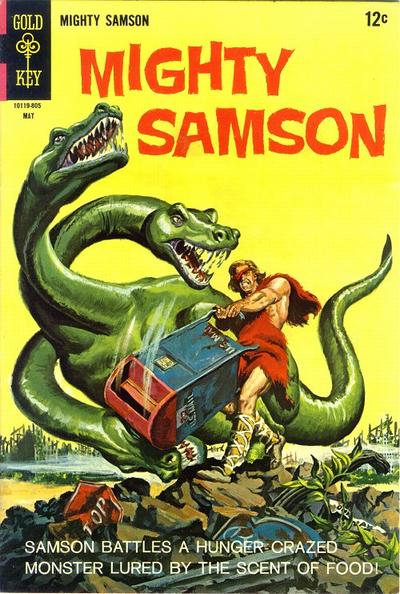
All of the comics in this run feature great covers by Morris Gollub who on that final issue chose to give the monster two heads instead of the three from the story. There's no doubt that despite the drop off in art quality inside the book, the covers remains highly evocative and tempting indeed. 

More Mighty Samson next week.  

Rip Off