Showing posts with label Kaiju Korner. Show all posts

Thursday, January 11, 2024

Godzilla Minus One!


Godzilla Minus One is a remarkable entry in the decades long monster series from Toho Studios. We are awash in Godzilla movies it seems these days, with a new one every few years. I'm a fan, so that's mostly fine with me. The original Godzilla is among my favorite movies, if not my favorite. (It has slowly over the years been edging out The Thing from Another World and the original King Kong for that honor for some years now.) What makes the original so fascinating and so compelling is that we know next to nothing about Godzilla. He's a force which just appears one day and brings death for thousands with him. He'd be like a hurricane if a hurricane was caused by the hand of man. (And with global warming maybe we've entered that arena as well). The movie is about the people who have to deal with the menace of Godzilla. What do you do when death comes for you cand you can't get out of the way. That's the threat of Godzilla, and it's that relentless menace that informs Godzilla Minus One. 


BEWARE! SPOILERS BEGIN. 

This is the exceedingly personal story of one man who is a kamikaze pilot in the final days of the World War II. When it comes time to give up his life for his country, he makes another choice. Later when confronted with the menace of a giant dinosaur he freezes when death stares him in the face. Men died that day, and his family died when Tokyo was bombed. He finds other survivors, a woman and baby, both orphaned by the war and the three form a family of sorts and go about finding life among the ruins. But his guilt never leaves him. And then Godzilla arises from the depths, and he knows that the menace of Odo Island has swelled to Earth-shaking proportions and tens of thousands die. His life seems to be a strand that constantly finds itself in periodic contract with Godzilla or his aftermath. Ultimately, when he's lost even more, he decides to take final action and the Japanese people, abandoned by their government and by the United States government, must unite to defeat the menace. 

RELAX! SPOILERS END. 


Wars take countless victims, both living and dead. This movie is about the living, those who survive devastating events such as war, and tells us the story of their guilt. The world is a ruthless place and good people die younger than they should have done, and when that happens those around them wonder why not them. What did they do to deserve to continue living, to have a life when the one they loved is gone. Most anyone who has lived for any length of time has confronted this dilemma of the soul. How do we justify our existence when better people than us have died. We are survivors, we get to live, and it can be a curse, but the message of Godzilla Minus One is that life is what matters. Live. 


I heartily recommend Godzilla Minus One. I was lucky enough to watch it in a near empty theater and got a seat right down near the screen for maximum effect. It was ideal for such a film. It's a great Godzilla movie, and just a great movie in all respects. 

Rip Off

Wednesday, January 10, 2024

Godzilla Reads Again!


Before I get into my thoughts on the book Godzilla and Godzilla Raids Again by Shigeru Kayama, indulge me in a little cinematic history. When they made King Kong in 1933 it was a revolutionary film, a movie that pure cinema with a star that did really exist in the real world save as a tiny model, and despite that handicap thanks to stop-motion magic made many in the audience cry when he tumbled from atop the Empire State Building.


King Kong was such a success that they made a sequel, Son of Kong, in six months-time but while still impressive it lacked the emotional potency of its predecessor. And that was it for giant monster movies for quite some time because the movies were so labor intensive. In fact, it was the 1950's when King Kong was released again that folks saw just how popular it was. 


Beast from 20,000 Fathoms arrived, powered by stop-motion and Toho Studios had an idea. But they couldn't do it in stop-motion, but they could put a man in a monster suit. and they did. So was born Godzilla. 


A great many talents worked on Godzilla. Ishiro Honda directed the movie, Ikira Ifukube created a masterful score, but it was Shigeru Kayama who wrote the story treatment. And it's that same Shirgeru Kayama who went on to write novelizations of the story, the first titled Monster Godzilla based on his own radio adaptation, a comic book version known as Monster Picture Story: Godzilla, and most importantly for this review two novels adapting the debut film and its sequel. The sequel story treatment Godzilla Raids Again (released in the United States as Gigantis the Fire Monster) was also written by Kayama. So, he's an expert on all things early Godzilla, though he'd not write another Godzilla movie until 1971's Godzilla vs. Hedorah.  


The novel version of Godzilla has now been translated after all these decades. It is basically the same story, an unknown dinosaur is exposed to radiation thanks to atomic testing and rises from the depths to wreak havoc on ships and eventually on land as well. A scientist named Yamane is torn between dealing with the threat and saving the creature so that mankind might benefit. He has a daughter named Emiko, but she's not engaged to another scientist named Serizawa. There is not romantic angle at all in this story. The hero is Shinkichi Yamada who fans of the movie will know as the young boy who survives the attack by Godzilla on Odo Island and comes to live with Yamane in Tokyo after his brother and mother are killed. In this story he is older and already working in Tokyo when the story starts. Another big change is that Godzilla glows pretty much all the time, evidence of his radioactive nature. Other than that, the story rumbles along pretty much the same. One critical difference in the ending is that Serizawa says point blank that he will kill himself to keep the secret of the Oxygen Destroyer out of evil hands, so few should be surprised by the ending. 


Not at all unlike King Kong, the success of Godzilla prompted a hectically produced sequel titled Godzilla Raids Again. It was with the release of the sequel in 1955 that Kayama adapted both stories to novel form. 


The original Japanese title to the movie Godzilla Raids Again literally translates to "Godzilla Counterattacks". Int he sequel we get two kaiju with the introduction of Anguirus. Notably in the novel Anguirus also has the same atomic breath ability as Godzilla, which is not the case in the movies. This second novel follows along with the movie quite well with only a few changes of any consequence. Godzilla is discovered by an airplane pilot working for a fishing company and soon enough so is his rival the new monster Anguirus. Osaka is the city picked for destruction this time and both monsters end up there soon enough. The sequel lacks the thematic depth of the original, possibly due to the director, but also one can see that the scenario designed by Kayama is much simpler as well. Eventually Godzilla defeats his rival and soon after that the military buries him under a mountain of ice. (It should be noted that this is a second animal named Godzilla, but as fans know this Godzilla will break out of his icy dungeon just in time to battle the might King Kong in the third movie in the series.)


Shigeru Kayama also wrote the scenario for another Toho monster flick titled Half-Human. (You can catch that one at this Internet Archive link. I'll have to do a review sometime.) Kayama was quite a well-respected author when he was tapped to devise the scenarios to these two movies, so it's perhaps not that unusual that he stepped away from the franchise. He was not happy to see Godzilla become so kid friendly, and as we all know that's just what happened when the popularity of the mighty monster overwhelmed his dangerous nature.  When he did come back to the franchise, it was to highlight another world crisis, this time pollution instead of atomic weaponry. These are light novels written for younger audiences, but I found them a fun way to revisit the classic story in a new way. 

Tomorrow is my review of Godzilla Minus One. 

Rip Off

Tuesday, January 9, 2024

The Monstrous Flying Reptile!


Reptilicus is a guilty pleasure of mine. I've been a fan ever since the movie actually scared me as a kid (believe it or not) in the middle of the night during a Halloween movie marathon decades ago. Produced in the wake of the success of Godzilla, this Danish entry into the monster sweepstakes is one of those movies that is beloved for its zany treatment and for its mildly ridiculous monster. The movie is part comedy, part romance, part monster story and more than a tad a travelogue singing the praise of Copenhagen. 


The poster for the movie by Reynold Brown (the same guy who gave us the iconic Attack of the 50 ft. Woman poster) is one of the finest ever made for any monster movie, of that era or any other. Nothing on the poster happens in the movie and the amazing beast on the poster bares only a slim similarity to the actual puppet behemoth of the film, but it's still a fantastic image. To actually watch this amazing classic bit of cinema in which despite the wings Reptilicus does not fly, check out this Internet Archive link. 


Looking much less ridiculous on the comic page though, Reptilicus was adapted twice by the folks at  Charlton publications.  First in novel form as penned by Dean Owen under the Monarch Books badge. I've never read it, but it's supposed to be quite salty. That's a pretty intense cover. Here's a sample of the prose. "General Grayson looked at the girl beside him, wondering if he would live to enjoy Connie's warm, vibrant flesh again. Svend Alstrup, his was remembering Karen's wanton seduction of him and hoping for a repeat performance." 


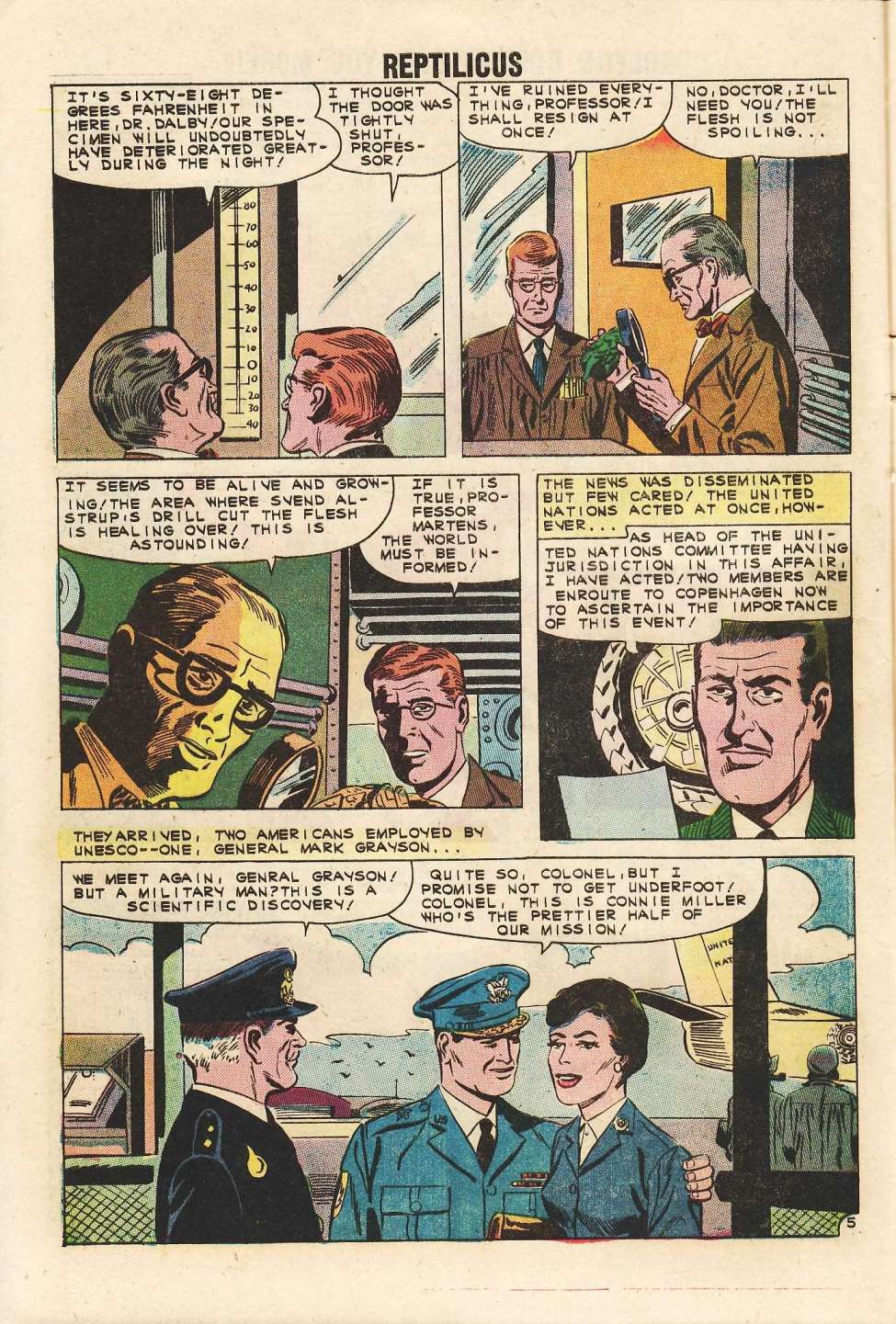
Then they adapted it to comic book form.  The story, which cleaves reasonably closely to the original story is below.  The comic story was written by Charlton iron man Joe Gill after the screenplay by Ib Melchior based on the story by producer Sid Pink. The pictures are by pencil artist Bill Molno with Vince Alascia on inks. The late great Rocke Mastroserio provided the exciting cover for the debut issue!


Charlton produced one more issue of Reptilicus, again featuring artwork by Bill Molno though the script is uncertain, it was likely Joe Gill yet again.


After the second issue featuring a Dick Giordano cover, Sid Pink took issue with Charlton and they had to change the name of the series to "Reptisaurus" and it continued for six more issues. Unlike Gorgo and Konga, Reptilicus was not blessed by the artwork of Steve Ditko and so alas is often overlooked and has not been reprinted in any nifty collectible format, at least not that I'm aware of. 

Rip Off

Monday, January 8, 2024

Ditko's Fantastic Giants!


Fantastic Giants #24 (t is a continuation of the numbering of Konga) was one of the earliest comic books I ever got my little mitts on and it's a book that has at its center not a character but an artist. Steve Ditko (shown enigmatically as a quasi-human ink bottle) is what this book is about, his artwork on some vintage projects as well as two new stories by the maker of so many fascinating Charlton yarns. 


Konga was of course once upon a time a movie and then Charlton adapted it to comic book form. Ditko drew the adaptation and many of the better Konga stories from the reasonably long run of the title. This volume showcases that wonderful Joe Gill written and Ditko drawn debut story. 


On the other side we have Gorgo, another very successful giant monster flick adapted by Charlton using the same team. The oddly touching tale of an enormous monster and her giant offspring taking a walking tour of London is exceedingly well told. Given the price of special effects, both the Konga and the Gorgo stories add to the luster of the cinematic renditions. 


In addition to the classic giant monsters we get a then-modern Ditko tale called "Mountain Monster" which might've fit into Ghostly Tales or The Many Ghosts of Dr. Graves, but is given special prominence here. This story written by Dave Kaler gives us Ditko at the top of his powers just as the lead character of this story is at the top of that mysterious mountain. 


And finally, there's the secret gem of this set, the other new story scripted by Dave Kaler called simply "With the Help of Hogar" which set in the depths of Africa offers Ditko the chance at a splash page, one of his best. Ditko didn't create impactful splash pages like his colleague Jack Kirby and but for Kirby might never have done. But when he was given the nod, he created some of my favorites such as the outstanding splashes in the first Spider-Man Annual and the debuts of the redesigned Captain Atom and Blue Beetle. This image above really lives up to the book's title, and gives us a "fantastic giant", a creature which seems to lumber out of the pages of a Lovecraft story brimming with utter weirdness. All this heady stuff indeed for a youngster just shaping his initial impressions of what comic book art should be. A Steve Ditko special indeed and the true "fantastic giant" in this tome is the artist himself.

But there's more thanks to Craig Yoe and his amazing collections. 


This YOe Books collection brings together all of the Joe Gill and Steve Ditko stories about the giant monster Gorgo. Gorgo stories were produced by other talents in the Charlton stable, but it's only the Ditko material which is on display here.


Likewise, both monsters are getting the collected treatment from YOe Books and IDW Publishing. The Konga collection, which is even larger  that the pretty hefty Gorgo book, is due to arrive in a few months.  The stories by the ever-ready scripter Joe Gill are solid and as illustrated by Steve Ditko, give the reader a incredible but entertaining thrill ride as the monster Gorgo, almost presented as a stranger-in-a-strange-land, deals with the wide world.


It's a lot of Gorgo to read, and truth told not all of the stories are gems. But they are all a hoot, an echo from a time when comics were such plain unabashed fun, that stuff like this could be published without apology or qualm. To read the novel version of the story by Carson Bingham check out this link to the Internet Archive. 

All of the Ditko Gorgo stories are here, as well as all the covers he produced for the series. Also showcased is some really great info on the classic movie and how the comics were an integral part of the marketing of the flick. Great Gorgo lore for any fan of the movie indeed.

Here's a cover gallery. Enjoy! The debut cover is by Dick Giordano if I'm any judge.


This final cover is by Bill Montes and Ernie Bache. These artists did a gaggle of Gorgo stories themselves and they did the cover here for an issue featuring Steve Ditko material inside. (It might be heresy in a post celebrating the great Ditko's art, but I actually prefer the Montes and Bache version to Ditko's.  Sadly, I doubt we ever see a collection of those stories, but there's always hope.)


And then there's Konga, also collected up by YOe Books in an even larger volume. It has long been established that some of the most invigorating work of Steve Ditko's career was done for the sometimes, hapless Charlton Publications. Infamous for low-quality, the publisher allowed Ditko near complete creative freedom, since for the most part they regarded comics as so limited an endeavor that the powers couldn't be bothered to really care too much about the content. Much of it was rotten, but surprisingly often it was really, really good. Steve Ditko's runs on both Gorgo and Konga with scripts by the indefatigable Joe Gill are among the most entertaining. 


The Lonely One published by Ditko and Robin Snyder was for a time the only way to get a collection of these vintage Konga tales. The YOe Book collection supersedes that. 


For those who might not know, Konga was an adaptation of an American-International Pictures schlock sci-fi flick which tried to re-fry the classic King Kong scenario by adding in bizarre plants with growth-inducing properties, mad lascivious scientists, and exceedingly perky teenagers. 


It's an entertaining brew, but hardly one would think the stuff for an ongoing comic series. Konga at Charlton was a peripatetic protagonist who finds humans often a bother, sometimes a threat, but always it seems fascinating. He battles monsters, aliens, robots, and whatever could clank, carom, or slither his way. He was drawn by many in the Charlton talent pool, but it's always been Steve Ditko's rendition which captured the imagination best.

Here's a cover gallery of Ditko's best.


Monsters are at their most fantastic when they are giant. More Charlton giant monster goodness tomorrow. 

Rip Off