Sunday, May 25, 2014
The Astounding, The Amazing, And The Unknown!
The Astounding, the Amazing, and the Unknown by Paul Malmont is a rousing sequel to his novel The Chinatown Death Cloud Peril, about the here-to-fore unknown adventures of pulp writers Walter Gibson and Lester Dent (both are also on hand for this adventure too). After too long a delay, I've at long last gotten around to reading this delicious story. This tale is set a few years later during 1944 when the momentum in the second World War was shifting to the side of the Allies (though of course they couldn't know that then). One of the best aspects of this novel is the way it presents the dread permeating the society as a deadly war engulfed the imagination and the resources of the entire globe.
At the center of this sprawling yarn is Nicola Tesla, the celebrated (now) genius who had among other things in his famous career tried to give the world free global communication and possibly power in 1908 with the Wardenclyffe Project, a grand mushroom-shaped tower which would broadcast energy worldwide. It was an unfinished project, which in our real world is becoming a museum to celebrate Tesla, but in this novel its the centerpiece of several schemes to possibly control the planet, if it works that is.
Drawn into this mystery are Robert Heinlein, L. Sprague DeCamp, and Isaac Asimov, three pulp writers collected by Astounding editor John W. Campbell as a braintrust of sorts for the military, their mission to dream up the war toys of the future before Hitler's boys do the same for the dictator. The center of their work in the city of Philadelphia is an experiment to render a battleship invisible to mines and possibly radar. We meet the men, their wives and their lovers as they wrestle with each other, their superiors, and the enemy to accomplish their mission. The real and the fictional blend in fascinating ways in the hands of Malmont, a sure and confident writer.
Also along for this wild ride is one Lafayette Ronald Hubbard, another pulp writer who has had less than a distinguished Navy career and finds himself tagging along and finally apart from the above gang of writers as he follows his own part of the elaborate mission. His bizarre personal life, which includes peculiar and eccentric religious rites and strange sex, resonate through the story of what I might even call "the secret history of Scientology".
On display in a way which I've never quite seen is the world of fandom itself. These writers are strong personalities and they have history, history which is quite unseemly at times. Their feuds are at once funny and exceedingly callow, but we get a sense despite all that, these are men who truly believe in something outside themselves, wishing for something better and newer for the entire world.
We hear of a real-life story titled "Deadline" by Cleve Cartmill which scares the United States government so much they send agents to investigate what must have been a leak of national secrets. We meet other writers such as Norvell Page, Hugh B. Cave, Fred Pohl, and Ray Bradbury. We encounter celebrities doing service for their country like Jimmy Stewart and Albert Einstein. The story goes from Philadelphia to Alaska to New York City to the South Pacific and back again.
There's a lot going on in this novel which grabs you and never lets go. The story is full of humor and real danger, not just for our protagonists but for the world itself. We visit remote parts of the world and see little discussed parts of the great war. This is a rich novel which at once celebrates its pulp writer heroes but at the same time makes them human in ways which make you care about them even more.
Highly recommended reading.
Rip Off
Saturday, May 24, 2014
Everybody Was Robot Fighting!
Now that was indeed satisfying. I've at long last been able to read all of Russ Manning's stunning Magnus Robot Fighter comics from Gold Key. Manning had been like most the capable staff at Gold Key a reliable and sturdy artist, first on Brothers of the Spear in the back pages of Tarzan and later on the Tarzan feature itself. In between these gigs he produced one of the most striking and memorable comics of the sizzling 60's. Magnus was an adventure comic in the spirit of the times, forward looking but blended with skepticism about the nature of mainstream society.
Magnus appears from nowhere (a problem for him in later stories when the authorities seek to restrict his behavior), the prodigal son of A-1, a benign robot who sees that mankind has become too dependent on the robots who serve their every need and whim. Magnus is given training specially designed to allow him to demolish his potential metal opponents and the ability to understand the subtle electronic communications between robots. This hidden talent is most useful to him and the one secret he guards most zealously, even from his paramour the gorgeous Leeja Clane.
Magnus saves North Am, the immense sprawling city-state which occupies all of what is the current United States and more. From the tallest most sleek towers to the darkest alleys in the depths of the society he finds enemies and allies and most importantly adventure, lots and lots of adventure.
Magnus battles aliens from the depths of space, troglodytes from the depths of the Earth, and depraved and sometimes insane men from the bowels of the society of 4000 A.D. The most frequent foe is Xyrkol, a maniac who hatches several schemes to take control of North Am, but he is always stopped by Magnus, though he always seems to turn up again. Also there's Dr.Laszlo Noel who hates robots and their influence on society even more than Magnus and takes extreme steps to eradicate the problem. Mekman shows up a few times, a deranged but dangerous fellow who imagines himself to be a robot. There are treacherous alien threats from Sirius and even a remote robot planet called Malev-6.
Magnus fights giant robots, tiny robots, indestructible robots, police robots, criminal robots, homemade robots, handsome robots, ugly robots, and even magical robots. Always Magnus with help of Leeja and his sometimes helpers The Outsiders wins the day.
The Outsiders are a gang of boys who want to emulate Magnus and figure in several of the stories. Another recurring item are the neo-animals. These are hyper-intelligent creatures (dogs, apes, raccoons, etc.) created by a lovely woman named Danae. One of these critters even gets the power to speak thanks to some special technology. Then there are the Gophs (as in "gophers"), the people who live in the remote depths of North Am and who challenge the rule of the "Cloud-Cloddies" of the upper reaches. This fracture in North Am society is not much developed in these original Manning stories, but does form a potent angle for Jim Shooter's Valiant revival.
Manning's artwork is uniformly superb throughout the series, his sleek and modern style ideal for this futuristic "Tarzan". Even the fact Magnus wears a tunic with fabulously white boots somehow works.
The saga of Magnus is not some sprawling extended story in the modern sense. Each issue is self-contained, each story has a distinct beginning, middle and end. But the stories do have memory and in the later installments there's an increased sense of a connected quality. Each installment takes you to another part of North Am, spreading the story from coast to coast. It's hard to remember that these stories of a largely contented populace is the dream of society. But there's always the threat to individuality and the interconnected nature of the society often makes it vulnerable to sabotage.
As I was reading I kept thinking how the world of North Am echoes our own modern world. While the robots which serve us are in the form of handheld communicators and even the desktop wizardry which allows me to type these words, among other things, the sense that society has fallen victim to its own success is familiar. Magnus would see many aspects of North Am in modern America, a shallow population increasingly reliant on technology to live what is deemed a civilized life. Threats to communication, food production, and even our own reproductive capacities are changing as man's ability to use technology gives opportunity and forces decisions. Magnus Robot Fighter is not primarily a cautionary tale for our times, but it is certainly that too.
Here are the covers for Russ Manning's outstanding run.
![]() |
| Russ Manning and George Wilson |
![]() |
| George Wilson |
![]() |
| Russ Manning |
![]() |
| George Wilson |
![]() |
| Russ Manning |
![]() |
| Russ Manning |
![]() |
| George Wilson |
![]() |
| George Wilson |
![]() |
| George Wilson |
![]() |
| George Wilson |
![]() |
| George Wilson |
![]() |
| George Wilson |
![]() |
| George Wilson |
![]() |
| Vic Prezio |
![]() |
| Vic Prezio |
![]() |
| Vic Prezio |
![]() |
| Vic Prezio |
![]() |
| Vic Prezio |
![]() |
| Vic Prezio |
![]() |
| George Wilson |
![]() |
| Vic Prezio |
Rip Off
Labels:
Dark Horse Comics,
Gold Key Comics,
Russ Manning
Friday, May 23, 2014
Victory Is Sacrifice!
When word came that Dynamite Comics had acquired the rights to produce new comics based on some of Jack Kirby's later concepts, I was at first excited then remembered it was Dynamite. They have a history of taking exciting concepts, draining the essence, then slapping a wonderful Alex Ross cover on the whole duller-than-it-ought-to-be shebang. Sadly as far as I could detect from afar that seemed to be the case with these wild and colorful comics. I stayed away.
But the other day I found a trade copy of the Captain Victory comics for the price of a single comic, so I thought that a harmless enough entry. I picked it up and alas my expectations were accurate. The comic was written okay, with attempts to "humanize" the members of the Dreadnought Tiger, but this general dreary introspective approach was mitigated even more so by some really poor storytelling from the artist who seemed neither capable of capturing the majesty of the Kirby power nor able to evoke the clarity of his narrative.
The stories are not without some high points, at least we do get to see more of the lion-faced Tarin, the hard-nosed Klavus, and the aquatic Orca. What we learn is not unimportant and perhaps might've paid off eventually, but in this storyline seemed merely to slow the main plot which surrounded Victory's final solution for a planet overrun with a zombie plague which would have turned them into slave warriors for the enemy. Too much and too little is made of this at the same time, if that's possible. Either spend time on this point or go onto something else, but here this key element becomes a backdrop for the other tales. Weird.
For the price I paid, I cannot complain overmuch, but I can tell you if I'd paid full price for these stories, I'd be pretty upset. I got a distinct Image Comics aroma from these comics, and that's not the modern Image, that's old blatant but fundamentally incompetent Image from the 90's.
It's too bad. The Alex Ross covers are pretty good by and large! Here they are.
Ironically after posting this I discovered it was just announced that Dynamite is trying out Captain Victory again. Here are the details.
Rip Off
Thursday, May 22, 2014
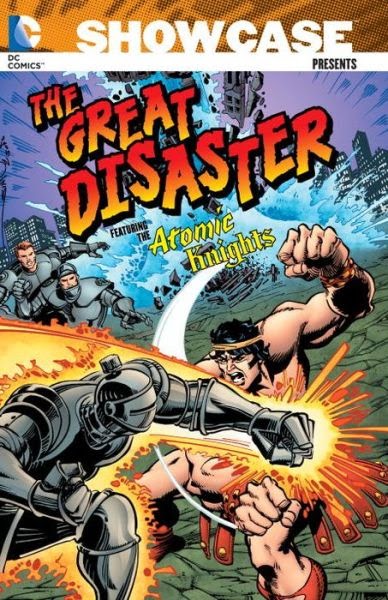
The Great Disaster Is Almost Upon Us!
Almost as long as I can remember this collection has been discussed on the internets. I found posts from 2007 anticipating its arrival and I personally remember hoping to get a copy of this sprawling volume which features the Atomic Knight stories and the Hercules Unbound stories from DC's Silver and Bronze Ages respectively. Also there seems to be some Kirby in the form of his one-off character Atlas. Now it seems it's almost here, scheduled to drop next month. Here's the full solictiation from DC's own site:
"In these stories, heroes including the Atomic Knights, Kamandi and Hercules must face a post-apocalyptic future brought about by the mysterious “Great Disaster” in the run of Atomic Knights tales from STRANGE ADVENTURES, plus 1ST ISSUE SPECIAL #1, HERCULES UNBOUND #1-10, KAMANDI #43-46, WEIRD WAR TALES #22, 23, 30, 32, 40, 42-44, 46-49, 51-53, 64, 68, 69 and 123, HOUSE OF MYSTERY #318, SUPERMAN #295, HOUSE OF SECRETS #86, 95 and 97, THE UNEXPECTED #215 and 221 and AMAZING WORLD OF DC COMICS #12."
Much of the material is derived from back up stories in various volumes including Kamandi. The Amazing World of DC Comics material is apparently an article discussing the Great Disaster.
Sadly this arrival might be the harbinger of sad things to come. I've absolutely adored the Essential volumes from Marvel and the Showcase volumes from DC, but with the recent demise of the Essential line (replaced by handsome but more expensive Epic Collections), the fact that DC is pushing this long-delayed collection out might suggest they going to close out their bargain reprint line as well. I hope not, but I fear for the worst.
The "Great Disaster" might well be upon us in more ways than one.
Rip Off
Wednesday, May 21, 2014
Humanoids From The Deep!
How I've been a sci-fi fan and missed this 1980 flick for this long is a mystery. But finally at last I can say I've watched Humanoids from the Deep (great title), a film also known (and this was the title I actually saw) as Monster. There's no denying that this is horror schlock, but by and large it's pretty decent horror schlock.
![]() |
| Hate this poster--probably why I've passed on this flick so long. |
The affable and reliable Doug McClure is on hand as the hero (of sorts) and he's joined by Ann Turkel as the obligatory scientist-who-knows-too-much and Vic Morrow as small town thug and racist. It's a pretty good cast and that helps a lot in a movie which forgets its own plot from time to time.
![]() |
| Doug McClure, Ann Turkel, and Friend |
Also the finale is pretty hair-brained, or at least the multitude of extras are. I guess they are following director's orders, but the constant milling back and forth as the monsters kill and ravage seems ludicrous. It takes long minutes for a local celebration to clear while the camera lovingly lingers on one brutal kill after another. Little of the action in this sequence makes a lot of sense, but it does (as intended I'm sure) create some ludicrous scenes such as a monster attacking folks on a carousel which reveals more of the killing on each successive pass.
This ain't necessarily a good movie, but it is at times diverting. There's sure no attempt to keep the monsters off the screen (maybe a mistake at times).
![]() |
| Love this poster. |
Rip Off
Tuesday, May 20, 2014
Borrowed Time!
I have read most if not all of these Challengers of the Unknown stories before at some point in time, once if not multiple times, but never before have I made it a point to sit down and read all of Jack Kirby's Challengers stories in order all the way through. It took a few days, but now that I've done it, I can see that even at twelve issues, the ideas were beginning to dwindle a bit for Kirby and his co-creators on this epic.
The Challenger magic is laid out in all its glory in the debut story "The Secrets of the Sorcerer's Box" which has the men who are living on borrowed time take on the highly imaginative threat of a dangerous "Pandora's Box" filled with danger. Different menaces emerge and the Challs have to find a way to corral that which they have unleashed. Each man's special nature seems called upon. That's a great premise and more or less it powered a series that ran well over a decade. But it didn't do it without some repetition and without some concession. Some of the stories that hit this balance best are "The Wizard of Time", "The Riddle of the Star-Stone", and "Secret of the Sorceror's Mirror".
Some of the later stories, despite their visual appeal are just too far out for the Challengers. "Captives if the Space Circus" is particularly guilty of this. A great wild yarn, but it doesn't have that verisimilitude that a Challs story needs. The fantasy is too broad. "Prisoners of the Robot Planet" is somewhat better, but still a bit too far out. Likewise the fascinating but off-note "The Human Pets". These read more like one-off yarns better suited to House of Mystery than as a Challs story.
On the other side of the coin, I didn't much care for stories which had the Challs functioning like crime fighters. Though admittedly most of the time that's just a ploy to get them involved in a broader story. The Challengers aren't cops, and they aren't spacemen. They are human men who have only their unblinking bravery to shield them from the dangers they encounter here on Earth. Whether the menace is mystical or scientific it matters little, but it must force them to make bold choices and to span the globe. When they wander into space they lose their footing a bit.
Don't get me wrong. All of these stories are humdingers. Full of vigor and outstanding storytelling. Some of the pages with Wally Wood inking Jack Kirby are arguably some of the finest ever produced in the genre, but not all of these stories are equal by any means and it showed me that if Kirby had stayed on the feature, either the nature of the Challs would've have had to change or we'd have seen a dangerous repetitive quality in the series.
I did learn that it was the success of these Challenger stories which convinced Jack Schiff to market the Kirby-Wood team for the comic strip Sky Masters of the Space Force. But alas it was also friction over the proceeds of that venture which caused a schism which drove Kirby to Marvel exclusively for over a decade and in the end spelled the end of DC's hegemony of the comic book landscape. It's neat to imagine what it might've been like if Kirby had stayed on the Challs, but based on the sample we have, it might actually have been a good think he moved when he did before the effort became even more repetitive.
Rip Off
Subscribe to:
Posts (Atom)


-007-06.jpg)

+003-10.jpg)