Wednesday, April 26, 2023

Ralph 124C 41+!


Ralph 124c 41+ A Romance of the Year 2660 was first written by Hugo Gernsback beginning in 1911 for his Modern Electrics magazine. It wouldn't be a novel until it was first gathered together in 1925 before the genre of "science fiction" was named. Gernsback was the guy who named it in the pages of his later magazine Amazing Stories. I assume most folks know that Gernsback is percieved by many as one founding father of the genre and in honor of that standing the annual award the "Hugo" bears his name. 


The story is the story of a rare intellect named Ralph 124C 41+, one of fifteen genius inventors who poplulate the world and feed the thriving society hungry for new improvements. He is a celebrated man, protected and seen as an asset to the world. As such he is isolated. That isolation comes to something of an end when he saves a young woman named Alice 212B 423 (everyone has these kinds of names) from an avalanche by long distance using his scientific genius and soon she and her father head to the United States to visit him. The two are madly in love and for the first time Ralph thinks of things other than science and inventing. 


But he's not the only one in love with Alice. There is a classic mustache-twirling villain named Fernand and a Martian named Llysanorah. Alice has rejected the unscrupulous Fernand which only makes him more determined and dangerous. Llysanorah knows that the law forbids marriage between Earth folks and Martians and is sorely depressed and eventually quite desperate. Quite a bit of this yarn is taken up describing the wonders of the world in 2660 which is brimming with technological marvels. Gernsback's interest is not primarily in spinning a story, but showcasing the wonders of a possible future paradise of electrical and chemical marvels. But that doesn't mean there isn't a story, you just have to wait for it. 


It gets into high gear when Alice is kidnapped first by Fenand and later by Llysanorah. I will say no more to allow some who want to read it, to learn how all that turns out, but it is safe to say the pursuit of the villains into space by Ralph aboard his personal spaceship is intended to be the rowsing high point of the narrative. The supposed theme of the novel is hidden in Ralph's name, but you have to wait until the last line to learn that. (You can cheat and check out the Wikipedia too if you can't wait.) This is not any means a great novel, some might argue it's not a good one. I rather liked it after I fell into its peculiar rhythm. The personalities of the two lovers are too idealized for anything like real characte development, but if you think of it as a fairy tale it works fine. 

Rip Off

Tuesday, April 25, 2023

Gold Key's Star Trek Volume Five!


The fifth and alas final volume of Star Trek - The Key Collection from Checker brings adventures of the Enterprise crew from 1975 to 1977.  The series from Gold Key goes through some profound changes during this time with a new artistic approach being brought to the series. To this time the Alberto Giolitti studio had been handling the artwork as they had done for any number of Gold Key projects, but a new artist Al McWilliams will become the mainstay of the series. Arnold Drake becomes the the regular writer of the series and wrote all the scripts in this volume. 


Drake and Giolitti tell the story of a world of crystal people who are also artists who eschew the sciences. Sadly this has made them prey to a deadly crystal dragon who can read their thoughts. The Enterprise crew fights to save them despite the distrust of the natives. A weakness in this story is the oddly cartoonish way the crystal people are rendered. 


Following a reprint issue the next new Star Trek story is a wild adventure that finds Scotty traveling back in time to the wild west and Kirk heading to the movie-making capitol of the world Hollywood in the 20th century. They are chasing some deadly weapon stolen and taken into the past, but to be honest the story was difficult to fathom at all times. Giolitti's art is inked by McWilliams giving an indifferent result, but pointing to the future changes. 


After yet another reprint issue Drake is joined Alden McWilliams, and the duo are the mainstays on the series from then on. This is a weird story which as Kirk tapped to go undercover on a planet being infiltrated by Klingons and a new captain taking command of the Enterprise. It all works out in the end, but it's a roundabout path indeed. 


The Enterprise chances upon a the body of a famous Earth scientist who was renowned not only for his intellectual accomplishments but also famous for his leadership of peace movements to end unpopular wars. No names were mentioned, but this seems clearly to be a spin on Albert Einstein and the war seems clearly to be the Vietnam conflict. But it turns out this scientist is not dead and the truth of his survival is even stranger still and poses a significant threat to the safety of Earth itself which the crew visit. 


It's back to Earth again when the Enterprise needs repair and the crew gets some shore leave. Kirk is introduced to Dr. McCoy's daughter, a lovely xenobiologist who is working with a large telepathic creature which becomes crucial in saving the Enterprise, Mr. Spock and solving an old crime. It's a topsy-turvy story but the characterizations do seem legit to the series. 


Now almost all of Gold Key's painted era were by George Wilson, but this one is not credited to him and the artist is unknown to me. The story is probably the heaviest in the volume and my favorite premise. A planet worships a god who is given credit for creating their civilization when suddenly a giant space ship arrives and their god is there before them, a member of a race who claim the planet itself because of prior occupancy. They are repelled, but not before it makes the people of the planet nearly mad because of the loss of their religion. 


This is a zany story about a race which due to a strange radioactive deposit is aging backwards until at the time the Enterprise arrives the world is occupied exclusively by children and led by same. The team tries to help but fall victim quick de-aging themselves before they can solve the problem. 


The final story in this final Key Collection is issue forty-three dated February 1977. It deals with a race of people who voluntarily turned themselves into water-breathers to escape deadly stellar radiation and carefully monitor the birth of all children not adapted to the sea. But it seems some do survive and a small but growing group of air-breathing folks do point to a new way forward. This story brought back McCoy's daughter who was specifically assigned to the Enterprise for this mission. This time however she brings with her an enmity for her father for his dedication to his career which deprived her of his attentions as a child. There was no hint of this in her first appearance. 


When this series began it was a full decade before in 1967 and the world was much different. In the time of these issues the United States has suffered through Watergate, an OPEC oil crisis, and a generally downward trending economy. Despite even a bicentennial celebration the mood of the U.S. was not all that great. I'd matured, gone to high school, started college and had gotten married in that time. I quit buying Star Trek comics after the first issue mentioned in this review, perhaps because of the change in artists, or more likely the need to economize. I wouldn't buy a Star Trek comic again until I picked up the adaptation of the movie, a movie made possible by the stalwart support of the fans over many years and the success of Star Wars. I have followed Star Trek over the years, but in the final analysis I'm a fan of the original series and these days pretty much ignore the successors. 

NOTE: This is a Dojo Revised Classic Post. 

Rip Off

Monday, April 24, 2023

Star Trek Beyond!


I am an unabashed fan of the new Star Trek movies, feeling unlike some of my generation that the veneration many have for the original series was trapping the movies in too much cloying nostalgia and not enough rockem' sockem' action. Well, they scraped off the barnacles off the old Enterprise when they rebooted the series in 2009 and gave us a whopper of a sequel in 2014 and now with Star Trek Beyond we get a really dandy up-scaled adventure which makes all the set up pay off a bit.


The Enterprise is in deep space and the captain of her is suffering a deep ennui as the endless mission seems to be dragging him down. But that all comes to an end when the crew is led into a trap in a distant nebula by a proper villain who wants to use his bee-like army to destroy the Federation. Idris Elba is the main villain, and we learn by the end that he's more human than he appears. It's a nifty secret but not one they really seem all that interested in pursuing during the movie so when it pays off it lacks some punch. The untimely death of Anton Yelchin did cast a bit of a pall on the viewing. The new girl, a rough and tumble scrounger type who is hiding from the villains who killed her family is charming and beautiful, a comely addition to the proceedings. 


I wanted to enjoy this one and I did despite some minor misgivings about pacing and some background information. I appreciated how the filmmakers kept trying to find new ways for fans to appreciate the rigors and fun of space travel though it didn't always work.


In the end we have charming people in a charming story doing charming stuff. I came, I saw and I cared enough. Pretty decent overall.

NOTE: This is a Dojo Revised Classic Post. 

Rip Off

Sunday, April 23, 2023

Showcase Corner - Legion Of Super-Heroes Four!


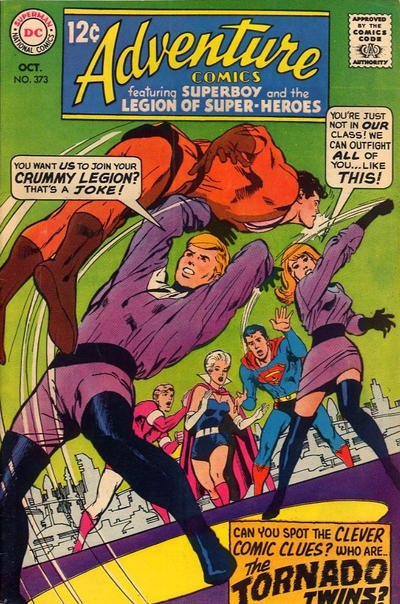
The fourth volume of Showcase Presents Legion of Super-Heroes gathers together the Legion's final appearances in the pages of Adventure Comics where they'd debuted a decade earlier, created by Otto Binder. Thanks to the writing of Jerry Seigel, Edmond Hamilton, E. Nelson Bridwell and Jim Shooter with art by John Forte, Curt Swan, George Klein among others the team had found brilliant success in the fan community. But apparently sales were sluggish as the 60's wore on and the wacky Silver Age nonsense of the DCU was waning in appeal to readers wanting a richer experience such as supplied by Marvel. The team would find success in the coming decade, but in the interim they were consigned to back-up status first in Action Comics and later in Superboy, a title they'd overtake just as they'd done with is feature in Adventure Comics. But that's for next time. 


I try to be gentle in my reviews about artists, but there's just no way to say it other than Win Mortimer's arrival on the Legion scene indicated a severe downturn in the quality of the images. His first few issues are dreadful, but later the arrival of inker Jack Abel helps things enormously. The Legion features a lot of characters and making them recognizable is key to good storytelling and Mortimer fails that test in his first few issues. He's not helped by Shooter's increasingly wonky stories which seem more interested in finding new settings than developing characters. An exception to that would be Bouncing Boy and Duo Damsel, two of the sillier heroes who eventually seem to find comfort in each other's company.  Shooter also focuses a lot on heroes he'd created, which is not unusual, but some of the classic heroes suffer. Karate Kid gets a lot of attention. Things in that area are not helped by the introduction of Chemical King and Timber Wolf. As good as these heroes might be, they become just more for the fire in the melee of these last Adventure Comic episodes. 


The Shooter-Mortimer-Abel team move over to Action Comics where the Legion becomes a back-up feature switching places with Supergirl who took over the cover feature in Adventure Comics. The Legion stories ranged from seven to twelve pages and given the limitation began to focus more on a few Legionnaires at a time. We learn about Matter-Eater Lad's unfortunate family life, we learn of Duo Damsel's lack of confidence and see her find comfort with Bouncing Boy for the first time, Shrinking Violet has boyfriend problems as her beau Duplicate Boy is always away, and we see Duplicate Boy seek love again, among other stories. Superboy takes on Reserve status when the ranks of the Legion grow too large to keep a tax-free status. One story uses the Legion Espionage Squad in a style reminiscent of Mission Impossible


E. Nelson Bridwell takes on the writing chores and is joined by Cary Bates. George Tuska becomes the artist when the strip moves to the back pages of Superboy. We begin to see new costumes for some of the heroes and heroines using designs sent in by fans. (See the bottom of the post for more on that.) Saturn Girl is the first to feature a fresh new look.  And then the most momentous event occurs when Cary Bates is joined by the art team of Murphy Anderson and Dave Cockrum. Soon the art is just by Cockrum and the Legion is on the verge of its next bright era. More on that next time as I take a gander at the fifth Showcase volume,

Here are the Adventure Comics covers in this volume and the Action Comics and Superboy covers which featured the debut of the back-up Legion tales. Most of these are by the late great Neal Adams. 


Adventure Comics interrupted the Supergirl feature to give us a Legion reprint volume. These are all classic Legion tales, but there were some fascinating pages featuring outfits designed by fans. Some of these would actually make their way into the comic. 


Rip Off

Saturday, April 22, 2023

Star Trek Season Three!


Star Trek has become such a sensational success that it's really difficult to fathom that the original series was loathed by the network which presented it. NBC seemed to work actively to make sure the show was a failure and in that pursuit in the third season, gained only after a potent and unprecedented mail response, saw to it by putting the show on late in the evening on Friday. This time slot was a virtual death sentence for a TV show at the time. The audience for Star Trek was young and on Fridays the young were out and about, and not home watching television. NBC well knew this and so did Gene Roddenberry, so when the time slot was revealed, Roddenberry stepped away from the show which he had husbanded into existence.  As producer he brought aboard a man named Fred Frieberger, a man who has been unfairly blamed for the third season's woes. 


The humor in the second season was not popular with Roddenberry and when Gene Coon departed he directed that the show again become the serious science fiction vehicle he wanted. He wasn't alone in that desire. So Freiberger was instructed to make the show serious which seemed to rile writers of episodes like "The Trouble with Tribbles" who saw potential sequels axed. Freiberger was ordered by NBC and the new owners Paramount to see to it the show stayed within budget, something it had failed to do in its previous two seasons and some of the reason NBC was put out by Roddenberry. At the same time they cut that budget. So Freiberger was given a battery of instructions and then told to go make it work. That it didn't work as well as it had in the previous seasons is hardly his fault alone. Roddenberry had already assigned most of the stories for the season, so Freiberger had little or no control over that aspect of the production either. It was truly a thankless task. But in the end despite the woes and complaints, Frieberger did deliver Star Trek on time and on budget, the first time that had been accomplished and if that had been the norm, maybe the show would not have been such a pariah with the network. But that's pure speculation. 


There seems to be a general agreement that the third season was inferior to the first two. I'm not sure I agree. "Spock's Brain" is held out as possibly the worst episode of the entire series. I rather enjoy it. Some Star Trek episodes can get a bit slow as a sometimes thin story is formatted to fit the four-act structure of hour-long episodic television. That never happens to "Spock's Brain". And it features some of my favorite Nimoy acting, almost a parody of his normally reserved response to his environment. 


But there's certainly no shortage of quality science fiction concepts such as the world in which people move so swiftly they cannot be detected by our human senses in any real way. This hyper speed is a great gimmick, even if a few concessions must needs be made to allow it work.It certainly showcases the most direct suggestion of an overt sexual act when we get the scene where Kirk is slipping on his boots as the comely alien adjusts her hair. Racy stuff for the simple-minded TV of the day. 


Episodes such as the one featuring Yvonne Craig's Orion slave girl have fun aspects even if she's not quite as alluring as Susan Oliver was in the second pilot show. She's still pretty hot. The characters are developed well in episodes like "Spectre of the Gun" which has the crew recreate the shootout at the O.K. Corral almost. I've never been a great fan of the episode which has Kirk marry an Indian maiden only to see her die, but I got more a sense of its depth this time. Maybe my life has matured enough to allow to share his pain somewhat. 


The "Tholian Web" is regarded as a great episode and I concur. Less well regarded is "Let this be our Last Battlefield" which does a great job (if a bit on the nose) of approaching the topic of racism. This show was produced and shown in 1969 at a time when the United States was boiling with violence in the streets and elsewhere in response to the Vietnam War and savage assassinations within the borders. 


Maybe I'm nostalgic for these episodes because this was the only season I actually was able to see (in part) because of its new schedule, the one intended to kill it off. I was a youngster and staying up until ten to see a great show was a struggle (still is) but I succeeded more than a few times. I think people who hold Gene Roddenberry in high esteem are quick to dismiss this season as lesser because his imprint was not as strong on it. I frankly think that Roddenberry is a bit overrated, though still a significant figure in television science fiction. Frieberger did more with less than Roddenberry did, and he did it his way. I get that some folks are not going to cotton to that. 


Star Trek was cancelled in brutal fashion. As was common in shows of the era, things could go bad quickly and NBC intent on getting rid of Roddenberry and his show saw to it that Star Trek was gone and prepared for the onslaught of letters from fans. NBC was intent on not backing down this time and prepared for the avalanche of mail they were about to receive. The show was of undeniable high quality and better ratings initially than has become legend. Given the times, it should have survived, but it didn't. The stories were often quite smart and dealt with the issues of the times, and that I think is really why NBC wanted this albatross from around their collective necks. Star Trek in each episode was capable of saying something which might stir up controversy and that was not good for business overall.  Star Trek stopped production and went into syndication. More on that next time when I take a closer look at the cartoon version of Star Trek. 


Rip Off

Friday, April 21, 2023

Mission To Horatius!


I don't read Star Trek novels normally. I bought and read the James Blish adaptations years and years ago, including the "first" Star Trek novel Spock Must Die. But it turns out that what I believed then about that novel was not true. There was another one, the only novel published during the actual run of the show, a Whitman book directed at a younger audience by veteran science fiction writer Mack Reynolds titled Mission to Horatius. I learned of this true first novel only a few years ago and immediately wanted to read it, as I do rather have a passion for items keyed to the first series and which actually were available before the advent of Stark Trek culture. Now I finally have read it. I've written here about the photo-novels and other early items produced for the series for instance and have a real appreciation for the early Gold Key comics.The illustrations for this book were done by  Richard "Sparky" Moore, a talented artist with a long list of accomplishments.


The story as it turns out is a pretty rousing one full of different settings and reasonably recognizable characters. It begins when Bones erupts onto the bridge and announces they have to go home and get everyone a break from the deeps of space or something called "cafard" (French for "cockroach" or "depression") will break out, a space madness which is highly contagious and has resulted in the destruction of more than one space ship when its crew goes mad. But the Enterprise has just gotten a secret mission which will take them to the very edge of Federation space to a star system named Horatius. It seems Horatius has three Class M planets and all have been settled at different times by humans with very specific desires about how to conduct society. A distress signal has been detected and the crew of the Enterprise, despite a long tour, are the closest to the system.


The first of the three planets the Enterprise visits is named Neolithia and the people who settled there were luddite back-to-nature folks who eschewed all modern technology. What Kirk and crew find is a very primitive culture which still uses bows and arrows. One representative named Grang attacks the landing team but eventually they take him captive and find their way to a shaman who takes them deep into the caves to find the leadership council.


The shaman looks suspicious but the team have little choice if they are to find out if it was the people of Neolithia who sent the distress signal. They are eventually led to the leadership who have already decided to kill them, thinking they are part of the mysterious forces from the sky who have harassed the people in the past.


The Enterprise crew seems surrounded by a massive force of bowmen, but Spock is able to detect that the force is merely an illusion cast by the hypnotic powers of the shaman. Kirk, Spock, Sulu, Chekov, and the others do manage to escape unwittingly taking Grong with them, since he too has fallen into disfavor with is people for leading the landing team to the cave system.


Next the Enterprise travels to Mythra, a planet settle by folks with distinct religious beliefs. There they find a medieval culture in which the majority of the population are held in the devout sway of the ruling church leadership by the regular use of an "anodyne" which results in extreme passivity in the face of an abusive heirarchy.


The landing team escapes capture by the powerful leadership, who do have minimal communications technology and also indicate invaders in their skies. The Federation representatives later take steps to neutralize the anodyne which keeps the populace in a drugged stupor. The hope is that they will awaken, rise up against the church overlords and seek a more just society.


The third planet is called Bavarya and it proves to be the most recently settled, merely a century previous but the planet is mysteriously overpopulated. This society is a modern dictatorship with hints of ancient barbaric practice such as the gladiator arena. While the Enterprise is under attack from the planet, Kirk, Spock, and Grong (who has demonstrated significant fighting skills) are pitted against three other warriors who seem to refresh themselves endlessly.


They eventually learn their opponents are "dopplegangers" or zombie-like clones bereft of a soul and a noble woman reveals to them she sent the distress signal because the leader of Bavarya is himself one of these soulless creatures and seeks endless conquest. The endless dopplegangers who currently overrun the planet are considered ideal soldiers. Kirk and his comrades are eventually able to escape but not before learning the forces of Bavarya were indeed the ones harassing the other two planets with an eye to conquest.


On the way back to Earth the Enterprise comes under another threat when many of the crew develop symptoms of cafard and at the same time a pet mouse by the name of Mickey has escaped into the bowels of the ship and the nigh-forgotten disease of Bubonic Plague threatens to break out. Dr. McCoy marshals all the forces of the Enterprise to at first gas the mouse and later work diligently to find it. But then reveals all of that was a stung to give the weary space travelers a mission to forestall progression of cafard. On that note this briskly paced saga comes to an end.

This is a rousing little saga with lots of changes of setting. The use of three planets visited in such quick succession gives the tale a Gulliver-esque quality as we are clearly meant to compare and contrast these three extreme attempts to organize society, none of which the Enterprise crew finds ideal, hence their eagerness in spite of the Prime Directive to take steps to alter each one of the cultures in turn. Kirk mentions "Special Order Number One" a lot, but he and his crew don't seem at all limited by its mandate, which was much like the show itself to be honest.

The three cultures also suggest something about how the writer might feel about certain drop-out cultures and other aspects of the late 60's. The back-to-nature society in particular reminds me of a hippy commune on the extreme, an utter rejection of modern convenience in an effort to achieve some Thoreau-like ideal balance with the natural world, but here shown to yield a superstitious backward society. The religious planet feels very much like a cult in which the practitioners are blind to the abuse of the leaders who are merely using the devout belief as a means to gain power over a passive culture, the drug in question being LSD makes the comparison even more exact. And finally a totalitarian military society in which the majority of the population are reduced to soulless zombies merely designed to wage war might indeed be an indictment of the way wars are often fought.

Whatever the case, Mission to Horatius is a fun and quick read. Highly recommended to anyone who like me likes these artifacts dedicated to a series which has since become all-consuming.

NOTE: This is a Dojo Revised Classic Post. 

Rip Off