Saturday, February 21, 2015

The City Under The City!


The Asphalt Jungle is sober crime caper flick directed by John Huston, presenting the criminal underworld as a group of fully realized characters captured by passions they have limited control over.


The movie is ostensibly set in (and apparently shot on location in limited scenes) what is likely Cincinnati, Ohio, a city which even today has sections which are unusually dangerous. Actually it was across the river in Newport, Kentucky that crime ruled, though Newport is much diminished these days in the shadow of its more famous sister across the water, mostly famous for its aquarium.

Hayden on the streets of Cincinnati
We meet first Dix Handley (Sterling Hayden) a thug with some truly scary dead eyes who pulls strong arm robberies to fund his gambling habit. His confidant is diner owner Gus Minissi (James Whitmore) a bitter hunchback who clearly carries a grudge against normal society. These two get drawn into a scheme by recently released convict Doc Riedenschineder (Sam Jaffe) who along with safecracker Louis Ciavelli (Anthony Caruso) plot to steal millions in jewels.

Whtimore and Hayden in a dive
The plot comes undone when their financier, a crooked local magnate name Emmerich (Louis Calhearn) connives to double cross his fellow thieves setting in motion a sequence of violent solutions to myriad problems. All the time the police are attempting to close in and capture the criminals, despite some of them being on the take the whole time.

Jaffe, Hayden, Whtimore and Caruso plot
There are other fascinating characters in this gritty John Huston effort, in particular two dames. One is Doll played by Jean Hagen who clearly has eyes for Dix, but gets little comfort in return. The other chick is not even listed in the credits but is Emmerich's ditsy girlfriend played by Marilyn Monroe. Monroe did not go unnoticed for long and dominates the posters for this movie after its initial run.

Jaffe, Hagen and Hayden marvel at the loot
The movie's best feature is its calm and steady storytelling which relentlessly follows each character as they try to deal with the successes and failures of the scheme. Some die, some live, but all meet their fates with some measure of dignity. That seems to be the point, that despite their lives of crime, these are people who have come to their respective ends as a result of life's powerful rigors.

Monroe steals the scene and maybe the movie
Stand outs are Sam Jaffe, the brilliant but flawed genius who plots the scheme and Sterling Hayden who puts up the best full-blooded presentation of a hood that I've come across. His violence is evident in every move he makes, but he doesn't fall to the level of a mere hoodlum. There's more there, a tragedy which defines his every moment on the screen. The film closes out with some beautiful scenery around Lexington, Kentucky and its almost recognizable still after over sixty years. The counterpoint of the seamy underbelly of the city with the idyllic beauty of the of the country is not overstated in this fable of modern fallible men.


Rip Off

Friday, February 20, 2015

Justice Incorporation!


Dynamite has finally published a comic series which took more than a few minutes to read, and that's a good thing.  The downside is that the story unfortunately had a cobbled-together feel which undermined the momentum of the narrative. But I must admit it was rather neat to read a yarn which blended together for the first time all three of Street and Smith's classic pulp stars, even if it was a flawed experience.

The biggest of those flaws was the artwork by Giovanni Timpano which admittedly seemed to improve as the saga continued through its six issues, but which to my mind never got above adequate. The storytelling, with a few exceptions, was mostly legible and while I did find myself getting confused because of a lack of distinctiveness in the faces, I will also give him points on mood.

But like nearly all the artists at Dynamite, the work came across as decidedly second tier, without the posh ease one should associate with something like this. Doc Savage often looked off model and The Avenger changes throughout. The Shadow looked the best, but then his face is often hidden.

Uslan's story has a kitchen sink feel to it a bit, lacking depth but not necessarily complexity. Characters come onto the stage and leave it with little aplomb or logic in places. Pat Savage takes the place of her cousin for a few pages, then leaves without any clear reason.  Monk is on hand, but I don't recall other members of the Fab Five in evidence. But then few of the Shadow's helpers were in the story either.

We get a nice helping of villainy and I'll say little about this to avoid spoilers, but clearly Uslan knows the lore, perhaps a bit too much with lots of in jokes with characters names.

I cannot actually recommend this when it comes out in trade, but I cannot exactly not recommend it. For those interested in these characters, this series is worth taking a glance at and seeing whether it meets your pulp specifications.

The covers though by Alex Ross are, as always, excellent. 


Rip Off

Thursday, February 19, 2015

Return Of The Originals!


I remember when Return Of The Originals: Battle for L.A. hit the stands and being a little bit interested, but alas I didn't pick it up. Found it a few weeks ago for a few bucks and thought it was well worth the tiny gamble. It was...sort of.

Moonstone has been a favorite publisher of mine now for several years. I followed their Phantom comics with glee and found most of them quite strong. It was a sad day when Moonstone lost that license to Dynamite who have had a difficult time with it. Moonstone though seems to a durable group and tried out some of the vintage pulp heroes not already being produced. Among these are the Phantom Detective, The Black Bat, G-8, Secret Agent X, and Domino Lady.

This story by  C.J. Henderson and artist Mark Sparacio is one of Moonstone's near-comics, actually a  relatively short yarn with a multitude of illustrations. Sadly this story is too short for the heavy cast and the art is ill-suited for the vintage World War II atmosphere the story attempts to convey.


We first encounter Secret Agent X as he attempts to survive his latest mission which has resulted in intel that the United States is about to suffer a devastating secret attack from the Japanese.  But survive he does and his info is passed to the Black Bat who recruits The Phantom Detective and the pair uncover further secrets.


The result is a trip to the west coast and ultimately Los Angeles where they meet up with Domino Lady and an older G-8. The story simmers but doesn't really ignite at any point and never does Henderson generate any real sense of a threat which might actually harm the heroes. Sure they fight and fight some more, but somehow it all feels too pat.

The Domino Lady really has no role of significance and seems added merely for the visual qualities the character brings to any story she participates in. She is a character who works better in prose than comics, since her costume is absolutely ludicrous for crime-fighting.

One of the biggest drawbacks for me is the art of Mark Sparacio. He's a capable and talented artist no doubt, but his characters all feel too real and too similar. I cannot really tell the male characters apart unless they perhaps have a mustache or something. The shimmer Sparacio brings to his artwork seem out of place in this supposedly gritty pulp tale.

All in all this package was reasonably pretty but fundamentally dull, the worst thing a pulp adventure can be.
 
Pretty cover art though.

Rip Off

Wednesday, February 18, 2015

Pitching The Perfect Game!


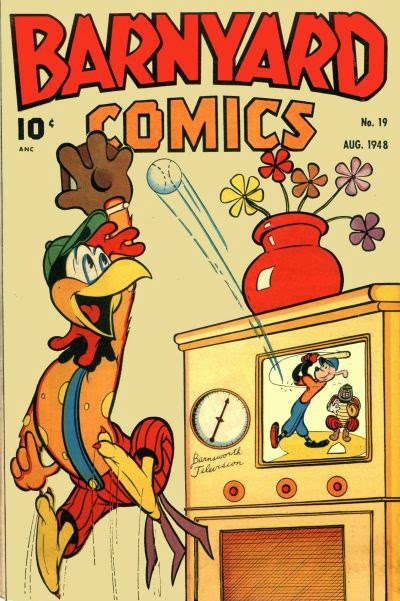
It's the best day in the sports calender, the one which marks the very beginning of baseball. Pitchers and catchers report for many clubs today to get a small jump on the Spring Training season. It is that ideal moment when all the teams have an equal chance to win the coveted World Series, when every player can become an All-Star (which is in the local Cincinnati ball park this year by the way).

No other game is as elegant as baseball which by definition can never have a tie. Football and basketball and hockey are ruled by the clock, subject to the relentless march of time where as a baseball game can potentially last for eternity, endless extra innings spanning into the distant future. No other sport can promise immortality and endless opportunity, at least in theory.

And Spring Training is the beginning of the beginning when the pure ideals of sport still blaze in the Arizona and Florida skies like perfect gems unsullied by the grit and grime of the world. That dirt will almost instantly begin to mar the perfection of the season, but for the time being it's a perfect world for anyone who is paying attention.

Just as Spring itself promises renewal, so too does this beatific moment in baseball.

Here are some covers which celebrate watching what still is (for me at least) America's (and Japan's and Cuba's too for that matter) most perfect game. 


Rip Off

Tuesday, February 17, 2015

The Boone Trace!


Daniel Boone is a culturally significant figure in my home state of Kentucky, a key part of the history of the earliest European settlements in the region. And in the 50's because of the Disney movies starring Davy Crockett, the coonskin cap wearing hero (he never did in real life by the way). Between them, Boone and Crockett had many different comics from many different companies. Charlton too had a Daniel Boone comic book and a Davy Crockett comic. The Daniel Boone trace is a long and oddly surprising one, even for Charlton.


Comic Media was a short-lived comics company which tries to put out comics in most of the popular genres of the time - horror, crime, romance, and westerns. Their western outing was a comic titled rather dramatically Death Valley. With a debut cover by Ross Andru and Mike Esposito, the comic was kicked off to a rousing start in 1953.


With the very next issue the workhorse of the company Don Heck took over the cover duties and supplied the art for all of the remaining issues.


The series ended in 1954 with the sixth issue as did sadly the company itself.


A year later in 1955 though, Charlton put out its own Death Valley comic picking up right where Comic Media left off. The issue kept the numbering intact and even sport a Heck cover.


Charlton produced two more issues in the run before the comic Death Valley lived up to its title at long last.


The genre stayed pretty much the same, but the title was changed to Frontier Scout Dan'l Boone and issue ten was his first.


With issue thirteen (lucky that) the comic ended its run at last in 1956.


But a nearly a decade later in 1965 a fourteenth and final issue at long last produce which was all reprints from various previous issues of the run. Note that "Dan'l" is now "Daniel" in the title. This comic sported a vivid and strong Dick Giordano and Sal Trapani cover with Daniel Boone in a crouched stance ready to fend off the enemy.


That cover is an almost exact reworking of the debut cover of Davy Crockett from 1955 by an enigmatic artist who signed his name "Roppe".

As with many of Charlton's comics, the trace ends but only after a very winding path indeed. 

To go and read the earliest issues of Comic Media's Death Valley go here. For the earliest issues of Frontier Scout Dan'l Boone check this out.

Rip Off

Monday, February 16, 2015

The Danger Road!


Comic Media was a short-lived publisher from the early 50's and they put out some handsome material in their brief existence. Their go-to artist appears to have been the painfully underrated Don Heck who of course went on a decade later to be a mainstay at Marvel.


Danger was one of the company's flagship titles and begins its run in 1953 with a wide range of manly men engaged in a variety of sweaty activities as evidenced by this debut cover by Heck. These are, as the banner announces, stories about "Men Without Fear".


Pete Morisi, better known a decade later for his Thunderbolt title for Charlton, also was a regular artist for the fledgling company and his cover for the second issue is quite handsome.


Morisi is back for the third issue, offering up an even more entrancing image.


Don Heck returns for the next couple of issues with some covers that promise some wild and intriguing adventures indeed.


But then with the sixth issue a new regular feature was introduced, drawn by Heck. Not named on the cover this is Duke Douglas, a dapper secret agent who appears by the many montages he is featured in on this cover and others to be engaged in all sorts of clandestine adventure.


With the ninth issue Duke's name finally rates a cover and the action here goes more for mood rather than action.


Duke holds down the comic until 1954 when it completes its Comic Media run, the company having given up the ghost. You can almost imagine him firing his gun into the fourth wall at the creditors.


Charlton Comics was in a position to swoop in and gathers up much of Comic Media's material and titles, though Duke Douglas and Don Heck alike are gone from the covers when they relaunched the title in 1955.


The series runs a mere three issues before a dramatic transformation takes place.


The comic shifts not only titles but genres as espionage gives way to western action and Jim Bowie takes over the star spot as well as the title in 1956.


But after only three issues, Bowie too bows out and a new star gallops in.


With the twentieth issue of the run the title is changes in 1957 to Rocky Lane's Black Jack, and a comic which once featured manly men without fear now stars another species entirely, a brave horse.


But it's a successful horse and the Black Jack lasts until the thirtieth issue when the comes to an end in 1959.

If you would like to savor some of those vintage Danger adventures with Don Heck still very much in his lush Milt Caniff mode, then check out this link

Rip Off