Sunday, February 6, 2022

The Sunday Funnies - Tarzan In The City Of Gold!


When the great Hal Foster left Tarzan to make more time for his masterpiece Prince Valiant it put the Ape Man in a hard place. Foster had become for many (including Burroughs himself) the definitive artist for the character and anyone who stepped in to fill his shoes was going to have a tough job. That person turned out to be Burne Hogarth who came to the strip in the middle of Don Garden's long saga "Tarzan int he City of Gold". Already the yarn had seen Tarzan wage a small-scale war alongside the citizens of the city against greedy invaders from the modern world. And for his efforts he'd been ordered into prison by the Queen who felt she had no choice when the miscreants seemed to hold all the cards.


But as the saga continues under Hogarth she suddenly relents and allows Tarzan to take command once again and to this end he attempts a different strategy and goes into the jungle to round up an army of wild beasts to counter the soldiers who want to ransack the city. He finds apes and lions and even elephants to help him after much effort and alongside the citizens they are able to eventually stave off the threats from the outside world. The city of the gold is safe and Tarzan makes a hasty exit to return to his old stomping grounds. 


After a revitalizing Dum-Dum or two get those old ape juices flowing Tarzan heads home to his ranch but is almost immediately called away to help a tribe with some invaders. These invaders called the Boers are actually settlers who have bought the territories they are heading to and the chief of the tribe just wants to renege and kill them off with Tarzan's help. But the Ape Man gets wise and what follows is more akin to a classic Western than a jungle epic. We have wagons arranged in a defensive posture and guns and arrows and even eventually a cavalry save. There's plenty of intrigue in this one as well. 

Then it's a displaced Asian culture which come into view in "Tarzan and the Chinese".  Actually, it seems that we get a tiny version of the invasions of Genghis Khan into China. Tarzan finds a immense wall and crosses over into a new territory where despite his help and nobility he is doomed to die. But eventually the invasion of barbaric natives creates a need for someone of Tarzan's talents and the highly civilized Chinese are then able to defend themselves somewhat more effectively. Eventually of course Tarzan wins the day and heads out for regions he's more at home in. 


That brings him in conflict with a strange race of "Half-Men" in "Tarzan and the Pygmies". A villain named Marsada is leading yet another safari to find treasure and it finds trouble instead. The daughter of the man paying for the quest is quickly the object of desire of the baddie and is saved by Tarzan and whisked away into the trees not unlike his original romance with Jane, though he has not such intentions with this young lady named Linda. 

They are only saved from the savage "Half-Men" when a powerful band of women appear to help in "Tarzan and the Amazons". Then Tarzan becomes the object of desire for the most powerful of these savage women Kuleeah and he has to do his best to let her down easily, though it proves mostly impossible. It's all he can do save Linda and get beyond the reach of these women. 


The final storyline in this volume has Tarzan once again meeting up with the Boer settlers and he must battle furiously to save them from a greedy villain named Klass Vanger who wants the diamonds he suspects is on the land owned by the Jan Van Boeren and his allies and works up the local natives with lies of the settlers breaking their promises to them. His daughter Matea falls under the spell of the villain despite the true love of a powerful man named Groot Carlis who fights alongside Tarzan to great effect. There is much back and forth intrigue in this storyline but as you'd expect by the end the lovers are united and the battle is won for the moment though danger sill lurks. 


We'll get a glimpse of that danger when we take on volume two of Burne Hogarth's Tarzan in Tarzan Versus The Barbarians next week. 

Rip Off

Saturday, February 5, 2022

Brothers Of The Spear Volume One!


The 1950's were hardly an era of racial harmony in these United States. In fact, the opposite was the case with Black men and women fighting every day for the opportunity to engage fully and fairly in the larger society which had promised them so much in its founding documents but had delivered so very little. For a sense of what race relations were like then check out this informative link for a glimpse. 


Comic books, at the time one of the most popular entertainments in the nation had hardly been a region apart from the greater society, promoting a greater sense of racial equality. In fact the opposite was true, with racism not a bug but a feature of most comics of the short history of the form. Comics such as All-Negro Comics #1 were beyond rare because retailers would not stock such publications on their racks for the population, a population which in the South still were forced to drink at separate water fountains.  So it's a surprise indeed when a comic appears which suggests with a sublime nobility that the races can indeed co-exist in harmony and even become family of sorts. That comic feature was Brothers of the Spear. 


One reason Brothers of the Spear could find a footing in the market is that never in the long history of the series did it ever get a cover in the 1950's and rarely in the 1960's. The series thrived in the back pages of the popular Tarzan comic book from Dell Comics and later from Gold Key Comics. The lead feature at the time was supportive of the long-standing film franchise which offered up a gaggle of handsome white men in the role of ERB's most famous creation. Behind those acceptable white faces, a drama featuring two young men, one white and one black, could unfold in a calm reliable fashion month after month beginning in Edgar Rice Burroughs' Tarzan #25 from 1951.


I maintain that comic book readers are more liberal than those who have not sampled the four-color delights. We as a breed are more open to varying ideas about human identity. At least it was the case in the 1960's when I first stumbled into the hobby and was presented a wide range of black men and women who were capable of the same selfless heroics that white heroes demonstrated month in and month out. Sometimes those liberal intentions could be a bit self-consciously ham-fisted such as Gardner Fox's story in Justice League of America #57. (Total credit to Carmine Infantino's and Murphy Anderson's landmark cover which I'm sure rankled more than a few newsstand operators in the day.)


And by the time the Black Panther debuted in Fantastic Four #52 in 1966, Gaylord Dubois and artists Jesse Marsh and Russ Manning had been spinning tales of a noble black warrior in the heart of Africa for fifteen years. And further that black man, a prince of his land was the blood brother of a white man who treated him as an equal and not a sidekick. While the Black Panther was still cloaked from racist eyes behind his full-face mask the "Brothers of the Spear" were still shielded from racists behind the stalwart white icon of Tarzan. 

Jesse Marsh's First Page

The two brothers who are the "Brothers of the Spear" are a young white man named Dan-El who was adopted by the Zulu tribe when his father appeared with him from a far-off unknown mountain land Natongo the son of the Zulu chief who raised the young men together in such a way that they made were devoted comrades and not rivals save perhaps when it came to spear throwing. The first story shows the two men passing a test of accuracy to earn a the role of sub-chief which indicates that Dan-El's skill might be fractionally better than Natongo's though not so much as to matter in real situations. Natongo graciously shares his role and his symbolic feathers with his "brother".  Both decide that now that they have become sub-chiefs and for all intents and purposes fully-grown men that they will together attempt to find the lost land from Dan-El originates. The clues are two keys, one a golden key which Dan-El's father brought with him and another a birthmark on Dan-El's shoulder which matches one his father had. With this information they strike out but quickly run into trouble from various quarters. But they meet good people and bad and are taken captive on more than one instance, but always they are able to use their wits and skills to work together to continue the journey. Natongo seems to be a bit wiser than Dan-El, or at least more cautious. Dan-El can be impulsive and perhaps a bit too trusting. Natongo seems to have a keen understanding of the world. 

Russ Manning's First Page

We follow the two young men on their trek thanks to the writing of Dubois and the deceptively simple artwork of Jesse Marsh. Marsh was an artist in the Caniff school who used broad rough lines to chisel out his images but to grand effect. He draws all of the chapters which show the first quest of the titular Brothers as they seek Dan-El's home. When they arrive a new artist by the name of Russ Manning takes the helm. And it's thanks to the fame and renown of Russ Manning that we have the collection of these wonderful adventures in three volumes from Dark Horse. It's interesting to see Manning in this early stage of his career when his sleek style was not yet fully honed. The celebrated artist of Tarzan of the Apes and Magnus Robot Fighter (pitched as a Tarzan of the future) came to the attention of the editors at Dell and Gold Key on the strength of his work on this series. 


When they do find Aba-Zulu, the kingdom from which Dan-El came from and which his keys make him the king of, the storytelling switches a bit. We go from a quest to a series of weird and wild court intrigues as the throne is contested between Dan-El and Kongoni, the regent who had waited and hoped for the return of Dan-El and his father or both and the pretender to the throne Han-Ool who is supported by the wicked witch-doctor Nagopa. Dan-El ably assisted by Natongo and others of the kingdom loyal to the old king battle against many plots to kill him and steal away the throne. Eventually Dan-El and Natongo are able to kill Han-Ool and chase the desperate but wily Nagopa into a hidden valley behind some caverns where they get stranded. They seek their way back to the land of the Aba-Zulu but it is a winding trail filled with slavers and many dangerous creatures and men. In his absence Kongoni's daughter Tavane rules in his stead with her father now killed and the true heir lost. It is a hair-raising journey for Dan-El and Natongo to get back to Aba-Zulu and even then the threats are not gone since Nagopa still lurks within the kingdom. And that's where volume one leaves off with the installment from Edgar Rice Burrouighs' Tarzan #67 from 1955. 


There is a wonderful naturalism to the storytelling of Dubois in this series, which is a long, connected tale that continues month after month and year after year. It must've been remarkable to follow this saga in real time, though I'm exceedingly happy I'm able to consume it at much quicker pace. Not unlike Tarzan, the lead feature, the Brothers are rarely flustered by the complications they encounter and remain cool and confident they will overcome the obstacles. This too is a great lesson for young readers and old ones too. 

To begin reading the Brothers of the Spear online at ERBZine check out this link.

More to come next week. 

Rip Off

Friday, February 4, 2022

Soul Cinema - Dr.Black - Mr. Hyde!


Dr. Black / Mr. Hyde from 1976 is a better-than-I-expected blaxploitation movie. The reason is Bernie Casey who gives a sensitive portrayal of Dr. Henry Pride, a madman, a man driven by the pain of the death of his mother and his compulsion to save the world. He's a good man (or appears to be) who goes over the line, who forgets the dignity of other human beings and imagines the necessary momentary evil act is worth it for the greater good. It's a deluded attitude, but not one the viewer cannot immediately dismiss. For a movie directed to a black audience this surely has more resonance.


Though the co-star of the movie is Rosalind Cash who plays another doctor who cares for Dr. Pride, the real power in the movie comes in the relationship between Casey and Marie O'Henry who plays the classic hooker with a heart of gold. She becomes the object of obsession of the Doctor who wants her to help him test a new drug to cure liver damage, but she quite logically and reasonably says no. And when he insists things get ugly.


The slow descent of Doctor Pride steadily presented, his self-destruction is on the screen for us to watch until he realizes he is lost and gives into the drug which turns him "white" and gives him great power, at least power to do harm. In a potent but somewhat uncomfortable finale at the Watts Towers, our hero-villain climbs the towers in a King Kong fashion as the authorities seek a final solution to the rampage of Dr. Black / Mr. Hyde.


I've seen a lot of deep analysis of the messages this film (also called The Watts Monster) delivers to diverse audiences, and I don't reject them, but best of all it's a compelling story pretty well told.


Note: This post originally appeared at Rip Jagger's Other Dojo

Rip Off

Thursday, February 3, 2022

He Died To Save The World!


When it comes to African-American comic book heroes I never want to overlook Al Harper. When he was stranded on the planet Earth by the edict of Galactus, the Silver Surfer was a woeful figure, pining for his home world and feeling sympathy for his prison world, full of fractious and morally compromised human beings. But he found some good ones among the teeming hordes and one of those was Al Harper, smart witty urbane black man who didn't talk jive nor want to. 


The best thing about Harper's story as spun out in Silver Surfer #5 is that his race was mentioned but not lingered on and certainly not a key part of the story. What was significant was the incredible bravery and feeling of compassion for our fellow men and women on this planet. Harper was not a cliche, he was presented as a man who smoked a pipe -- the universal comic book sign of thoughtful intelligence.  


The Stranger has brought deadly device or other to Earth and challenges the Silver Surfer to find it in time to save all mankind. For him it's just another ploy in his endless drive to investigate the worlds around him, mankind just another test subject.


It is left to Al Harper to find the weapon and to put it out of commission. He does so at the cost of his own life, a life he sacrifices without hesitation "for the sake of everyone on Earth". 


The Silver Surfer knows of his challenge and of his sacrifice, but he is the only one to know that Al Harper gave up his life to save us all. And so he ignites a flame to burn for all time in silent recognition of the act. Al Harper was a hero, the kind not sung about nor lionized, he was a man willing to give up what was his to allow others to keep and hold dear what was theirs. That he was a black man only pointing out the crude irrational pointlessness of the distinctions of ethnicity and race we all cling to so powerfully in this tiny world. A comic book taught me that - thanks to Stan "The Man" and "Big" John Buscema. 

Note: This post originally appeared at Rip Jagger's Other Dojo

Rip Off

Wednesday, February 2, 2022

Black Lightning Strikes!


The 70's were a rollicking time in the comic book sphere. After decades of relative security the big publishers saw the entire industry disappearing sooner than later despite lots of publicity. Veterans who had been at the helm since the beginning were retiring and new talents were stepping aboard what seemed to many a sinking ship.


A boy from Cleveland named Tony Isabella was one such youngster come to New York City to make good in the business he loved. At first he worked at Marvel doing what needed doing but eventually he found his way to DC and there he found a company desperate to find relevance with an audience they scarcely understood and in many cases had a loathing for. Isabella was told he had control over the project but was not in on the choice of artist Trevor Von Eden, a sixteen year-old artist which immense promise who just happened to be African-American to boot. Inspiration struck on the cover of Wonder Woman.


The name "Black Lightning" was evocative for sure and for a writer who had left behind stints on Luke Cage Hero for Hire and Black Goliath a vehicle to bring some modernity to the house Superman built. Black Lightning wasn't an alien, a somewhat deranged knight, nor even a mutant. He was a man, a black man from the depths of Suicide Slum (first created as the home of the Newsboy Legion by Jack Kirby and Joe Simon decades before) in the heart of Metropolis. This was the "other side of the tracks" where Superman didn't necessarily spend most of his time, this was a place needing heroism of a smaller kind but a kind no less potent in their daily lives.


Jefferson Pierce was an Olympic decathalete, a man of skill and training who came back home to teach in the local high school, to try to do some good. But events led to the tragic and ignoble death of one of his students and a need for a more direct approach seemed all to evident. Getting help from his mentor Peter Gambi, a tailor who lived beneath him, he created an identity with an electrical pop. He donned an Afro wig, not all that different than blonde wig worn by  Black Canary, a statement and to some extent a distraction. He quit being Pierce and became Black Lightning and the criminals of Suicide Slum were about to pay the price.


Black Lightning's central enemy is Tobias Whale, a crime boss who reminds me a bit too much perhaps of the Kingpin, but who is a pretty nasty customer nonetheless. He part of the One Hundred, an uber-gang of villains I first remember coming across in the Rose and Thorn stories.


Being in Metropolis he has to tangle with Superman of course. There's no practical way a small-timer like Lightning can hang and bang with a world shaker like Superman, but Isabella finds a way for them to clash and then work together.


The original eight issues have an arc to them as Pierce finds out more about the people around him. It makes his story all the more tragic in the end, but adds fuel to his sense of mission.


Tony Isabella dedicates the first eight issues of Black Lightning to his wife Barbara and they are I guess as close to the ideal for his hero as he could get at the time. Black Lightning will only last a hand full of issues beyond this story line. 


After defeating the One Hundred (or at least the Metropolis branch) Black Lightning needs a mission and finds it in trying to save some school kids from a terrorist dubbed "The Annihilist". It's pretty good story that brings out all the strengths of Black Lightning's character.


Less impressive is his clash with The Trickster, a Flash rogue moved over to give him trouble as BL tries to protect a jewel or something like. There's also a bogus Black Lightning in this story, but that part of the yarn is pretty good.


Black Lightning's book comes to a close with the eleventh issue as the great "DC Implosion" takes him off the newsstands for the time being. Denny O'Neil had stepped in to write what became the last regular issue and the changes in tone are evident.


It's still O'Neil but this time with Mike Nasser on what was to be the final issue of Black Lightning, a comic never published save in Cancelled Comics Cavalcade #1, but now available in beautiful full color in the first Black Lightning collection. 


Note: This post originally appeared at Rip Jagger's Other Dojo

Rip Off

Tuesday, February 1, 2022

Black Heroes Matter!


It's Black History Month in these United States and we need that annual period of reflection more than ever in this struggling democracy. Racism has of course been a mainstay element of United States history from its very beginnings and shaking off that curse required a civil war. But the racism which quickened slavery and made it palatable has not gone away with the loathsome legal practice of owning other people. Black Americans were second class citizens officially in many if not most of the states of the Union until federal legislation in the 1960's made such distinctions illegal. But despite that sweeping change (which has been somewhat pushed back in recent years sadly) the underlying attitudes which empowered it remained but did soften somewhat it seemed. 


So much so that America was able to elect a black President over a decade ago now. But that very act of healing only made those who still harbored ugly feelings stiffen their backs and grow more vocal in their objections to equality throughout the land. They muffle their rhetoric with lots of gimmicks and tricks, but the old ideas are still there, that white folks and in particular white men are the ones who have been chosen (by God I guess they imagine?) to lead this nation and the world too I suppose. This of course will change with time and demographics and the white power worshippers will slip into the minority, but until then, there will be a fierce struggle that gnaws at the timbers of the country itself as supporters of racism rationalize attacks on legally elected governments and endorse open insurrection as "patriotism". 


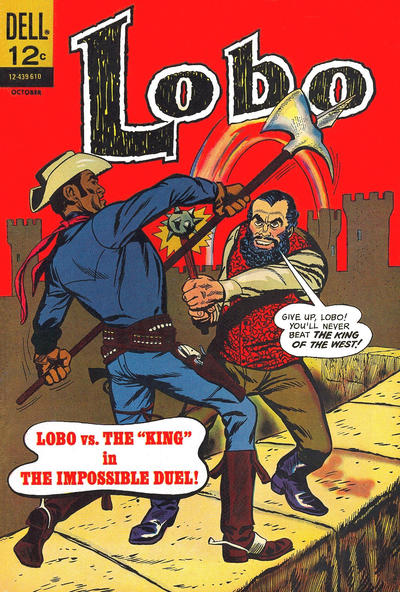
But enough of my speech. Above is the first comic book series Lobo (all two issues of it) which featured a black main character and hero. It was published in 1965 by Dell Comics. It was the idea of artist Tony Tallarico (who just passed away this past January) and writer D.J. Arneson and they produced the first issue and sent it on its way and went to work on the second. But there was a snag, the news vendors in the land weren't quite ready yet it seemed, and many bundles returned to Dell unopened. The series was ended after just two issues. But it didn't matter, the times they were "a-changin'"and soon black heroes were to spread throughout the pop culture of the American scene and help shape and redefine what the scene was. This month I want to look at some of the comics and movies that brought about those changes. 


The mainstay read this month will be the three volumes of Brothers of the Spear from Dark Horse. This back-up series from Tarzan of the Apes by Gaylord Dubois, Jesse Marsh and later Russ Manning was groundbreaking in the sensitive way it portrayed the relationship between Dan-El and Natongo who were "brothers" literally as a result of Dan-El's adoption. Dan-El was from a lost white tribe in Africa but he and his black brother Natongo battled together against many threats for many, many years. A remarkable series that showed many a comic book reader how the color of skin is not a significant and limiting consideration in how humans should interact with one another. 


I also want to read yet again the early adventures of Luke Cage Hero for Hire. Produced in the early 70's in the heat of the "Blaxploitation" era this comic brought a black hero front and center demanding spinner rack space alongside his fellow supertypes. Eventually he teamed up Iron Fist and the pair not unlike the Brothers of the Spear showcased a way that men could work together in spite of the limits society seeks at times to put on them. In these early Hero for Hire stories though, Luke Cage is very much like Richard Roindtree's portrayal in Shaft -- street smart and channeling a rage about how the larger society attempts to put limits on him. 


Another focus will be Tony Isabella's Black Lightning. This street-level superhero was a late Bronze Age addition to the DCU, but proved a sturdy one over the decades. I'll be pulling these posts and others as well from Rip Jagger's Other Dojo, a blog I operated for a time some years ago when this location became difficult for a bit. Look for Lightning each Wednesday. 


Marvel has had some remarkable black heroes over the decades and Falcon and Black Panther are among the most successful, both thriving in the new Marvel movies. I want to look at some of their early struggles against oppression. Expect to see other heroes from Marvel as the month tumbles along. Again Rip Jagger's Other Blog will supply these posts with a fresh perspective at times.  


"Showcase Corner" will feature Men of War, a later Bronze Age addition to DC's remarkable war stable of comics. It's notable in that its cover feature was Codename: Gravedigger which starred Captain Ullysses Hazard, a black soldier during WWII. This was DC's last new WWII hero from their classic period of great war stories. 


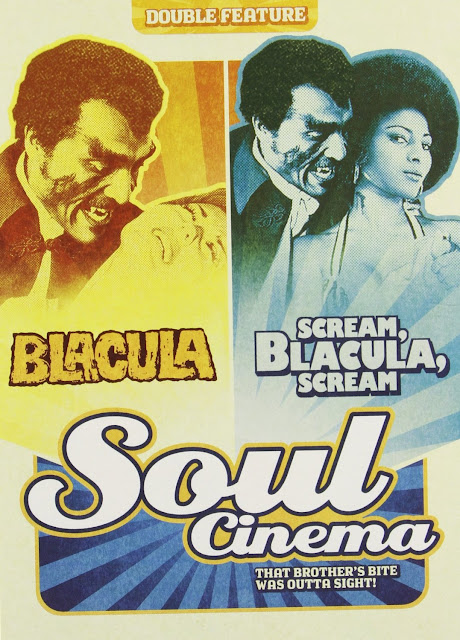
And I want to take a glimpse at some classic "Blaxploitation" horror flicks such as Blacula, Blackenstien and suchlike. These also will be exported from my other now defunct blog. Look for "Soul Cinema" on Fridays this month. 


And in keeping with that "Blaxploitation" theme I'd also like to take a gander at two of Marvel's 70's horror titles which played into the trend -- The Living Mummy and Brother Voodoo!  


And "The Sunday Funnies" returns as once we again focus our attention on those vintage Tarzan comic strips, these by Burne Hogarth who had the difficult job of following Hal Foster's definitive act. The story literally picks up where Foster left off. Hogarth added a whole new dynamic dimension to the Tarzan universe.


It's going to be a full if short month. And remember that black heroes and black lives matter, not just this month but every month. 

Rip Off