Wednesday, July 21, 2021

The Lemon Grove Kids Meet The Monsters!


The Lemon Grove Kids Meet The Monsters is not really a movie in the sense that you'd expect. It's actually comprised of three half-hour shows featuring different versions of Ray Steckler's Lemon Grove Kids. The Lemon Grove Kids are an homage to the East End Kids who became The Bowery Boys. Steckler is a fan of classic movies as is shown in most of his mainstream work. The Incredibly Strange Creatures Who Stopped Living and Became Mixed-Up Zombies is his attempt to make a horror movie and weirdly a musical at the same time. The Thrill Killers was a straightforward noir suspense flick but was marketed later as horror when the name was changed to  Maniacs on the Loose. The Lemon Grove Kids shorts are comedies through and through, though blended with a hardy helping of sci-fi to stiffen the brew. 


The name Lemon Grove is selected because that's where Steckler and his family lived when they were making these little movies. In the first one titled The Lemon Grove Kids we meet the gang led by Slug with a wide array of bizarre characters in the gang, none more than Gopher played by Steckler himself. Slug was an homage to Leo Gorcey's "Slip" who led the gang with pugnacious efficiency and Gopher was a tribute to Huntz Hall as "Sach" the most moronic of the gang of morons. This little movie shows a showdown between the Lemon Grove Gang and the East Lemon Grove Gang in the form of a race which is infiltrated by gangsters who have bet heavily on the outcome. There is a wide range of zany gags with pratfalls being nigh endless. At end though the movie switches gears and Gopher encounters a Mummy and a blonde chick who menace him and at the same time the audience itself as mummies invade the theater. Later still Gopher chances upon a scene from Rat Pfink A Boo Boo (more on this movie next week) and a whole club of 8-milimeter movie afficianados. 


The second show is if anything even weirder with a somewhat different gang of Lemon Grove Kids working to help out a neighbor with his yardwork and landscaping. The neighbor was played by Colman Francis, a low-budget moviemaker himself and director of The Beast of Yucca Flats. (He'd also played a small part in the first Lemon Grove show as a gangster.) While the kids are working they are steadily kidnapped by denizens of a spaceship. The aliens are a Green Grasshopper, a Vampire Lady, and two costumed critters called "Choopers". There are also three witches, but at some point the sheer volume of weird almost collapses this one, though the energy never drops. 


The third show is much more modest with the Lemon Grove Kids being mostly Steckler's actual kids led by a folk singer. They help C.B Beaumont (more on her next week as well.) played by Carolyn Brand (who also was the Vampire Lady in the second flick). There's a fortune teller and two gangsters who plot to kidnap Beaumont, an actress they think they can demand a hefty ransom for. It's a wild ride but ultimately less successful than the other two due to its more modest aspirations. 

All three are weird, the second winning that contest. The best one is the first which cleaves most closely the the classic Bowery Boys model with some added spice. I enjoy these and being only a half hour each they don't wear out their welcome as Steckler movies sometimes can do. 


Next time it's some of Ray Dennis Steckler's most peculiar and darkest films. 

Rip Off

Tuesday, July 20, 2021

Dojo Classics - Mr. Monster - His Books Of Forbidden Knowledge Volume One!


The early 80's saw a burst of creativity when a generation of young and eager creators (and some not so young but still eager) had the chance to showcase their talents with the development of a new marketplace for comic books. The Independent market in new christened "comic shops" saw a batch of new publishers keen to find purchase there and hungry for talent to create product to make that possible, and on terms the talent couldn't resist. Lots of nifty new superhero types hit the stands such as Megaton Man, Flaming Carrot and Nexus. Alongside those would appear Michael T. Gilbert's Mr. Monster.


Mr. Monster began as a project for Pacific Comics, the little company that spearheaded the Indy market with titles such as Captain Victory by Jack Kirby and Starslayer by Mike Grell.


They were looking for material for Vanguard Illustrated, an anthology comic with a science fiction and fantasy twist that catered to up and coming talent. The first chapter of Mr. Monster debuted there, part of a three-part story about a "Reluctant Werewolf". But before the story could be continued Vanguard Illustrated was cancelled and Pacific Comics was defunct, among the first wave of victims in the new marketplace.


Gilbert's Mr. Monster has one of the more fascinating origins in comics lore. Mr. Monster was not so much"created" but "recreated" by Gilbert using an obscure Golden Age character who had only a few appearances, and only one in the distinctive costume above as drawn by Fred Kelly. This particular comic fell into the mitts of a young Michael Gilbert and he wondered what such a hero might really be all about. He twisted and reconfigured the character substantially and he became a burly monster hunter with a surly attitude toward his fellow men.


The complete story of the "reluctant werewolf" was showcased in Mr. Monster #1 from Eclipse Comics and the character was well and truly launched. A delightful Dave Stevens cover adorned the second issue,  which featured a story about an odd and innocent little fellow named "Hemo-Boy".


The third issue under a Stephen Bissette cover had Mr. Monster battle garbage made sentient and so even more dangerous to one and all than normal. This story was written by Alan Moore and drawn by Gilbert.


The fourth issue showcased a wonderful teaming as Gilbert used the talents of Jon Bonivert's unique art stylings to draw literally a distinction between two different universes in the story. It's a crafty and a well-crafted story for sure.


The first wave of Mr. Monster stories ends with an anthology of short stories in the fifth issue in which Mr. Monster fights a plague, a ghost and invaders from Mars. Wonderful fun all, and more evidence that no Mr. Monster story would ever be quite like the last one or the next one either. 


These first five issues were collected in Mr. Monster's Forbidden Book of Knowledge Volume One. Sadly no second volume came around to collect the next five Eclipse issues though collections of the latter days of Mr.Monster from Dark Horse do exist, though for a pretty penny these days. This is a hero desperately in need of a showcase, a chance to prove that wicked can be funny, very funny indeed. 

Rip Off

Monday, July 19, 2021

Dojo Classics - The Complete Wraith!


The Wraith is Michael T. Gilbert's 70's reinvention of the classic Eisner The Spirit. According to Gilbert he was casting about for work in those halcyon days when comics seemed to about to expel the last gasp just any minute and found work with Mike Friedrich's little Star*Reach outfit. Specifically in a short-lived comic dubbed Quack which hoped to reap some of the glamour stirred up by the out-of-nowhere ascendancy of Marvel's Howard the Duck. Suddenly the superhero was displaced and funny animals were on...if only briefly. 


Looking for inspiration, Gilbert was a fan of The Spirit and thought a funny animal version might just work. He produced seven stories featuring The Wraith, one each for the six issues of Quack and another for his later comic Strange Brew published by Aardvark-Vanaheim. And as far as I know that's all of the Wraith there is.


The Wraith begin as a slight homage to the classic Eisner hero and little else, saving a lady of the evening from her employers. Other stories have him battling mad scientists and even falling in love on an isolated island. The stories are in continuity, so despite their frolicsome nature what happens is remembered. That adds quite a bit to stories which by design are often quite slender, the whole perhaps greater than the sum of the parts. The one cover appearance for "The Reality Ray" really shows how offbeat and creative Gilbert was in trying to make the stories click.


The tome I read featured very detailed text pages by Gilbert about how The Wraith came to be and how his misadventures often reflected Gilbert's own personal life at the time. We also get a nifty explanation of some of the techniques Gilbert used. We are seeing an artist grow in real time with these stories and this background info helps to make sense of the style and thematic changes.


But Gilbert seemed all too ready to leave The Wraith, suggesting he'd done all he could do and it was time for other projects (such as his most famous creation Mr.Monster --more tomorrow on that). I doubt he thinks that still today and I wonder if and when we'll ever see another Wraith tale. I'd be interested.

Rip Off

Sunday, July 18, 2021

The Sunday Funnies - Captain Easy 1938-1940!


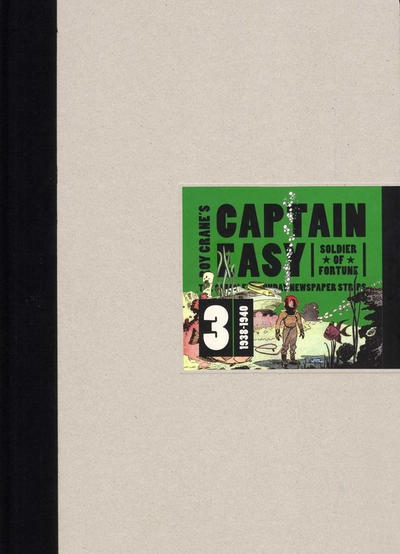
With the third volume of Fantagraphic's Roy Crane's Captain Easy - Soldier of Fortune - The Complete Sunday Newspaper Strips the nature of that weekly outing by artist Roy Crane and his assistant Leslie Turner changes quite significantly. For one thing in the last volume Easy was reunited with his longtime friend and ally Washington Tubbs. Wash Tubbs was the daily strip which ran concurrently with Captain Easy. That reunion added a steady diet of humor to the proceedings. While humor had always been an ingredient, it's clear that it swells in importance as the derring-do begins to diminish. While the duo still globe trot, they are doing so with less of a sense of actual danger, merely complications. 


The long adventures give way to shorter yarns that wrap up in two or three maybe four weeks. Some stories begin and end in a single strip. There are a few longer narratives tucked in and Easy does break away from Wash for an adventure or two, but mostly they are a doughty team that must confront dangerous folks like the addled gun-toting Papa Shalayli, the happy-go-lucky pirates of Paradise Island, the knife-throwing Little Bessie, the femme fatale spy Z-1, the deadly pair of Rufe and Pap Skint, the gangster Boss Ladronn, and the gun-running Mexican bandit Don Bovino. They make quite a few new friends, such as escape artist and safe cracker Lonnie Plunkett. There are lots of dames too, most all in danger and seeking rescue by Wash and Easy, such as Mona Milson, Imogene Twitchet, and the silver-haird Honey Darling. Easy and Wash spend their time doing good deeds, running from the law and heavies, and seeking sundry treasures. They take to hunting down villains for the bounties at one point even. Whenever they have cash they buy a plane, a plane which usually ends up crashed before very long in some foreign territory in the South Pacific or South America. The boys even take time help Santa run his rounds, at least that's what they claim. 


The one thing which ties many of the stories together though is the "Swinks". Captain Easy and Wash Tubbs end up on an island on which they looks for the treasure of the Swinks. The Swinks turn out to be ant-eating aardvark-like critters that prove quite helpful in many instances. Wash is so smitten with the Swinks that he takes one as a pet and names him "Bennie". Bennie tags along with our heroes for most of the two years this volume covers. He has an uncanny sense of smell and at different times is sent looking for gold and for oil with marginal success. When the story doesn't need him, he conveniently disappears for some weeks then turns up again as if he'd been there all along. The Swink disappears for good at the end 1939 with no mention of his having gone. 


The strip has lost the vigor which informed hits earliest years, the artwork being quite good, but not anything approaching spectacular. Mostly the stories don't demand the lush exotic images, but are somewhat staid light-hearted adventures. More's the pity. We wrap things up next time. 

Rip Off

Saturday, July 17, 2021

Joe Kubert's TOR - Volume Three!


The first two volumes of  Tor from the Joe Kubert Library by DC brought into print in a handsome and lasting form the first seven issues of the St. John comic book series from the 1950's. This third volume gathers together Kubert's later efforts on the character. 


We jump forward to 1975 and DC notices that Marvel's barbarian characters are doing quite well on the newsstands of the day, so they cook up some of their own and included in that is a revival of Tor. The debut issue features work that Kubert had done years before, which had already appeared in unfinished form in Alter Ego. Now Kubert has the chance to finish this tale from Tor's youth in which he learns about the harshness of life outside the confines of his clan. 


DC then reprints the St. John Tor stories, the 3-D ones in color for the first time. Kubert creates some exciting new covers for this run on the character. Kubert likely thought he have a chance to add more stories to the canon, but the series was canceled after six issues. 


But Kubert does create some new Tor anyway, but in a comic of his own making. Sojourn was an oversized effort to tap the independent market by offering comics that looked more like newspaper sections. I am much reminded by these issues of DC's Wednesday Comic sections they produced back in 2009, to which Kubert contributed some Sgt. Rock stories  actually. There are only two issues of 1977's Sojourn featuring work by Sergio Aragones, Doug Wildey along with two silent black and white Tor adventures.


In 1986 Eclipse Comics reprinted the groundbreaking Tor 3-D comics in two issues. Kubert produced some new artwork for the covers and that's included in the collection. 


It would be many years before Kubert made more Tor adventures, but he was given the chance by Carl Potts, then editor of Marvel's Epic line-up in 1993. In a brand dubbed "Heavy Hitters" Kubert created four magazine-sized issues of Tor. This is a departure from what he'd done before and it's actually one long epic tale which reprises and revises Tor's "origin" story. Clearly this is an attempt by Kubert to make Tor a little more gritty as his refined sense of justice evident in the early days is pretty rusty, though in the end he proves himself to be a worthy hero. Tor battles a gang of murderous cavemen as well as a bizarre clan of non-human creatures in the depths of a deadly mountain. The dinosaurs which had been such a significant part of the Tor landscape are largely missing from this story which relies rather on indistinct monsters. Further there is no room for little Chee-Chee in this version of Tor, such light-heartedness having no purchase in the bleak landscape that Kubert creates. The two Sojourn tales already mentioned were reprinted in color in these issues and appear in this library collection in that form. 


And that closes out the Joe Kubert Library presentation of Tor. But Joe wasn't done with his doughty caveman as he had one more tale to tell. More on that next week. 

Rip Off

Friday, July 16, 2021

Girl Fridays - Betty!


Dave Stevens was the best "Good Girl" artist of his generation. And he never concocted a more intoxicating image than when he was inspired to draw Betty in the pages of his iconic The Rocketeer stories. Betty was a true bombshell, a gorgeous gal with a body to die for, which Cliff Secord the Rocketeer himself was all too ready to do. 


Of course most everyone knows nowadays that Stevens was inspired to create Betty and in fact based her bodacious form on the real life bombshell Bettie Page. Page has herself become an icon of an era when celebration of the female form was still regarded as an artform, albeit a somewhat shoddy one. In these modern days of instant access to internet porn, the pictures of Bettie Page, both clad and unclad seem rather quaint. But what was provocative, illicit, and even at times illegal once upon a time is now the merely quaint in the rosy glow of nostalgia. 


And Dave Stevens evoked nostalgia in its finest form in his Rocketeer pages, hearkening back to the adventurous times of bygone decades when airplanes were still fresh and exciting and not merely transportation. Stevens gave all of his worlds and the people in them a happy glistening touch which made them ideals and not just people. Here is a time with simple virtues when bravery was enough to win the day. It was good guys and bad guys and always beautiful dames. 

Rip Off

Thursday, July 15, 2021

The Best Of The Three Stooges Comicbooks Volume Two!


The Three Stooges are almost considered a guilty pleasure these days with shows which are riddled with violence such as theirs were are verboten in many households. Clonking your mate in the forehead with a claw hammer is seen as behavior that children should not be exposed to. I can see the argument, but then if I followed those rules I'd never has witnessed the lunacy of Curly when he becomes enraged by "Pop Goes the Weasel" or Larry when he thinks he's safe only to be cracked on the noggin by the backswing of Moe's ferocious blow. Moe himself administers the punishment but in grand Karmic order gets hoist on his own quite sharp petard from time to time too. The Stooges were violent, but they were also funny. People disagree about that, but I think they are funny. 


The second of two Papercutz volumes offers us the last two St. John Three Stooges comics from the hand of Norman Maurer, then the partner of Joe Kubert who was doing Tor for St. John. The duo brought a new 3-D process to St. John and it was a major winner for a very short time. But despite such fads comics were being dragged down by many factors, not the least of which was much public pressure on comics not to damage the precious American youth. Saucy covers like the one above probably didn't go very far to help arguments to the contrary, though I admire it mightily. 


Throughout all of the Stooges misadventures in the St. John books was a nemesis created just for the comic -- one Benedict Bogus who was a con man with more ambition than talent and who almost always suffered when he tried to snooker the Stooges. In fact some of the stories focus on Bogus with the Stooges being mere background players. L'l Stooge is not represented in these last few issues. There are some fun stories, even one which recapture to reprise that "Pop Goes the Weasel" yarn from the very beginning of the Stooges famous run in film shorts.  


There are also two more Dell issues of Four Color starring the Three Stooges. The artwork in these two issues is by Joe Messerli, another talent who worked both in comics and animation. Part of the third Stooges Dell Comic is also included with more work by Pete Alvarado. This story was pushed out of the first volume due to space I reckon. Again these lack the heft of the Maurer comics, but are fun breezy reads with some nifty gags. 


Following his work on the Stooges comics Norman Maurer became more involved with the Three Stooges in their film work and even attempted to get the trio onto television. At about the same time as these Dell issues were coming out, there were new feature-length movies with the Stooges prompted by the popularity of the trio on TV when their old film shorts started showing up. 


Maurer was a screenwriter for four of these movies and directed two of them. Frankly the ones he wrote and were directed by Edward Berndt are funnier than the ones Maurer directed himself. He's said in interviews that he didn't like directing. The gags are there but the pacing is missing.  Eventually the rigors of age and the fading of interest caused the The Three Stooges to hang up their spurs at last. 


But it was not quite over for Norman Mauer yet. In 1972 Gold Key came out with The Little Stooges, which ran for seven issues or so. It was written and drawn by Maurer and his son and featured the sons of the original Stooges who do have cameos. The sons are identical and go by the names of Moe, Larry and Curly just as their fathers had done. These are lively comics and Maurer's craftsmanship has not slipped. It's too bad Papercutz had not done at least one more volume, maybe two to get all of the Stooge comics back into print. 

Rip Off