Monday, September 7, 2020

Star Trek - The Key Collection Volume One!


For me it might have well started with Star Trek. I'm just a bit young to have been a booster from the get-go of that seminal sci-fi show, but I do have snippets of memories of waiting up to catch episodes in what was the third season, alas the final one as well. Star Trek then went away or seemed to do so. It was still on my scope because I read comics and on the stands from time time were Star Trek comics from Gold Key. Now while I loved Turok Son of the Stone and cottoned to but often ignored Magnus Robot Fighter, I tended to shy away from most all licensed comics from Gold Key, especially those with photo covers. For some reason I don't remember I was dismissive of photo covers back then, as if they were a cheap way to go about business or something.

Star Trek The Original Series Rewatch: “Where No Man Has Gone Before” |  Tor.com

Well I didn't dive into Star Trek until things were brewing in the fan base which resulted in the creation of a cartoon version from Filmation. The reruns were around by that time and I'd seen many if not most of the shows. And we all thought the screaming for a new show or a movie or something was just pissing in the wind. That is until Star Wars dropped like a bomb on the pop culture world and it was all on again. But all that time Gold Key had been chugging away and had kept the Star Trek standard up, along with the prose adaptations by James Blish and other bits of stuff here and there.


The first Gold Key issue was way back in 1967 and the show was not a known quantity to the folks putting it out. Clearly watching old Star Trek shows is interesting, especially if you do as I'm currently doing, watching them in production order. The first season wheezes and squeaks and finally like a jalopy begins to thrum along. When Gold Key got the franchise though there was one thing about Star Trek that was dominating the conversations about the show and that was the devilish look and distinctively cold demeanor of Mister Spock. Spock is all over the covers, being featured, even alone on some. In the first issue drawn by Nevio Zaccara the Enterprise crew goes to "Planet K-G" which stands for "Kelly Green". It's a planet of intelligent plants and the crew is barely able to get away from the Triffid-like creatures and their spawn.


The second issue which came out six months later or so is also drawn by Zaccara, has Kirk and Spock and the rest falling victim to a wily criminal who along with many of his species are imprisoned on asteroids which randomly explode. Of course they seek to use the Enterprise to escape but in the end they are overcome and alas their deadly sentences are carried out. This is the last issue that show Yeoman Rand in any capacity that I can detect. She was of course an early character and Kirk love interest on the show but was unceremoniously phased out in the first dozen episodes or so.


The next issue of the Gold Key run has an outstanding cover and Spock's domination of the brand is all too evident. This issue comes at the end of 1968 and has the crew try to help a culture in which its own technology has overwhelmed it with a program of building which never strops. Alberto Giolitti takes on the art chores and his muscular and direct style is one I find very attractive.


The Enterprise itself is featured on the next issue coming in the summer of 1969 and the Enterprise crew is confronted with the challenge of surviving on "Metamorpha" a planet that's landscape changes perpetually. The writer for all these adventures was Dick Wood and large he concocts robust adventures that move at a rapid clip. The characterizations are off here and there with Kirk coming across as very aggressive at times. Always Spock is the lead to solve the issues at hand. McCoy is around and looks about right though is personality is pretty bland. Scotty is there, but is some blonde guy and it takes the comic a long time to get this right.


More of the same on "The Ghost Planet" when the Enterprise crew is confronted with saving a culture from itself because as soon as they rescue the population from deadly radiation they want to go back to war for the express benefit of two leaders, both named "Justin" for some reason. There's little mention or use of what was to become the "Primary Directive" to not interfere in cultures, and to be honest it's not mentioned in the early episodes of the show either.


Under a cover with only Mister Spock featured which dropped on the stands in the winter of 1969 the crew finds another problem to solve when two planets are racing towards each other and their eventual demise. It requires lots of savvy to find the fix but they do thanks to the smarts of Spock of course.


My favorite cover of the run is on the seventh issue and again Spock is featured though both McCoy and Kirk get aboard. This issue has an evil dictator from Earth using alien technology and what appears to be magic to wreck monuments on Earth like the Eiffel Tower and the Sphinx. He is of course defeated but only when Spock uses Vulcan "voodoo" to overcome him.


This collection wraps with a story that was dated September 1970 and this time the crew of the Enterprise faces a threat which sees some of them turned into teenagers and younger. They quickly discover the enemy but it takes a while to defeat him. While she had appeared in the background of one cover before, almost to small to see, this is the first cover on which Uhura can be recognized reallyt, though she's not in the comic itself. Sulu had been around but not at all featured. And that wraps up the early Gold Key run, at least in this Checker volume. The show had been off the air for a year by the time this issue hit the stands and a long period of time was coming when pretty much only Gold Key was going to be telling new Star Trek tales. And for that they would bring in a new writer, someone you likely know.

More next week.

Rip Off

Sunday, September 6, 2020

The Sunday Funnies - Buck Rogers In The 25th Century!


In almost every way measurable by the aesthetics of the art of comics, Buck Rogers, though the first of the hugely successful comic strips, was inferior to the later Flash Gordon. But don't try and tell that to Buck's many fans. 

Badges and Decoder Rings for the Buck Rogers Clubs (the Solar Scouts) from  the 1930s | motto.media

In a nifty book I own called Blast Off! dedicated to the myriad collectibles from decades of sci-fi and outer space comics and TV shows and elsewhere there are thirteen whole pages dedicated the sundry collectibles of Flash Gordon such as ray guns, Big Little Books, and such. But for Buck Rogers the book spends no less than thirty-seven pages documenting just some of the badges, toys, games and such inspired by the characters. 

Vintage Buck Rogers items up for bid at Hake's

After reading the first few years of the daily strip in the collection The Collected Works of Buck Rogers in the 25th Century, a book I've had in my collection for decades, I am a little tired to be honest. The concepts by the creators come at the reader fast and furiously, something that likely quickened the imaginations of folks coming to these notions for the first time. In two panels of the first daily Buck Rogers is transported to the world of the future and quickly made a soldier of the "Orgs". These are organizations which have replaced states in what was once the continental United States and these "Orgs" are in different states of technological development with some being rather primitive indeed. Buck has wakened to a world dominated by the Mongols. 

A Louis Marx clockwork Buck Rogers 25th Century Rocket Ship | Christie's

And that brings up the nastiest aspect of the Buck Rogers story, the rampant racism in the inherent concept. While Flash Gordon dabbles in "Yellow Peril" tropes with the faraway Ming the Merciless, Buck Rogers jumps into the outlandish racist attitude with both anti-gravity levitated feet. It's a race war across the continent and the "white" forces are definitely on the defensive and feeling their long and in their minds deserved hegemony over other races slipping away. (Not at all like the real modern world. Yikes!) A line like that's "white of you" is actually used at one point in the series. Now I don't want to beat this to death, and truth told I felt that after the initial story the story went in some less offensive directions, but there's no getting away from that fundamental fix at first. 


Artistically the best I can say for the earliest Buck Rogers strips is that they are cramped, hampered by too much text squeezed into too small panels. There is a static quality to the story telling which gets a little dull after a time, a lack of imagination as to angles and there are no close-ups that I recollect. Knowing what anyone looks like really is a guess at best. 


Like much of the early science fiction these strips are less about the people than the technology they use and that explains I guess the fascination with machines and the toys too. 


There is, to the strip's credit a strong move to interact with the readership and based on what I've seen of later years of the series the art gets much better and even in color compelling. 

Rip Off

Saturday, September 5, 2020

The Saturday Serials - Buck Rogers 1939!

Lauren Looks Back: The 1939 Buck Rogers Serial

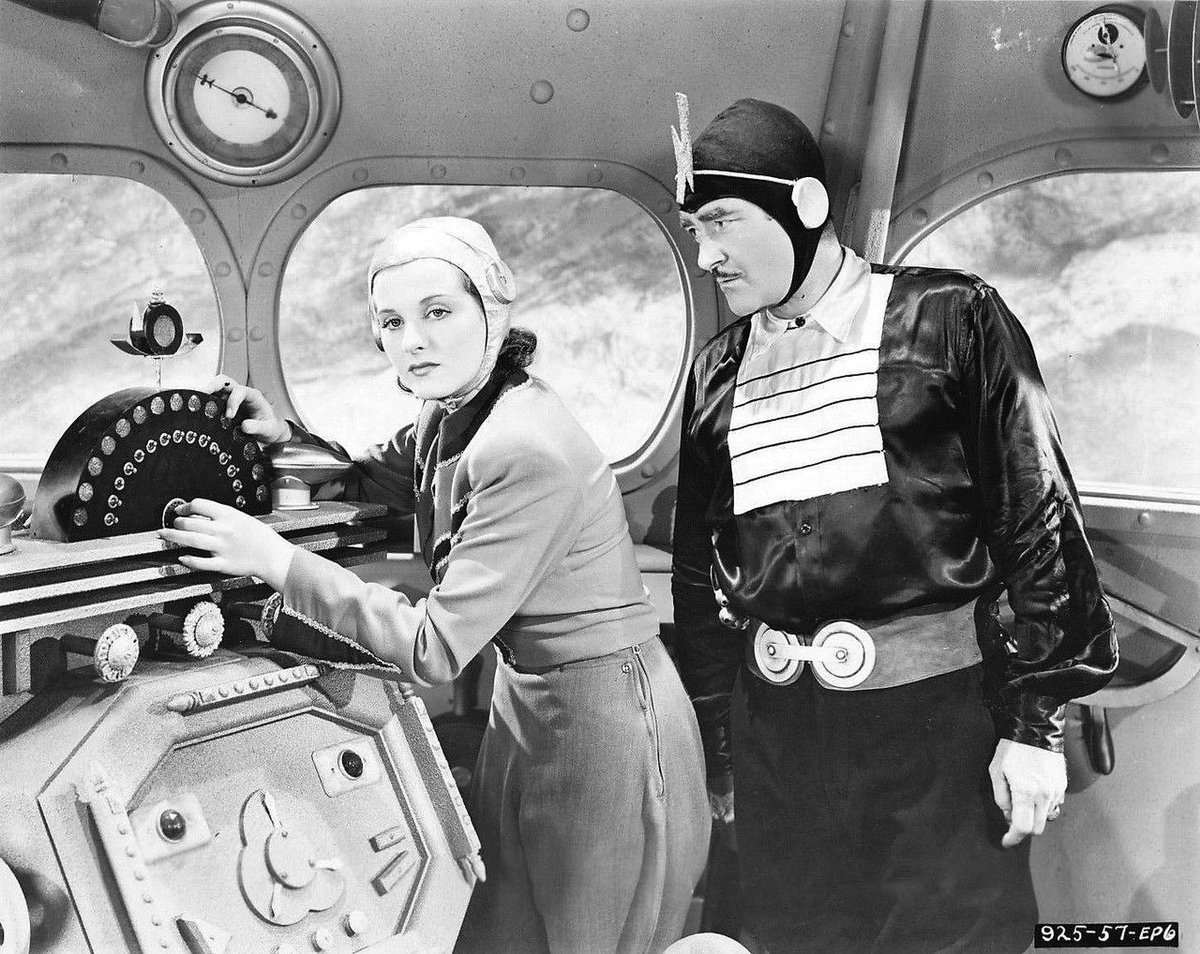
There's little doubt that Buck Rogers came to the screen in 1939 as a serial because of the success of Flash Gordon. I like a lot of people I suspect just sort of consider this a variation on the Flash saga, though when you take a peek into the details there are some significant differences.

Buster Crabbe, Jackie Moran & Constance Moore in Buck Rogers (serial), 1939.  ' GAS BOMBS' for emerency use only … | Vintage movies, Sci fi movies, Photo  sessions

Now not unlike the comic strip itself the notion of suspended animation thrusting a man into the distant future five hundred years from his own is dispensed with almost as soon as it's mentioned. Buck just jumps into this new era with aplomb, bravery and an uncanny knack on the technology of this new era.

Most aesthetically pleasing starship | Page 25 | SpaceBattles Forums

The anti-gravity belts are the neatest gimmick in this serial as they are distinctive and a neat twist on the classic rocket pack. The characters move in ways not exactly like any other movie I've seen of this kind. The spaceships on the other hand are just more flat and angular versions of the classic Mongo type. They all look like little darts, but they function pretty identically.  The "Hidden City" is a pretty nifty thing and seeing those ginormous rock doors open and close is good stuff.

Buck Rogers (1939)

One of the weakest parts of the story is its insistence on flying back and forth to Saturn to get allies. Maybe there's some point being made about the events of the day, 1939 being a crucial year for people of good will to lock horns with a deadly enemy. The Saturnians are a fickle lot and without the constant badgering of Buck would have gone the way of appeasement for sure.

Cory Doctorow #BLM on Twitter: "Buck Rogers (1939) https://t.co/2q7Tx8mhlA  1/2… "

The cliffhangers are a bit weak, with more than a few being of the just shake it off variety. Deadly crashes are just ignored and at least one instance the story was changed to solve the dilemma. But I don't really watch them for that, but for the characterizations and Buster Crabbe is in fine form. He's a more mature go-getter in this one, less awkward on screen in the action sequences and his pal Buddy is fine and appears just the right number of minutes. Wilma Deering seems to have a good role early, but diminishes as the story tumbles along. 

Buck Rogers Serial 1938-39 | This abridgement of Universal's… | Flickr

A really good serial and at twelve chapters not too long. Only a few partial repeat elements. Buck Rogers is a good addition to the Larry "Buster" Crabbe filmography, neatly tucked in with his Flash Gordon work. 

Rip Off

Friday, September 4, 2020

Buck Rogers 1979!

The year is 1979…”: 40 years of “Buck Rogers in the 25th Century” – Musings  of a Middle-Aged Geek

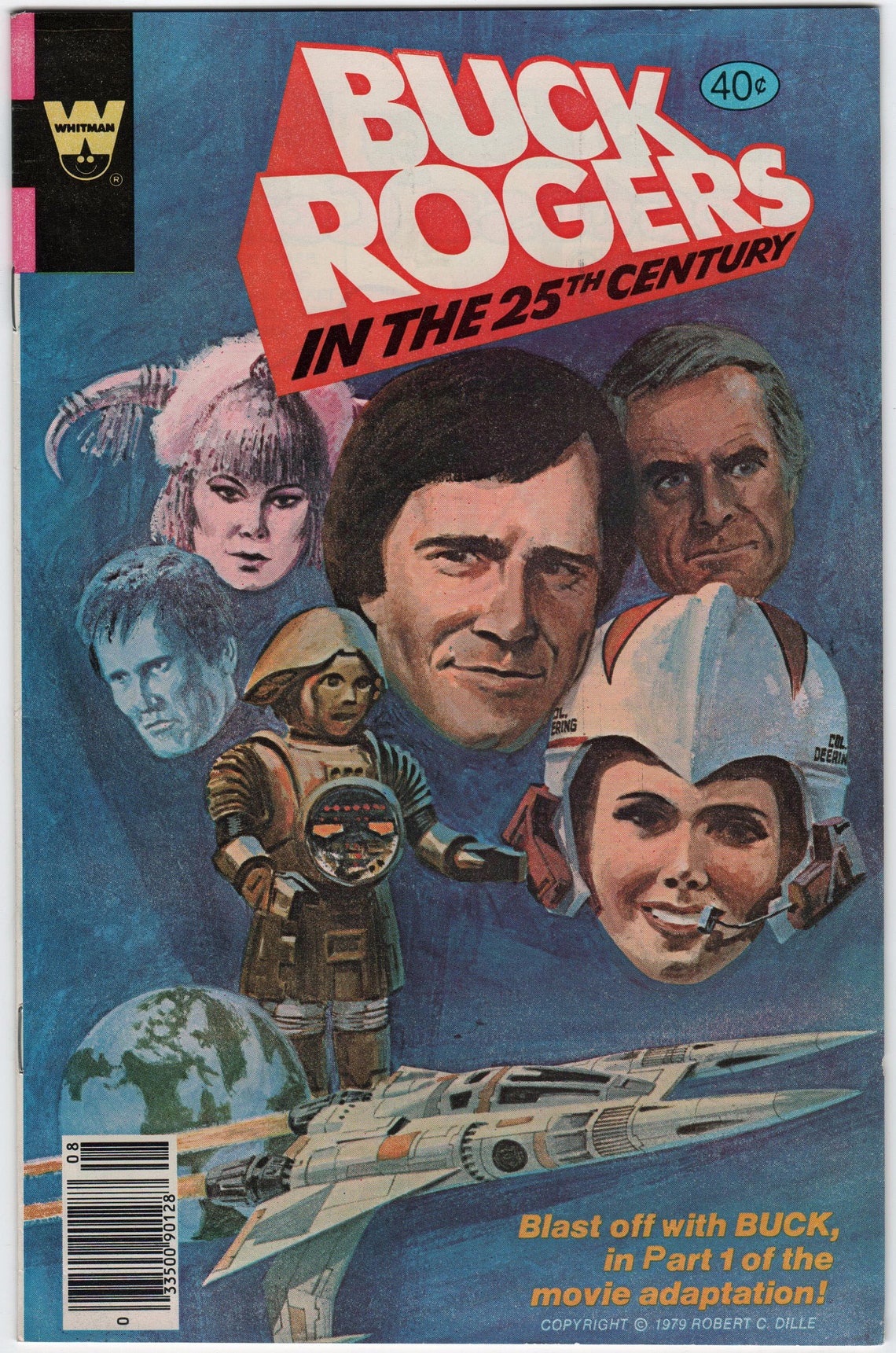
Buck Rogers is a curiosity in that the concept at once inspired Star Wars and was inspired by it when in 1979 Glen Larson's outfit, the fame folks who gave us Battlestar: Galactica revived the vintage comic strip  hero and dressed all in white and let him dash around for the amusement of those of us hungry for every mote of science fiction we could vector in on. 

Which sci-fi TV show did you think was better between Buck Rogers In The  25th Century and Battlestar Galactica? And why? - Quora

The update as seen in the "theatrical release" is reasonably true to the classic, a time-lost hero is awakened five hundred years in his future to an Earth struggling after devastating conflicts. The open racism of the classic Nowlan-Calkins strip is disappeared largely but in its place are heaping gobs of anti-feminest dross. The old comic was sexist as heck too, but by 1979 most of that was still okay. The "movie" starts with a title sequence that would've made James Bond proud, a gaggle of slinking beauties bathing in the reflected light of the logo. Among that assembly was the lovely Erin Gray who has become arguably the sci-fi sex icon of the era. 

Pamela Hensley as Princess Ardala in the television series "Buck Rogers in  the 25th Century" which was first broadcast … | Buck rogers, Pamela  hensley, Buck rodgers

Most of the show is pretty decent rot for the time, save for Gil Gerard's take on what passes for perseverance and mostly resembles contrarianism. There's a whole dance sequence I just ignore, so painful is it to watch that I find it a grand opportunity to get something to drink or eat. Pamela Hensley is seriously hot, but her role is cliched beyond her control. Henry Silva connects the dots on his villainy, and not do much more ain't his fault as far as I can see. 

Our Favorite Helper Robots from TV Shows and Video Games | Buck rogers, Sci  fi tv shows, Buck

The two things I most remember about the show are Twiki along with his medallion buddy Doctor Theopolous, and the trailer. I did see Buck Rogers in the theater, as it was a time when I saw most every show even sort of science fiction like. But I don't remember seeing it so much as seeing the trailer which was incredibly long and told the story fairly completely, less an incentive to see the movie and more a summary. I've always applied the rule that the longer the trailer the worse the movie and that usually holds up.

Buck Rogers 39 year old Whitman Comic   No. 2 In the 25th image 0

Buck Rogers became a television show and it was fine, something passably decent to watch with competent acting and production. But it rarely if ever rose above its upbringing, and that's a pity too. 

Rip Off

Thursday, September 3, 2020

Frazetta's Rogers And Out!


Buck Rogers was enormously successful on the comics page and made his way into the comic books via Famous Funnies which reprinted the comic strip yarns. Toward the end of the Famous Funnies run, Buck Roger became the cover feature and it's a grand thing too. Frank Frazetta was tapped to create the covers for many of these comics and they are simply magnificent. Here is the complete run of Frazetta covers.


The image above is the first of these I ever remember seeing. It was reproduced in black and white in A History of Comic Strips, a tome I would check out the library on a regular basis. It's spectacular to see the art in glorious color.


Apparently there was at least one Buck Rogers cover produced by Frazetta which was not run by Famous Funnies as it neared its cancellation.


Instead Frazetta converted the art into a exotic and wildly active cover for an issue of EC's Weird Science-Fantasy.

Rip Off

Wednesday, September 2, 2020

Armageddon 2419 AD!


Buck Rogers is a name utterly associated with science and especially the speculative science of the pulp magazines and comic strips of the last century. Just as John Carter and Flash Gordon found themselves on distant planets, similarly Buck Rogers is a man who is stranded in time. There are two kinds of time travel, the short kind and the long variety. H.G. Wells wrote of a man who uses his machine to go the quick way into the distant future, a time in which he and all he knew of the world was utterly dead and forgotten. The long type of time travel is the kind we all participate in as we march moment by moment into the minutes, hours, days and weeks of our lives to come. Buck Rogers is a man who went into the future the long way. 


The story of the time traveler Buck Rogers was first told in Hugo Gernsback's Amazing Stories, the premiere "scientifiction" magazine of its era. Although the cover features a flying man, it's not about Buck Rogers. The story titled "Armageddon 2419 AD" tells us how a man is trapped in the depths of the Earth, finds himself in suspended animation, and recovered centuries later. To read that original Philip Francis Nowlan story check out this link.


The story proved quite popular and was reprinted.


It even was taken and expanded into novel form. The version above is the one I first read and still have kicking around here someplace. More Buck Rogers tomorrow.

Rip Off

Tuesday, September 1, 2020

Science Fiction Space Adventures!

Space Adventures #12 cover by Steve Ditko, Charlton Comics, August 1954. :  comicbookart

This month it's all about outlandish imagination and mind-bending science fiction. Building off last month's extensive look at Flash Gordon, I want to look at what came before and after and after that.


The most famous science fiction star of the comics aside from Flash Gordon is Buck Rogers. While the Buck Rogers comic strip never had the lush elegance that Alex Raymond brought to his strip, it's clear that Flash Gordon began as a copy of the successful strip by Dick Calkins based by the character invented by Philip Francis Nowlan. In more recent times times the strip has been converted to a reasonably well-remembered television show. We'll take some time to revisit Buck Rogers in a few of his icarnations.


"Space...the final frontier." That line resonates in the memory and more importantly in the imagination of many a man and woman of my vintage who caught hold of a little space opera TV show called Star Trek. Nowadays Star Trek is a brand, a franchise with multiple variations and versions in a multitude of formats. But we only had the show, some novels Ballantine, and some cards from Topps. Gold Key did offers up some comics, but in early days a rough-hewn doppleganger of the actual show. I want to read a bunch of those comics this month and will be using my Checker collections to do so. Star Trek took many years to catch fire as the iconic cultural experience it has become, but there was another similar project that burst into  bright raging flames in an instant.


"The Sunday Funnies" feature will continue with some investigations of a that little flick called Star Wars reference above. Before it became this behemoth which was at once consumed by and consumed the "House of Mouse" Star Wars was a transforming brand with toys and books and cartoons and more. Everyone knew at once that the world had changed, but the nature of those changes took a bit to sort out. When that first "new hope" hit the theaters there was just a few novels by Ron Goulart and a comic strip by Russ Manning. That remarkable bit of comics lore in dire need of reading and reporting here at the Dojo and so it shall be.


On Saturdays and otherwise expect more movies, and those flickers will have a Star Wars inspiration as well, though George Lucas will not have been involved in any of them. I'm also looking into movies which anticipated Star Wars and the sci-fi boom that followed it, or at the very least inspired it. I'm looking forward to spoofs and spacemen, as my country tries to wrestle back its soul. Wish us all luck as we venture into the where no man has gone before in a time long long ago.

Rip Off