Wednesday, July 27, 2022

Robert Of The Jungle!


The first season of Filmation's adaptation of Edgar Rice Burrough's Tarzan, Lord of the Jungle is among the smartest and most literate presentations of the Ape Man which either the small or large screen have ever seen. If anything, the Tarzan presented in these cartoons is a little bit too reserved and too cautious. He's certainly not the grunting, barely verbal creation of the popular Weissmuller movies. The voice for Tarzan in these excellent cartoons was Robert Ridgely, a veteran voice actor. The Tarzan here is the master of his domain who by his absolute willingness to help others weaker than himself finds himself cast into weird and time-lost domains all across the mythical geography of his Africa.


The folks at Filmation apparently had a deep understanding of the original Burroughs novels and sought to bring that literary version of the famous jungle hero to the small screen rather than the skewed rendition which still sadly dominates the popular imagination today. Tarzan here is not exactly the same character from the books (no Jane, no expansive estate either in England or Africa, no Waziri) but he is an intelligent and literate man who lives in the jungle and has a special affinity to the animals there by dint of his peculiar upbringing. And the use of the monkey N'Kima and not that tiresome Cheetah was most welcome as well as the inclusion of the remarkable Jad-bal-ja the Golden Lion.


He finds himself visiting versions of famed ERB locations such as Opar, the Golden City, the Forbidden City, and even a offbeat version of Pellucidar. But he also takes on robots and outer space aliens when those show up in his jungle too. Tarzan in these stories always seems to have someone to take care of, usually a denizen of the civilization he's visiting who has a reason to object to some aspect of that society. Usually the kingdom in question whether the Golden City of Zandor, the tree-top city of the Giants, or some other are despots who need to be defeated or deposed. Sometimes they are misguided and Tarzan's lesson is all they need to mend fences and make a better life for their subjects such as the land of the Vikings. As in most romantic fiction, the very notion of monarchy is rarely objected to, rather complaints are about personal failings in leaders and not in the very notion of class societies. But that's a bit much for Saturday morning to be fair.


This is Filmation at its finest and worst. The limited animation requires lots of repeated action, but generally that stuff is very well done to begin with and seeing it again and again is not really a problem. Though I confess the pace of the shows seems sluggish at times. The real weakness with Filmation is in the sound recording. Tarzan himself is excellent but often there seems to be an indifference to other voices in the show, with some meager acting filling in and hurting the proceedings. Having read about Filmation, I realize that Lou Schiemer was often part of these recordings as were his kids, but I don't really know the extent they are used here. It's a weakness for certain.


But that said, this is still a rousing version of Tarzan and I heartily recommend it to everyone with an interest in the Lord of the Jungle.

Rip Off

Tuesday, July 26, 2022

Ron Of The Jungle


I have spent weeks enjoying all things Tarzan. Next on the schedule was the Ron Ely TV series, both seasons (three DVDS - two for season one) and now that I've much more quickly than I imagined have finished the series with a smile. These are tasty television shows with a lot of natural vistas and some fine acting. 


Ely's Tarzan is "my" Tarzan, he's the first actor I ever saw portray Edgar Rice Burrough's iconic Ape Man and so like any child he's imprinted on my imagination. His sleek body style, his fluid modern speech patterns, and his handsome friendly face all add up to Tarzan in my book. I was surprised to find that the TV series only lasted two seasons. I seem to remember watching it for what seems forever. Ely as Tarzan standing atop that magnificent waterfall in the opening credits is often the go-to image in my memory when the name of Tarzan is evoked. I didn't until recently know that waterfall was in Brazil.


But alas my boyhood memories fail me a bit when it comes to the texture of the show. Its editing is more hodge-podge with clear stock footage interpolated with shots of the Ape Man and his associates. This is especially true in the earliest five or six episodes made in Brazil. The production of a weekly TV show was daunting because of weather and Ely's desire to do his own stunts which resulted in injuries and delays. The production seems to get on firmer ground after a switch to a Mexican location mixed with more interior set shooting. Yet it seems none of these things bothered a young boy rapt with romance of Tarzan, the ultimate wish-fulfillment hero, assured, strong, agile, handsome, and most of all independent. 


Tarzan's Deadly Silence was a theater release made from my favorite two-part episodes. It pitted Ely against Jock Mahoney as "The Colonel" a brutal military man who sought to build an empire among the tribes. He is assisted by Woody Strode, always a formidable presence on screen. Both Mahoney and Strode showed up on the show several times in an array of roles and added value each time. 


Tarzan's Jungle Rebellion is a compilation of two episodes from the second season. By this time the series had found its mojo and was kicking out episodes with regularity. The same faces often appeared week after week playing a gaggle of different African chiefs and white hunters and such. Often there  was a lovely dame in evidence, often she was misled or confused and likely she found her way to clarity by episode's end.  Some episodes featured Jai almost exclusively. I didn't much care for Tarzan's sidekick originally, but this viewing made appreciate you Manuel Padilla's acting much more. He does some pretty sophisticated stuff from time to time. 

Watching the series after having just seen the films produced by Sy Weintraub, it's fun to look for footage from the movies that is often used to give the television show some heft. There are fires from Joch Mahoney's India adventure we see over and over again and the "death dance" from one of Gordon Scott's movies shows up several times. Event he credits owe much to the films as the memorable gimmick of Tarzan swinging across the screen to reveal the title is actually Mike Henry.

Here are some more of Gold Key's tribute to the then-current TV Tarzan.


Rip Off

Monday, July 25, 2022

Tarzan Powers Activate!

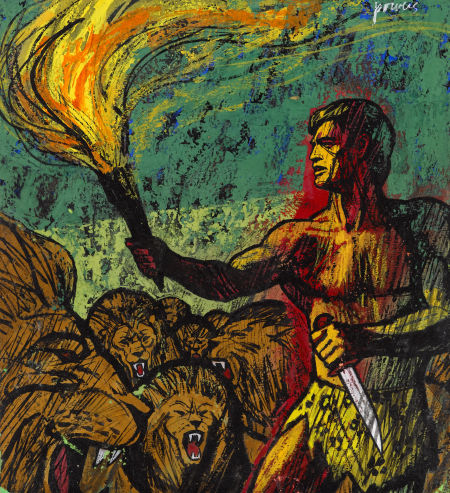
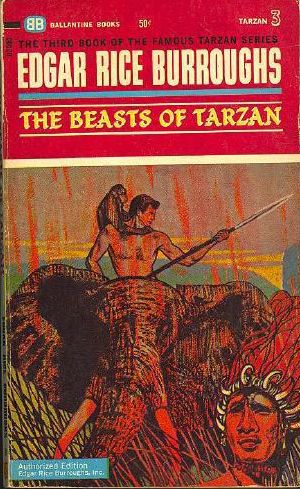
Richard Powers was a popular artist with an arresting and distinctive style who did the cover for scores if not hundreds of books. He was called upon by Ballantine Books to supply covers for their line of authorized paperback reprints of the Edgar Rice Burroughs creation. His artwork is at once attractive and strange and not at all what one might expect for a blood and thunder property of this type. The abstractness of many of the images makes for an effective cover, if not necessarily the most powerful jungle scene. Below is a gallery of the Powers covers. These are the best scans of these handsome covers that I was able to gather.

  Rip Off

Sunday, July 24, 2022

Sunday Funnies - The Complete Russ Manning Tarzan 1974-1979!


It's all in color for the final of the four Tarzan collections from IDW collecting Russ Manning's Tarzan comic strip work. Tarzan - The Complete Russ Manning Newspaper Strips Volume Four has strips from across five years, from 1974 to the end in 1979. At the same time as he and his studio were hectically producing this strip, they were also contracted to created full-color graphic albums for the overseas market. These wonderful tomes were not available in the United States so as to not compete with DC's Tarzan material. It was a project full of more promise than accomplishment as the ERB people were trying to find ways to have full control of the comics produced. 

But let's begin. 


"Tarzan Returns to Castra Sanquinarius" finds Tarzan mysteriously captured and aboard a slave galley which is headed to the lost Roman outpost of Castra Sanquinarius which Tarzan first encountered in Tarzan and the Lost Empire. He finds another outsider named Gino Moscatti who is also a slave. Tarzan is drawn into the court intrigues of the vile empress Claudia. After some terrific fights in the arena and outside of it Tarzan and a group of slaves are able to escape. 

"Tarzan and the Valley of the Mist" is a strange outing which finds Tarzan exploring a bizarre little valley in which strange mists make animals and people able to cast off their basic instincts and live side by side as is suggested in the story of the Garden of Eden. This world is overseen by a girl named Luz who wants Tarzan to stay but he rejects this false paradise and sees to it that the valley is closed. 

"Korak and the Amazons of the Elephants' Graveyard" has the son of the Ape Man carried off by balloons to a strange world which turns out to be yet another lost outpost of ancient Atlantis like Opar. In this weird place only women rule, a strange sort of harem maintained by a warrior named Hunlaka who uses ancient powerful armor to maintain control. This yarn had one of the more surprising endings of any I've read. The reader is surprised to learn that the beautiful but deadly women of this city use phrases like "Spa Fon!" and "Squad Tront!" which sound familiar to many a comic book fan. 


"Tarzan and the Giant Insects of Opar" is a sprawling and truly strange epic of an adventure that spans most of a year. It begins when Tarzan and Jane must return to Opar for more gold to help feed the tribes who live around them. Soon Jane is captured by the wild men of Opar and offered up as sacrifice. La for some reason is not in control but soon she and Jane are rescued only for Tarzan and La to fall into another world beneath Opar filled with giant spiders, beetles, dragonflies and other insects. Men live here too but have adapted to life by attempting to become more like insects and seek to make La the mother of thousands of people. What she might become is kept behind the curtain by Manning. 

"Tarzan and the Emigrants" is a story about the classic struggle between those who want to fence in territory and those who want to leave the ranges open for natural migration. When farming settlers build an enormous wall that stops the animals Tarzan goes to see about getting it down and faces a great deal of hostility. But a flood caused by the wall changes things. Tarzan with the help of Tantor fights to save the day. 

"Tarzan and the Jungle Revolution" picks up immediately after and co-stars Jane. She and Tarzan go to town and meet with hostility. Confused they discover a revolution has divided folks and made them wary. When they and a friendly captain are kidnapped along with a paddle boat by revolutionaries they are in for a fight for life. But it's not just soldiers who are a deadly threat when in the middle of vast swamp dinosaurs appear to prey on everyone. It's a very close call for Tarzan and Jane indeed. 

"Korak and the Sacred Lake of Karakao" is a peculiar tale about the son of Tarzan and how he becomes impossibly infatuated with an impossibly beautiful woman from a society which lives inside a volcano. She was bred to be so beautiful that men fall helplessly in love with her if they see her uncovered face. Weird priests protect against the day when she will be sacrificed to the "god" which lives in the waters of the sleeping volcano. That god is an enormous squid and Korak is barely able to escape with is life when the volcano erupts. His heart is well and truly broken. 

"Tarzan and the Dead Moon of Pellucidar" is a delightful adventure which sees Tarzan and his Waziri hop aboard the dirigible which takes them to the world at the center of the Earth after receiving a message from David Innes. Whatever the threat to Pellucidar it is also a threat to the suface world which has been experiencing earthquakes. Tarzan finds arms of varied Pellucidarian populations in arm fighting each other until he is able to galvanize them into a single force to approach Pellucidar's only source of darkness, it's strange moon. He is taken to the surface of that moon and into its interior by Mahars who are using a strange crystal to expand their mental might to create earthquakes. Tarzan's limitless will is all that saves the day. 

"Tarzan and the Games of Ibizzia" is a short adventure in which Korak and Tarzan who follows him are forced to take part in strange games by a mad despot. Instead of actual sport he creates deadly spectacles for a worldwide audience. But Tarzan is more than capable of ending his threat. So ends Russ Manning's run on the comic strip. He signs the final panel of the final Sunday strip with both is names and his assistant Mike Royer. 


These vintage Russ Manning stories of ERB's famous Ape Man are almost all new to me. Reading them was an exquisite pleasure and among the very best comic strip reading experiences I've ever had. The stories flowed delightfully well with a great pacing which never allowed the reader to relax. Sometimes comic strips are burdened by sluggishness but not these. One gets the sense that Manning couldn't wait to get to the next batch of ideas and that communicates to the reader. 

Reading the support pieces in these collections has also given me a greater understanding of the man Russ Manning was as well. I knew he was a great artist, that's obvious. But I've discovered by that was a good man and responsible to his community. He was gracious by most accounts and created a workspace which proved effective and enjoyable to an extent for many artists. His Tarzan was idealistic and sleek, a thoroughly modern interpretation. It's one I've gained an even greater affection for after reading years of Manning's work on the famous ERB creation. 

Rip Off

Saturday, July 23, 2022

Tarzan - The Russ Manning Years Volume One!


Gold Key was a great place to work in comics at the time as they not only supplied a salary and health insurance to many of their talents, but also had a royalty program. Russ Manning was the kind of artist who did well in such a program. After many years in the trenches at Dell and Gold Key Comics, Russ Manning had made his reputation within the company as an artist of immense style who was able to hit the deadlines. He'd shown his potential on Brothers of the Spear and later proven his worth on Korak Son of Tarzan, so it was only logical that he would take on Edgar Rice Burroughs' Tarzan of the Apes. When he did it was with a renewed cohesion to the original ERB stories. Dell had recognized the books but had designed the series around the movie franchise, but Gold Key went back to basics and offered up legit adaptations of the novels. It all began with Tarzan of the Apes. 


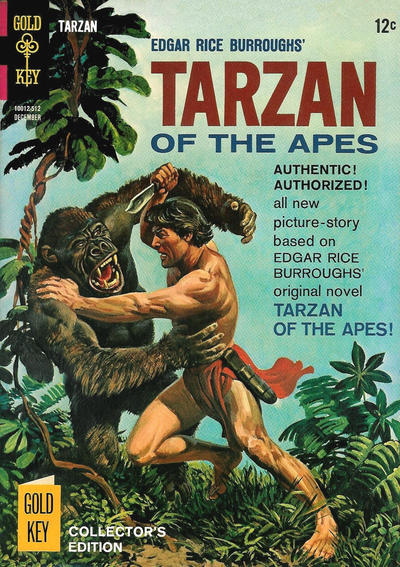
Compressed to a mere twenty-four pages the original ERB novel Tarzan of the Apes is adapted only in part by writer Gaylord Dubois and artists Russ Manning with assists by Mike Royer in Edgar Rice Burroughs' Tarzan of the Apes #55. The common element to the Gold Key adaptations is the keep Tarzan in the jungle as much as possible and focus on those elements of ERB's novels. Here we meet his parents, follow their plight briefly and then see Tarzan grow up among the apes, eventually becoming their king. We then meet Jane and the cadre of castaways who Tarzan helps in several ways. He rescues Jane but as the story ends and she sails away she still doesn't know that "Tarzan" and the man who saved her are one and the same. George Wilson supplied the action filled cover for this issue based on a Manning drawing. Wilson will be the cover artist for all the issues in this run.


I would like to note that I first ran across this story when it was reprinted by Gold Key in 1968. It was among my first encounters with Tarzan and my first experience enjoying the sleek artwork of Russ Manning. 


The very next issue adapts The Return of Tarzan but again begins just before Tarzan returns to the jungle. We do get a brief synopsis of what happened after the end of the previous adventure, so we know that Tarzan went after Jane and then to spare her denied his identity. (I'm a bit disappointed we didn't get some more of his Paris adventure as Tarzan kicking ass among civilized folk is some of my favorite stuff.) We follow him as he once again asserts himself in the jungle and then finds himself seeking out the lost city of Opar for the first time and we see how he discovers the wealth that will make his future life as both Tarzan and Lord Greystoke possible. Later we follow him when goes to rescue Jane when she is captured by the bestial men of that land. We encounter La for the first time and see how her passions for Tarzan are quickened. This time the story ends much like the novel with Tarzan and Jane being married. 


The Beasts of Tarzan is adapted in the next issue and once again the story is condensed in such as way as to keep the jungle adventures front and center. This novel is an especially convoluted one and the adaptation by Dubois and Manning does its best to keep things trim and coherent. Jane is at the center of much of the action in this adventure as she is forced by circumstances to defend herself and for a time the baby she thinks is her own. There is considerable death in this story, something Gold Key might've been reluctant about but it was necessary to remain true to ERB's yarn. Manning does a great job of showcasing Tarzan's gang of animals who help him save his beloved. 


It's a challenge for Dubois and Manning to get as much of ERB's The Son of Tarzan as they do into the spare twenty-four page limit. But they do a pretty good job and we meet Tarzan's progeny who rescues Tarzan's old friend Akut and helps to get him back to the jungle and freedom. There he becomes Korak and meets the love of his life Meriem, a slave he rescues. They are happy for many years, but things get convoluted when Tarzan rescues Meriem but has no knowledge of his son's whereabouts. By the end though we get a happy ending. 


With the next adaptation of an original Tarzan novel, Dubois and Manning get the nod to expand beyond the constraints of a single twenty-four page comic. This is a mixed blessing actually as the novel Tarzan and the Jewels of Opar is one of ERB's most elaborate plots with lots of coincidences to keep it humming. Those twists and turns are evident here as Jane is kidnapped by Arab raiders while Tarzan and the Waziri go to Opar to get another batch of gold. Tarzan finds some splendid jewels just before he is hit on the head and loses his memory. Thus begins a wild succession of events which see Tarzan find and lose his jewels time and again as they pass among many hands. For much of the adventure and all of the second part Tarzan is not himself. I hate to say it, but two issues would've been ideal for this story and allowed the team to eliminate some of the needless complications before arriving at its rather clever ending. 


Tarzan the Untamed is next. Dubois and Manning simplify the plot somewhat and focus on Tarzan's efforts to assist his British countrymen in their WWI era battles in Africa against the Germans. He is a ferocious warrior but after a time seeks to return home. (In the novel Jane is kidnapped and Tarzan thinks she is dead for a time. That detail is missing here but will be picked up later.) Tarzan becomes involved with a woman he believes to be a German spy and a British flyer as the trio have to try and survive the wild population of Xjua. The Xujans worship lions and might be a bit mad though Dubois does little with the ERB concept. After considerable derring-do all three escape the city and Tarzan learns the truth about his colleagues. 


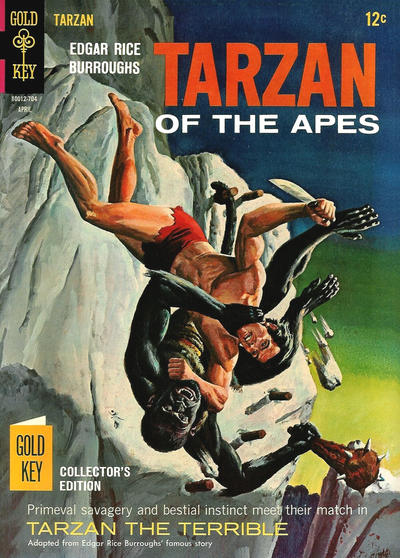
Tarzan the Terrible was originally a sequel to the previous tale. As it opens Tarzan is now looking for Jane for two months. No mention is made of when and how she was captured by the Germans. In his search he arrives in the land of Pal-Ul-Don for the first time. It's a land of dinosaurs and warring tribes of primitive peoples who are distinguished by the facts they are furry and have tales. Tarzan stands out needless to say but his bravery in battle soon earns him the title of "Tarzan-Jad-Guru" which translates to "Tarzan the Terrible".  Once again in these two issues we have a very convoluted tale which eventually reunites Tarzan with Jane just in time for both of them to be captured and put on a sacrificial altar. Only the timely arrival of Korak (who had been fighting in the Argonne) saves the day. The family is finally reunited as the story closes. 

This wraps up this first volume of Tarzan comics by Russ Manning. Manning was not alone in drawing Tarzan at this time. Doug Wildey also drew the Ape Man as well as Alberto Giolitti. But Manning did adapt three more Tarzan novels in partnership with Dubois. 


Sadly Dark Horse did not publish a second volume which would've included Manning's adaptations of Tarzan and the Golden Lion, Tarzan and the Ant Men, and Tarzan, Lord of the Jungle. In retrospect it's a glaring omission given that they'd worked to get all of his Brothers of the Spear and Korak Son of Tarzan material into print. The need for the remaining Tarzan stories seems all too evident. But it was not to be. Russ Manning left the Tarzan comic to go full time on reviving the comic strip which had lost some traction over the years. His work there has been reported on here already and I will wrap it up this week. Manning's Tarzan is one of the great achievements in comics by one of the fields greatest practitioners. 

Rip Off