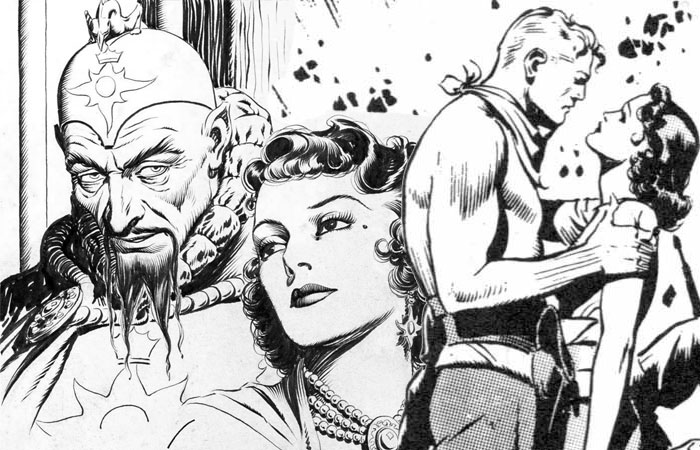
This link will take you some fascinating art by Ruben Garrido where he takes some of the classic Alex Raymond images and blends them in collages which evoke other times and places and artists. Fascinating.
Monday, August 24, 2020
Sunday, August 23, 2020
The Sunday Funnies - Flash Gordon 1939-1941!
Flash Gordon is properly remembered as one of the finest adventure comic strips of any era. The story of three desperate people rocketing to an unknown planet hurtling toward Earth to save that Earth is the stuff of legends. But once Flash Gordon, Dale Arden and Professor Hans Zarkov are stranded on the planet Mongo and this planet is safe they must still fight hard land long to free the various peoples of that world from the grip of an evil tyrant Ming the Merciless. It is in the later Sunday pages that the struggle against an evil military force finds it more complete development.

My gripe about these Flash stories which detail Flash's second victory over Ming (albeit as always temporary) is that the episodes themselves seem to take a dang long time to unfold. (Actually now that I reflect on it, the first time Flash came to an accord with Ming when the latter made Flash the king of the cavern territories.) At one point Flash, Dale, Zarkov and their allies are trapped inside a glacier by a dangerous ice worm (an utterly fantastic monster by the way) and spend an enormous time trying to escape. It gets more than a bit monotonous after a time.
![]() |
Rip Off
Saturday, August 22, 2020
The Saturday Serials - Filmation's Flash Gordon!
I wasn't smart enough to snatch up a copy of The New Adventures of Flash Gordon complete series when it was available for all too brief a time some years ago. The company which produced it dissolved and only an incomplete DVD package with most of the first season is currently available for a reasonable price. That said, it's an impressive achievement and one fondly remembered by cartoon fans from of the era.

This Filmation series was triggered by the interest which sparked the Dino DeLaurentis film, and has some details in common though I don't think there was any direct connection between the productions. Both were sparked by the sci-fi boom ignited by Star Wars and it's that common new influence which takes the classic Alex Raymond material and gives it a somewhat new gloss, especially in terms of machinery.

This series, at the first season, is formatted as were the vintage serials of decades gone by, with cliffhanger endings, or at least incomplete conclusions for most of the episodes in this run. The first five are actually derived from a feature-length version of the story which appeared on television in prime time and drew direct comparisons between the Nazis in WWII and Ming the Merciless and his cutthroat empire. Much of that is missing from the serialized version.
Given that this is a Filmation effort, it's marked by many of the gimmicks the company used to present animation for TV on a limited budget. There are lots of repeated shots, many used enough to be called stock and it's the clever reuse of these which tell the stories of our trio of heroes from Earth battling Ming on Mongo and surviving the effort. There are many callbacks to the classic original comic strip by Don Moore and Alex Raymond as well the structure itself being evocative of the vintage Buster Crabbe movies.
![]() |
| (Frank Cho Artwork) |
There's a lot to love about these shows for Flash fans and I only wish the whole series were available again for a decent price. The series is available on Youtube though and it's there that I finished up the first season.
Rip Off
Friday, August 21, 2020
Meet The Man Who Hated Laughter!
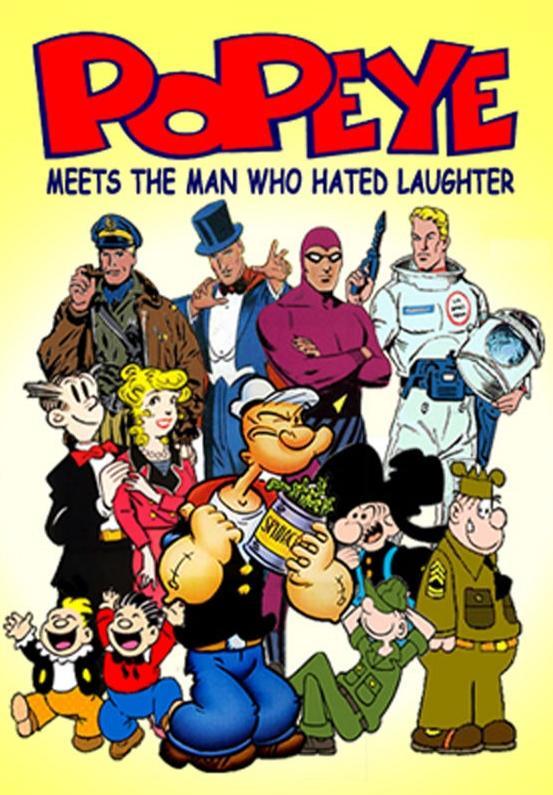
I am constantly amazed at what I uncover on the vast undiscovered country which is the internet. Popeye Meets The Man Who Hated Laughter was originally a TV movie of the week which offered up no less than most if not all of the famous King Features characters in one adventure.
Popeye is the captain of a cruise ship named "Hilarious" which takes the King Features funnies ( the casts of Popeye, Blondie, Snuffy Smith, Beetle Bailey, Tiger, Henry, Lil Iodine, Katzenjammer Kids, and more) on a vacation in the South Seas where they run afoul of an evil scientist assisted by Brutus who plots to eliminate laughter by ridding the world of comic characters.
This earliest adventure of the "Defenders of the Earth" plus many is not available on DVD. More's the pity. To encounter this oddity, follow this link to YouTube.

It's a gem...of sorts.
Rip Off
Labels:
Flash Gordon,
King Features,
Mandrake the Magician,
Popeye,
The Phantom
Thursday, August 20, 2020
Whitman's Flash Gordon!
Western Publishing was a large and successful outfit for a very long time in comics. Early on they partnered with Dell to make comics but later when that fell apart established the Gold Key brand to make their own distinctive mark on the field. The "key" to their success was a slightly higher price (fifteen cents as opposed to twelve when I started reading for instance) and the painted covers, most by George Wilson. Gold Key comics looked more sophisticated than most comics and while their interiors might be a bit dry from time to time, the whole was always reliable and entertaining.
Eventually the comic book market changed and newsstands, the longtime primary outlet for comics began to disappear. With such sales diminishing the "Gold Key" brand was retired and another name -- "Whtiman" was used for the very same comcis. Whitman was the name Western used on their copious coloring books and other projects and now it was used for comics as well. Editorially there was no difference, but in terms of delivery to the consumer things were changed immensely. Western began to bag comics up into plastic and offer them three at a time, trying to find a package which seemed a bargain n a marketplace which saw prices rising continually. It was not ultimately successful,but it did buy Western a little time and in that time they made some more Flash Gordon comics.
John Warner and Carlos Garzon are both still on hand for the first Whitman issue and the continuity established in Alex Raymond's comic strip is still being adhered to more or less with Flash, Dale and Zarkov heading to the Cave Kingdom of Mongo where Flash had been made monarch in the comic strip decades before. They find a former Ming soldier hiding there but soon flush out the culprit.
The next issue saw a new artist by the name of Gene Fawcette. Fawecette had a clean smooth style similar to what had come before, though not as dynamic, but still quite handsome. The story sees Flash wanting to consolidate his power in the Cave Kingdom with exploration and Ming sending in a most competent spy to put an end to Flash.
The story continues in the next issue with Flash and his comrades finding a virtual new undersea domain tucked inside the vast caverns.
Then there's quite a shake up as three issues of the Whitman run are used to adapt the Flash Gordon movie. I will be taking a look at these issues individually later, so we'll skip ahead for now.
The issue following the adaptation is business as usual with Gene Fawcette back drawing a John Warner script that picked up the adventures of Flash and his allies as they are confronted by dreams sent to them by Ming. There's a second adventure in this issue written by George Kashdan and drawn by Frank Bolle taking Flash to a land where a man is held in limbo.
With newsstand sales gone, Whitman abandons the secret sauce of their success and the painted covers are gone. Now we have a patchwork cover using images from several parts of comic. It's accurate though and tells of yet another small kingdom and yet another queen, this one able to command a giant buzzard. It reminded me of The Giant Claw frankly. Carlos Garzon is back on the art chores too.
More of the same in the next issue but with a difference as a character from the movie shows up -- Klytus the top second-banana to Ming himself. There is no apparent change in the larger back story though as Ming is still alive and plotting as Flash has to confront an Amazon-like kingdom where spiders are used as livestock and more. All McWilliams takes on the artwork from a George Kashdan script.
Finally the Flash Gordon comic comes to an end as we get new art from Gene Fawcette on scripts by Kashdan. But lots of things are changed in this last outing as the character models are altered to resemble the actors from the movie. Again the background story is unchanged, but it's a bit startling to suddenly see Flash Gordon wearing a tank top and looking like Sam Jones. The series goes out with a bit of whimper as these changes are never really explained. And that's it for Flash Gordon in the comics until DC takes a spin and later Marvel Selects the Alex Raymond hero for a few issues in the next decade.
Rip Off
Wednesday, August 19, 2020
Gold Key's Flash Gordon!
Gold Key was the kind of comic book company which generally published quality if sometimes unexciting comic books. The place was manned by seasoned professionals who approached the job of making comics with a solid professionalism. Alas that reliability and experience made for work which rarely deviated from the norm. Unlike idiosyncratic Charlton which had bubbles of creativity and break though talent, Gold Key was the calm reliable comic book company. But as the marketplace for comics was shifting in the Bronze Age, Gold Key was on the way out, but not before delivering some really excellent Flash Gordon comics.
Flash Gordon had not been seen in mainstream American comics since the lapse of the Charlton run, but a new movie from the producer Dino DeLauentis suddenly made Flash Gordon desirable and so they picked it up and continued its numbering from the King and Charlton runs. Gold Key had a good track record with heroic science fiction being the home to such fine comics as Magnus Robot Fighter, Turok Son of Stone, Tragg and the Sky Gods, and Doctor Solar.
And they wanted to do Flash Gordon right, so they asked Al Williamson to do it and he said no, but he did put them into contact with an artistic ally Carlos Garzon, a guy who drew a lot like Williamson. I still remember being quite excited when I first opened up this new Flash Gordon comic. John Warner writes the stories and they pick up as if nothing in the earlier Charlton series had happened. In fact the King Comics features seem out of place too as Flash, Dale and Zarkov are back on Mongo and battling Ming directly for a couple of issues.
Then with Warner still on scripts we get two directly connected issues drawn by the every ready Frank Bolle the go-to fill-in man for comic strips and books alike. Bolle's style is not lavish nor particularly exciting but it's story telling is rock steady. The stories deal with Barin's son and a tutor who works for Ming among other things.
With Garzon back, Flash and his compadres head off into Mongo to round up help in the battle against Ming.
In the spirit of the comic strip, the hard headed Flash invades Mingo City to face off against the evil emperor, but as usual the result is less than final.
The trio then encounter the lava men and find among other things some new allies against the tyrant. The look of the lava men here is very reminiscent of the lava men in the Marvel Universe.
They are somewhat less successful in a land where serpents are worshipped. The queen of this city is a lovely raven-tressed woman, but weirdly so have all of the women shown in the series so far. Perhaps it's to contrast with Flash's blonde hair, but every woman Garzon draws looks alike, save for Dale. The men are very distinctive by and large and seem based on real folks and not types.
But it is in the other-dimensional city of Illusia ruled by magicians that the biggest event occurs -- Zarkov finds love. What will become of this new aspect to the story will have to wait for the Whitman issues as the Gold Key brand is retired along with most of the newsstand distribution. More of the same Flash Gordon on that next time -- but different.
Rip Off
Tuesday, August 18, 2020
Charlton's Flash Gordon!
Charlton Comics is my favorite comic book company. That said I know that many find their comics a bit slapdash and mundane, and truth told a lot of them are. But among all the dross there are many many gems to find and polish and enjoy. For a time Flash Gordon was a part of that operation. It's an uneven effort, but a well if not necessarily fondly remembered outing for the classic King Features space opera.
The first Charlton issue is really left over from the King Features effort to put out their own comics. This comic by Bill Pearson and fan-favorite artist Reed Crandall carries on directly from the stories being told in the King Comics rendition of the title. In this one we meet Sheng the Savage, a minor-league Ming who gives Flash, Dale and Zarkov some mild problems.
The next issue marks the beginning of the Charlton era but also puts a coda on the King Comics run. Under a cover by Pat Boyette, the first story features another Pearson story and artwork by an up and coming Jeffery Jones.

Jones was tole the comic pages he produced would not see publication since King was on the way out, so he was encouraged to get them done by a certain date which precluded the finest quality. When the story was published he was understandably chagrined, but I for one like the loose approach, though truth told the story telling does waver. Closing out this issue was Pat Boyette's first take on the character.
The next issue is all Boyette. Now Pat Boyette might seem an odd choice, and I'd agree with that, but his take on the character was certainly distinctive. Using scripts by Pearson as well as Charlton workhorse Joe Gill, Boyette does his typical full-bodied job.
The adventures are fairly typical stuff for Flash Gordon and his allies. They fight to save themselves from the myriad dangers of Mongo. Old favorites like the Witch Queen show up and new foils are developed for Flash to confront.
Even Ming the Merciless returns to go hand to hand with Flash. Boyette's version of the world is absolutely unique. Boyette was a one-man shop doing pencils, inks and letters for his own comics. This auteur approach to making comics seems at first blush to the assembly-line, knock-'em-out attitudes of the Charlton operation, but actually the hands off attitude of editorial was ideal for a creator like Boyette.
He was satisfied with the low page rates if it meant he could do what he wanted in his approach to comics and that's what he had at Charlton.
Rip Off
Subscribe to:
Posts (Atom)