Monday, June 25, 2012

The Return Of Tarzan - Chapter Twenty-Four!


The Return of Tarzan
Chapter 24 -- How Tarzan Came Again to Opar
by Edgar Rice Burroughs


When Clayton returned to the shelter and found Jane Porter was missing, he became frantic with fear and grief. He found Monsieur Thuran quite rational, the fever having left him with the surprising suddenness which is one of its peculiarities. The Russian, weak and exhausted, still lay upon his bed of grasses within the shelter.

When Clayton asked him about the girl he seemed surprised to know that she was not there.

"I have heard nothing unusual," he said. "But then I have been unconscious much of the time."

Had it not been for the man's very evident weakness, Clayton should have suspected him of having sinister knowledge of the girl's whereabouts; but he could see that Thuran lacked sufficient vitality even to descend, unaided, from the shelter. He could not, in his present physical condition, have harmed the girl, nor could he have climbed the rude ladder back to the shelter.

Until dark the Englishman searched the nearby jungle for a trace of the missing one or a sign of the trail of her abductor. But though the spoor left by the fifty frightful men, unversed in woodcraft as they were, would have been as plain to the densest denizen of the jungle as a city street to the Englishman, yet he crossed and recrossed it twenty times without observing the slightest indication that many men had passed that way but a few short hours since.

As he searched, Clayton continued to call the girl's name aloud, but the only result of this was to attract Numa, the lion. Fortunately the man saw the shadowy form worming its way toward him in time to climb into the branches of a tree before the beast was close enough to reach him. This put an end to his search for the balance of the afternoon, as the lion paced back and forth beneath him until dark.

Even after the beast had left, Clayton dared not descend into the awful blackness beneath him, and so he spent a terrifying and hideous night in the tree. The next morning he returned to the beach, relinquishing the last hope of succoring Jane Porter.

During the week that followed, Monsieur Thuran rapidly regained his strength, lying in the shelter while Clayton hunted food for both. The men never spoke except as necessity demanded. Clayton now occupied the section of the shelter which had been reserved for Jane Porter, and only saw the Russian when he took food or water to him, or performed the other kindly offices which common humanity required.

When Thuran was again able to descend in search of food, Clayton was stricken with fever. For days he lay tossing in delirium and suffering, but not once did the Russian come near him. Food the Englishman could not have eaten, but his craving for water amounted practically to torture. Between the recurrent attacks of delirium, weak though he was, he managed to reach the brook once a day and fill a tiny can that had been among the few appointments of the lifeboat.

Thuran watched him on these occasions with an expression of malignant pleasure--he seemed really to enjoy the suffering of the man who, despite the just contempt in which he held him, had ministered to him to the best of his ability while he lay suffering the same agonies. At last Clayton became so weak that he was no longer able to descend from the shelter. For a day he suffered for water without appealing to the Russian, but finally, unable to endure it longer, he asked Thuran to fetch him a drink. The Russian came to the entrance to Clayton's room, a dish of water in his hand. A nasty grin contorted his features.

"Here is water," he said. "But first let me remind you that you maligned me before the girl--that you kept her to yourself, and would not share her with me--"

Clayton interrupted him. "Stop!" he cried. Stop! What manner of cur are you that you traduce the character of a good woman whom we believe dead! God! I was a fool ever to let you live--you are not fit to live even in this vile land."

"Here is your water," said the Russian. "All you will get," and he raised the basin to his lips and drank; what was left he threw out upon the ground below. Then he turned and left the sick man.

Clayton rolled over, and, burying his face in his arms, gave up the battle.

The next day Thuran determined to set out toward the north along the coast, for he knew that eventually he must come to the habitations of civilized men--at least he could be no worse off than he was here, and, furthermore, the ravings of the dying Englishman were getting on his nerves. So he stole Clayton's spear and set off upon his journey. He would have killed the sick man before he left had it not occurred to him that it would really have been a kindness to do so.

That same day he came to a little cabin by the beach, and his heart filled with renewed hope as he saw this evidence of the proximity of civilization, for he thought it but the outpost of a nearby settlement. Had he known to whom it belonged, and that its owner was at that very moment but a few miles inland, Nikolas Rokoff would have fled the place as he would a pestilence. But he did not know, and so he remained for a few days to enjoy the security and comparative comforts of the cabin. Then he took up his northward journey once more.

In Lord Tennington's camp preparations were going forward to build permanent quarters, and then to send out an expedition of a few men to the north in search of relief.

As the days had passed without bringing the longed-for succor, hope that Jane Porter, Clayton, and Monsieur Thuran had been rescued began to die. No one spoke of the matter longer to Professor Porter, and he was so immersed in his scientific dreaming that he was not aware of the elapse of time.

Occasionally he would remark that within a few days they should certainly see a steamer drop anchor off their shore, and that then they should all be reunited happily. Sometimes he spoke of it as a train, and wondered if it were being delayed by snowstorms.

"If I didn't know the dear old fellow so well by now," Tennington remarked to Miss Strong, "I should be quite certain that he was--er--not quite right, don't you know." "If it were not so pathetic it would be ridiculous," said the girl, sadly. "I, who have known him all my life, know how he worships Jane; but to others it must seem that he is perfectly callous to her fate. It is only that he is so absolutely impractical that he cannot conceive of so real a thing as death unless nearly certain proof of it is thrust upon him."

"You'd never guess what he was about yesterday," continued Tennington. "I was coming in alone from a little hunt when I met him walking rapidly along the game trail that I was following back to camp. His hands were clasped beneath the tails of his long black coat, and his top hat was set firmly down upon his head, as with eyes bent upon the ground he hastened on, probably to some sudden death had I not intercepted him.

"`Why, where in the world are you bound, professor?' I asked him. `I am going into town, Lord Tennington,' he said, as seriously as possible, `to complain to the postmaster about the rural free delivery service we are suffering from here. Why, sir, I haven't had a piece of mail in weeks. There should be several letters for me from Jane. The matter must be reported to Washington at once.'

"And would you believe it, Miss Strong," continued Tennington, "I had the very deuce of a job to convince the old fellow that there was not only no rural free delivery, but no town, and that he was not even on the same continent as Washington, nor in the same hemisphere.

"When he did realize he commenced to worry about his daughter--I think it is the first time that he really has appreciated our position here, or the fact that Miss Porter may not have been rescued."

"I hate to think about it," said the girl, "and yet I can think of nothing else than the absent members of our party."

"Let us hope for the best," replied Tennington. "You yourself have set us each a splendid example of bravery, for in a way your loss has been the greatest."

"Yes," she replied; "I could have loved Jane Porter no more had she been my own sister."

Tennington did not show the surprise he felt. That was not at all what he meant. He had been much with this fair daughter of Maryland since the wreck of the Lady Alice, and it had recently come to him that he had grown much more fond of her than would prove good for the peace of his mind, for he recalled almost constantly now the confidence which Monsieur Thuran had imparted to him that he and Miss Strong were engaged. He wondered if, after all, Thuran had been quite accurate in his statement. He had never seen the slightest indication on the girl's part of more than ordinary friendship.

"And then in Monsieur Thuran's loss, if they are lost, you would suffer a severe bereavement," he ventured.

She looked up at him quickly. "Monsieur Thuran had become a very dear friend," she said. "I liked him very much, though I have known him but a short time."

"Then you were not engaged to marry him?" he blurted out. "Heavens, nol!" she cried. "I did not care for him at all in that way."

There was something that Lord Tennington wanted to say to Hazel Strong--he wanted very badly to say it, and to say it at once; but somehow the words stuck in his throat. He started lamely a couple of times, cleared his throat, became red in the face, and finally ended by remarking that he hoped the cabins would be finished before the rainy season commenced.

But, though he did not know it, he had conveyed to the girl the very message he intended, and it left her happy-- happier than she had ever before been in all her life.

Just then further conversation was interrupted by the sight of a strange and terrible-looking figure which emerged from the jungle just south of the camp. Tennington and the girl saw it at the same time. The Englishman reached for his revolver, but when the half-naked, bearded creature called his name aloud and came running toward them he dropped his hand and advanced to meet it.

None would have recognized in the filthy, emaciated creature, covered by a single garment of small skins, the immaculate Monsieur Thuran the party had last seen upon the deck of the Lady Alice.

Before the other members of the little community were apprised of his presence Tennington and Miss Strong questioned him regarding the other occupants of the missing boat.

"They are all dead," replied Thuran. "The three sailors died before we made land. Miss Porter was carried off into the jungle by some wild animal while I was lying delirious with fever. Clayton died of the same fever but a few days since. And to think that all this time we have been separated by but a few miles--scarcely a day's march. It is terrible!"

How long Jane Porter lay in the darkness of the vault beneath the temple in the ancient city of Opar she did not know. For a time she was delirious with fever, but after this passed she commenced slowly to regain her strength. Every day the woman who brought her food beckoned to her to arise, but for many days the girl could only shake her head to indicate that she was too weak.

But eventually she was able to gain her feet, and then to stagger a few steps by supporting herself with one hand upon the wall. Her captors now watched her with increasing interest. The day was approaching, and the victim was gaining in strength.

Presently the day came, and a young woman whom Jane Porter had not seen before came with several others to her dungeon. Here some sort of ceremony was performed--that it was of a religious nature the girl was sure, and so she took new heart, and rejoiced that she had fallen among people upon whom the refining and softening influences of religion evidently had fallen. They would treat her humanely--of that she was now quite sure.

And so when they led her from her dungeon, through long, dark corridors, and up a flight of concrete steps to a brilliant courtyard, she went willingly, even gladly--for was she not among the servants of God? It might be, of course, that their interpretation of the supreme being differed from her own, but that they owned a god was sufficient evidence to her that they were kind and good.

But when she saw a stone altar in the center of the courtyard, and dark-brown stains upon it and the nearby concrete of the floor, she began to wonder and to doubt. And as they stooped and bound her ankles, and secured her wrists behind her, her doubts were turned to fear. A moment later, as she was lifted and placed supine across the altar's top, hope left her entirely, and she trembled in an agony of fright.

During the grotesque dance of the votaries which followed, she lay frozen in horror, nor did she require the sight of the thin blade in the hands of the high priestess as it rose slowly above her to enlighten her further as to her doom.

As the hand began its descent, Jane Porter closed her eyes and sent up a silent prayer to the Maker she was so soon to face--then she succumbed to the strain upon her tired nerves, and swooned.

Day and night Tarzan of the Apes raced through the primeval forest toward the ruined city in which he was positive the woman he loved lay either a prisoner or dead.

In a day and a night he covered the same distance that the fifty frightful men had taken the better part of a week to traverse, for Tarzan of the Apes traveled along the middle terrace high above the tangled obstacles that impede progress upon the ground.

The story the young bull ape had told made it clear to him that the girl captive had been Jane Porter, for there was not another small white "she" in all the jungle. The "bulls" he had recognized from the ape's crude description as the grotesque parodies upon humanity who inhabit the ruins of Opar. And the girl's fate he could picture as plainly as though he were an eyewitness to it. When they would lay her across that trim altar he could not guess, but that her dear, frail body would eventually find its way there he was confident.

But, finally, after what seemed long ages to the impatient ape-man, he topped the barrier cliffs that hemmed the desolate valley, and below him lay the grim and awful ruins of the now hideous city of Opar. At a rapid trot he started across the dry and dusty, bowlder-strewn ground toward the goal of his desires.

Would he be in time to rescue? He hoped against hope. At least he could be revenged, and in his wrath it seemed to him that he was equal to the task of wiping out the entire population of that terrible city. It was nearly noon when he reached the great bowlder at the top of which terminated the secret passage to the pits beneath the city. Like a cat he scaled the precipitous sides of the frowning granite kopje. A moment later he was running through the darkness of the long, straight tunnel that led to the treasure vault. Through this he passed, then on and on until at last he came to the well-like shaft upon the opposite side of which lay the dungeon with the false wall.

As he paused a moment upon the brink of the well a faint sound came to him through the opening above. His quick ears caught and translated it--it was the dance of death that preceded a sacrifice, and the singsong ritual of the high priestess. He could even recognize the woman's voice. Could it be that the ceremony marked the very thing he had so hastened to prevent? A wave of horror swept over him. Was he, after all, to be just a moment too late? Like a frightened deer he leaped across the narrow chasm to the continuation of the passage beyond. At the false wall he tore like one possessed to demolish the barrier that confronted him--with giant muscles he forced the opening, thrusting his head and shoulders through the first small hole he made, and carrying the balance of the wall with him, to clatter resoundingly upon the cement floor of the dungeon.

With a single leap he cleared the length of the chamber and threw himself against the ancient door. But here he stopped. The mighty bars upon the other side were proof even against such muscles as his. It needed but a moment's effort to convince him of the futility of endeavoring to force that impregnable barrier. There was but one other way, and that led back through the long tunnels to the bowlder a mile beyond the city's walls, and then back across the open as he had come to the city first with his Waziri.

He realized that to retrace his steps and enter the city from above ground would mean that he would be too late to save the girl, if it were indeed she who lay upon the sacrificial altar above him. But there seemed no other way, and so he turned and ran swiftly back into the passageway beyond the broken wall. At the well he heard again the monotonous voice of the high priestess, and, as he glanced aloft, the opening, twenty feet above, seemed so near that he was tempted to leap for it in a mad endeavor to reach the inner courtyard that lay so near.

If he could but get one end of his grass rope caught upon some projection at the top of that tantalizing aperture! In the instant's pause and thought an idea occurred to him. He would attempt it. Turning back to the tumbled wall, he seized one of the large, flat slabs that had composed it. Hastily making one end of his rope fast to the piece of granite, he returned to the shaft, and, coiling the balance of the rope on the floor beside him, the ape-man took the heavy slab in both hands, and, swinging it several times to get the distance and the direction fixed, he let the weight fly up at a slight angle, so that, instead of falling straight back into the shaft again, it grazed the far edge, tumbling over into the court beyond.

Tarzan dragged for a moment upon the slack end of the rope until he felt that the stone was lodged with fair security at the shaft's top, then he swung out over the black depths beneath. The moment his full weight came upon the rope he felt it slip from above. He waited there in awful suspense as it dropped in little jerks, inch by inch. The stone was being dragged up the outside of the masonry surrounding the top of the shaft--would it catch at the very edge, or would his weight drag it over to fall upon him as he hurtled into the unknown depths below?

More to come in Chapter Twenty-Five.

Rip Off

Sunday, June 24, 2012

Tarzan And The Black Art!


The famous "Black Edition" of the Tarzan novels from Ballantine feature some outstanding artwork of the Ape Man from Neal Adams. I featured the covers on this blog some time ago here. The art Adams produced for the tenth novel, Tarzan and the Ant Men was not used by Ballantine.

Above are some spectacular scans of that Adams artwork from the portfolios which were derived from this artwork. I'm lucky to have those three sets in my craven mitts. They are outstanding examples of what Neal Adams could do in his prime. He captures the savagery of the ERB's Ape Man better than anyone even the great Joe Kubert. And more subtly his use of light can be most effective, giving the compositions a translucent look in places.


Spectacular!

Rip Off

Tarzan Finds A Son - 1939


With this fourth entry the series seeks to rekindle some of the energy drained after the confusion of the last movie. But Maureen O'Sullivan's problems with the role of Jane creates an oddly effective climax for the movie. Here's the summary.

A plane carrying the Lord and Lady Greystoke (named Lancing oddly) crashes on the remote Mutia Escarpment and all the adults aboard are killed by the crash or by natives who discover the crash. The lone survivor is the young baby son of the Greystokes. He is found by Cheetah and his mates who take him (rather roughly actually) to Tarzan and Jane who end up adopting him naming him "Boy". A few years pass and more Lancings come looking. The old Gaboni attack footage is dusted off again but the safari gets atop the escarpment this time with little trouble. Soon we meet the obligatory white hunter named Sande (Henry Wilcoxin) and the greedy husband and wife Lancings (Morton Lowry and Freida Inescort) as well as the noble Sir Thomas Lancing (Henry Stephenson). They meet the Tarzan clan and pretty quickly figure out that the "son" of the Jane and Tarzan is the heir they need to get hold of a fortune. The greedy couple with Sande plot to trick Jane into getting Boy to them and Sir Thomas is tied up. Jane does but has to betray Tarzan by trapping him in a deep ravine. She and Boy are quickly tipped off by Sir Thomas that evil is afoot but he is killed for his trouble. Almost as quickly another murderous tribe captures the safari and begin the torture deaths of the whole party beginning as usual with the unfortunate bearers. Jane plots to have Boy run through a gap in the wall of their prison but is speared in the back. Boy rescues Tarzan after a dangerous jaunt through the jungle. The evil Lancing is killed just as Tarzan and his elephant shock troops arrive to destroy the village and rescue Sande and the Lancing woman. He quickly sends them away and Jane assumes she must go too, but then swoons as if dead. Tarzan embraces her, but she recovers and the trio rides off into the sunset yet again, a happy family once more.


Apparently O'Sullivan wanted out of the role and the original script had her killed off. But executive pressure changed that situation and so she is suddenly all better. But oddly the shift does add an actual moment of tension in a story which by this time was becoming loaded down with predictability.

Boy (Johnny Sheffield) is not a bad addition to the cast as he takes up a lot of the screen time that was once overwhelmed by a mugging Cheetah. I prefer seeing Boy to seeing Cheetah larking through the jungle so it works for me here.

But it does make Tarzan and Jane even more domestic than before. This time Jane seems to have added shoes to her clothing, making her less and less the daughter of Eden and more and more a product of civilization once again. The first two movies seemed to be about getting her clothes off and the last two about getting them back on again.

Johnny Weissmuller is still physically able to do the part, his age not showing too much. His swimming scenes are especially nice in this one and most the swinging in the trees is repeated from earlier films. Tarzan does behave less like a child in this one, a real problem in the previous movie.

Sadly though the movies are getting more than a bit dull as the patterns begin to repeat. The savagery of ERB's Ape Man is getting more and more difficult to discern among all the calm home life that dominates the Mutia Escarpment.

Rip Off

The Return Of Tarzan - Chapter Twenty-Three!


The Return of Tarzan
Chapter 23 -- The Fifty Frightful Men
by Edgar Rice Burroughs


For several long minutes Jane Porter and William Cecil Clayton stood silently looking at the dead body of the beast whose prey they had so narrowly escaped becoming.

The girl was the first to speak again after her outbreak of impulsive avowal.

"Who could it have been?" she whispered.

"God knows!" was the man's only reply.

"If it is a friend, why does he not show himself?" continued Jane. "Wouldn't it be well to call out to him, and at least thank him?"

Mechanically Clayton did her bidding, but there was no response.

Jane Porter shuddered. "The mysterious jungle," she murmured. "The terrible jungle. It renders even the manifestations of friendship terrifying."

"We had best return to the shelter," said Clayton. "You will be at least a little safer there. I am no protection whatever," he added bitterly.

"Do not say that, William," she hastened to urge, acutely sorry for the wound her words had caused. "You have done the best you could. You have been noble, and self-sacrificing, and brave. It is no fault of yours that you are not a superman. There is only one other man I have ever known who could have done more than you. My words were ill chosen in the excitement of the reaction--I did not wish to wound you. All that I wish is that we may both understand once and for all that I can never marry you--that such a marriage would be wicked."

"I think I understand," he replied. "Let us not speak of it again--at least until we are back in civilization."

The next day Thuran was worse. Almost constantly he was in a state of delirium. They could do nothing to relieve him, nor was Clayton over-anxious to attempt anything. On the girl's account he feared the Russian--in the bottom of his heart he hoped the man would die. The thought that something might befall him that would leave her entirely at the mercy of this beast caused him greater anxiety than the probability that almost certain death awaited her should she be left entirely alone upon the outskirts of the cruel forest.

The Englishman had extracted the heavy spear from the body of the lion, so that when he went into the forest to hunt that morning he had a feeling of much greater security than at any time since they had been cast upon the savage shore. The result was that he penetrated farther from the shelter than ever before.

To escape as far as possible from the mad ravings of the fever-stricken Russian, Jane Porter had descended from the shelter to the foot of the tree--she dared not venture farther. Here, beside the crude ladder Clayton had constructed for her, she sat looking out to sea, in the always surviving hope that a vessel might be sighted.

Her back was toward the jungle, and so she did not see the grasses part, or the savage face that peered from between. Little, bloodshot, close-set eyes scanned her intently, roving from time to time about the open beach for indications of the presence of others than herself. Presently another head appeared, and then another and another. The man in the shelter commenced to rave again, and the heads disappeared as silently and as suddenly as they had come. But soon they were thrust forth once more, as the girl gave no sign of perturbation at the continued wailing of the man above.

One by one grotesque forms emerged from the jungle to creep stealthily upon the unsuspecting woman. A faint rustling of the grasses attracted her attention. She turned, and at the sight that confronted her staggered to her feet with a little shriek of fear. Then they closed upon her with a rush. Lifting her bodily in his long, gorilla-like arms, one of the creatures turned and bore her into the jungle. A filthy paw covered her mouth to stifle her screams. Added to the weeks of torture she had already undergone, the shock was more than she could withstand. Shattered nerves collapsed, and she lost consciousness. When she regained her senses she found herself in the thick of the primeval forest. It was night. A huge fire burned brightly in the little clearing in which she lay. About it squatted fifty frightful men. Their heads and faces were covered with matted hair. Their long arms rested upon the bent knees of their short, crooked legs. They were gnawing, like beasts, upon unclean food. A pot boiled upon the edge of the fire, and out of it one of the creatures would occasionally drag a hunk of meat with a sharpened stick.

When they discovered that their captive had regained consciousness, a piece of this repulsive stew was tossed to her from the foul hand of a nearby feaster. It rolled close to her side, but she only closed her eyes as a qualm of nausea surged through her.

For many days they traveled through the dense forest. The girl, footsore and exhausted, was half dragged, half pushed through the long, hot, tedious days. Occasionally, when she would stumble and fall, she was cuffed and kicked by the nearest of the frightful men. Long before they reached their journey's end her shoes had been discarded--the soles entirely gone. Her clothes were torn to mere shreds and tatters, and through the pitiful rags her once white and tender skin showed raw and bleeding from contact with the thousand pitiless thorns and brambles through which she had been dragged.

The last two days of the journey found her in such utter exhaustion that no amount of kicking and abuse could force her to her poor, bleeding feet. Outraged nature had reached the limit of endurance, and the girl was physically powerless to raise herself even to her knees.

As the beasts surrounded her, chattering threateningly the while they goaded her with their cudgels and beat and kicked her with their fists and feet, she lay with closed eyes, praying for the merciful death that she knew alone could give her surcease from suffering; but it did not come, and presently the fifty frightful men realized that their victim was no longer able to walk, and so they picked her up and carried her the balance of the journey.

Late one afternoon she saw the ruined walls of a mighty city looming before them, but so weak and sick was she that it inspired not the faintest shadow of interest. Wherever they were bearing her, there could be but one end to her captivity among these fierce half brutes.

At last they passed through two great walls and came to the ruined city within. Into a crumbling pile they bore her, and here she was surrounded by hundreds more of the same creatures that had brought her; but among them were females who looked less horrible. At sight of them the first faint hope that she had entertained came to mitigate her misery. But it was short-lived, for the women offered her no sympathy, though, on the other hand, neither did they abuse her.

After she had been inspected to the entire satisfaction of the inmates of the building she was borne to a dark chamber in the vaults beneath, and here upon the bare floor she was left, with a metal bowl of water and another of food.

For a week she saw only some of the women whose duty it was to bring her food and water. Slowly her strength was returning--soon she would be in fit condition to offer as a sacrifice to The Flaming God. Fortunate indeed it was that she could not know the fate for which she was destined.

As Tarzan of the Apes moved slowly through the jungle after casting the spear that saved Clayton and Jane Porter from the fangs of Numa, his mind was filled with all the sorrow that belongs to a freshly opened heart wound.

He was glad that he had stayed his hand in time to prevent the consummation of the thing that in the first mad wave of jealous wrath he had contemplated. Only the fraction of a second had stood between Clayton and death at the hands of the ape-man. In the short moment that had elapsed after he had recognized the girl and her companion and the relaxing of the taut muscles that held the poisoned shaft directed at the Englishman's heart, Tarzan had been swayed by the swift and savage impulses of brute life.

He had seen the woman he craved--his woman--his mate --in the arms of another. There had been but one course open to him, according to the fierce jungle code that guided him in this other existence; but just before it had become too late the softer sentiments of his inherent chivalry had risen above the flaming fires of his passion and saved him. A thousand times he gave thanks that they had triumphed before his fingers had released that polished arrow.

As he contemplated his return to the Waziri the idea became repugnant. He did not wish to see a human being again. At least he would range alone through the jungle for a time, until the sharp edge of his sorrow had become blunted. Like his fellow beasts, he preferred to suffer in silence and alone.

That night he slept again in the amphitheater of the apes, and for several days he hunted from there, returning at night. On the afternoon of the third day he returned early. He had lain stretched upon the soft grass of the circular clearing for but a few moments when he heard far to the south a familiar sound. It was the passing through the jungle of a band of great apes--he could not mistake that. For several minutes he lay listening. They were coming in the direction of the amphitheater.

Tarzan arose lazily and stretched himself. His keen ears followed every movement of the advancing tribe. They were upwind, and presently he caught their scent, though he had not needed this added evidence to assure him that he was right.

As they came closer to the amphitheater Tarzan of the Apes melted into the branches upon the other side of the arena. There he waited to inspect the newcomers. Nor had he long to wait.

Presently a fierce, hairy face appeared among the lower branches opposite him. The cruel little eyes took in the clearing at a glance, then there was a chattered report returned to those behind. Tarzan could hear the words. The scout was telling the other members of the tribe that the coast was clear and that they might enter the amphitheater in safety.

First the leader dropped lightly upon the soft carpet of the grassy floor, and then, one by one, nearly a hundred anthropoids followed him. There were the huge adults and several young. A few nursing babes clung close to the shaggy necks of their savage mothers.

Tarzan recognized many members of the tribe. It was the same into which he had come as a tiny babe. Many of the adults had been little apes during his boyhood. He had frolicked and played about this very jungle with them during their brief childhood. He wondered if they would remember him--the memory of some apes is not overlong, and two years may be an eternity to them.

From the talk which he overheard he learned that they had come to choose a new king--their late chief had fallen a hundred feet beneath a broken limb to an untimely end.

Tarzan walked to the end of an overhanging limb in plain view of them. The quick eyes of a female caught sight of him first. With a barking guttural she called the attention of the others. Several huge bulls stood erect to get a better view of the intruder. With bared fangs and bristling necks they advanced slowly toward him, with deep-throated, ominous growls.

"Karnath, I am Tarzan of the Apes," said the ape-man in the vernacular of the tribe. "You remember me. Together we teased Numa when we were still little apes, throwing sticks and nuts at him from the safety of high branches."

The brute he had addressed stopped with a look of half-comprehending, dull wonderment upon his savage face.

"And Magor," continued Tarzan, addressing another, "do you not recall your former king--he who slew the mighty Kerchak? Look at me! Am I not the same Tarzan--mighty hunter--invincible fighter--that you all knew for many seasons?"

The apes all crowded forward now, but more in curiosity than threatening. They muttered among themselves for a few moments.

"What do you want among us now?" asked Karnath.

"Only peace," answered the ape-man.

Again the apes conferred. At length Karnath spoke again.

"Come in peace, then, Tarzan of the Apes," he said.

And so Tarzan of the Apes dropped lightly to the turf into the midst of the fierce and hideous horde--he had completed the cycle of evolution, and had returned to be once again a brute among brutes.

There were no greetings such as would have taken place among men after a separation of two years. The majority of the apes went on about the little activities that the advent of the ape-man had interrupted, paying no further attention to him than as though he had not been gone from the tribe at all.

One or two young bulls who had not been old enough to remember him sidled up on all fours to sniff at him, and one bared his fangs and growled threateningly--he wished to put Tarzan immediately into his proper place. Had Tarzan backed off, growling, the young bull would quite probably have been satisfied, but always after Tarzan's station among his fellow apes would have been beneath that of the bull which had made him step aside.

But Tarzan of the Apes did not back off. Instead, he swung his giant palm with all the force of his mighty muscles, and, catching the young bull alongside the head, sent him sprawling across the turf. The ape was up and at him again in a second, and this time they closed with tearing fingers and rending fangs--or at least that had been the intention of the young bull; but scarcely had they gone down, growling and snapping, than the ape-man's fingers found the throat of his antagonist.

Presently the young bull ceased to struggle, and lay quite still. Then Tarzan released his hold and arose--he did not wish to kill, only to teach the young ape, and others who might be watching, that Tarzan of the Apes was still master.

The lesson served its purpose--the young apes kept out of his way, as young apes should when their betters were about, and the old bulls made no attempt to encroach upon his prerogatives. For several days the she-apes with young remained suspicious of him, and when he ventured too near rushed upon him with wide mouths and hideous roars. Then Tarzan discreetly skipped out of harm's way, for that also is a custom among the apes--only mad bulls will attack a mother. But after a while even they became accustomed to him.

He hunted with them as in days gone by, and when they found that his superior reason guided him to the best food sources, and that his cunning rope ensnared toothsome game that they seldom if ever tasted, they came again to look up to him as they had in the past after he had become their king. And so it was that before they left the amphitheater to return to their wanderings they had once more chosen him as their leader.

The ape-man felt quite contented with his new lot. He was not happy--that he never could be again, but he was at least as far from everything that might remind him of his past misery as he could be. Long since he had given up every intention of returning to civilization, and now he had decided to see no more his black friends of the Waziri. He had foresworn humanity forever. He had started life an ape--as an ape he would die.

He could not, however, erase from his memory the fact that the woman he loved was within a short journey of the stamping-ground of his tribe; nor could he banish the haunting fear that she might be constantly in danger. That she was illy protected he had seen in the brief instant that had witnessed Clayton's inefficiency. The more Tarzan thought of it, the more keenly his conscience pricked him.

Finally he came to loathe himself for permitting his own selfish sorrow and jealousy to stand between Jane Porter and safety. As the days passed the thing preyed more and more upon his mind, and he had about determined to return to the coast and place himself on guard over Jane Porter and Clayton, when news reached him that altered all his plans and sent him dashing madly toward the east in reckless disregard of accident and death.

Before Tarzan had returned to the tribe, a certain young bull, not being able to secure a mate from among his own people, had, according to custom, fared forth through the wild jungle, like some knight-errant of old, to win a fair lady from some neighboring community.

He had but just returned with his bride, and was narrating his adventures quickly before he should forget them. Among other things he told of seeing a great tribe of strange-looking apes.

"They were all hairy-faced bulls but one," he said, "and that one was a she, lighter in color even than this stranger," and he chucked a thumb at Tarzan.

The ape-man was all attention in an instant. He asked questions as rapidly as the slow-witted anthropoid could answer them.

"Were the bulls short, with crooked legs?"

"They were."

"Did they wear the skins of Numa and Sheeta about their loins, and carry sticks and knives?"

"They did."

"And were there many yellow rings about their arms and legs?"

"Yes."

"And the she one--was she small and slender, and very white?"

"Yes."

"Did she seem to be one of the tribe, or was she a prisoner?"

"They dragged her along--sometimes by an arm--sometimes by the long hair that grew upon her head; and always they kicked and beat her. Oh, but it was great fun to watch them."

"God!" muttered Tarzan.

"Where were they when you saw them, and which way were they going?" continued the ape-man.

"They were beside the second water back there," and he pointed to the south. "When they passed me they were going toward the morning, upward along the edge of the water."

"When was this?" asked Tarzan.

"Half a moon since."

Without another word the ape-man sprang into the trees and fled like a disembodied spirit eastward in the direction of the forgotten city of Opar.

More to come in Chapter Twenty-Four.

Rip Off

Saturday, June 23, 2012

At The Mountains Of Madness At Last!


This short novel by H.P. Lovecraft has been on my must-read-eventually table for years, but for whatever combination of reasons (distractions and forgetfulness) I never got around to actually reading it. I've dabbled in Lovecraft my whole life, reading and re-reading "The Call of C'Thulhu", "The Dunwich Horror" and "The Colour Out of Space" many times as well as other classic Lovecraft short stories. But I've never read some of his longer works. I'm rectifying that oversight this summer.


Lovecraft's At the Mountains of Madness was serialized in Astounding Science Fiction in three parts in 1936. Lovecraft (according S.T.Joshi) regarded it as his favorite work. It begins in wonderful Lovecraft fashion as a report in vivid detail of an expedition to Antarctica which after some reality-establishing labor, finds a vast range of mountains which are taller and more vast than then discovered on Earth. And inside a cave at the foot of these mountains they uncover strange seemingly preserved new life forms. What evolves from there is vintage Lovecraft. I won't spoil any of the twists, but Lovecraft's ability to describe the weird and make the reader feel that weirdness in the depths of their being is well on display in this tour of this outpost of "The Old Ones".

Then I dug out "The Vaults of Yoh-Vombis" by Clark Ashton Smith, a story which likely was inspired by Lovecraft's original, just as Lovecraft's story was inspired by Edgar Allen Poe's The Narrative of Arthur Gordon Pym.


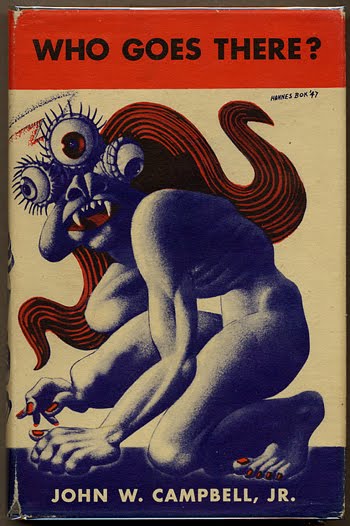
The soul-chilling Antarctic setting of this story is assumed to have also inspired John W. Campbell's "Who Goes There?" the inspiration for RKO's The Thing from Another World which itself inspired John Carpenter's bleaker version many years later. I'll have to dig out that classic and give it another reading, and perhaps bring home that "Thing" movie they made last year and finally watch it. Lovecraft's influence on fantasy is difficult to overstate.

On yet another note, my recent Wold Newton reading suggests that McReady from Campbell's original story is highly suggestive of Kenneth Robeson's Doc Savage. That's a curious connection I'd like to examine first hand.

Rip Off

The Return Of Tarzan - Chapter Twenty-Two!


The Return of Tarzan
Chapter 22 -- The Treasure Vaults of Opar
by Edgar Rice Burroughs


It was quite dark before La, the high priestess, returned to the Chamber of the Dead with food and drink for Tarzan. She bore no light, feeling with her hands along the crumbling walls until she gained the chamber. Through the stone grating above, a tropic moon served dimly to illuminate the interior.

Tarzan, crouching in the shadows at the far side of the room as the first sound of approaching footsteps reached him, came forth to meet the girl as he recognized that it was she.

"They are furious," were her first words. "Never before has a human sacrifice escaped the altar. Already fifty have gone forth to track you down. They have searched the temple--all save this single room."

"Why do they fear to come here?" he asked.

"It is the Chamber of the Dead. Here the dead return to worship. See this ancient altar? It is here that the dead sacrifice the living--if they find a victim here. That is the reason our people shun this chamber. Were one to enter he knows that the waiting dead would seize him for their sacrifice."

"But you?" he asked.

"I am high priestess--I alone am safe from the dead. It is I who at rare intervals bring them a human sacrifice from the world above. I alone may enter here in safety."

"Why have they not seized me?" he asked, humoring her grotesque belief.

She looked at him quizzically for a moment. Then she replied:

"It is the duty of a high priestess to instruct, to interpret-- according to the creed that others, wiser than herself, have laid down; but there is nothing in the creed which says that she must believe. The more one knows of one's religion the less one believes--no one living knows more of mine than I."

"Then your only fear in aiding me to escape is that your fellow mortals may discover your duplicity?"

"That is all--the dead are dead; they cannot harm--or help. We must therefore depend entirely upon ourselves, and the sooner we act the better it will be. I had difficulty in eluding their vigilance but now in bringing you this morsel of food. To attempt to repeat the thing daily would be the height of folly. Come, let us see how far we may go toward liberty before I must return."

She led him back to the chamber beneath the altar room. Here she turned into one of the several corridors leading from it. In the darkness Tarzan could not see which one. For ten minutes they groped slowly along a winding passage, until at length they came to a closed door. Here he heard her fumbling with a key, and presently came the sound of a metal bolt grating against metal. The door swung in on scraping hinges, and they entered.

"You will be safe here until tomorrow night," she said.

Then she went out, and, closing the door, locked it behind her.

Where Tarzan stood it was dark as Erebus. Not even his trained eyes could penetrate the utter blackness. Cautiously he moved forward until his out-stretched hand touched a wall, then very slowly he traveled around the four walls of the chamber.

Apparently it was about twenty feet square. The floor was of concrete, the walls of the dry masonry that marked the method of construction above ground. Small pieces of granite of various sizes were ingeniously laid together without mortar to construct these ancient foundations.

The first time around the walls Tarzan thought he detected a strange phenomenon for a room with no windows but a single door. Again he crept carefully around close to the wall. No, he could not be mistaken! He paused before the center of the wall opposite the door. For a moment he stood quite motionless, then he moved a few feet to one side. Again he returned, only to move a few feet to the other side.

Once more he made the entire circuit of the room, feeling carefully every foot of the walls. Finally he stopped again before the particular section that had aroused his curiosity. There was no doubt of it! A distinct draft of fresh air was blowing into the chamber through the intersection of the masonry at that particular point--and nowhere else.

Tarzan tested several pieces of the granite which made up the wall at this spot, and finally was rewarded by finding one which lifted out readily. It was about ten inches wide, with a face some three by six inches showing within the chamber. One by one the ape-man lifted out similarly shaped stones. The wall at this point was constructed entirely, it seemed, of these almost perfect slabs. In a short time he had removed some dozen, when he reached in to test the next layer of masonry. To his surprise, he felt nothing behind the masonry he had removed as far as his long arm could reach.

It was a matter of but a few minutes to remove enough of the wall to permit his body to pass through the aperture. Directly ahead of him he thought he discerned a faint glow --scarcely more than a less impenetrable darkness. Cautiously he moved forward on hands and knees, until at about fifteen feet, or the average thickness of the foundation walls, the floor ended abruptly in a sudden drop. As far out as he could reach he felt nothing, nor could he find the bottom of the black abyss that yawned before him, though, clinging to the edge of the floor, he lowered his body into the darkness to its full length.

Finally it occurred to him to look up, and there above him he saw through a round opening a tiny circular patch of starry sky. Feeling up along the sides of the shaft as far as he could reach, the ape-man discovered that so much of the wall as he could feel converged toward the center of the shaft as it rose. This fact precluded possibility of escape in that direction.

As he sat speculating on the nature and uses of this strange passage and its terminal shaft, the moon topped the opening above, letting a flood of soft, silvery light into the shadowy place. Instantly the nature of the shaft became apparent to Tarzan, for far below him he saw the shimmering surface of water. He had come upon an ancient well--but what was the purpose of the connection between the well and the dungeon in which he had been hidden?

As the moon crossed the opening of the shaft its light flooded the whole interior, and then Tarzan saw directly across from him another opening in the opposite wall. He wondered if this might not be the mouth of a passage leading to possible escape. It would be worth investigating, at least, and this he determined to do.

Quickly returning to the wall he had demolished to explore what lay beyond it, he carried the stones into the passageway and replaced them from that side. The deep deposit of dust which he had noticed upon the blocks as he had first removed them from the wall had convinced him that even if the present occupants of the ancient pile had knowledge of this hidden passage they had made no use of it for perhaps generations.

The wall replaced, Tarzan turned to the shaft, which was some fifteen feet wide at this point. To leap across the intervening space was a small matter to the ape-man, and a moment later he was proceeding along a narrow tunnel, moving cautiously for fear of being precipitated into another shaft such as he had just crossed.

He had advanced some hundred feet when he came to a flight of steps leading downward into Stygian gloom. Some twenty feet below, the level floor of the tunnel recommenced, and shortly afterward his progress was stopped by a heavy wooden door which was secured by massive wooden bars upon the side of Tarzan's approach. This fact suggested to the ape-man that he might surely be in a passageway leading to the outer world, for the bolts, barring progress from the opposite side, tended to substantiate this hypothesis, unless it were merely a prison to which it led.

Along the tops of the bars were deep layers of dust--a further indication that the passage had lain long unused. As he pushed the massive obstacle aside, its great hinges shrieked out in weird protest against this unaccustomed disturbance. For a moment Tarzan paused to listen for any responsive note which might indicate that the unusual night noise had alarmed the inmates of the temple; but as he heard nothing he advanced beyond the doorway.

Carefully feeling about, he found himself within a large chamber, along the walls of which, and down the length of the floor, were piled many tiers of metal ingots of an odd though uniform shape. To his groping hands they felt not unlike double-headed bootjacks. The ingots were quite heavy, and but for the enormous number of them he would have been positive that they were gold; but the thought of the fabulous wealth these thousands of pounds of metal would have represented were they in reality gold, almost convinced him that they must be of some baser metal.

At the far end of the chamber he discovered another barred door, and again the bars upon the inside renewed the hope that he was traversing an ancient and forgotten passageway to liberty. Beyond the door the passage ran straight as a war spear, and it soon became evident to the ape-man that it had already led him beyond the outer walls of the temple. If he but knew the direction it was leading him! If toward the west, then he must also be beyond the city's outer walls.

With increasing hopes he forged ahead as rapidly as he dared, until at the end of half an hour he came to another flight of steps leading upward. At the bottom this flight was of concrete, but as he ascended his naked feet felt a sudden change in the substance they were treading. The steps of concrete had given place to steps of granite. Feeling with his hands, the ape-man discovered that these latter were evidently hewed from rock, for there was no crack to indicate a joint.

For a hundred feet the steps wound spirally up, until at a sudden turning Tarzan came into a narrow cleft between two rocky walls. Above him shone the starry sky, and before him a steep incline replaced the steps that had terminated at its foot. Up this pathway Tarzan hastened, and at its upper end came out upon the rough top of a huge granite bowlder.

A mile away lay the ruined city of Opar, its domes and turrets bathed in the soft light of the equatorial moon. Tarzan dropped his eyes to the ingot he had brought away with him. For a moment he examined it by the moon's bright rays, then he raised his head to look out upon the ancient piles of crumbling grandeur in the distance.

"Opar," he mused, "Opar, the enchanted city of a dead and forgotten past. The city of the beauties and the beasts. City of horrors and death; but--city of fabulous riches." The ingot was of virgin gold.

The bowlder on which Tarzan found himself lay well out in the plain between the city and the distant cliffs he and his black warriors had scaled the morning previous. To descend its rough and precipitous face was a task of infinite labor and considerable peril even to the ape-man; but at last he felt the soft soil of the valley beneath his feet, and without a backward glance at Opar he turned his face toward the guardian cliffs, and at a rapid trot set off across the valley.

The sun was just rising as he gained the summit of the flat mountain at the valley's western boundary. Far beneath him he saw smoke arising above the tree-tops of the forest at the base of the foothills.

"Man," he murmured. "And there were fifty who went forth to track me down. Can it be they?"

Swiftly he descended the face of the cliff, and, dropping into a narrow ravine which led down to the far forest, he hastened onward in the direction of the smoke. Striking the forest's edge about a quarter of a mile from the point at which the slender column arose into the still air, he took to the trees. Cautiously he approached until there suddenly burst upon his view a rude boma, in the center of which, squatted about their tiny fires, sat his fifty black Waziri. He called to them in their own tongue:

"Arise, my children, and greet thy king!"

With exclamations of surprise and fear the warriors leaped to their feet, scarcely knowing whether to flee or not. Then Tarzan dropped lightly from an overhanging branch into their midst. When they realized that it was indeed their chief in the flesh, and no materialized spirit, they went mad with joy.

"We were cowards, oh, Waziri," cried Busuli. "We ran away and left you to your fate; but when our panic was over we swore to return and save you, or at least take revenge upon your murderers. We were but now preparing to scale the heights once more and cross the desolate valley to the terrible city."

"Have you seen fifty frightful men pass down from the cliffs into this forest, my children?" asked Tarzan.

"Yes, Waziri," replied Busuli. "They passed us late yesterday, as we were about to turn back after you. They had no woodcraft. We heard them coming for a mile before we saw them, and as we had other business in hand we withdrew into the forest and let them pass. They were waddling rapidly along upon short legs, and now and then one would go upon all fours like Bolgani, the gorilla. They were indeed fifty frightful men, Waziri."

When Tarzan had related his adventures and told them of the yellow metal he had found, not one demurred when he outlined a plan to return by night and bring away what they could carry of the vast treasure; and so it was that as dusk fell across the desolate valley of Opar fifty ebon warriors trailed at a smart trot over the dry and dusty ground toward the giant bowlder that loomed before the city.

If it had seemed a difficult task to descend the face of the bowlder, Tarzan soon found that it would be next to impossible to get his fifty warriors to the summit. Finally the feat was accomplished by dint of herculean efforts upon the part of the ape-man. Ten spears were fastened end to end, and with one end of this remarkable chain attached to his waist, Tarzan at last succeeded in reaching the summit.

Once there, he drew up one of his blacks, and in this way the entire party was finally landed in safety upon the bowlder's top. Immediately Tarzan led them to the treasure chamber, where to each was allotted a load of two ingots, for each about eighty pounds.

By midnight the entire party stood once more at the foot of the bowlder, but with their heavy loads it was mid-forenoon ere they reached the summit of the cliffs. From there on the homeward journey was slow, as these proud fighting men were unaccustomed to the duties of porters. But they bore their burdens uncomplainingly, and at the end of thirty days entered their own country.

Here, instead of continuing on toward the northwest and their village, Tarzan guided them almost directly west, until on the morning of the thirty-third day he bade them break camp and return to their own village, leaving the gold where they had stacked it the previous night.

"And you, Waziri?" they asked.

"I shall remain here for a few days, my children," he replied. "Now hasten back to thy wives and children."

When they had gone Tarzan gathered up two of the ingots and, springing into a tree, ran lightly above the tangled and impenetrable mass of undergrowth for a couple of hundred yards, to emerge suddenly upon a circular clearing about which the giants of the jungle forest towered like a guardian host. In the center of this natural amphitheater, was a little flat-topped mound of hard earth.

Hundreds of times before had Tarzan been to this secluded spot, which was so densely surrounded by thorn bushes and tangled vines and creepers of huge girth that not even Sheeta, the leopard, could worm his sinuous way within, nor Tantor, with his giant strength, force the barriers which protected the council chamber of the great apes from all but the harmless denizens of the savage jungle.

Fifty trips Tarzan made before he had deposited all the ingots within the precincts of the amphitheater. Then from the hollow of an ancient, lightning-blasted tree he produced the very spade with which he had uncovered the chest of Professor Archimedes Q. Porter which he had once, apelike, buried in this selfsame spot. With this he dug a long trench, into which he laid the fortune that his blacks had carried from the forgotten treasure vaults of the city of Opar.

That night he slept within the amphitheater, and early the next morning set out to revisit his cabin before returning to his Waziri. Finding things as he had left them, he went forth into the jungle to hunt, intending to bring his prey to the cabin where he might feast in comfort, spending the night upon a comfortable couch.

For five miles toward the south he roamed, toward the banks of a fair-sized river that flowed into the sea about six miles from his cabin. He had gone inland about half a mile when there came suddenly to his trained nostrils the one scent that sets the whole savage jungle aquiver--Tarzan smelled man.

The wind was blowing off the ocean, so Tarzan knew that the authors of the scent were west of him. Mixed with the man scent was the scent of Numa. Man and lion. "I had better hasten," thought the ape-man, for he had recognized the scent of whites. "Numa may be a-hunting."

When he came through the trees to the edge of the jungle he saw a woman kneeling in prayer, and before her stood a wild, primitive-looking white man, his face buried in his arms. Behind the man a mangy lion was advancing slowly toward this easy prey. The man's face was averted; the woman's bowed in prayer. He could not see the features of either.

Already Numa was about to spring. There was not a second to spare. Tarzan could not even unsling his bow and fit an arrow in time to send one of his deadly poisoned shafts into the yellow hide. He was too far away to reach the beast in time with his knife. There was but a single hope--a lone alternative. And with the quickness of thought the ape-man acted.

A brawny arm flew back--for the briefest fraction of an instant a huge spear poised above the giant's shoulder--and then the mighty arm shot out, and swift death tore through the intervening leaves to bury itself in the heart of the leaping lion. Without a sound he rolled over at the very feet of his intended victims--dead.

For a moment neither the man nor the woman moved. Then the latter opened her eyes to look with wonder upon the dead beast behind her companion. As that beautiful head went up Tarzan of the Apes gave a gasp of incredulous astonishment. Was he mad? It could not be the woman he loved! But, indeed, it was none other.

And the woman rose, and the man took her in his arms to kiss her, and of a sudden the ape-man saw red through a bloody mist of murder, and the old scar upon his forehead burned scarlet against his brown hide.

There was a terrible expression upon his savage face as he fitted a poisoned shaft to his bow. An ugly light gleamed in those gray eyes as he sighted full at the back of the unsuspecting man beneath him.

For an instant he glanced along the polished shaft, drawing the bowstring far back, that the arrow might pierce through the heart for which it was aimed.

But he did not release the fatal messenger. Slowly the point of the arrow drooped; the scar upon the brown forehead faded; the bowstring relaxed; and Tarzan of the Apes, with bowed head, turned sadly into the jungle toward the village of the Waziri.

More to come in Chapter Twenty-Three.

Rip Off

Friday, June 22, 2012

The Old Head Splitter!


Inspired by the rather neat promos from the upcoming movie Abraham Lincoln - Vampire Hunter I dug up a copy of this very popular pseudo biography by Seth Grahame-Smith. I've been reading a lot of Wold Newton stuff by Philip Farmer lately and this kind of blend of fact and fiction was just in my wheelhouse right now.

The book has a wonderful conceit, that Abraham Lincoln was not only the great man and statesman and president we know, but also a secret vampire hunter in an America rife with the plague of vampires who have come over from the old countries to try and find success in the New World. The way the biography of the sixteenth president is blended with the vampire lore is deftly handled.

The story begins when a mysterious man drops off a bundle of journals written by Abe Lincoln himself into the hands of idle writer wannabe Seth Grahame-Smith (putting himself into his own story is a trick worthy of Phil Farmer I must say) and what we get from then on is a blend of narrative and excerpts from the journals themselves.

The early material in particular moves back and forth between the two formats repeatedly and often many times on a page. I had some difficulty shifting from one voice to the other over and over, but this got better as I read.

We follow the whole history of Lincoln from a boy in Kentucky to a President in Ford's Theater. The secret history of the Civil War is revealed and we learn that Lincoln could split a hell of lot more than rails with his well-worn axe.

I found myself swept up in the story and especially liked the final sections dealing more with the larger history of the country.


I recommend this, but know it's a frothy entertainment. The movie likely is the same, though it seems to cast Honest Abe as something of a Buffy-type killer which isn't really in the book. When Abe chops up a vampire in the book, it's more like King Kull than the cheerleader.

Rip Off