Tuesday, December 5, 2023

Conan Of The Paperbacks!


As potent as I find Robert E. Howard's Conan stories, there's little doubt I would not know about them at all if Lancer Books had not decided to take the Gnome hardback series from the 1950's and present them to the world all over again in affordable paperback beginning in 1966. Paperbacks were after all the equivalent in many ways of the pulps from which Howard's brawny barbarian had emerged decades before.  And further one can fairly speculate that without the hiring of the late and great Frank Frazetta to paint covers for many of those paperbacks, their impact on the racks of the day might well have been less potent. 


So many people of my generation were struck by the absolute powerful image of Conan by Frazetta which graces the debut volume titled Conan the Adventurer. Now Frazetta didn't do all the cover paintings. John Duillo was the artist for Conan the Freebooter, Conan the Wanderer, and Conan of the Isles. Boris Vallejo painted the final cover in the series Conan of Aquilonia, but only after the series had lapsed due to the collapse of Lancer and had been transferred to Ace Books. 


Boris Vallejo went on to do more paintings for the Ace series, replacing all of the Duillo covers. I like Vallejo's work in general, but I for my part really like the original Lancers better. 


It should also be noted that Lancer came out with a King Kull volume as well, a proper companion to its Conan series. This cover was done by Roy Krenkel. Robert E. Howard was brought forward in time, and to no small extent immortalized, something the author likely could have hardly imagined. 


Rip Off

Monday, December 4, 2023

Conan's Gnome Coming!

(Art by John Forte)


(Art by Frank Kelly Freas)

(Art by Ed Emshwiller)

(Art by Ed Emshwiller)

(Art by Wally Wood)

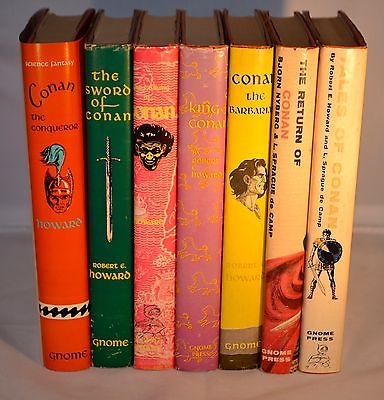
I've been reading up on the publishing history of Robert E. Howard's Conan and while doing so discovered all over again the lovely Gnome Press editions of the stories which appeared in the 1950's. The first appeared in 1950 and the final volume in 1957. These are the stories as reorganized and to some extent re-imagined by L. Sprague De Camp. They quit doing them for a very simple reason, they ran out of Conan stories, so the last one is a bit of fan fiction by Bjorn Nyberg with additions and adjustments by De Camp. The famous Lancer paperbacks which ignited the Conan craze in the 1960's were mostly just reprints of the material first organized in these handsome tomes.


Many folks and fans of REH decry the involvement of De Camp and his willingness to adapt and alter the original REH material. That's an argument for another day, but it's clear to me without his efforts, it's unlikely that Conan might be the recognizable character he is today. Would love to have a set of these on my shelves, but the price is prohibitive. Still, they are exceedingly nice to look at.

Rip Off

Sunday, December 3, 2023

The Coming Of Conan The Cimmerian!


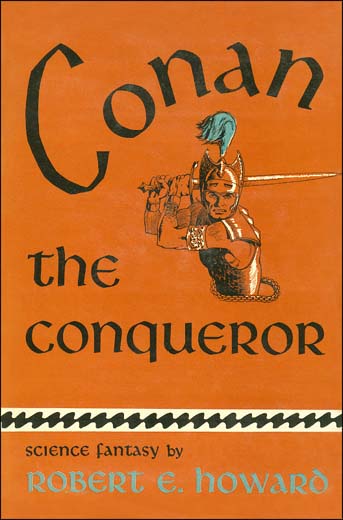
As can be evidenced by many a post here, one of my favorite characters is Conan the Barbarian. I was the ideal age when the Marvel comic hit the stands and almost at the same time or even perhaps before (I forget) I found a copy of Lancer's Conan the Conqueror in my local library. Since then I've read and followed the creation of Robert E. Howard here and there and most everywhere.

When I first got hold of Ballantine's trade paperback edition The Coming of Conan the Cimmerian, I was most pleased the stories were presented in the order in which Howard created the stories. I've never read them in this fashion, so it's been fascinating to watch the development of the character as Howard came to fully realize the aspects of the character which he claims came to him almost unbidden and demanded the stories be told. It's a great yarn, but these collections reveal that Conan is the product of a professional writer who is trying to make a sale in tough economic times and casting about for a formula which will win over his reluctant editors.


These earliest Conan stories showcase the barbaric hero as an seasoned adult in "The Phoenix on the Sword", a story of his kingship in Aquilonia derived from an unsold Kull story title "By This Axe I Rule", or a callow and reckless youth fighting in the far North as a mercenary who encounters a goddess and her bloody brothers in "The Frost Giant's Daughter". This latter story along with "The God in the Bowl" did not sell for Howard, but he did find a sale with "The Tower of the Elephant", a story of Conan's thieving days in Zamora which firmly established the character as something of a hit for Weird Tales. This was soon followed by "The Scarlet Citadel", another sweeping story of Conan as king which would later inform the only Conan novel. "Queen of the Black Coast" shows us Conan the freebooter who finds true love in the warrior goddess Belit, a story which showed the true potential for the character. "Black Colossus" is a trim Conan story, now an established character finding the sure-footed barbarian battling black magic in remote parts of Hyboria.


What followed are a trio of tales written in quick succession which establish a formula for Conan which include remote ruins, barely-dressed babes, and creepy magical monsters. "Iron Shadows in the Moon", "Xuthal of the Dusk", and " Pool of the Black One" are rip-snorters, but rather predictable stories with some dandy moments. "Rouges in the House" offers up a vivid portrayal with Conan getting side characters worthy of him and a most memorable monster to battle. "Vale of the Lost Women" and "The Devil in Iron" finish off this collection in fine form. Conan is firmly established, and Weird Tales has an ample supply. Howard has a bonafide hit on his hands.

This volume has some dandy behind-the-scenes documents, drafts, and such which show how Conan came to be, the result of work and some inspiration, not the more mythic origin Howard sometimes touted. We see really in this volume how one of the iconic heroes of the modern culture came to be.

The artwork in this volume by Mark Schultz is vivid and enhances the pure pulp feel of many of the stories. 


Rip Off

Saturday, December 2, 2023

The Coming Of Conan!


Marvel's Conan the Barbarian series is a very important one for me and I think I just figured out why. I'm second-generation Marvel fanboy, chiming in around 1968 or thereabouts. By this time most comics scholars reckon the burst of utter energy which most identify as Marvel had already begun to recede. Galactus has come and gone, as has Steve Ditko. Stan was writing fewer and fewer books as Roy, Gary, Archie and others step in to fill the void. Jack Kirby is annoyed and has bottled up many of his creations for himself at a later date, though one here and there will still slip out. DC Comics recognizes at last the threat of Martin Goodman's company which has just slipped the leash which limited Marvel's newsstand presence. New comics by new talents were flocking onto the stands and among these was an old hero made new, one created by one of the pulp's greatest Robert E. Howard. 

New artists were needed to fill the pages and among the talents tapped by Marvel was a Britisher named Barry "Not-Yet-Windsor" Smith. He along with his writer buddy Steve Parkhouse had dropped in on the Marvel Universe but immigration law flogged them back to "Merry Old England" and it was some months before Smith could properly showcase his talents which blossomed with each page he drew. Seeing a raw talent like Smith grow and become increasingly skilled and recognized for that skill was fun to see, but also growing up before my eyes was a surly Cimmerian from a shadowy territory in the North of a mythical land. Conan is a teenager when we first meet him, not much older than I was myself and not unlike many older fans who utterly identified with Peter Parker, I found I identified with Conan. 


Part of the power of Smith's Conan is that when his style matured, he drew Conan as what he was, a lithe young man, still immensely powerful but clearly not a man who had grown into his full maturity. That sense of youth was unconsciously attractive to a boy like myself who yearned for a life different from what he was leading on a farm tucked neatly way in the shadows of the Appalachian hills of Kentucky. Conan was a free man who wandered his world and took on threats without hesitation or qualm. While that's not the kind of man I have ever been, that clarity of purpose in life, to live on your own terms was and is immensely attractive. I might not have daydreamed of cleaving skulls precisely but the modern world does make young men and women seek uncluttered responses. Learning that life is not nor ever will be so simple is called growing up. 


As I read the Conan stories this time, I consulted the recent book by Roy Thomas where he once again illuminates from his perspective how those stories came to be shaped and how they fitted into the larger Marvel publishing scheme. It was a hectic time for comics in the early 70's and the eventual success of Conan the Barbarian helped shape it to no small degree. 


Actually the first story in this collection is not about Conan at all, but rather was inspired by Lin Carter. Starr the Slayer is a character who doesn't wish to disappear when his creator tires of making his stories and in the pages of Chamber of Darkness #5 we discover how he's able to do something about it. This was an experiment by Thomas and Windsor-Smith (hereafter dubbed "BWS") and is filled with raw energy that even the untutored BWS could bring to a comic page. 


In the debut issue of Conan the Barbarian we meet our hero as he fights on the snow-covered slopes alongside the Aesir against the Vanir. His savagery is immediately evident and in this story which has the thankless task of introducing a new hero, a new world, some villains, some allies, and more than few supernatural monsters, we find it deft at all of these tasks. We even learn as does Conan that he will be a king some day and that knowledge will come up again and again in the series. 


The second issue finds our hero battling a semi-civilized underground society of ape-men. The art is improved by the addition of Sal Buscema on the inks (Dan Adkins had inked the debut) and BWS is still drawing in his raw forceful way. This early Conan story feels a tad too science-fictional to me, as it puts Conan into a weird hidden society. Usually, he is firmly rooted in a more realistic world. Still, it's a fun read. 


The art takes a tremendous leap forward in the third issue which is much more elegant in many respects and much more somber. Conan is an important presence in the story but the tale itself is really about others in the cast who choose both wisely and unwisely in life and love. The advance in art technique is because this is actually the fifth issue to be drawn by BWS and he improved by the page. The dour atmosphere in this story which confronts mortality head on, is unlike anything else Marvel was doing at the time and showed how different Conan was going to be. 


The fourth issue is also the fourth drawn by BWS and its one of the most famous Conan stories ever told. The story of Yag-Kosha the forlorn visitor from the stars has always been one of the most potent that Marvel ever produced. This story won awards and deservedly so. These early Conan stories feel almost like fine gems, precious one-offs. When the series gets its legs under it, the momentum of the larger saga will consume some aspects of the stories, making them parts of a whole. At this stage, each story feels like a separate thing. 


The fifth issue is a step back artistically, but that makes sense since it was the third to be drawn. The encounter with the wizard Zukala and his daughter who can change into a tiger will of course come back to haunt Conan again later in the series. This is one of Barry Windsor-Smith's best covers. 


In the sixth installment Conan the Barbarian really matures as a series with BWS doing the best work yet and the obligatory horned helmet getting the shove after doing its duty to make Conan a recognizable figure on the stands. Besides a sideways introduction of Fhafrd and the Grey Mouser created by Fritz Leiber (Fafnir and Blackrat) we also meet one of the best characters ever in the series, the lovely and always untrustworthy Jenna. It's Jenna who gets rid of Conan's iconic horned helmet. 


The God in the Bowl was developed from a fragmentary REH story and it's one of the best of the series long run. The monster, a giant snake with a refined human mug was truly scary. Roy Thomas considers some of these panels by Smith to be among his very best.  


Jenna's back in the eighth issue as Conan has to hit the trail again being chased by the local authorities. His attempts to steal various things from various places over the course of the series constantly put him at odds with the powers that be and in this one he fights ancient mummies and an enormous Gila Monster to boot. 


"The Garden of Fear" is one of scariest damn stories Marvel ever published. The flying creature who never speaks and lives alone in a tower surrounded by meat-eating flowers in a valley of Mastodons is as weird as the series ever gets. The monster man in this one reminded me much of the enigmatic creature from those Jeepers Creepers movies. 


The series gets one of its most potent emotional moments when an ally of Conan's gets hanged. Conan always seems to be a man alone but when he makes a friend he is true to the core and loyalty means more to him than all the gold he constantly gets and loses. Fending off a giant bull god ain't no fun either. Marvel was toying with its prices at this time and so we get a somewhat larger package overall, if not additional Conan. 


The lovely Jenna is at it again and in this one she turns on Conan just as he's about to confront the Red Priest. This is a double-size saga, with some of the BWS art in the series and a wonderful adaptation of one of the most famous REH stories "Rogues in the House". The fight with Thak the ape that-wants-to- be a man is amazing, and brutal. 


Conan finds himself in the desert again and has to struggle against a wicked queen who wants his body of course but then cannot share him even for a second. This one was a story done originally for Savage Tales #2 and so has more nudity that the color comic usually displayed, and the violence had a little more blood as well. It's a good story with BWS inking himself.  And the cover by Gil Kane is a dandy, and a precursor of artistic choices to come. 


This collection wraps up with a story plotted by John Jakes who at this time was most famous for his Brak the Barbarian. 


Conan has to fight yet another giant spider, a humongous one as big as a bus and he survives but barely. This is wild and crazy adventures with some dandy images, but it's missing a little of the heart of some of the earlier escapades. 


This collection is chock full of extra goodies as well. Several "Roy's Rostrum" articles from Marvelmania magazine as well as the house ad used to promote Conan. I love this kind of material as it takes me back to those heady days as a kid reading these stories for the first time and wanting to be Conan, at least when he wasn't getting nibbled by giant spiders. 

Rip Off

Friday, December 1, 2023

Weird Tales From Cross Plains!


Robert E. Howard is one of the most successful pulp writers of an era filled with great talents. His production is epic in its scope and scale. And he only had an effective writing career of a mere decade. 
He sold his first story "Spear and Fang" to Weird Tales in 1925 and sadly killed himself in 1936 before many of his later works were even published. 


In that span he created a powerful array of heroes such as King Kull, Solomon Kane, Breckenridge Elkins, Turlogh Dubh O'Brian, James Allison, Steve Costigan, El Borak, Cormac Mac Art, Bran Mak Morn,and of course Conan the Barbarian. His work was popular in its day, and he created not only heroic fiction in sundry categories but horror as well in the manner of H.P. Lovecraft, a correspondent and to some degree mentor. Howard's fame diminished with his death and the passing of the pulp genre, but never did his work disappear. 


Many of his tales were collected in hardback by Gnome Press. But it was in the heat of the paperback phenomena of the early 1960's that Howard's fame was well and truly fashioned when his Conan stories were collected by Lancer under covers rendered by the great Frank Frazetta. These sold remarkably well and inspired Roy Thomas to try to license the character for comic books. Conan the Barbarian became Marvel's most successful new comic of the early 1970's and created sufficient interest for a movie to be made starring a young Arnold Schwarzenegger later in the decade. 


To close out the tempestuous year of 2023 I want to spend a cool wintry month revisiting many of those Robert E. Howard classics. I'll be revising and updating posts from across the years as well as creating new ones as I read through the entire Conan the Barbarian color comic book series as recently collected in Marvel's Epic series before the license drifted over to Titan. Sadly, this will not take me all the way through the Thomas years, but I might just leap to my Dark Horse reprint volumes and finish that as well, though I doubt I'll be able to report on all of that. 


I also plan to read as many of the original prose Conan stories by Howard as I can during the course of the month. My preferred way to enjoy now is to read them in chronological order as they were published in three handsome volumes some years ago now by Ballantine. These are the stories minus the amendments and adjustments made by L. Sprague DeCamp and Lin Carter among others when the series was first revitalized for Gnome and later for Lancer. And there are the other Howard heroes as well. Conan's inspiration Kull of course, as well as Howard's first hit swordsman Solomon Kane. 


And then there are the other projects inspired by Howard's creations in comics and films and elsewhere. Robert E. Howard was a somewhat famous writer of pulp entertainment when he decided to end his life in 1936, but he and his creations have become an industry in the intervening decades, supplying entertainment in all sorts of venues from cinema to video games. 


But all that aside, when you read a pulsating REH story from long ago, filled with tough dames and bloody-handed heroes it's difficult not to get a rumble deep down in our psyches from when some forgotten ancestor once had to fight just to keep a hard-scrabble life. 


Sharpen your broadswords and wipe the sweat from your brows, amigos, the battle doe the sweeping territories of the Hyborian Age is about to be joined here at the Dojo. 


Note: Throughout this post you will see all nine of the Weird Tales covers featuring a story about Conan by Robert E. Howard. Conan himself doesn't always make the cut, as the artist Margaret Brundage loved to showcase damsels in degrees of distress, particularly in various states of undress. Apparently, that's what sold. 

Rip Off