Thursday, December 26, 2013

The Complete Ultraman!


I finally got around to watching the complete season of Ultraman. This series can be found for small money most places, and for that tiny dime is huge entertainment for anyone interested in Kaiju, or the particular version of giant monsters which habitually attack Japan.

The series is a sequel of sorts to a science fiction show called "Ultra Q", which had no superheroic elements. In the first episode the alien Ultraman follows a deadly monster to Earth and is for all practical purposes killed alongside a member of the Science Patrol named Hayata. In an effort to save both their lives Ultraman bonds with Hayata giving him the ability to transform into the giant hero when the need arises, which it does regularly.

Along with Hayata is a nice assembly of fellow officers. Muramatsu is the no-nonsense captain, a father figure of sorts; Arashi is the fiery marksman; Ide is the often goofy but brilliant inventor; Fuji is the lovely token female member and reliable agent; and Hoshino is the kid mascot who pops in and out of the stories.These five core members along with Hayata and several other semi-regulars create a nice cast of fun folks to watch.

Muramatsu, Ide, Fuji, Arashi, and Hayata
Ultraman is very smart in that it keeps the monster fights pretty small and focuses instead on the science fiction elements of the plot before reliably having Ultraman turn up and fight for a few minutes. It's a pretty stock approach to making an entertainment, but it works and they spice it up sufficiently that it only gets dull a few times.

Ultraman
One thing about the show that changes often is the overall tone of the stories. Some are light-hearted children's fables, some are more severe sci-fi episodes, some are somber fantasies, and a few are even quite scary relatively speaking.

My favorite is a beautiful fantasy which features a lovely young girl who loses her mother in the mountains but is able to call upon a giant Yeti-like creature called a "Woo" who comes to her protection. The lovely snowy mountain setting makes this one stand out and the story is elegantly told. Another that stands out is about an unfortunate boy who is killed on the highway in a hit-and-run accident and whose spirit evokes an ancient dragon who seeks justice but who unleashes quite a bit of destruction too.

All the stories offer up a monster. Sometimes they are aliens, sometimes they are legendary beasts, sometimes they are products of man's technology run amok. Always the threat is identified and solved by the end of the episode, as good solid kid's entertainment should do. But a few linger with messages rather heavy for this kind of  TV, or so I'd have thought. 

The monsters sometimes pose a threat to mere commerce, but they are nonetheless expunged, such as the beast which only wants to sleep in the middle of Tokyo's streets, or the creature which seeks to eat as much of the rich pearl trade as possible. There's no shame demonstrated here, as commerce seems central to the Science Patrol's mission.

Godzilla's Fashion Statement
A few of the monsters seem pretty familiar, such as the creature who is for all practical purposes Godzilla with a colorful frill around his neck. Sheer economics indicated the need to re-use as many of the costumes as possible and a few familiar creatures run amok. Even Rodan's distinctive cry gets used in this show, serving as the ring for the Science Patrol phone. 

Most Dangerous Car Known to Kaiju
I loved the fact the Science Patrol with all their clever and sleek jets and VTOL planes drove around in a humble Corvair. My folks had a Corvair when I was a tot and it holds a special place in my memory despite Ralph Nader's shenanigans.

Overall, I found Ultraman a light-hearted entertainment, good stuff and greater food for thought than one might expect from material of this sort.

Rip Off
Wednesday, December 25, 2013

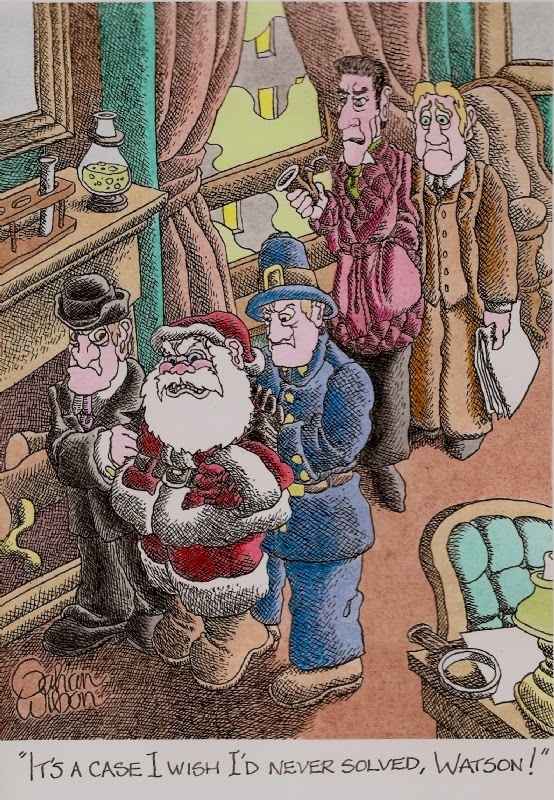
The Case Of The Un-Jolly Old Elf!


Merry Christmas to one and all! Be very merry out there, but be careful and safe and smart, and don't let the coppers nab ya!

And for some true holiday detecting entertainment, here is an actual Sherlock Holmes Christmas-season story -- take a...ahem... gander at Arthur Conan Doye's  "The Adventure of the Blue Carbuncle".

And for some more hilarious Gahan Wilson Christmas-themed diversion, check this out.

Rip Off

Tuesday, December 24, 2013

Getting Cole For Christmas!


If I got these pieces of "Cole" for Christmas, I don't think I'd be too unhappy at all. Five deliriously vivid Santa covers by the great L.B.Cole. Fascinating - this Santa has almost certainly been at the nog. Hope Santa brings you what you want this season.

Rip Off

The Lost Pages Of Stone!


I hear that Dynamite Comics is about to unleash yet another incarnation of the vintage Gold Key character Turok Son of Stone. I'll have more to say on that matter at a later date. (Though I read he will be a young warrior and not the stern, experienced mature adult which makes the character fascinating and different...sigh.) But what I want to focus on today is the end of the original run. The series which began under the Dell banner in the early 50's became a mainstay series for Dell and later Gold Key running until the brand itself disappeared in the 80's. The last issue was the one above, issue one hundred and thiry. But apparently the end came so abruptly that work was still in the pipeline.


This page by the Alberto Giolitti studio was clearly intended for the never-to-be-published one hundred and thirty-first issue of the Turok. If you want to see more pages go here.


And the cover above is a mock up for the unpublished one hundred and thirty-second issue. The artwork on this one appears to my eye to be by Tony DeZuniga.


Here's the original artwork, which might suggest that DeZuniga inked the pencils of Jack Sparling who did the final published cover. And as it turns out did a full story for the unpublished issue itself.


This one oddly is for sale on Amazon. Look it up. I have to admit I'm tempted to get a glimpse of this lost Turok, a comic story as seemingly footloose as its lead characters.

Rip Off

Monday, December 23, 2013

Landing The Kilgore Trout!


Venus on the Half-Shell arrived the other day, the final volume in the Titan Books Wold Newton collection, for now. These have trickled out over the last several years and each one has been a treat, most of which I've only heard of and never read. This is the exception.


It's not your typical Wold Newton saga, but an exceedingly fun conceit by Philip Farmer. He fell in love with the work of Kurt Vonnegut (so did I once upon a time, but I've somewhat gotten over it) and wanted to write a story in the voice of Vonnegut's character "Kilgore Trout", specifically a novel referenced in a Vonnegut novel titled "Venus on the Half-Shell". It took Farmer a while to get permission from the bewildered Vonnegut, but eventually he did and the story appeared in The Magazine of Fantasy and Science Fiction. I didn't see the story there though.


I stumbled across it completely naively on the book rack at my local college bookstore. The cover was sufficiently racy to get my attention despite having no knowledge of an author named "Kilgore Trout". I bought it and enjoyed it sort of. I like the idea of the story better than the novel itself, but it's all a piece, and I only learned it later. A bravura piece of performance art by Farmer, which he tried to get rolling with a number of his friends. They'd each select a character from a favorite work and then (with the author's permission) write a story in that voice. Some got produced and a list of them is in this latest Titan volume.

It's been many moons indeed since a brash college kid first swallowed Farmer's joke hook line and sinker. I'm curious what the disgruntled old codger I've turned into over the decades will make of this story.

Rip Off

Sunday, December 22, 2013

A Matter Of Life And Death!


The second volume of THUNDER Agents Classics from IDW is chock full of vintage Silver Age goodness. With artwork by a who's who of the time, the reader can feast on some of the core stories which created the myth of this Tower Comics phenomenon. Wally Wood continues on the lead feature, but finds more help from Reed Crandall, Mike Sekowsky, George Tuska, Gil Kane, John Giunta, and especially Steve Ditko and Dan Adkins. Many of the stories are credited to Steve Skeates, something of a surprise to me.

The real surprise is the key story in this collection which includes THUNDER Agents #5, 6, and 7 along with the debut issue of Dyanamo is a blockbuster tale titled "A Matter of Life and Death" written and designed by Dan Adkins, drawn by Steve Ditko and inked by Adkins and Wood.  This is the story upon which much of the Agents reputation sits, the story which changed the game. Early in the series Egghead,  a member of the THUNDER Squad died, but in this story one of the headline members of the agents meets his maker as Menthor is killed in action.

Unlike the ballyhooed and bombastically hyped "deaths" in modern comics which seem to occur on nearly a monthly basis, this demise was surprise. Heroes didn't die in the Silver Age, at least not mainstays like Menthor seemed to be. He was one of the original three THUNDER Agents before the advent of Lightning. Raven would hop onto the scene soon after, filling the void somewhat, but there was no denying the death of Menthor was a big deal in the Silver Age of comics.

Here are the covers of the issues included in the second volume.


And if you haven't yet picked up the first volume and want to read some wonderfully vivid Silver Age comics, I heartily recommend it.


Rip Off

Saturday, December 21, 2013

We Who Are About To Die!


Strikeforce: Morituri was one of those offbeat comics which slipped into the market with little fanfare, but left a heavy impression. In late 1986 when this comic showed up on the newsstands and direct sales comic shops, the Marvel Universe was locked down tightly after many years of Jim Shooter's careful attention to details. "The New Universe" had arrived suddenly and seemed to be dwindling just as suddenly. Marvel was a predictable company, producing reliable, often mediocre comics entertainment for a market which seemed well trained and conditioned to receive what they were given.

Then came Strikeforce: Morituri, a tour de force by somewhat iconoclastic writer Peter B. Gillis and undervalued artist Brent Anderson, with the occasional helping hand of Whilce Portacio. Anderson, an artist who evoked Neal Adams without aping him, was ideal for this project which offered a somewhat more mature and realistic vision of a future in which aliens invade the Earth. Nothing much earth-shaking there in pop fiction of the time, but the response of the Earthlings to this threat was a bit different, at least in comics. This story was not, and is not to my knowledge part of the great Marvel mythology. It's a mythology all its own, and that makes the difference.

Strikeforce: Morituri were agents, young men and women who volunteered to fight for their world, but with a peculiar condition. They were inspired by patriotism influenced though the popular culture of their time, including comics. They were given a special treatment which gave them superpowers, powers sufficient to wage a credible counter-force against the alien enemy known as "The Horde" , but which pretty much guaranteed the agent would die sooner than later, almost certainly within one calendar year.

It's one thing to say you are willing to lay down your life for your country should circumstances arise, but it's fundamentally something different to virtually guarantee your imminent death so that a battle or two might be won. It's what soldiers actually do, but focused in a way to make the plight seem palpable and immediate. And we no sooner begin getting familiar with our cast that we begin losing them as the side effects remove them from the game, some before they can achieve that which they've sacrificed themselves for.


It's pretty awesome stuff, and not a formula just any talent could handle effectively. This was something more intense than what passed for Marvel comics before. These were people, not just characters, who were not identifiable, but recognizable. If Marvel told stories in a landscape just outside your window, the stories of the Strikeforce were tales told from inside your most cruel nightmares. This was life and death in every issue, and not the usual comic type of death, with unreal consequences, but death everlasting. A member of the Strikeforce died, and they remained dead. Powerful stuff.

The series was twenty of the most incredible issues I've ever read, then Gillis and Anderson left. They were replaced by reliable types, but not talent capable of evoking the immediacy that had gone before. The book became a more typical sci-fi read, not bad, but weak compared to its earliest days.

Marvel has reprinted this remarkable series, one which cannot be discussed in too much detail for fear of spoiling some of the greatest surprises in the whole of comics history. The first volume, which I picked up a few weeks ago reprints the first thirteen issues, and in it we meet the first, second, and third generation of Morituri, most all of them distinctive and memorable personalities.

Below are the issues contained in the first volume.


I haven't yet picked up the second volume which concludes the Gillis-Andeson run, and I don't know if I will pick up the third which includes much weaker material, but we'll have to see.


For the record, let me say, that Strikeforce: Morituri is a saga any comics fan must read. I cannot recommend the first twenty issues enough.

Rip Off